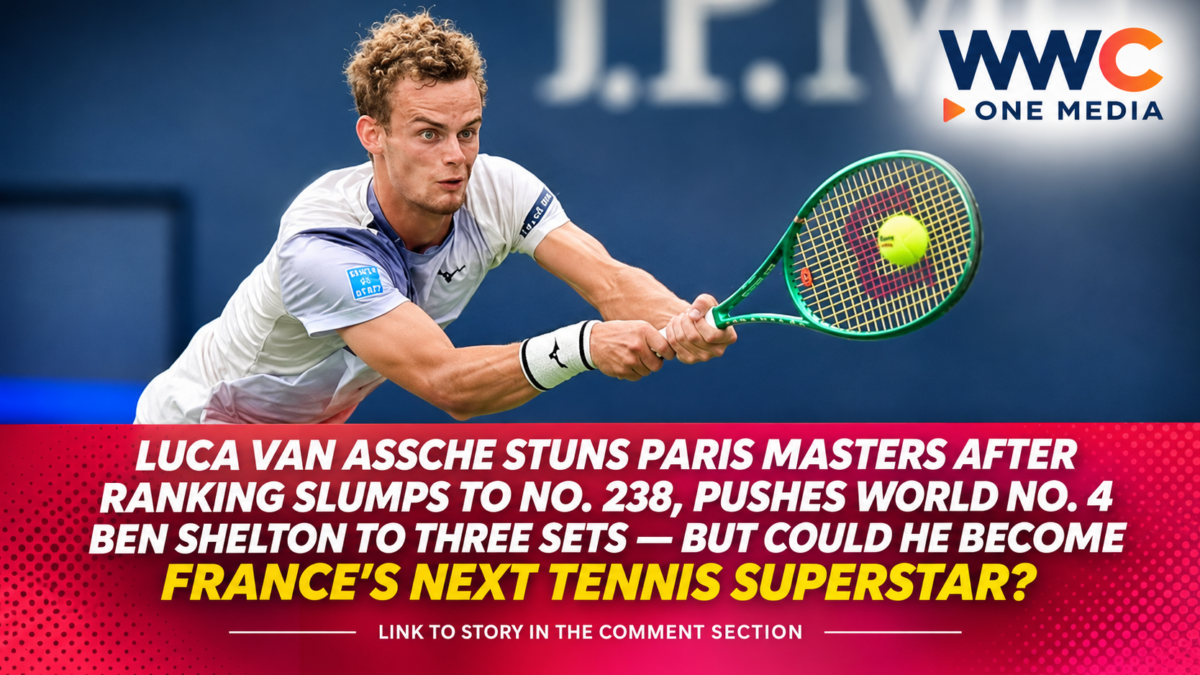
PARIS, FRANCE — November 8, 2026 — France’s hopes of a first homegrown Paris Masters champion since 2008 ended on Saturday, but the country’s newest tennis breakthrough story may only be beginning.
Luca Van Assche, the 22-year-old Frenchman whose career was derailed by injuries and a collapse in confidence last year, pushed American world No. 4 Ben Shelton to the limit before falling 5-7, 6-3, 6-4 in a dramatic semifinal at the Rolex Paris Masters.
For Van Assche, the defeat marked the end of an extraordinary tournament.
But rather than leaving Paris devastated, the rising star says the experience has reinforced his belief that he can compete against the world’s elite.
His remarkable campaign is projected to lift him from world No. 47 to a career-high No. 34 when the next ATP rankings are published on Monday, November 9.
That ranking surge comes after a difficult 2025 season in which injuries and declining confidence sent him tumbling as low as world No. 238.
Now he is within reach of the top 32, a ranking position that could improve his chances of earning a seed at January’s Australian Open.
And after defeating several highly regarded opponents during the week, Van Assche has emerged as another player to watch in French men’s tennis.
But can one breakthrough tournament become the foundation of a sustained rise—or will the pressure of competing against the world’s best present a much bigger challenge?
Ben Shelton Ends Van Assche’s Dream Paris Masters Run
Van Assche entered Saturday’s semifinal as the last French player remaining in the men’s singles competition.
His opponent was one of the most dangerous competitors on the ATP Tour.
Shelton, 24, arrived as the world No. 4 and third seed, carrying the powerful serve, aggressive baseline game and growing big-match experience that have made him a leading American tennis player.
But Van Assche refused to be intimidated.
The Frenchman matched Shelton in extended exchanges and repeatedly forced the American into uncomfortable positions.
With the opening set tied at 5-5, Van Assche secured the decisive service break.
He then held serve to take the set 7-5, delighting the French supporters inside the Plenitude Arena in Nanterre, just outside Paris.
The first-set result raised hopes that France might send a home player into the Paris Masters final.
However, Shelton regrouped.
The American improved his consistency, reduced his errors and began imposing greater control over the rallies.
He broke Van Assche in the second set and eventually took it 6-3.
That forced a deciding set in which both players were under pressure.
Van Assche Leads 3-1 in Final Set Before Shelton Fights Back
The deciding set produced the match’s most dramatic moments.
Van Assche broke Shelton’s serve to move ahead 3-1.
For a brief period, the Frenchman appeared within reach of the biggest victory of his professional career.
But Shelton responded almost immediately.
The American regained his composure and broke back as Van Assche committed costly mistakes, including a double fault.
Shelton’s stronger groundstrokes and improved consistency helped him seize control.
He went on to win five of the final six games, closing out the match in two hours and 16 minutes.
The victory sent Shelton into the Paris Masters final.
For Van Assche, the loss was disappointing because he had twice established an advantage against the higher-ranked player.
Yet he also demonstrated that he could challenge a top-five opponent over three competitive sets.
That performance may ultimately prove more important to his development than the result alone.
Van Assche Leaves Paris With Greater Belief
Speaking to reporters after the match, Van Assche emphasized the value of competing against high-level opponents throughout the tournament.
The Frenchman said the experience helped him understand both his strengths and the areas he must improve.
He also acknowledged that reaching a Masters 1000 semifinal had changed his expectations.
The tournament showed him that he could compete with players who regularly appear in the later stages of major events.
His message was not that he had already joined the elite.
Instead, he expressed a desire to continue improving.
That distinction is important.
One successful week can provide confidence, but sustained success on the ATP Tour requires consistency across different opponents, surfaces and tournaments.
Van Assche appears determined to use Paris as a starting point rather than a career-defining finish.
From World No. 238 to a Career-High No. 34
Van Assche’s Paris campaign becomes even more remarkable when considered alongside his recent struggles.
In 2025, the former junior world No. 1 experienced a difficult period marked by injuries and problems with confidence.
His ranking dropped to No. 238.
For a player previously regarded as one of France’s most promising young prospects, the slide represented a major setback.
But the 2026 season has brought substantial improvement.
Van Assche won an ATP Tour title in Estoril in July, strengthening his comeback.
His results improved as he began competing more confidently against established players.
The Paris Masters then provided the biggest stage for demonstrating that progress.
Entering the event ranked No. 47, he produced the strongest Masters 1000 run of his career.
His projected rise to No. 34 represents a major step forward.
According to Tennis Majors, the result is also expected to make him the second-highest-ranked Frenchman, behind Arthur Fils.
The improvement does not guarantee future victories.
But it shows that Van Assche has rebuilt his position among the world’s leading players after a difficult period.
How Van Assche Reached the Paris Masters Semifinals
Van Assche’s journey through Paris was not built on a single upset.
He won four matches to reach the semifinal.
| Round | Opponent | Result |
|---|---|---|
| First round | Mariano Navone | Won 6-3, 7-5 |
| Second round | Learner Tien | Won 7-6(4), 6-4 |
| Third round | Lorenzo Musetti | Won 7-5, 3-6, 6-4 |
| Quarterfinal | Rinky Hijikata | Won 6-4, 6-7(4), 7-5 |
| Semifinal | Ben Shelton | Lost 7-5, 3-6, 4-6 |
His victory over Italy’s Lorenzo Musetti was particularly significant.
Musetti had already demonstrated his ability to compete against the world’s best, and the three-set contest tested Van Assche’s mental resilience.
The Frenchman then faced Australia’s Rinky Hijikata, who had stunned Novak Djokovic earlier in the tournament.
Van Assche survived another three-set battle, this time prevailing 6-4, 6-7(4), 7-5.
He recovered from a break down in the deciding set.
The result carried him into his first Masters 1000 semifinal.
By the time Shelton ended his run, Van Assche had already recorded the biggest week of his career at this level.
The Rinky Hijikata Victory May Have Been His Biggest Mental Test
Van Assche’s quarterfinal victory over Hijikata revealed the defensive qualities that have helped him develop as a professional player.
Hijikata arrived with confidence after defeating Djokovic.
The Australian attacked aggressively and tried to dictate points with flat, powerful groundstrokes.
Van Assche responded with speed, court coverage and persistence.
He was pushed to three sets and faced a dangerous situation after falling behind early in the decider.
But he recovered and eventually secured the victory.
Speaking after the match, Van Assche credited the French crowd for supporting him through difficult moments.
The performance was significant because it demonstrated his ability to manage pressure against an opponent playing at a high level.
It also gave him valuable experience in one of the largest tournaments outside the Grand Slams.
For emerging players, the ability to recover from setbacks during matches is often as important as technical skill.
France’s Wait for Another Paris Masters Champion Continues
Van Assche’s elimination means France must continue waiting for another homegrown Paris Masters champion.
Jo-Wilfried Tsonga was the last Frenchman to win the tournament, capturing the title in 2008.
Since then, French players have enjoyed notable success on the international circuit, but another Paris Masters singles trophy has remained elusive.
Van Assche was the country’s last remaining hope in this year’s singles draw.
His semifinal performance brought excitement to the home crowd and renewed discussion about France’s emerging generation.
Yet reaching the semifinal is not the same as winning the tournament.
His result represents an important individual breakthrough rather than the end of France’s title drought.
Still, the 22-year-old’s progress offers supporters reason for optimism.
A young French player has shown he can challenge one of the world’s leading competitors on a major stage.
The next challenge is demonstrating that level more consistently.
Ben Shelton Advances to Face Carlos Alcaraz
While Van Assche reflects on his breakthrough, Shelton is preparing for the Paris Masters championship match.
The American will face Spanish star Carlos Alcaraz, who defeated Casper Ruud 6-4, 6-4 in the other semifinal.
Both players enter the final seeking their first Paris Masters title.
Shelton is also attempting to become the first American to win the tournament since Jack Sock in 2017.
His victory over Van Assche gives him another opportunity to add to his growing collection of Masters 1000 achievements.
Alcaraz, meanwhile, arrives with an extensive record of success at the highest level.
The Spaniard has won seven Grand Slam singles titles and remains one of the defining players of his generation.
The final promises a compelling confrontation between two aggressive competitors.
For Van Assche, watching players of that caliber compete for the title may provide another reminder of the level he hopes to reach.
Australian Open 2027 Seeding Becomes a New Possibility
Van Assche’s projected ranking rise introduces another important possibility.
A position inside the world’s top 32 could improve his chances of receiving a seeded position at the Australian Open in January 2027.
Seeded players are generally separated in the early rounds of Grand Slam draws to reduce the likelihood of top-ranked competitors meeting immediately.
However, the final seeding positions depend on the relevant rankings and player entries closer to the tournament.
Being ranked No. 34 on November 9 does not guarantee a seed in January.
Van Assche may need additional ranking points or changes among the players entered.
Asked about that possibility, he declined to make a seeded position his primary target.
Instead, he emphasized improving his game and continuing to develop new skills.
That approach suggests he is focused on long-term progress rather than a particular ranking milestone.
The distinction may be especially important for a player rebuilding confidence after a difficult previous season.
The Next Generation Is Reshaping International Tennis
Van Assche’s breakthrough comes during an era in which younger players are challenging established names across the men’s and women’s tours.
Alcaraz and Shelton represent different examples of competitors who have reached major finals and built strong international profiles.
Van Assche has not yet achieved the same level of consistent success.
But his Paris performances show that he possesses qualities capable of troubling elite opponents.
The development also has relevance beyond France.
Young players from different countries are using strong tournament results to establish themselves against better-known competitors.
In the Philippines, Alex Eala has similarly attracted attention through her rise in women’s tennis.
As WWC ONE MEDIA previously reported, Eala’s Hong Kong Tennis Open campaign demonstrated how a young player can draw significant national support while competing on the international stage.
Related WWC ONE MEDIA coverage: Alex Eala Conquers Hong Kong With Filipino Fans Behind Her — Can She Turn Her Quarterfinal Run Into Another WTA Trophy?
Eala competes on the WTA Tour, while Van Assche plays on the men’s ATP Tour.
Their results are separate, but both illustrate the importance of opportunities for young players to compete against experienced international opponents.
Rankings Can Change Quickly in Professional Tennis
Van Assche’s climb also demonstrates how a deep tournament run can significantly influence a player’s ranking.
ATP rankings are based on results across eligible tournaments over a rolling period.
Higher-level events offer substantial ranking points.
Strong performances at Masters 1000 tournaments can therefore create meaningful changes in a player’s position.
But ranking gains must be sustained through future results.
Players can lose points when previous tournament performances fall outside the ranking calculation period.
That makes consistency important.
On the women’s tour, rankings and qualification for major competitions also shape the competitive calendar.
As WWC ONE MEDIA covered, changes involving Elena Rybakina and the WTA Finals highlight the pressures experienced by top-ranked players managing demanding seasons and major tournament commitments.
Related WWC ONE MEDIA coverage: World No. 1 Elena Rybakina Withdraws From WTA Finals After 4-Title Season as Sabalenka Eyes Comeback — But Who Will Claim the $3.37-Million Prize?
Van Assche’s rise to No. 34 would be an important achievement, but maintaining his position will require more strong results.
Why Grassroots Tennis Development Matters
Breakthrough performances do not happen overnight.
Elite tennis players typically spend years developing their skills through junior competitions, professional events, coaching and physical preparation.
Van Assche’s career reflects that process.
He was once the world’s top-ranked junior player before navigating the difficult transition into professional tennis.
His setbacks demonstrate that junior success does not guarantee immediate or permanent success on the ATP Tour.
The development of young players requires sustained opportunities.
That issue is also relevant to Philippine tennis.
WWC ONE MEDIA has reported on the Palawan Group’s support for the Philippine Columbian Association Open and grassroots tennis initiatives.
Related WWC ONE MEDIA coverage: Palawan Group Expands Philippine Tennis Support Through 43rd PCA Open — But Can Its Grassroots Program Discover the Next Alex Eala?
Such programs can help young players gain competition experience and access to organized events.
However, developing professional talent also requires coaching, funding, travel opportunities and long-term support.
Van Assche’s comeback reinforces how important those resources can be, even after a player reaches the professional tour.
Tennis Popularity Continues to Grow Among Filipino Fans
International tennis is also reaching wider audiences in Southeast Asia.
High-profile players, international tournaments and major exhibitions have contributed to growing interest in the sport.
In the Philippines, Alex Eala’s rise has created opportunities to bring professional tennis closer to local audiences.
She is scheduled to appear in a December 8 exhibition event at the Philippine Arena in Bulacan, where she will face Indonesian player Janice Tjen.
As WWC ONE MEDIA previously reported, the event is expected to combine professional tennis, youth activities and entertainment.
Related WWC ONE MEDIA coverage: Alex Eala Returns Home for Historic Philippine Arena Tennis Showcase
The planned exhibition is unrelated to Van Assche’s Paris Masters campaign.
But the wider interest in tennis offers a useful comparison.
International breakthroughs and high-profile competitions can help introduce the sport to new audiences and inspire aspiring players.
What Must Van Assche Improve to Reach the Top 20?
The Paris Masters provided encouraging signs, but also revealed areas where Van Assche may need to improve.
His movement and defensive consistency were effective against several opponents.
His ability to extend rallies also placed pressure on Shelton, particularly in the opening set.
However, the semifinal demonstrated the importance of protecting leads against elite competitors.
Van Assche lost the momentum after leading 3-1 in the final set.
Double faults and errors became costly as Shelton increased the pressure.
Against top-ranked players, opportunities can disappear quickly.
Van Assche may need to strengthen his serve, improve the consistency of his attacking shots and become more effective at closing out high-pressure matches.
These are analytical observations from the match, not a confirmed training plan announced by his team.
The encouraging aspect is that he has already demonstrated the ability to create winning positions against world-class opponents.
The next stage is converting more of those opportunities into victories.
The Bigger Picture: Has France Found Another Future Tennis Contender?
Luca Van Assche’s Paris Masters campaign ended without a trophy.
He did not end France’s title drought.
He also fell short of his first Masters 1000 final.
But the tournament delivered something that may prove equally important at this stage of his career.
It gave him evidence that he belongs in competitive matches against some of the world’s best players.
He defeated four opponents, reached his first Masters 1000 semifinal and pushed Ben Shelton to three sets.
His projected ranking climb to No. 34 would be the highest of his career.
And after falling as low as No. 238 during a difficult 2025 season, he has rebuilt his position among the leading players in men’s tennis.
His next challenge is maintaining that progress.
A strong Australian Open, consistent performances at ATP tournaments and further victories over high-ranked opponents could help establish him as a regular contender.
But there are no guarantees.
Professional tennis remains highly competitive, and promising players often experience fluctuations in form.
For Van Assche, the most important takeaway from Paris may be that his ambitions now appear more realistic than they did a year ago.
And as the 22-year-old prepares for the next chapter of his career, one question remains: Was his spectacular Paris Masters run simply an unforgettable homecoming—or the first sign that France has discovered its next genuine contender for the world’s biggest tennis titles?