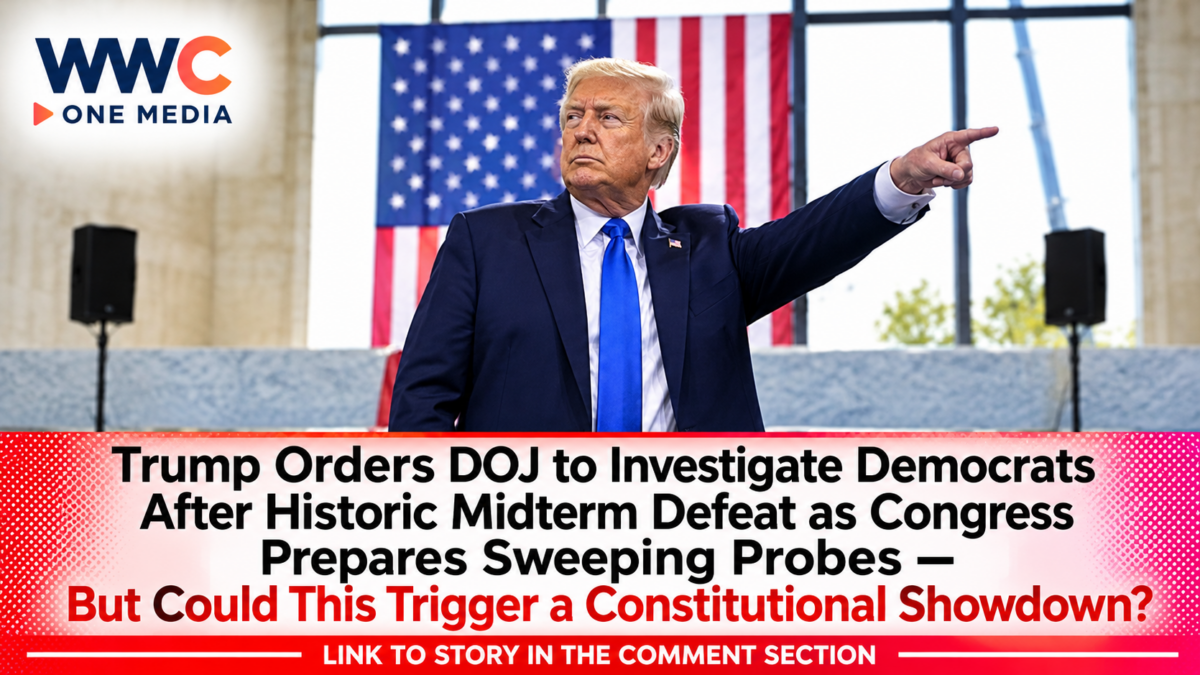
WASHINGTON, D.C. — November 8, 2026 — President Donald Trump has opened a new political confrontation with Democrats, directing the US Department of Justice to investigate opposition lawmakers he accused of threatening members of his administration and Republican donors with impeachment, criminal prosecution and other punishment.
The extraordinary announcement came Saturday, November 7, just four days after Democrats won control of both chambers of Congress in the US midterm elections, dramatically weakening Trump’s legislative position for the remaining two years of his presidency.
According to Bloomberg and Reuters, Trump accused Democrats of engaging in intimidation and what he characterized as political extortion as they prepare to launch congressional investigations into his administration.
Trump made his accusations in a Truth Social post, demanding that the Justice Department examine what he called a criminal act.
However, the president did not publicly provide evidence demonstrating that Democratic lawmakers had committed a crime.
The Justice Department had not immediately announced a formal investigation or criminal charges in response to the president’s statement.
The escalating dispute comes as Democratic leaders prepare to examine White House spending, immigration enforcement, political donations, government contracts and the conduct of senior administration officials.
With Democrats preparing to wield congressional subpoena powers and Trump threatening a Justice Department counterattack, could Washington be heading toward one of the most explosive battles over presidential power and congressional oversight in years?
Trump Accuses Democrats of Extortion and Political Intimidation
Trump’s November 7 statement followed warnings from Democratic lawmakers that congressional investigations would intensify once their party assumes control of Congress in January 2027.
The president accused Democrats of threatening Republican officials, administration employees and political donors with investigations and impeachment proceedings.
He characterized the warnings as an attempt to intimidate people associated with his administration.
Trump described the situation as an example of political lawfare and directed the Justice Department to examine the conduct.
According to Reuters, Trump specifically complained about letters sent by congressional Democrats requesting information from people and organizations associated with his administration.
Some of those requests involved donations to the White House ballroom project.
Trump also referred to threats of impeachment against senior administration officials.
His allegations, however, remain unproven.
Congressional investigations and impeachment proceedings are established constitutional mechanisms. Their use does not automatically constitute criminal intimidation or extortion.
Whether a particular communication crosses a legal boundary depends on its contents, purpose, applicable law and supporting evidence.
The president’s public directive therefore marks a serious political escalation, but it does not establish wrongdoing by the lawmakers he criticized.
Democrats’ Midterm Victory Changes the Balance of Power
The confrontation is unfolding after Republicans suffered major losses in the November 3 elections.
Democrats captured control of the House of Representatives and Senate, ending the Republican Party’s congressional majorities when the new Congress convenes on January 3, 2027.
The results gave Democrats a stronger position to challenge Trump’s policies, examine government spending and scrutinize federal agencies.
Reuters and the Associated Press reported that Republicans lost at least seven Senate seats while Democrats also secured significant gains in the House.
The election outcome reflected widespread dissatisfaction with economic conditions and the administration’s performance, although voters had different reasons for supporting individual candidates.
For Trump, the consequences extend beyond legislative negotiations.
A Democratic-controlled House can use congressional committees to investigate executive-branch decisions, summon witnesses and request records.
Democratic control of the Senate also creates a more difficult environment for presidential appointments and confirmations.
As previously reported by WWC ONE MEDIA, the midterm victory has fundamentally changed the political balance in Washington.
Related WWC ONE MEDIA report: Democrats Seize Control of US Congress in Historic Midterm Upset as Trump Accepts Defeat — Two Years of Political Showdown Loom
But Democrats’ victory does not immediately end Republican control of the current Congress.
Nor does it remove Trump’s presidential powers.
The result is a difficult political environment in which congressional oversight and presidential authority could repeatedly collide.
Robert Garcia’s Warning Puts Trump’s Team on Notice
One of the most prominent Democratic figures in the dispute is California Representative Robert Garcia.
Garcia, who is positioned to lead the House Oversight Committee when Democrats assume the majority, issued a pointed warning to potential investigation targets following the election.
His message was brief: “Lawyer up.”
The statement signaled that Democrats intend to conduct aggressive oversight of the administration.
Potential subjects include government contracts, spending decisions, financial relationships involving the Trump family and allegations concerning immigration enforcement.
Garcia and other Democrats have argued that Congress has a responsibility to investigate possible misuse of public resources.
However, an investigation does not establish that a person has violated the law.
Any findings would have to be evaluated against documentary evidence, witness testimony and applicable legal standards.
The Oversight Committee may seek records and testimony through congressional procedures, but disputes involving executive privilege and other legal defenses could lead to litigation.
Trump’s response indicates that the White House may contest the legitimacy of some of those investigative efforts.
That creates the possibility of prolonged battles between congressional committees and federal agencies.
Senator Elissa Slotkin Becomes a Target of Trump’s Accusations
Trump also singled out Michigan Democratic Senator Elissa Slotkin.
Slotkin has argued that individuals who break the law or misuse taxpayer money should face accountability.
She has also suggested that potential legal consequences could discourage people from participating in unlawful government conduct.
Republicans criticized her statements, arguing that they amounted to threats against people considering government service.
Slotkin disputed that characterization.
According to Reuters, she emphasized that officials who comply with the law should have nothing to fear.
The dispute also follows an earlier Justice Department investigation involving Slotkin and other Democratic lawmakers who participated in a video encouraging military and intelligence personnel to refuse unlawful orders.
A federal grand jury declined to indict the lawmakers in that earlier matter.
That decision does not establish the outcome of any future investigation.
However, it is important background because Trump’s latest accusations involve some of the same political tensions over government accountability and executive authority.
The central legal distinction remains whether lawmakers are engaging in legitimate oversight or making unlawful threats.
No publicly reviewed evidence has established that Slotkin committed extortion.
Democrats Prepare a Five-Front Investigation Strategy
Trump’s statement comes as Democrats are developing a broad oversight agenda for the next Congress.
Bloomberg Government has identified five major areas likely to attract increased scrutiny: executive-branch investigations, federal spending, the Iran conflict, artificial intelligence and cryptocurrency regulation.
House and Senate committees are preparing to seek information from administration officials, federal agencies and private organizations connected to government policies.
Potential inquiries include the White House’s financial arrangements, government contracting, alleged conflicts of interest and decisions made by senior officials.
Democrats are also expected to examine the administration’s approach to immigration enforcement.
The Justice Department, Department of Defense and other federal agencies could face extensive requests for documents and testimony.
As WWC ONE MEDIA previously reported, congressional Democrats are preparing to challenge Trump’s administration across several economic, political and national security issues.
Related WWC ONE MEDIA report: Democrats Prepare Five-Front Congressional Offensive Against Trump After Historic Midterm Sweep — But Could Subpoenas, Iran War Probes and Crypto Investigations Shake the White House?
These investigations could generate significant political pressure.
But congressional oversight powers are not unlimited, and requests for information may be challenged through established legal procedures.
White House Ballroom Donations Draw Congressional Attention
One subject mentioned in the dispute concerns the construction of a new ballroom at the White House.
Democratic lawmakers have requested records relating to donations and private-sector involvement in the project.
The inquiries involve questions about transparency, financial relationships and possible conflicts of interest.
Trump has defended the project and its financing arrangements.
However, the existence of congressional letters seeking information does not establish that donors or officials committed misconduct.
Congress can examine potential conflicts of interest, particularly where private donations intersect with public institutions.
Whether any arrangement violated applicable rules would require evidence and legal analysis.
Trump’s accusation that Democratic lawmakers were intimidating donors must therefore be treated as his allegation rather than a verified criminal finding.
This distinction is particularly important when reporting on individuals or businesses that have not been charged with wrongdoing.
Attorney General Todd Blanche Faces a Political Test
The president’s directive also places the Justice Department in a politically sensitive position.
Attorney General Todd Blanche has criticized Democratic warnings about investigations and impeachment.
According to The Washington Post, Blanche described the opposition’s rhetoric as objectionable during a November 6 television appearance.
Trump’s subsequent statement increased attention on whether the Justice Department would respond to the president’s accusations.
The attorney general oversees federal law enforcement, but criminal investigations must operate within applicable legal and constitutional requirements.
Political disagreement alone is not sufficient grounds for criminal prosecution.
Investigators would need evidence supporting a potential violation of federal law.
As of the reporting reviewed, the Justice Department had not immediately provided a public response confirming a formal investigation arising from Trump’s November 7 directive.
That distinction is essential.
Trump has publicly demanded an investigation. That is not the same as a confirmed prosecution or criminal charge.
The next developments will depend on whether federal authorities take formal action and whether any such action is supported by evidence.
Stephen Miller’s Promotion Adds Another Layer to the Confrontation
The dispute comes just one day after Trump announced that longtime adviser Stephen Miller would become White House chief of staff.
Miller is scheduled to replace Susie Wiles on November 9.
The personnel change follows the Republican Party’s midterm defeat and is expected to influence how the administration manages its relationship with Congress.
Miller has been a central figure in Trump’s immigration and domestic policy strategy.
His appointment could strengthen coordination among senior White House officials as the administration prepares for more aggressive congressional oversight.
But it may also intensify tensions with Democratic lawmakers who have criticized his policy positions.
As previously examined by WWC ONE MEDIA, the leadership transition raises questions about how the White House will manage political confrontation during the remaining years of Trump’s presidency.
Related WWC ONE MEDIA report: Trump Replaces Susie Wiles With Immigration Hardliner Stephen Miller After Democrats Seize Congress — But Could His White House Shake-Up Trigger an Even Bigger Political War?
Miller’s appointment does not itself change the legal powers of the president or congressional committees.
Its practical significance will depend on the strategy the administration adopts.
Could Democrats Impeach Trump or His Cabinet Officials?
The possibility of impeachment has become another flashpoint.
Some Democrats have discussed impeachment proceedings involving senior administration officials.
Congress possesses constitutional authority to impeach and remove certain federal officials under specified procedures.
The House can approve articles of impeachment by a simple majority.
Conviction and removal require a two-thirds vote in the Senate.
Democratic control of Congress therefore does not guarantee that impeachment proceedings would result in removal from office.
There is also an important distinction between discussing impeachment and making an unlawful threat.
Lawmakers may lawfully criticize officials and advocate constitutional accountability measures.
However, allegations of illegal coercion would require evidence demonstrating conduct beyond legitimate political and legislative activity.
The incoming Democratic majorities may decide to prioritize investigations rather than impeachment proceedings.
Reuters previously reported that some Democratic strategists favored gathering evidence through inquiries into businesses and financial institutions connected with Trump rather than immediately pursuing another impeachment effort.
The final approach remains undecided.
Republicans Still Have Time Before Democrats Take Control
The political confrontation is occurring during the remaining weeks of Republican congressional control.
The new Democratic-controlled Congress is scheduled to convene on January 3, 2027.
Until then, Republicans maintain their existing majorities.
That gives GOP lawmakers a limited period to pursue unfinished legislative business, including spending measures, national security priorities and other administration-backed proposals.
But the remaining calendar is constrained by congressional procedures, recesses and political disagreements.
As WWC ONE MEDIA previously reported, Republicans are facing a shrinking window to finalize priorities before Democrats assume control.
Related WWC ONE MEDIA report: Trump’s Republicans Have Just 57 Days to Push Through Final Agenda After Democrats Seize Congress — But Could a Last-Minute Power Play Change America’s Future?
The transition makes the political stakes especially high.
Trump may seek to advance legislative priorities while Republicans still hold majorities.
Democrats, meanwhile, are preparing to use their incoming authority to scrutinize decisions made by the administration.
The two competing strategies could produce an unusually contentious period in Washington.
Could Trump’s DOJ Directive Trigger a Constitutional Battle?
The central controversy involves the relationship between presidential authority and congressional oversight.
Congress has constitutional responsibilities involving legislation, appropriations, impeachment and the investigation of matters connected to its legislative functions.
The executive branch, meanwhile, is responsible for enforcing federal law.
Conflict can arise when lawmakers seek documents or testimony that an administration refuses to provide.
Disputes may involve executive privilege, subpoena enforcement or the boundaries of congressional investigative authority.
The courts can play an important role in resolving some of those disagreements.
However, not every political dispute becomes a constitutional crisis.
For a more serious confrontation to emerge, there would need to be concrete actions, such as contested subpoenas, disputed prosecutions or judicial orders that government institutions refuse to follow.
Trump’s November 7 statement raises concerns about how the Justice Department might be used in a confrontation with political opponents.
But it does not, by itself, prove an unlawful use of prosecutorial power.
The available facts support describing the situation as an escalating political and institutional dispute.
They do not yet establish a completed constitutional breakdown.
What the Political Showdown Means for Financial Markets and the Philippines
The confrontation could also influence perceptions of political stability in the United States.
Investors generally monitor congressional spending negotiations, regulatory policy and major legal disputes because they can affect business conditions.
A prolonged fight over government oversight could complicate legislative negotiations and consume political attention.
However, there is no basis to conclude that Trump’s November 7 statement has independently caused a particular stock-market decline or currency movement.
For the Philippines, US political developments are relevant because of trade, investment, financial-market links and the bilateral defense relationship.
Changes in American foreign policy or federal spending can have international consequences.
But a dispute over congressional investigations does not automatically change US-Philippine agreements or Philippine domestic policy.
The practical effects will depend on future legislative and executive decisions.
The Bigger Picture: Is Washington Heading Toward Two Years of Political Warfare?
The November 3 elections have dramatically altered the balance of power in Washington.
Democrats are preparing to regain control of both chambers of Congress.
Trump remains president and retains his executive authority.
The opposition is promising extensive investigations into administration policies, federal spending and possible conflicts of interest.
The president is responding by accusing Democratic lawmakers of political intimidation and directing the Justice Department to examine their conduct.
Both developments create the potential for serious institutional conflict.
For Democrats, the challenge will be demonstrating that congressional investigations serve legitimate oversight purposes and produce credible findings.
For Trump, the challenge will be defending his administration while ensuring that federal law enforcement is not used improperly against political opponents.
The strength of the American constitutional system will depend partly on whether the institutions involved respect their legal boundaries.
Neither congressional accusations nor presidential allegations should be treated as proof of criminal wrongdoing without evidence.
The confirmed development is that Trump has publicly demanded a Justice Department investigation of Democrats who intend to investigate his administration.
What remains uncertain is whether the Justice Department will take formal action, whether congressional inquiries will uncover wrongdoing and how the courts may respond to future disputes.
As Democrats prepare to take control of Congress and Trump threatens to fight back through the Justice Department, one question could define the final two years of his presidency:
Will Washington’s escalating war of investigations strengthen government accountability—or trigger a far more dangerous confrontation over the limits of presidential power?