MANILA, PHILIPPINES — November 8, 2026 | WWC ONE MEDIA | Philippine Entertainment, Business, Lifestyle and Digital Media
One of the Philippines’ most recognizable men’s lifestyle magazines has officially returned, bringing back a name that once dominated newsstands, celebrity conversations and popular culture.
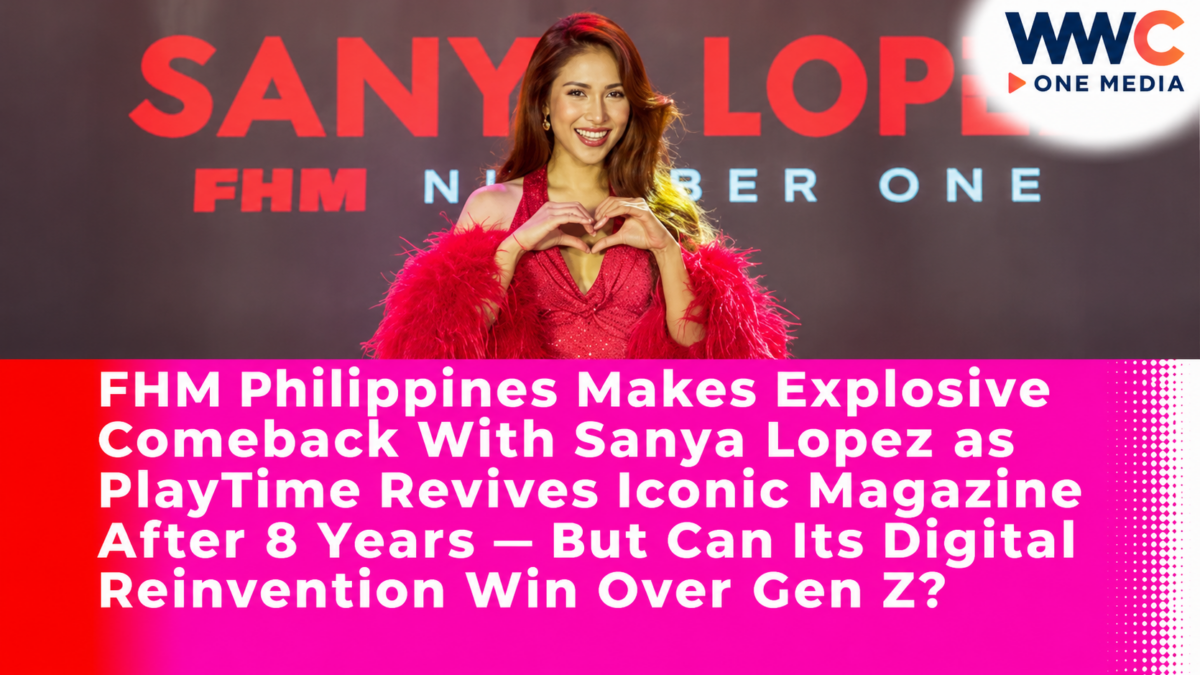
FHM Philippines is back after an eight-year absence from regular print publication, with actress Sanya Lopez leading the comeback as the cover star of its November 2026 relaunch issue.
But this is not simply the return of a familiar magazine.
Under PlayTime Entertainment, the revived FHM is being transformed into a digital-first entertainment brand that combines celebrity features, social media content, podcasts, exclusive events, interactive experiences and limited-edition collectibles.
The relaunch was held at Okada Manila on November 6, attracting entertainment personalities, media representatives and industry guests.
According to Bilyonaryo’s November 7 report, the comeback forms part of PlayTime Group’s expansion into media and entertainment as its original online gaming business operates in an increasingly scrutinized regulatory environment.
For longtime readers, the announcement brings back a brand associated with some of the most memorable celebrity magazine covers in Philippine publishing.
For a younger generation, however, the new FHM promises something different: a content platform built around digital creators, audience participation and live experiences.
But can PlayTime turn the nostalgia surrounding FHM into a profitable modern media business—or will the magazine discover that winning attention on social media is much harder than dominating newsstands?
Sanya Lopez Headlines the Historic FHM Comeback
Kapuso actress Sanya Lopez was unveiled as the November 2026 cover star during the official relaunch at Okada Manila.
The announcement was independently confirmed by Philstar.com and GMA Entertainment.
Lopez has built a career through television dramas, entertainment projects and brand endorsements.
Her selection represents the new management’s attempt to connect FHM’s established identity with a contemporary audience.
Speaking at the event, Lopez described the opportunity as a personal milestone.
She recalled seeing prominent actresses such as Marian Rivera appear in the magazine and hoping that she might one day receive a similar opportunity.
The relaunch issue also features five Sparkle personalities:
- Faye Lorenzo
- Vanessa Peña
- Liezel Lopez
- Analyn Barro
- Arra San Agustin
Their inclusion provides the new FHM with an established group of entertainment personalities capable of reaching audiences across television and digital platforms.
However, their participation does not by itself establish how many readers, paying customers or advertisers the brand will attract.
That will become clearer as the revived business develops.
FHM Returns Eight Years After Its Original Print Run Ended
FHM Philippines became a major name in the country’s magazine industry after launching in 2000 under Summit Media.
During its original run, the title combined celebrity photography with entertainment, lifestyle, fitness, gadgets, fashion and humor.
Its covers and annual rankings regularly attracted public attention.
The magazine also became associated with a particular period in Philippine media, when physical publications played a more prominent role in shaping celebrity culture.
But changes in consumer behavior transformed the publishing business.
More readers began consuming entertainment and lifestyle content through websites, smartphones and social media platforms.
Traditional print publications faced increasing competition for advertising revenue and audience attention.
FHM Philippines ended its original regular print run in 2018.
The international FHM brand had already experienced similar pressures in other markets.
Its return in 2026 is therefore more than a nostalgic revival.
It represents an attempt to rebuild a legacy media property around the commercial realities of the modern digital economy.
PlayTime Entertainment Takes FHM Beyond the Magazine
The revival is being led by PlayTime Entertainment, the entertainment division of PlayTime Group.
PlayTime’s business originally developed around digital gaming.
In December 2025, the group established PlayTime Entertainment to pursue opportunities beyond its gaming activities.
Its expansion includes entertainment, talent development, sports-related activities, digital experiences and media ventures.
GMA News reported in August 2026 that the group was accelerating its diversification by developing non-gaming operations.
FHM is now one of the most visible examples of that strategy.
Instead of relying mainly on magazine circulation, the company wants to develop multiple ways for audiences and commercial partners to engage with the brand.
PlayTime Entertainment president Crisanto Roy Alcid has described the new strategy as one that creates experiences before distributing the resulting content.
The concept changes the traditional publishing process.
A conventional magazine produces stories and images for readers to purchase or view.
The revived FHM plans to create events, interactions and digital experiences that can become content across different channels.
That approach could generate value through advertising, sponsorship, events, partnerships and other commercial arrangements.
But the company has not publicly provided enough financial information to determine whether the new FHM business is profitable.
Seven Platforms Form the New FHM Universe
PlayTime’s official FHM website outlines seven areas of activity.
These include FHM Exclusive Digital, collectible editions, live events, audience engagement, conversation-led content, the FHM 100 Sexiest tradition and talent promotion.
Each platform serves a different purpose.
Digital features allow the company to publish celebrity stories and lifestyle content.
Collectible editions provide limited physical products for longtime fans and enthusiasts.
Events offer opportunities for sponsors and audiences to interact with featured personalities.
The FHM Talks platform is designed for interviews, podcasts and conversations.
FHM Spot focuses on audience participation, campaigns and interactive experiences.
FHM Status provides a platform for personalities associated with the brand.
The FHM 100 Sexiest franchise remains one of its most recognizable properties.
Together, these initiatives are intended to turn FHM into a broader entertainment ecosystem rather than a single publication.
However, the financial performance of each platform has not yet been disclosed.
Limited Print Editions Could Become Collector’s Items
Although the new FHM is primarily digital, physical publishing has not disappeared completely.
PlayTime has announced plans for limited-run collectible editions.
Earlier promotional material described releases limited to approximately 50 signed physical copies.
The strategy is different from distributing a conventional magazine through large numbers of newsstands.
Scarcity can make a collectible attractive to dedicated fans.
Autographed editions may also provide a tangible connection between featured personalities and their audiences.
However, there is no independently verified resale-market valuation for the new FHM collectibles.
Nor has the company established that every release will command significant premiums.
For PlayTime, the commercial opportunity will depend on whether fans view the limited editions as desirable products rather than ordinary printed material.
FHM Afters, FHM Nights and FHM World Expand the Brand
The company is introducing several entertainment formats alongside its digital publication.
FHM Afters: The Podcast is intended to feature interviews and conversations with personalities associated with the brand.
FHM Nights focuses on live entertainment and exclusive events.
FHM World is positioned as a premium lifestyle offering involving high-end experiences and brand partnerships.
The company also plans to revive the FHM 100 Sexiest Women tradition.
These initiatives could allow FHM to attract audiences through multiple channels.
A fan might discover an interview on social media, follow a featured personality, attend an event or purchase a collectible edition.
That creates different opportunities for commercial engagement.
But it also increases operating complexity.
Live events require planning, venues, staffing and reliable execution.
Podcast production requires consistent content and audience development.
Premium experiences must offer enough value to justify their pricing.
Whether FHM can coordinate these different activities successfully will be one of the major tests of its relaunch.
FHM Promises a More Collaborative Approach to Featuring Women
Another significant change involves how the publication intends to represent its featured personalities.
During the November 6 launch, PlayTime Entertainment spokesperson Adela-Mae Marshall said the new FHM would give women greater influence over their concepts, styling and presentation.
She described the approach as collaborative, with featured personalities actively participating in how their stories are told.
That differs from older publishing models in which magazine editors and photographers often exercised greater control over visual presentation.
The company says it wants to emphasize confidence, individuality and self-expression.
Its management has also expressed openness to featuring transgender women.
Marshall said the revived publication is willing to consider diverse forms of beauty and representation.
These statements describe the company’s editorial intentions.
How consistently those principles are applied will depend on future features and production practices.
For readers, the important question is whether the new approach produces more substantive stories or simply changes the promotional language surrounding celebrity coverage.
Why the Creator Economy Matters to FHM’s Return
The new FHM is entering a Philippine digital marketplace where content creators have become increasingly influential.
Social media personalities can build audiences without depending entirely on traditional television networks, newspapers or magazines.
Brands now collaborate with creators through sponsored videos, product demonstrations, livestreams and affiliate marketing.
As WWC ONE MEDIA reported on Shopee’s creator-led affiliate program and its reported increase in sales and traffic, digital creators are playing a larger role in how Filipino businesses reach consumers.
FHM’s strategy reflects that broader change.
The magazine no longer needs to serve as the only channel through which a featured personality reaches fans.
Instead, it can work with creators who already have substantial audiences.
The challenge is providing something those personalities cannot easily produce independently.
FHM must offer stronger storytelling, production quality, commercial partnerships or audience experiences.
Without that additional value, the revived brand could struggle to differentiate itself from existing entertainment accounts.
Philippine Creative Industries Offer a Major Commercial Opportunity
FHM’s return also comes during a period of expansion in the Philippine creative economy.
According to Philippine Statistics Authority data, the country’s creative industries generated approximately ₱2.12 trillion in 2025.
The sector includes publishing, advertising, audiovisual media, digital interactive products, entertainment and other creative activities.
As WWC ONE MEDIA reported on Senator Loren Legarda’s call for greater support for the Philippine creative economy, sustaining that growth requires investment in Filipino talent, intellectual property and creative businesses.
FHM could participate in this market through content production, events and talent partnerships.
But the industry’s overall economic size does not establish the revenue potential of any individual publication.
The new management will need to demonstrate its ability to attract advertisers, retain audiences and develop sustainable commercial products.
Digital Skills Are Becoming More Important for Filipino Creators
The transformation of FHM reflects wider changes in creative employment.
Publishing today increasingly requires skills in video production, social media management, digital marketing, analytics and audience engagement.
As WWC ONE MEDIA reported on Unilab Education and FutureProof’s content-creation internship initiative, organizations are beginning to prepare young Filipinos for professional opportunities in the digital creator economy.
The connection is relevant because a modern media brand depends on more than writers and photographers.
It may require video editors, graphic designers, producers, event managers, marketing teams and technical specialists.
For the new FHM, developing a competitive creative workforce could become an important part of its operating strategy.
However, the relaunch announcement does not establish how many additional jobs PlayTime intends to create.
Any specific employment forecast would require official company figures.
Why PlayTime’s Gaming Background Is Important
Bilyonaryo’s report highlights an additional business issue: PlayTime’s roots in the online gaming industry.
The Philippines has increased scrutiny of digital gambling businesses, including concerns about consumer protection, advertising and responsible gaming.
PlayTime has expanded into non-gaming entertainment while maintaining separate gaming operations.
That diversification may allow the group to develop business opportunities outside its original sector.
But the timing alone does not prove that FHM was acquired or relaunched specifically to avoid gambling regulation.
No verified corporate disclosure reviewed for this article establishes that motive.
The business connection is nevertheless relevant.
Companies operating in regulated industries often consider diversification as a way to broaden their revenue base and reach different customers.
As WWC ONE MEDIA previously reported on DigiPlus’s GameZone partnership with Filipino rapper Gloc-9, entertainment personalities and cultural partnerships have become part of the branding strategies used by digital gaming companies.
FHM is a distinct lifestyle and media venture.
Its relaunch should not be described as a gambling product merely because its parent group operates in that industry.
The relevant business question is whether PlayTime can build a successful entertainment operation with a clear identity of its own.
Can FHM Compete With TikTok, YouTube and Modern Entertainment Platforms?
The revived FHM faces a significantly different competitive environment from the one it left in 2018.
Audiences can now follow celebrities directly through social media.
Short-form videos, podcasts, livestreams and entertainment pages compete for attention throughout the day.
A familiar magazine name may generate curiosity, but curiosity does not necessarily produce lasting audience loyalty.
FHM will need to publish content consistently and give audiences reasons to return.
It must also consider how to balance its traditional identity with changing expectations about representation and inclusivity.
Too much reliance on nostalgia could limit its appeal to younger audiences.
But abandoning the qualities that made the brand recognizable could weaken its connection with longtime fans.
The challenge is finding a balance between continuity and reinvention.
Three Possible Outcomes for FHM’s New Era
Scenario 1: FHM successfully becomes a major digital entertainment brand.
The company could build a substantial online audience and generate commercial opportunities through events, creators and premium experiences.
Scenario 2: The comeback attracts initial attention but struggles to sustain engagement.
The return of a familiar name may draw fans, but long-term success will depend on content quality, consistent execution and an effective business model.
Scenario 3: PlayTime expands FHM into a broader talent and lifestyle platform.
If the company’s creator-first approach succeeds, FHM could become an important vehicle for talent development, partnerships and branded entertainment.
These are possible outcomes, not confirmed forecasts.
The relaunch is too recent to determine which path will emerge.
The Bigger Question: Can a Legendary Magazine Survive Without Being a Traditional Magazine?
FHM Philippines has returned at a moment when the publishing business is undergoing profound change.
The brand that once relied on physical covers, magazine sales and newsstand visibility is now embracing digital storytelling, live events and direct audience participation.
Sanya Lopez’s November 2026 cover provides a high-profile beginning.
The lineup of featured personalities gives the relaunch additional visibility.
PlayTime Entertainment’s investment strategy offers resources and commercial connections.
And FHM’s established name provides a level of recognition that many new entertainment startups must spend years building.
But none of those advantages guarantees success.
The company must prove that it can build lasting relationships with audiences who have almost unlimited entertainment choices.
It must also show that a creator-first strategy delivers meaningful benefits to its featured personalities and commercial partners.
FHM’s comeback is confirmed. Its ability to become a profitable and influential digital entertainment platform remains unproven.
For PlayTime, the stakes extend beyond reviving an old magazine.
The relaunch could become a major test of its ambition to establish a diversified entertainment business.
And as FHM prepares to introduce its legendary identity to a generation raised on smartphones rather than newsstands, one question could define its future:
Will Sanya Lopez and PlayTime successfully transform FHM into the Philippines’ next major digital entertainment powerhouse—or will the iconic magazine discover that its greatest challenge is no longer getting people to buy a copy, but convincing them to keep watching?