MAKATI CITY / MANILA, PHILIPPINES — November 8, 2026 | WWC ONE MEDIA | Philippine Business, Corporate Governance and Media
One of the Philippines’ most influential business leaders has delivered a powerful warning to corporate executives and the media: public trust can no longer be taken for granted, and companies must become more willing to face difficult questions if they want to rebuild confidence in the country’s institutions.
Jaime Augusto Zobel de Ayala, chairman of Ayala Corporation, urged Philippine businesses to embrace greater transparency, welcome independent scrutiny and provide journalists with meaningful access to executives, company data and industry expertise.
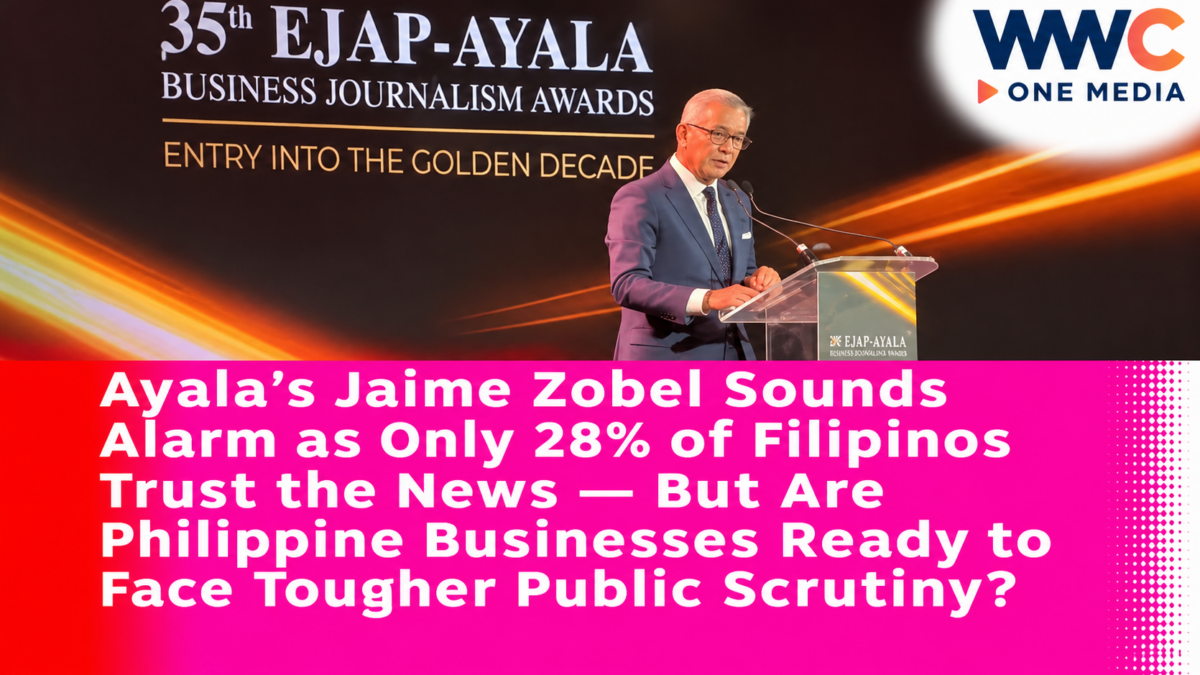
Speaking at the 35th Business Journalism Awards of the Economic Journalists Association of the Philippines (EJAP) in Makati City on November 6, Zobel said companies and news organizations share responsibility for helping Filipinos understand the forces shaping the economy.
His warning comes as confidence in news reaches troubling levels.
The Reuters Institute’s 2026 Digital News Report found that only 28% of Philippine respondents generally trust news, a decline of 10 percentage points from the previous year.
Meanwhile, 51% said they sometimes or often avoid the news.
The figures reveal a difficult environment for institutions trying to communicate with the public.
But Zobel argued that businesses should not simply blame journalists, social media platforms or public skepticism.
Companies themselves must demonstrate honesty, accountability and a willingness to explain their decisions.
His challenge raises a question with consequences for the country’s biggest conglomerates, banks, utilities and listed companies:
If public confidence is declining, will Philippine corporations genuinely open themselves to independent examination—or will transparency remain another promise made in boardrooms and annual reports?
Ayala Chairman Urges Businesses to Welcome Scrutiny
Zobel delivered his remarks during the EJAP awards ceremony, which recognized excellence in Philippine economic and business journalism.
The event marked the organization’s 35th Business Journalism Awards and its 41st year.
Rather than focusing exclusively on the achievements of reporters, Zobel challenged business leaders to reconsider their responsibilities to the public.
He said corporate institutions influence public understanding through the information they disclose and the access they provide.
Businesses therefore have an obligation to engage with independent journalism rather than treat questioning as a threat.
In his keynote address, Zobel stated:
“We in business should make ourselves open to scrutiny.”
The message was significant coming from the chairman of one of the country’s oldest and largest conglomerates.
Ayala Corporation has substantial interests in banking, telecommunications, property development, renewable energy and other businesses.
Decisions involving these industries can influence employment, household expenses, investments and the development of entire communities.
Zobel argued that independent journalism helps the public evaluate those decisions and understand their consequences.
He also recognized that well-supported reporting can reveal corporate shortcomings and encourage improvements.
The implication is that scrutiny should not be viewed solely as a reputational risk.
It can also serve as a mechanism for identifying weaknesses before they become larger problems.
Only 28% of Filipinos Trust News, Reuters Institute Reports
One of the most striking elements of Zobel’s speech was his reference to the Reuters Institute’s Digital News Report 2026.
The report found that overall trust in news among Philippine respondents had fallen to 28%.
That represented a decline of 10 percentage points from 2025.
The Philippine figure was also below the report’s global average of 37%.
The findings suggest that a large share of Filipinos remain skeptical about the information they encounter.
However, the results should be interpreted carefully.
The survey measures people’s reported perceptions of news, not an independent audit of whether every news organization is accurate or trustworthy.
It also does not establish that 72% of Filipinos believe all news is false.
Trust is influenced by many factors, including political polarization, personal experiences, public controversies and the media environment.
The Reuters Institute noted that confidence in major individual news brands remained more stable than the overall national trust figure.
That distinction offers an important lesson.
Trust in news generally can decline even while specific organizations retain credibility with their audiences.
For business leaders, this means communicating through trusted channels and supporting accurate reporting may become more important than simply increasing the volume of corporate publicity.
More Than Half of Filipinos Sometimes Avoid the News
The Reuters Institute also reported that 51% of Philippine respondents sometimes or often actively avoid the news.
That was an increase from 48% in 2025.
News avoidance can arise for several reasons.
Some readers feel overwhelmed by political conflict or negative developments.
Others may find coverage repetitive, confusing or emotionally exhausting.
The expanding role of social media platforms also means many people encounter headlines without necessarily seeking out a full news report.
The trend creates a challenge for economic journalism.
Decisions about inflation, interest rates, infrastructure and business investment can directly affect families.
But complex financial reporting may struggle to reach people who are already disengaged from news.
Zobel said journalists and businesses must help explain these issues in ways the public can understand.
The objective should not be to simplify matters so aggressively that important qualifications disappear.
Instead, news organizations should make complex developments accessible while retaining the context needed for accurate understanding.
For companies, that requires providing useful information rather than relying exclusively on carefully worded announcements.
Why Zobel Believes Public Distrust Is More Than a Media Problem
Zobel’s speech did not place responsibility for declining trust solely on journalists.
He acknowledged that public skepticism can arise from institutional failures, unmet expectations and situations where people believe decision-makers have not been held accountable.
That is an important distinction.
Trust cannot be restored merely by asking audiences to become more positive about institutions.
Organizations must demonstrate that they deserve public confidence.
For businesses, this can involve clear financial disclosures, ethical conduct and responsiveness to customers, employees and communities.
For journalists, it requires fact-checking, independence, fairness and correction of errors.
For public institutions, confidence depends partly on whether decisions are transparent and whether rules are applied consistently.
Zobel’s message was that these responsibilities are interconnected.
Reliable journalism helps people understand whether institutions are meeting their obligations.
Responsible businesses, in turn, can support better reporting by making relevant information accessible.
The relationship should remain independent rather than becoming an arrangement in which corporations control favorable coverage.
Why Independent Business Journalism Matters to Filipino Families
Business reporting is sometimes treated as a specialized subject intended mainly for investors and corporate executives.
But its consequences extend far beyond financial markets.
Consider inflation.
A report explaining rising food prices can help families understand changes in their grocery expenses.
Coverage of interest rates can influence decisions about borrowing, mortgages and savings.
Reporting on electricity and water providers can reveal how corporate investment decisions affect household costs and service reliability.
Stories about infrastructure projects can examine whether promised economic benefits are reaching communities.
And coverage of mergers, acquisitions and corporate restructuring can identify potential consequences for employees and consumers.
Zobel emphasized that economic journalism connects these developments to people’s everyday lives.
That is why accuracy alone is not always sufficient.
A financial figure may be mathematically correct but misleading when presented without the relevant period, comparison or explanation.
Similarly, a company’s investment announcement may sound impressive without evidence showing how the project will affect jobs, productivity or consumers.
Effective business reporting must examine both the announcement and its consequences.
Zobel Calls for Greater Access to Corporate Executives and Data
A practical proposal emerged from the speech.
Zobel urged companies to make greater use of their technical expertise and resources to support informed public discussion.
He suggested that businesses provide journalists with better access to senior executives, industry specialists and useful data.
Companies could also organize site visits and substantive discussions beyond formal earnings announcements or product launches.
For example, reporters covering renewable energy projects may benefit from access to technical experts who can explain electricity generation, financing costs and grid requirements.
Journalists examining artificial intelligence need reliable information about the technology’s applications, costs and possible effects on employment.
Likewise, reporting on international trade could improve when companies provide detailed explanations of supply-chain developments and market changes.
However, access must not be mistaken for editorial influence.
Companies can provide facts, expertise and opportunities to ask questions.
Journalists must remain free to verify those claims independently and publish conclusions that may be critical of corporate decisions.
That separation is central to the credibility Zobel wants to strengthen.
Ayala’s Governance Awards Put the Message in a Wider Context
Zobel’s call for accountability comes shortly after Ayala Corporation received major recognition for corporate governance.
At the 2026 Golden Arrow Awards organized by the Institute of Corporate Directors, Ayala received Five Golden Arrows, the highest distinction, for the second consecutive year.
As WWC ONE MEDIA reported on Ayala’s top corporate governance recognition, the award reflects the company’s performance under a governance assessment framework.
The recognition is relevant to Zobel’s latest remarks because both concern accountability and responsible corporate management.
But a governance award should not be interpreted as a guarantee that a company will never face operational problems, regulatory issues or criticism.
It represents an assessment against specified governance standards.
Long-term public trust depends on how companies behave when difficult questions arise, including those involving financial performance, customer service or controversial business decisions.
For Ayala, the challenge is translating recognized governance practices into consistent engagement with the public.
Globe’s Hall of Fame Recognition Highlights Governance Expectations
Ayala’s subsidiaries have also received attention for corporate governance.
Globe Telecom achieved a Golden Arrow Hall of Fame distinction after receiving the highest governance recognition for five consecutive years.
As WWC ONE MEDIA reported on Globe’s historic Hall of Fame award, the recognition comes as the telecommunications company navigates continued digital expansion.
That creates practical questions about transparency.
Large telecommunications and financial technology businesses handle significant amounts of customer information and provide services used by millions of people.
Their governance responsibilities involve more than financial reporting.
Customers may also expect clear explanations about pricing, service interruptions, privacy protections and operational decisions.
Governance recognition can reinforce confidence, but customers will ultimately assess a company’s credibility through its behavior and service.
This is consistent with Zobel’s broader argument that organizations must continually earn the public’s trust.
Banks Face Similar Pressure to Explain Corporate Decisions
The discussion also applies to Philippine financial institutions.
Banks have particularly important obligations because they safeguard deposits, extend credit and influence economic activity.
The public needs understandable information about financial performance, risk management and major business decisions.
As WWC ONE MEDIA reported on Security Bank’s Three Golden Arrows recognition, corporate governance standards have become a major area of attention across the banking industry.
But awards alone cannot determine whether an institution is financially safe or offers suitable products.
Customers and investors must still consider financial disclosures, regulatory requirements and the terms of individual services.
Independent economic journalism plays an important role in explaining those distinctions.
It can also help readers understand why a bank’s profitability may rise or fall, how lending decisions affect businesses and what new regulations mean for ordinary customers.
Transparency Matters for Utilities and Infrastructure Companies
The demand for accountability extends to utilities and infrastructure developers.
These businesses frequently make investments that affect essential services over many years.
Electricity, water and transportation infrastructure can influence household expenses, employment and local economic development.
As WWC ONE MEDIA reported on Vivant’s consecutive Three Golden Arrows recognition and ₱67-billion expansion plans, governance standards and investment ambitions often need to be evaluated together.
An announced capital expenditure program may signal growth.
But reporters must also examine implementation schedules, funding arrangements, regulatory approvals and potential effects on consumers.
Likewise, companies should be prepared to explain their business assumptions.
Zobel’s message offers a framework for such coverage.
Strong reporting should recognize genuine achievements while examining risks, delays and unresolved questions.
Neither automatic criticism nor automatic praise serves the public particularly well.
Artificial Intelligence Makes the Trust Problem More Complicated
Zobel also identified artificial intelligence as one of the major developments changing the relationship between businesses, journalists and the public.
AI can help organizations analyze information, improve operations and create new services.
But it also introduces concerns about inaccurate content, synthetic media, data privacy and workforce changes.
For journalists, AI tools can assist with research and production.
However, AI-generated information may contain mistakes or fabricated details.
Newsrooms remain responsible for verifying material before publication.
For businesses, the challenge is explaining how AI is being used, what risks it creates and whether appropriate human oversight remains in place.
Corporate statements about AI-driven productivity improvements should be assessed against actual results.
Claims about job creation or displacement also require supporting evidence.
Access to technical specialists can help journalists report on these issues more accurately.
But independent verification must remain essential.
Climate Change and the Energy Transition Require Better Reporting
Another issue raised in Zobel’s address was climate change.
Philippine businesses face growing exposure to severe weather, physical infrastructure risks and changing international environmental standards.
At the same time, the transition toward cleaner energy creates opportunities for investment and employment.
Economic journalists play a role in explaining both the benefits and costs.
For example, renewable energy announcements should be examined in terms of actual generation capacity, completion schedules, financing and effects on electricity prices.
Businesses should also be prepared to explain environmental claims rather than relying on broad sustainability language.
Zobel suggested that deeper engagement between technical experts and reporters could improve the quality of coverage.
That cooperation would be especially useful when policies or projects involve complicated scientific and financial considerations.
The Risks of Corporate Access Becoming Public Relations
There is an important limitation to the partnership Zobel proposed.
Access to executives and company data can improve reporting, but it can also create conflicts if companies attempt to control coverage.
Invitations, sponsored events and access to senior officials should not determine a journalist’s editorial conclusions.
Similarly, corporate relationships should not prevent reporters from asking about controversies, regulatory findings or negative financial developments.
The challenge is to maintain constructive communication without compromising independence.
Businesses should be willing to answer difficult questions.
Journalists should fairly represent responses and verify competing claims.
Readers benefit when reporting includes credible evidence and meaningful context rather than simply repeating either corporate publicity or unsupported allegations.
This is the practical test of the relationship Zobel described.
EJAP Awards Highlight the Continuing Importance of Business Reporting
The November 6 event also recognized the work of Filipino business journalists.
EJAP, founded in 1985, has spent more than four decades promoting professional standards in economic reporting.
At the 35th Business Journalism Awards, reporters and news organizations received recognition for their coverage of important economic issues.
BusinessMirror reported that BusinessWorld emerged as the Business News Source for 2025 and received three of the eight Reporter of the Year honors.
The awards demonstrated the value of detailed reporting on financial markets, government policy, corporate developments and public-interest issues.
EJAP President John Ted Cordero emphasized the importance of accuracy, investigation and analytical reporting.
The recognition came at a time when the broader news industry faces pressure from declining trust, changing digital platforms and intense competition for audiences.
For journalism organizations, the challenge is to remain both credible and accessible.
For businesses, the responsibility is to support informed public discussion without expecting editorial control.
What Philippine Businesses Can Do to Rebuild Trust
Zobel’s speech offers a practical direction for corporate leaders.
Transparency should be demonstrated through consistent behavior rather than occasional public statements.
Companies can improve public understanding by explaining major decisions, providing relevant evidence and acknowledging uncertainty.
They can make technical experts available to answer questions about complex developments.
They can also respond substantively when journalists raise concerns.
Independent verification remains necessary.
A company’s willingness to communicate does not automatically prove that its explanations are correct.
But refusing reasonable scrutiny can make it harder for customers, investors and communities to evaluate decisions affecting them.
The goal is not simply to make companies look more trustworthy.
It is to create the conditions under which the public can assess whether they deserve trust.
The Bigger Question: Will Corporate Transparency Become a Real Business Priority?
Jaime Augusto Zobel de Ayala’s message arrives at a critical moment for Philippine institutions.
The Reuters Institute reports that overall trust in news has dropped to 28%.
More than half of surveyed Filipinos sometimes or often avoid news.
Social media has become an increasingly important way people encounter information.
And new technologies, including artificial intelligence, are making the information environment more complicated.
Against that backdrop, Zobel is urging both corporations and journalists to take greater responsibility for public understanding.
Businesses should welcome legitimate scrutiny, offer meaningful information and engage with difficult questions.
News organizations should maintain their independence, explain complex issues accurately and provide context rather than relying on isolated headlines.
For Ayala and other major Philippine corporations, the challenge is turning those principles into practices that employees, investors, customers and communities can observe.
The 28% trust figure measures confidence in news—not confidence in Ayala or the business sector as a whole. But Zobel’s warning reflects a broader concern that institutions must demonstrate accountability if they want public confidence.
His call also challenges corporate leaders to reconsider how they respond when questions become uncomfortable.
Will Philippine businesses genuinely give journalists and the public greater access to the information needed to judge their performance—or will the country’s biggest companies discover that rebuilding trust requires much more than another promise of transparency?