NEW YORK / ZUG, SWITZERLAND / MANILA — November 7, 2026 | WWC ONE MEDIA | Global Business, Healthcare Innovation, Biotechnology and Financial Markets
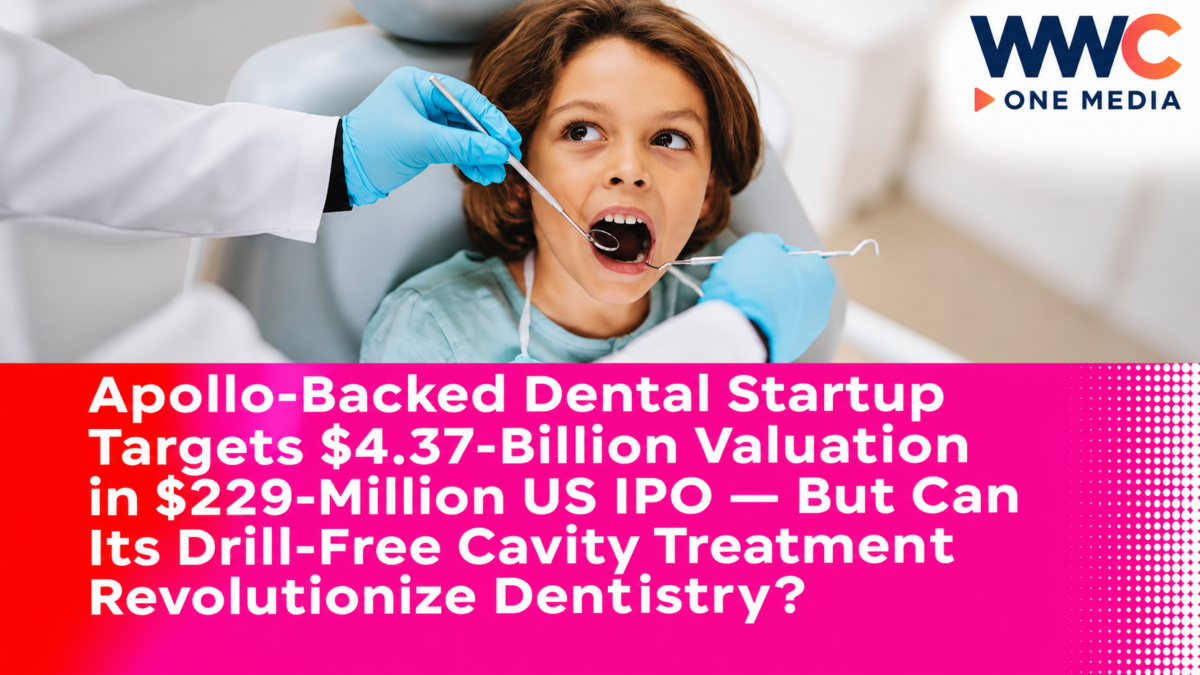
A Swiss dental technology startup backed by Wall Street investment giant Apollo Global Management is preparing for a major US stock market debut, seeking to raise as much as $228.6 million through an initial public offering that could value the business at up to $4.37 billion on a fully diluted basis.
But the company behind the proposed listing is not developing another artificial intelligence chatbot, weight-loss medication or conventional medical device.
Instead, vVardis Holding AG is betting on something billions of people can understand: treating early-stage tooth decay without traditional drilling or injections.
Founded by Swiss dentist sisters Dr. Haley Abivardi and Dr. Goly Abivardi, the company has developed a dental treatment platform called Curodont, designed to support the remineralization of early tooth decay.
The treatment represents a potentially significant development in preventive dentistry because it aims to address certain early cavities before they require conventional restorative procedures.
And investors are paying attention.
According to Bloomberg and Reuters reports published November 6, vVardis has established a proposed share-price range of $21 to $24 for its planned listing on the New York Stock Exchange.
The company intends to offer approximately 9.52 million shares under the ticker symbol VVVV.
At the top of the proposed price range, the offering would generate approximately $228.6 million in gross proceeds before underwriting fees and other expenses.
The deal follows an April investment by funds managed by Apollo Global Management that valued vVardis at more than $1 billion.
Just months later, the company is seeking a substantially higher valuation as it expands its presence in the American dental market.
Yet behind its extraordinary growth story lies an important financial challenge.
Despite rapidly increasing revenue, vVardis continues to report substantial losses.
Can a startup promising a less invasive approach to cavity treatment become Wall Street’s next healthcare success story—or could its ambitious valuation prove difficult to justify?
vVardis Targets $228.6 Million in New York Stock Exchange IPO
The company disclosed the proposed offering terms in an amended registration statement filed with the US Securities and Exchange Commission on November 6.
Under the proposed transaction, vVardis plans to issue 9,523,810 Class A ordinary shares at an expected price between $21 and $24 apiece.
At the midpoint of $22.50, the transaction would raise approximately $214.3 million.
At the maximum proposed price, gross proceeds would reach approximately $228.6 million.
The company has also granted underwriters a 30-day option to purchase up to approximately 1.43 million additional shares from selling shareholders.
Those additional shares would come from the company’s founders rather than from newly issued company stock.
Consequently, vVardis would not receive proceeds from those particular sales.
Goldman Sachs and JPMorgan are the lead bookrunning managers for the offering.
William Blair, UBS Investment Bank and Deutsche Bank Securities are also participating in the underwriting syndicate.
The listing is expected to price during the week beginning November 9, according to Renaissance Capital.
However, the IPO has not yet been completed.
The actual pricing, proceeds and first trading date remain subject to market conditions and completion of the offering process.
Two Dentist Sisters Built a Billion-Dollar Healthcare Company
The story behind vVardis begins with two Swiss dentists who believed conventional dentistry needed a different approach to treating early tooth decay.
Haley and Goly Abivardi established the business in 2020 with a focus on developing treatments that could help preserve natural tooth structure.
Their objective was to move certain dental treatments away from invasive procedures and toward biologically assisted repair.
Traditional dental treatment for more advanced cavities often requires removing decayed tooth material and restoring the tooth with a filling.
That approach is widely used and clinically appropriate when the damage has progressed beyond the stage at which remineralization can effectively treat it.
However, early enamel lesions can sometimes be managed without drilling.
The founders believed that new peptide-based technology could expand the available options for treating those early lesions.
Their company developed a commercial platform centered on Curodont.
The technology is intended to help promote the natural remineralization process within damaged enamel.
The company’s progress attracted institutional investors, including healthcare investment firm OrbiMed and affiliates of Apollo Global Management.
Its early shareholders also include investors connected to the luxury and private-investment sectors.
What began as a specialized dental technology business has now developed into a company seeking hundreds of millions of dollars from public investors.
How Curodont Aims to Treat Early Cavities Without Drilling
The centerpiece of vVardis’ business is its proprietary peptide-based technology.
Its flagship US product, Curodont Repair Fluoride Plus, is intended for use in dental practices to help remineralize early enamel lesions.
The product works by using peptide technology to support the formation of a scaffold within early enamel damage.
This structure is designed to facilitate the accumulation of minerals, helping restore mineral content within the affected area.
The process is sometimes described as biomimetic remineralization because it seeks to imitate aspects of the natural processes through which tooth enamel develops and repairs early mineral loss.
Unlike a conventional filling procedure, treatment does not require mechanically removing decayed enamel with a dental drill.
The company says application can take five minutes or less.
But there is an important medical limitation.
Curodont is designed for appropriate early-stage enamel lesions, not every type of cavity.
Once tooth decay has progressed into deeper structures or caused substantial cavitation, a dentist may still need to perform conventional restorative treatment.
The product should therefore not be portrayed as a universal replacement for fillings, root canals or other dental procedures.
Its effectiveness and suitability depend on the condition of the tooth, the treatment protocol and professional assessment.
In the United States, Curodont Repair Fluoride Plus is marketed under the applicable FDA over-the-counter drug monograph framework, rather than as a new drug approved through an individual FDA application.
That regulatory distinction is important when describing the company’s products and clinical claims.
More Than 20,000 US Dental Practices Have Purchased Its Products
One reason vVardis has attracted significant investor interest is its rapid commercial expansion.
According to its IPO registration documents, Curodont products had been sold to more than 20,000 dental practices in the United States as of June 30, 2026.
The company estimates that approximately 110,000 general dental practices represent its addressable US market.
The 20,000-practice figure therefore indicates commercial reach across a substantial portion of its targeted market.
However, it is not equivalent to confirming that every practice is ordering products regularly or that all patients treated have experienced successful outcomes.
The metric reflects commercial distribution, not a comprehensive clinical success rate.
The company also estimates that its technology had been used to treat more than 3.5 million teeth by mid-2026.
Those numbers suggest a significant increase in adoption since Curodont Repair Fluoride Plus became commercially available in the United States in early 2024.
A major distribution partnership has supported that expansion.
vVardis works with Henry Schein, one of the world’s leading distributors of products and services to healthcare professionals.
The arrangement gives the Swiss company access to an established commercial network serving dental practices across the United States.
For a young healthcare company, such distribution infrastructure can be crucial.
Developing an innovative treatment is one challenge.
Convincing thousands of dental professionals to incorporate it into their everyday practices is another.
Revenue More Than Doubles as vVardis Expands
The company’s financial disclosures reveal how quickly its business is growing.
For the six months ended June 30, 2026, vVardis reported revenue of approximately $28.6 million, compared with $9.1 million during the same period in 2025.
That represents growth of more than 200%.
The company subsequently disclosed preliminary results for the nine months ended September 30, 2026.
Revenue for that period is expected to range between $47.7 million and $49.2 million.
The comparable figure in the previous year was approximately $22.3 million.
At the midpoint of the preliminary range, revenue would have more than doubled year over year.
The growth reflects wider commercial distribution, increased product adoption and expanding customer demand.
The company’s financial disclosures also point toward improving manufacturing economics.
Its preliminary gross margin for the nine-month period is estimated at approximately 86%.
Management attributes part of that improvement to manufacturing efficiencies and lower production costs.
The company reported an approximately 60% reduction in per-unit manufacturing costs.
These developments could strengthen profitability if growth continues and operating expenses become more manageable.
However, strong revenue expansion does not automatically translate into positive net earnings.
And that is where vVardis faces one of its most important challenges.
The Warning Sign: vVardis Is Still Losing Millions
Despite growing revenue, vVardis has not yet established consistent profitability.
Its financial statements show a net loss of approximately $27.8 million during the first six months of 2026.
That compares with a loss of $32.1 million in the corresponding period of 2025.
The reduced loss indicates some improvement.
But the business continues spending substantially on commercialization, distribution, research, corporate operations and other expenses.
For the nine months ended September 30, management expects a net loss between approximately $39.7 million and $41.3 million.
The comparable loss during the previous year was approximately $40.7 million.
In other words, the company has expanded revenue considerably while its net losses remain substantial.
Its adjusted EBITDA loss is expected to narrow to approximately $9.2 million to $9.4 million, compared with $17.1 million a year earlier.
Adjusted EBITDA is a non-GAAP financial measure and should not be confused with net income or operating cash flow.
For prospective shareholders, the difference matters.
A company can report improving gross margins and adjusted earnings while still consuming cash or reporting losses under standard accounting rules.
vVardis will need to show that its commercial growth can eventually support sustainable profitability.
Apollo Investment Helps Propel vVardis Into the Billion-Dollar Club
The company’s path toward a US listing accelerated in April 2026.
Funds managed by Apollo Global Management made a strategic minority investment in vVardis, placing the company’s valuation above $1 billion.
Apollo is one of the world’s largest alternative investment managers, with businesses spanning private equity, credit and other investment strategies.
Its participation gave vVardis additional financial backing and strengthened the company’s profile among institutional investors.
Bloomberg reported that the investment positioned the company among Europe’s privately held healthcare businesses valued at more than $1 billion.
The founders retained substantial ownership following the transaction.
The partnership also supported the company’s plans to expand commercially in the United States and Europe.
But the IPO introduces a new financial test.
Private investment valuations are established through negotiated financing transactions.
Public valuations depend on market demand, share supply, financial performance and investor expectations.
A company valued above $1 billion in a private transaction does not automatically command a substantially higher valuation on a stock exchange.
That is why the upcoming listing will be important for Apollo, the founders and other shareholders.
Why the $4.37-Billion Valuation Requires Careful Interpretation
One of the most striking figures in the IPO coverage is the company’s reported valuation of up to $4.37 billion.
Reuters and Investing.com reported that figure on a fully diluted basis.
However, IPO research firm Renaissance Capital separately estimated a market value of approximately $1.3 billion at the midpoint of the proposed range.
The difference reflects distinct valuation methodologies and share-count assumptions.
The proposed transaction includes multiple share classes and a structure under which the founders retain substantial voting power.
Investors should therefore avoid treating every quoted valuation as an identical measure of ordinary equity market capitalization.
The IPO prospectus, its capitalization tables and the final offering price are essential to understanding the economics of the transaction.
The distinction also applies to the fundraising target.
The proposed $228.6 million represents maximum gross proceeds from the initial primary shares at the top of the indicated range.
It does not mean that vVardis has already raised that amount.
And it should not be added directly to the quoted valuation without understanding how that valuation was calculated.
For investors, accurate interpretation of the share structure is especially important when comparing vVardis with other publicly traded healthcare businesses.
Founders Could Retain 87% of Shareholder Voting Power
The IPO structure contains another significant detail.
Following the proposed offering, Haley and Goly Abivardi are expected to retain approximately 87% of total shareholder voting power.
That control would be maintained through the company’s dual-class share structure.
Ordinary investors purchasing publicly offered Class A shares would therefore have substantially less influence over corporate decisions than the founders.
The company expects to qualify as a controlled company under applicable New York Stock Exchange rules.
Controlled-company status can provide exemptions from certain corporate governance requirements.
For example, qualifying companies may not be required to maintain the same level of independent board oversight in certain areas as companies without controlling shareholders.
This structure can help founders maintain a long-term strategic vision.
But it also limits the ability of minority shareholders to influence major decisions.
Potential investors should therefore examine the company’s governance arrangements alongside its financial projections.
Buying shares in vVardis would provide economic exposure to the business, but not voting influence proportional to the founders’ control.
What Will vVardis Do With the IPO Proceeds?
According to the company’s registration materials, proceeds from the offering are expected to support general corporate purposes.
These include working capital, operating expenses and capital expenditures.
The additional funding could help vVardis expand its commercial operations, support product development and strengthen its financial position.
The company is continuing to pursue opportunities in the United States and other international markets.
However, proceeds will be reduced by underwriting discounts, commissions and other transaction expenses.
The final amount available for corporate use will depend on the actual IPO price and offering expenses.
It is also important to distinguish an IPO from a completed commercial expansion.
Raising money strengthens a company’s ability to invest.
It does not guarantee that the investments will generate profitable revenue.
vVardis will still need to manage manufacturing, distribution, research and customer adoption effectively.
Why Healthcare IPOs Are Attracting Wall Street Attention
The planned vVardis offering arrives during a period of substantial volatility in global financial markets.
Technology shares have experienced significant pressure as investors question artificial intelligence infrastructure spending and expensive corporate valuations.
The changing environment has made public offerings more sensitive to investor demand.
However, healthcare businesses may attract interest because their products serve needs that can persist through economic cycles.
Dental treatment, chronic disease management and other medical services are not driven by the same spending patterns as many discretionary consumer products.
That does not make healthcare investments risk-free.
Medical companies still face regulatory requirements, competition, pricing pressure, operating expenses and clinical uncertainties.
As WWC ONE MEDIA previously reported on Bambusa Therapeutics’ $168.9-million IPO, healthcare businesses can attract substantial public investment even while recording losses.
But the comparison also reveals an important difference.
Bambusa is developing experimental pharmaceutical treatments that must advance through clinical trials.
vVardis already sells commercial dental products.
Its investment case therefore depends more directly on expanding sales, maintaining margins and proving that its business model can generate sustainable earnings.
Other IPOs Show Why Market Timing Matters
The IPO market has become increasingly selective.
Companies with rapidly expanding revenue may still struggle to secure attractive public valuations when investor sentiment deteriorates.
As WWC ONE MEDIA examined in its report on Hong Kong’s wave of abandoned IPOs, volatile markets can cause companies to postpone, withdraw or restructure fundraising transactions.
That risk is relevant to vVardis.
Although the Swiss startup has published an offering range, the final transaction remains subject to investor demand.
The company could price within the proposed range, adjust its terms or change the offering schedule.
Its current filing should not be interpreted as a guarantee that the shares will begin trading on a particular date.
The broader challenge also affects rapidly growing Asian companies.
VNG’s experience illustrates how companies seeking access to American capital markets must consider valuation expectations, investor appetite and broader financial conditions.
The businesses operate in different sectors, but both demonstrate why securing a public listing is only one step in a company’s development.
The more important question is whether the business can create lasting value after entering the market.
Could Drill-Free Dentistry Become a Major Global Industry?
The potential market for less invasive dental treatment is substantial.
Tooth decay remains one of the most widespread health problems globally.
The World Health Organization identifies untreated dental caries in permanent teeth as one of the most common health conditions worldwide.
Early intervention can help prevent some lesions from progressing into more serious problems.
That creates opportunities for products designed to support preventive and minimally invasive treatment.
For patients, avoiding unnecessary drilling may reduce discomfort and help preserve natural tooth structure.
For dentists, appropriately selected non-invasive treatments may provide additional options for managing early enamel lesions.
For healthcare systems, early treatment could potentially reduce the need for certain more expensive restorative interventions.
However, those benefits should not be assumed for every patient or clinical situation.
The evidence must support the specific indication, and the treating dental professional must evaluate the extent of decay.
The commercial opportunity also depends on reimbursement, price, clinical acceptance and whether practitioners continue purchasing the products.
vVardis’ early sales growth suggests encouraging adoption.
But the longer-term market potential remains uncertain.
What Does the vVardis IPO Mean for the Philippines?
The company’s expansion could have implications for dentistry in the Philippines and other Asian markets.
Filipino patients often face financial barriers to dental care, while access to preventive services varies across communities.
Technologies that can help manage appropriate early enamel lesions without invasive treatment could eventually become relevant to dental professionals in the country.
However, availability, regulatory authorization, local pricing and professional adoption would need to be established before any widespread Philippine rollout could be assumed.
The reviewed IPO disclosures do not confirm a specific launch schedule for the Philippines.
The deal also highlights another issue: global investors continue funding healthcare innovation even as financial markets become more demanding.
The Philippines has an expanding healthcare services sector, but domestic companies pursuing international capital must demonstrate credible growth, governance and sustainable business models.
As WWC ONE MEDIA reported on GCash’s record-breaking Philippine IPO and the participation of major global investors, international capital can support ambitious businesses emerging from developing markets.
The GCash and vVardis transactions involve completely different industries.
Nevertheless, they highlight how investors evaluate growth opportunities in companies seeking capital beyond their domestic markets.
For vVardis, the attraction lies in commercial dental innovation.
For shareholders, the challenge remains determining whether the proposed valuation is justified by financial performance and future growth.
Three Major Risks Facing vVardis Investors
Despite its attractive growth figures, vVardis faces several important risks.
First, the company remains unprofitable.
Rapid revenue growth has not yet eliminated substantial net losses.
The company will need to manage spending while continuing to expand commercially.
Second, the valuation depends heavily on future growth.
A business seeking a multibillion-dollar fully diluted valuation must convince investors that its products can sustain high sales growth and attractive margins.
If adoption slows, the market may assign a lower value to the shares.
Third, the founders will retain overwhelming voting control.
Public shareholders may have limited influence over corporate governance and strategic decisions.
Other risks include competition, regulatory requirements, product claims, distribution dependence and changing reimbursement arrangements.
The company’s relationship with Henry Schein provides important commercial reach, but reliance on a major distribution partner also creates concentration risk.
These considerations should be evaluated alongside the company’s reported commercial achievements.
What Happens Next for the vVardis IPO?
The immediate focus is the proposed pricing of the offering.
Renaissance Capital expects the IPO to price during the week beginning November 9.
Investors will be watching whether the company secures the proposed valuation and the full amount of capital it hopes to raise.
The final prospectus should provide the confirmed pricing, share structure and offering details.
After the listing, attention is likely to shift toward revenue growth, gross margins, customer retention and cash generation.
Investors will also monitor whether the company continues expanding distribution to additional dental practices.
Another important metric will be repeat orders.
Initial product adoption can generate strong early growth.
But recurring sales and sustained usage are necessary to establish the durability of a commercial healthcare business.
The company will ultimately need to demonstrate that its peptide-based dental technology can support more than a successful stock market debut.
The Bigger Question: Can vVardis Transform Dentistry and Reward Investors?
The vVardis IPO combines several compelling business themes.
Two dentist sisters have built a company around a less invasive approach to early tooth decay.
The business has attracted backing from major investment firms, including Apollo.
Its products have reached more than 20,000 American dental practices.
Revenue is growing rapidly, and the company is seeking to raise as much as $228.6 million from public investors.
These are meaningful achievements for a company founded in 2020.
But the financial picture remains complicated.
vVardis continues to lose money.
Its proposed valuation requires careful interpretation because of the company’s share structure.
And the offering has not yet been completed.
For patients and dentists, the central question is whether the technology can deliver reliable, clinically appropriate benefits across its intended uses.
For investors, the question is whether those benefits can support a profitable global business.
vVardis has demonstrated that its dental technology can attract customers and powerful financial backers. The next challenge is proving that rapid commercial adoption can translate into lasting shareholder value.
And as the Swiss company approaches its anticipated Wall Street debut, one question could determine whether this becomes another healthcare IPO success story.
Can the company that wants to change how dentists treat early cavities justify a multibillion-dollar valuation—or will investors discover that transforming dentistry is easier than transforming explosive revenue growth into sustainable profits?