NEW YORK / TEXAS / MANILA — November 7, 2026 | WWC ONE MEDIA | Global Business, Real Estate, Investments and Insurance
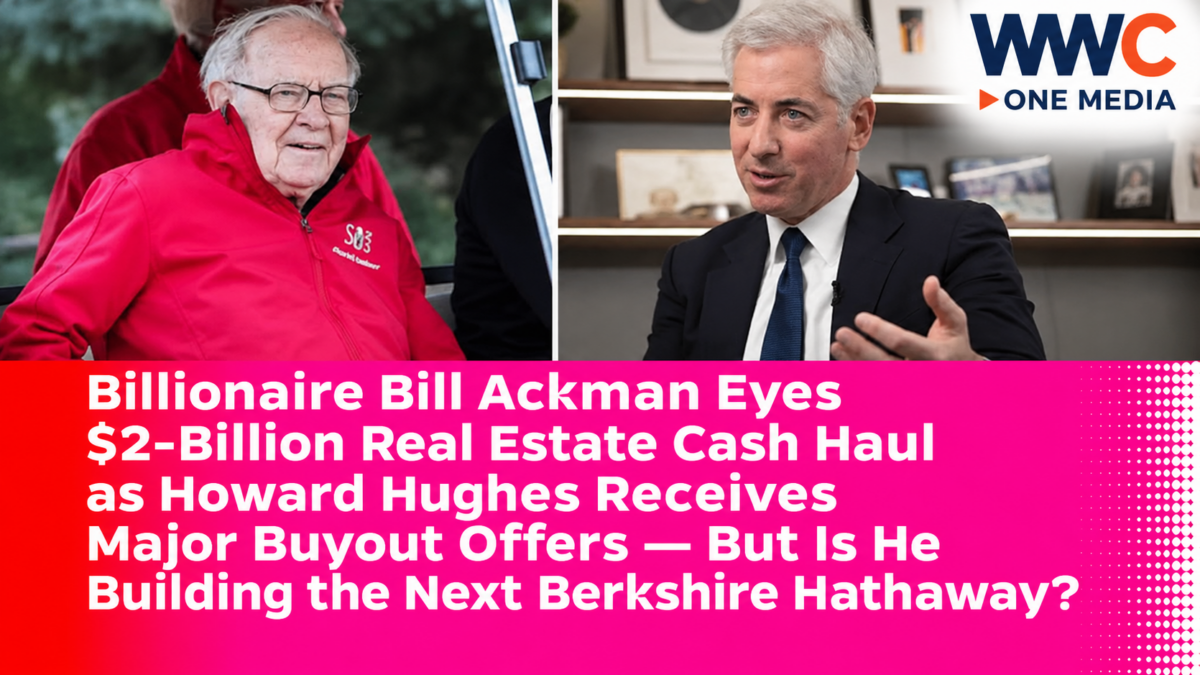
Billionaire hedge fund investor Bill Ackman is preparing a dramatic transformation of Howard Hughes Holdings, and major investors are already expressing interest in some of the company’s valuable real estate assets.
The American property developer, which owns extensive master-planned communities, commercial buildings and residential developments, has received significant offers as Ackman pursues a strategy designed to release billions of dollars tied up in real estate.
The ultimate ambition is much bigger than selling properties.
Ackman wants to transform Howard Hughes Holdings into a diversified investment company inspired by Warren Buffett’s Berkshire Hathaway, using capital released from real estate to expand its recently acquired insurance business, Vantage Group Holdings.
During the company’s November 6 earnings conference call, Ackman confirmed that Howard Hughes had already entered discussions with prospective investors and received multiple substantial offers.
The development follows his September announcement that the company would pursue an asset-light real estate model, reducing the amount of its own money committed to selected properties while bringing in institutional partners.
Under the strategy, Howard Hughes could reduce its equity exposure to some real estate investments by as much as 80%, potentially unlocking billions in capital for other opportunities.
But Ackman is not planning to abandon the property business.
Instead, he wants Howard Hughes to retain meaningful ownership and control over developments while sharing capital commitments with outside investors.
The question is whether the billionaire investor can transform a traditional real estate company into a Berkshire Hathaway-style investment powerhouse—or whether the ambitious restructuring could expose shareholders to an entirely new set of financial risks.
Ackman Confirms Major Offers for Howard Hughes Properties
The latest development emerged during Howard Hughes Holdings’ third-quarter 2026 earnings call.
Ackman, the company’s executive chairman and founder of Pershing Square Capital Management, said the company was making substantial progress toward its new real estate strategy.
According to Bloomberg’s November 6 reporting and the earnings-call transcript, Howard Hughes has already received significant expressions of interest involving properties in its portfolio.
The offers followed the company’s announcement that it intended to introduce outside capital into a business historically funded largely through its own equity.
Howard Hughes has also hired advisers to help pursue potential transactions.
Ackman indicated that the earliest meaningful transaction announcements could arrive in approximately three months, with more substantial progress expected over the following six to nine months.
However, he cautioned against assuming that the transformation would be completed before the end of 2027.
He expects significant progress by that point, rather than a full restructuring of every applicable property investment.
The timing will depend on negotiations, valuations, investor demand and the company’s assessment of each transaction.
An important distinction remains: Howard Hughes has received offers and entered discussions, but the company has not announced definitive agreements covering all the targeted assets.
Neither the complete list of prospective buyers nor the individual offer values was disclosed during the call.
Ackman’s $2-Billion Plan Could Reshape Howard Hughes
The scale of the proposed restructuring is substantial.
Ackman previously discussed the possibility of releasing approximately $2 billion to $3 billion in capital through property partnerships and asset monetization.
During the November 6 earnings call, he described potentially generating around $2 billion in incremental proceeds as a reasonable broad target.
He emphasized that the actual amount could be higher or lower.
The strategy involves bringing third-party investors into real estate projects that Howard Hughes previously financed with a much larger share of its own capital.
For example, instead of funding nearly all the equity required for a particular property, Howard Hughes could retain a minority economic interest while continuing to manage the investment.
Institutional partners would provide much of the remaining capital.
Such an arrangement could free up money for insurance expansion, new developments or other corporate purposes.
Howard Hughes could also earn asset-management fees and potentially performance-related compensation from managing properties on behalf of outside investors.
That would shift part of its business model away from simply owning assets and waiting for their value to appreciate.
The company would increasingly generate income by overseeing real estate investments using capital supplied by other institutions.
The approach resembles strategies employed by major alternative asset managers such as Blackstone and Brookfield.
But it is not without risks.
Sharing ownership also means sharing future profits and giving outside partners economic claims on assets that Howard Hughes previously controlled more completely.
The success of the strategy will depend on obtaining favorable valuations and structuring partnerships that preserve attractive long-term returns for shareholders.
Why Howard Hughes Wants to Become More Like Berkshire Hathaway
Ackman’s larger objective is to turn Howard Hughes Holdings into a diversified business with exposure to both operating companies and investment opportunities.
The strategy draws inspiration from Berkshire Hathaway, the conglomerate historically led by Warren Buffett.
Berkshire built much of its business around owning durable companies and using capital generated by its insurance operations to support investments in other businesses.
Insurance companies collect premiums before paying many of their future claims.
The funds held between premium collection and claim payments are commonly known as insurance float.
When managed prudently, that capital can support investment income.
Ackman believes a similar structure could help Howard Hughes generate higher long-term investment returns.
His strategy combines three important elements: a profitable real estate development and asset-management platform, an insurance and reinsurance business, and disciplined investment of available capital.
The company’s acquisition of Vantage Group Holdings in June 2026 represented a major step toward that vision.
According to TheStreet and other financial reporting, the transaction valued Vantage at approximately $2.1 billion.
With Vantage now part of the group, Ackman wants to redeploy capital from selected real estate assets toward expanding the insurance platform.
The potential benefit is a company that can invest across multiple industries rather than depending principally on property development.
However, insurance float is not free money.
Insurers must maintain adequate reserves, manage claims exposure and meet regulatory capital requirements.
Poor underwriting results or investment losses could undermine the model.
The Berkshire Hathaway comparison describes Ackman’s ambition. It does not establish that Howard Hughes will achieve Berkshire’s historical returns or investment performance.
Vantage Insurance Reports $315.8 Million in Quarterly Premiums
Howard Hughes’ latest financial results provide important context for why Ackman wants to accelerate investment in insurance.
According to the company’s November 5 earnings release, Vantage generated $315.8 million in net earned insurance and reinsurance premiums during the third quarter of 2026.
It also contributed $76.6 million in income before income taxes, including acquisition-related accounting adjustments.
The results marked Vantage’s first full quarter under Howard Hughes ownership.
The insurance business reported net investment income of $22.7 million and net investment gains of $50.9 million.
These figures help demonstrate how insurance underwriting and investment activities could contribute to the holding company’s future earnings.
However, not every financial measure was positive.
Vantage reported a combined ratio of 101.8% on the company’s consolidated accounting basis.
A combined ratio above 100% generally indicates that claims and applicable underwriting expenses exceeded earned premiums.
Without certain purchase-accounting adjustments, Vantage’s underlying combined ratio was 94.9%, reflecting an underwriting profit on that adjusted basis.
The distinction matters.
Investors should not interpret the adjusted underwriting result as identical to the company’s reported consolidated accounting outcome.
The broader holding company also recorded a third-quarter net loss attributable to common shareholders of approximately $1.1 million, compared with net income of $119.5 million a year earlier.
For Ackman, the challenge is to turn Vantage into a sustainable long-term earnings engine without exposing Howard Hughes shareholders to excessive insurance or investment risk.
Howard Hughes’ Real Estate Business Remains Valuable
The proposed restructuring does not mean that Howard Hughes’ property operations are failing.
Its real estate portfolio remains a substantial collection of master-planned communities, commercial developments and income-producing properties.
The company has major operations across five US states, including developments in Texas, Nevada, Maryland, Arizona and Hawaii.
Among its best-known communities are The Woodlands and Bridgeland in the Houston region, Summerlin in Las Vegas and Ward Village in Honolulu.
Howard Hughes’ portfolio includes office buildings, retail properties, multifamily residential developments and extensive remaining land holdings.
During the third quarter of 2026, its master-planned communities generated $89.5 million in earnings before taxes.
That was lower than the $205 million reported in the comparable period of 2025, partly reflecting a significant bulk land transaction completed during the previous year and the effects of a joint-venture consolidation.
Meanwhile, the company’s operating properties delivered $73 million in net operating income, representing approximately 8% growth from a year earlier.
The increase suggests that recurring income from commercial and residential properties remained resilient.
Howard Hughes also reported that its operating portfolio was benefiting from improved leasing activity.
The company therefore wants to raise capital from a functioning property business rather than simply conduct a distressed liquidation.
That distinction is central to understanding Ackman’s plan.
The strategy is intended to release capital while preserving development expertise, recurring property income and long-term control over valuable communities.
Howard Hughes Could Retain Control While Selling Economic Stakes
One of the most important features of Ackman’s proposal is that the company does not intend to sell everything outright.
Some non-core properties could be sold completely.
But for major real estate developments, the preferred structure may involve partnerships that allow Howard Hughes to remain the controlling manager.
Institutional investors such as pension funds, private investment firms and family offices could supply capital in exchange for ownership interests.
Howard Hughes could then continue directing development and management activities through contractual arrangements.
Such partnerships are common in institutional real estate investing.
They allow property managers to oversee assets without providing all the equity themselves.
The approach could be especially relevant to long-term projects where substantial money remains tied up in buildings or development land for many years.
By releasing some of that capital, Howard Hughes could pursue opportunities elsewhere.
However, retaining managerial control would not mean retaining 100% of the financial benefits.
Partners would receive their negotiated share of income, distributions and any eventual gains.
The company would also need to manage potential conflicts between investors with different risk preferences and investment timelines.
Wall Street Sees a Potential Valuation Opportunity
The announcement has attracted attention from analysts following Howard Hughes Holdings.
In October, Bisnow reported that Piper Sandler analyst Alexander Goldfarb had highlighted the possibility that the restructuring could narrow the gap between the company’s market valuation and the estimated value of its underlying assets.
At the time, the analyst referenced an estimated intrinsic value of approximately $104 per share, compared with a market price near $75.
That estimate represented an analyst’s assessment, not a guaranteed future share price.
The rationale is that investors could assign greater value to Howard Hughes if it successfully reduces capital intensity and increases returns on equity.
An asset-management business capable of earning fees while investing less of its own money can have different economics from a traditional property developer.
The insurance operation could also introduce new sources of earnings.
But there are several uncertainties.
Asset-sale valuations may fall below expectations.
Potential partners may demand more favorable terms.
Insurance performance may fluctuate.
And the company must demonstrate that redeployed capital generates better returns than the property investments it replaces.
Ultimately, Wall Street will judge the strategy by actual cash proceeds, profitability and long-term shareholder returns—not simply the number of offers received.
What Howard Hughes’ Strategy Reveals About the Global Property Market
The transformation reflects a broader shift in how property companies manage capital.
Real estate development often requires large upfront investments.
Developers may spend substantial sums acquiring land, securing permits, constructing buildings and waiting for properties to begin generating income.
When borrowing costs rise or investors demand stronger returns, tying up large amounts of equity can become expensive.
An asset-light model offers an alternative.
Instead of financing every development primarily from corporate resources, companies bring in partners and seek to generate earnings from development expertise, management and smaller retained stakes.
That strategy is also relevant to Asian real estate markets.
Philippine property companies are increasingly focused on balancing expansion with recurring income, liquidity and capital discipline.
As WWC ONE MEDIA reported on Megaworld’s expanding shopping-mall business, major developers continue investing in retail properties that can generate rental revenue.
Megaworld’s planned expansion illustrates the importance of building long-term income streams, although its strategy differs from Howard Hughes’ proposed property partnerships.
Meanwhile, WWC ONE MEDIA examined Ayala Land’s major retail expansion and the pressure facing its residential business.
The challenges are not identical, but they demonstrate why developers must consider capital allocation carefully when different property segments deliver different growth and profitability trends.
For Howard Hughes, the objective is to maintain the advantages of owning premier communities while reducing the financial resources locked into those assets.
The Philippine Real Estate Comparison: Growth Versus Capital Discipline
The importance of managing development capital is also visible in the Philippines’ commercial property market.
WWC ONE MEDIA recently reported on Robinsons Land’s 29-story Bridgetowne office tower, a project designed to expand the company’s commercial leasing portfolio.
The project demonstrates how major developers continue allocating money toward new properties despite changing office demand and financing conditions.
But the investment must eventually generate sufficient rental income and asset value to justify its cost.
Developers can pursue that objective through direct ownership, partnerships, leasing strategies or asset monetization.
Howard Hughes is increasingly favoring a structure involving outside investors.
The approach could offer a useful comparison for Philippine property businesses evaluating how to fund future growth.
However, US and Philippine real estate markets operate under different tax rules, ownership structures, interest-rate environments and regulatory frameworks.
A financing strategy that works for one company cannot automatically be replicated by another.
The broader principle is that efficient capital allocation can be just as important as property development itself.
DoubleDragon’s Hotel101 Shows Another Model for Property Expansion
Other developers are pursuing different methods of scaling their businesses.
For instance, WWC ONE MEDIA reported on DoubleDragon’s strong earnings growth and international Hotel101 expansion.
DoubleDragon has been developing an international hotel concept built around standardized rooms and expansion across multiple markets.
The business structure differs from Howard Hughes’ proposed real estate investment partnerships.
Nevertheless, both highlight how property companies seek opportunities to grow beyond conventional development models.
For DoubleDragon, the focus is on building an international hospitality platform.
For Howard Hughes, the focus is on releasing capital from established communities and expanding a diversified investment holding company.
Both approaches require execution, reliable partners and disciplined financial management.
Three Major Risks That Could Derail Ackman’s Strategy
Despite the apparent investor interest, several challenges could affect the Howard Hughes transformation.
First, property valuations may disappoint.
Receiving a significant offer does not guarantee that a property will sell at the value management believes it deserves.
Real estate investors evaluate income growth, financing costs, market demand and expected returns before committing capital.
If bids are too low, Howard Hughes may choose to retain its existing ownership.
Second, the transition could take longer than expected.
Joint ventures require negotiations over governance, profit sharing, development responsibilities and future capital contributions.
Complex transactions can take months or longer to complete.
Ackman has already indicated that the strategy is unlikely to be fully implemented by the end of 2027.
Third, the insurance business introduces different risks.
Real estate returns depend heavily on land values, leasing activity and development execution.
Insurance profitability depends on pricing risk, claims experience, reserving accuracy and investment performance.
Expanding Vantage could increase Howard Hughes’ exposure to insurance losses or market volatility.
There is also the question of whether the company should redeem preferred shares, reinvest in its property projects or allocate more money toward Vantage.
Ackman said capital-allocation decisions would need to be evaluated as proceeds arrive, with the board playing a role in determining the appropriate uses.
That process will be important for shareholders because Pershing Square has substantial financial interests in Howard Hughes.
Could Howard Hughes Become America’s Next Investment Powerhouse?
Ackman’s investment career has been defined by large corporate positions, activist campaigns and a willingness to challenge conventional business strategies.
Howard Hughes represents a different kind of test.
Rather than simply investing in an established public company, Ackman is attempting to help transform the structure of an operating business.
His long-term vision involves combining real estate expertise, insurance operations and investment management into a single capital-allocation platform.
The resemblance to Berkshire Hathaway is intentional.
But Berkshire’s success developed over decades and depended on disciplined acquisitions, substantial operating earnings, strong insurance underwriting and careful investment decisions.
Howard Hughes is still in the early stages of its transformation.
Its acquisition of Vantage established the insurance platform.
The planned real estate partnerships could provide additional capital.
The next challenge is converting those plans into completed transactions and attractive investment returns.
Management’s upcoming earnings reports should provide greater clarity on whether the strategy is producing measurable results.
Investors will be watching for specific asset-sale announcements, joint-venture agreements, cash proceeds and changes in the company’s return on equity.
The Bigger Question: Will Ackman’s Gamble Pay Off?
Howard Hughes Holdings is approaching a turning point.
Its property portfolio continues to produce recurring income, while prospective investors have expressed interest in acquiring stakes in valuable real estate assets.
Its insurance business has begun contributing substantial premiums and investment income.
And its executive chairman has outlined a strategy intended to release approximately $2 billion in additional capital over time.
But the most important part of the plan remains unfinished.
The company still needs to negotiate transactions, secure favorable valuations and demonstrate that money released from real estate can generate superior returns elsewhere.
The offers received so far are encouraging evidence of buyer interest.
They are not yet proof that the restructuring will deliver billions in cash.
For Bill Ackman, the opportunity is to transform Howard Hughes from a capital-intensive real estate developer into a diversified investment holding company with a powerful insurance platform.
The risks are equally significant.
Howard Hughes could emerge as a more flexible and profitable business—or discover that replacing predictable property income with a complex insurance and investment strategy creates challenges that investors have not fully anticipated.
The next several quarters may reveal whether Ackman’s Berkshire Hathaway-inspired ambitions are becoming reality.
But as billions of dollars in property assets potentially move into new partnerships, will Howard Hughes become Wall Street’s next great investment success—or could Ackman’s biggest transformation become his most expensive gamble?