LOS ANGELES / NEW YORK / MANILA — November 7, 2026 | WWC ONE MEDIA | Fashion, Entertainment, Retail and Global Business
Kanye West is attempting one of the most closely watched comebacks in modern fashion.
Four years after losing his lucrative Adidas partnership and becoming increasingly isolated from mainstream fashion, the controversial rapper and designer, now known as Ye, has returned to the runway with a newly independent Yeezy collection, a flagship store in Los Angeles and a retail distribution agreement with JD Sports.
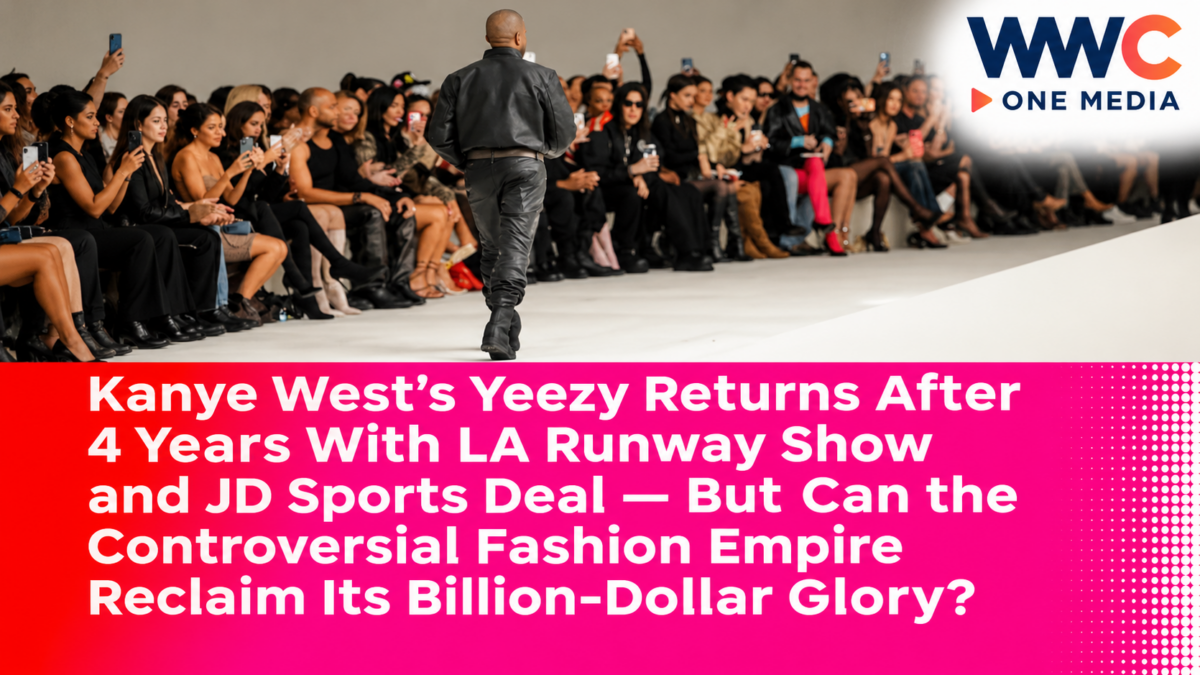
The comeback gained momentum on November 4, when Yeezy staged its Season 01 presentation at the brand’s new Droam 1 flagship store in Los Angeles.
The show marked Yeezy’s first major runway presentation since 2022, bringing the brand back into the fashion spotlight after years of controversy, corporate fallout and uncertainty surrounding its future.
The return is not simply another celebrity fashion event.
It represents a potentially significant attempt to rebuild a business that once generated billions of dollars in sales through its relationship with Adidas.
Meanwhile, JD Sports has already started distributing independent Yeezy footwear, giving the brand access to established physical stores and online retail channels.
According to Bloomberg and other fashion-industry reports, the renewed commercial push suggests that Yeezy is trying to regain its position in the global sneaker and streetwear market.
But the road back could be difficult.
Can Ye transform renewed public attention into sustainable sales, or will the controversies that destroyed his previous partnerships continue to limit Yeezy’s future?
Yeezy Season 01 Marks a Dramatic Return to Los Angeles
The comeback unfolded at Yeezy Flagship Droam 1, located at 4317 Beverly Boulevard in Los Angeles.
The November 4 presentation introduced a collection titled Yeezy Season 01, signaling a fresh chapter for a brand whose original major fashion collection debuted in 2015.
The decision to restart the numbering system was particularly symbolic.
Instead of simply continuing the previous collection sequence, Ye presented the relaunch as a new beginning for his independent fashion operation.
According to coverage by Complex, XXL and The Business of Fashion, the presentation attracted prominent entertainment and fashion-industry figures.
Among the attendees were Kid Cudi, Big Sean, 2 Chainz and designer Jerry Lorenzo, along with members of Ye’s family.
The show also featured unreleased music, reinforcing the connection between Yeezy’s fashion identity and its founder’s recording career.
Rather than relying on an elaborate traditional catwalk, the production centered on a large white installation, with models moving around the sculptural structure.
The collection emphasized understated colors, streamlined silhouettes and practical garments.
Black outerwear, neutral shades and military-inspired pieces featured prominently.
The relatively restrained presentation contrasted with some of the controversy that surrounded Yeezy’s earlier fashion shows.
Industry observers were left to consider whether the return represented a meaningful creative reset or a familiar aesthetic repackaged for a new audience.
JD Sports Partnership Gives Yeezy a Crucial Retail Comeback
While the Los Angeles runway show captured public attention, Yeezy’s commercial recovery may depend more heavily on its relationship with JD Sports.
The international sportswear retailer began distributing independent Yeezy footwear in August 2026.
According to The Business of Fashion, the agreement marked an important return to mainstream retail distribution after the collapse of Ye’s Adidas relationship.
Sneaker News reported that the distribution arrangement involved JD Sports and Finish Line, with footwear releases beginning in August.
For Yeezy, the significance extends beyond having another retailer stock its products.
Major retail partners provide established relationships with consumers, physical storefronts, digital shopping platforms and distribution infrastructure.
These resources can be difficult and expensive for independent brands to develop.
The arrangement also offers Yeezy an opportunity to rebuild its relationship with sneaker buyers who previously purchased the brand through Adidas and other established retailers.
However, the JD Sports agreement should not be confused with Yeezy’s former Adidas partnership.
The Adidas relationship involved extensive manufacturing, product development and global distribution arrangements.
The reported JD Sports relationship concerns retail distribution of independent Yeezy footwear.
There is no verified evidence that JD Sports has acquired Yeezy, obtained ownership of the brand or committed to an Adidas-sized financial partnership.
For now, the deal represents a meaningful route back into stores—not proof that Yeezy has restored its former commercial scale.
How Adidas Turned Yeezy Into a Global Sneaker Powerhouse
Understanding the significance of the comeback requires examining the brand’s earlier success.
Ye first entered the premium sneaker business through collaborations with Nike, including the Air Yeezy line.
He subsequently moved to Adidas, where the Yeezy name became one of the most recognizable brands in contemporary sneaker culture.
The partnership produced influential designs including the Yeezy Boost 350 and Yeezy Boost 750.
Yeezy footwear developed a reputation for distinctive silhouettes, unconventional materials, limited releases and substantial resale premiums.
The collaboration also helped popularize a commercial strategy that combined celebrity influence, product scarcity and social-media attention.
According to historical business reporting, Yeezy generated approximately $1.7 billion in annual revenue for Adidas in 2020.
But that figure represented sales associated with the Adidas partnership, not independently verified revenue for today’s Yeezy business.
The distinction matters because the restarted brand operates under a substantially different commercial structure.
Recreating the former success would require more than viral marketing.
Yeezy must demonstrate that it can consistently develop appealing products, manufacture them reliably, distribute them effectively and maintain consumer demand.
The broader athletic footwear market has also changed significantly.
As WWC ONE MEDIA previously reported in its coverage of Nike’s India-specific Vegam Run launch, even established global sportswear companies are adjusting their product strategies to respond to changing consumer preferences and stronger competition.
Yeezy now faces the challenge of rebuilding market share in an environment where its past reputation alone may no longer guarantee success.
The 2022 Controversy That Changed Everything
Yeezy’s previous commercial empire unraveled in October 2022.
The turning point followed Ye’s Yeezy Season 9 presentation in Paris, where he and some models wore shirts featuring the phrase “White Lives Matter.”
The presentation drew widespread criticism.
Ye subsequently made a series of antisemitic statements that prompted major companies and business partners to sever relationships with him.
Adidas announced the termination of its Yeezy partnership in October 2022, condemning his remarks as hateful and unacceptable.
The collapse of the Adidas relationship represented a major financial and operational setback.
Other companies also distanced themselves from Ye, including Balenciaga and talent agency CAA.
Ye’s separate collaboration with Gap had already ended earlier that year.
The controversy raised questions about whether major retailers and fashion companies would ever consider working with the artist again.
It also demonstrated how quickly a globally recognized consumer brand could lose commercial support when a founder’s conduct created substantial reputational risks.
A similar issue has confronted other fashion companies, particularly when marketing decisions provoke public criticism.
For example, WWC ONE MEDIA reported on Converse’s apology following controversy surrounding an advertisement featuring aespa’s Karina.
The situations are different, but both illustrate the importance of reputation and public accountability in consumer-facing businesses.
For Yeezy, rebuilding confidence among retailers and buyers remains a central challenge.
Ye’s 2026 Apology Becomes Part of His Comeback Strategy
In January 2026, Ye published a full-page public apology in The Wall Street Journal addressing his previous antisemitic remarks and other offensive behavior.
He apologized to Jewish and Black communities and discussed his mental health and past medical experiences as part of his explanation.
The apology represented an attempt to address the conduct that had damaged his reputation.
However, an apology does not automatically resolve the consequences of previous statements or guarantee renewed commercial relationships.
Some consumers and industry observers remain skeptical of the artist’s efforts to rebuild his public image.
Others continue supporting his music and fashion projects.
The resulting debate highlights a difficult question for brands considering partnerships with controversial public figures.
How should companies weigh commercial opportunity against potential reputational damage?
The JD Sports distribution agreement suggests that at least one major retailer sees a viable business opportunity in independent Yeezy footwear.
Whether other fashion companies will pursue similar relationships remains uncertain.
Yeezy 800 and AB-01 Alpha Boot Could Test Consumer Demand
The November runway presentation is only one component of Yeezy’s broader relaunch.
Fashion-industry reporting indicates that the company is preparing additional footwear releases.
Two anticipated products are the Yeezy 800 sneaker and the AB-01 Alpha boot.
The Yeezy 800 has been previewed in an all-black design featuring layered materials, mesh construction and angular detailing.
Meanwhile, the AB-01 Alpha boot draws inspiration from military-style footwear.
Both products are expected to form part of the brand’s December 2026 release plans.
However, exact launch dates, official retail prices, production volumes and geographic availability have not been fully confirmed.
The upcoming releases could help reveal whether Yeezy’s remaining fan base is large enough to support the company’s ambitions.
Strong demand would provide an encouraging sign.
But sustained commercial success would require more than a single popular release.
The brand would need to maintain product quality, manage inventory, satisfy customers and demonstrate that demand can continue beyond the publicity surrounding Ye’s comeback.
Can Yeezy Compete Against Nike, Adidas and the Changing Fashion Market?
Yeezy is returning to a global footwear industry facing significant change.
Nike has been restructuring its operations and attempting to improve performance amid competitive pressure in several markets.
As WWC ONE MEDIA reported in its analysis of Nike’s additional job cuts and declining revenue outlook, the company has been working to simplify operations and strengthen its focus on performance products.
Adidas, meanwhile, continues to operate as a major global sportswear company with established footwear franchises and extensive international distribution.
Yeezy must compete against these businesses without the same scale of corporate infrastructure it previously enjoyed.
Consumers also have more alternatives than during the original Yeezy boom.
Running shoes, technical footwear, retro sneakers and independent fashion labels have competed for a larger share of streetwear attention.
New brands can gain visibility through social media, while established competitors increasingly use collaborations and limited releases to attract younger buyers.
That makes the fight for consumer loyalty more difficult.
Yeezy’s recognizable identity remains an advantage, but its ability to convert that recognition into repeat purchases has yet to be established.
The Wider Luxury and Fashion Industry Is Facing a Reset
The Yeezy comeback arrives amid broader challenges in global fashion.
Several established brands have struggled with changing consumer spending patterns, weakening demand in important markets and the need to refresh their creative direction.
For example, WWC ONE MEDIA previously examined Gucci’s declining sales and the pressure on parent company Kering.
Although Gucci and Yeezy operate in different segments, their experiences illustrate a common commercial challenge.
Brand recognition does not necessarily guarantee growing sales.
Fashion companies must continually convince consumers that their products remain desirable and relevant.
For Yeezy, that means developing an identity capable of standing independently from the Adidas collaboration that once defined its success.
The Season 01 presentation offered an initial look at that direction.
Whether consumers embrace it will become clearer as the company expands its retail operations and introduces additional products.
What the Comeback Means for Filipino Sneaker Fans
Yeezy has long attracted interest among sneaker enthusiasts in the Philippines.
Its distinctive designs, association with hip-hop culture and history of limited releases helped build an international audience.
The JD Sports distribution relationship could eventually make independent Yeezy footwear more accessible to consumers in additional markets.
However, Philippine availability of specific upcoming Yeezy products has not been confirmed in the reviewed reports.
Filipino consumers should therefore avoid assuming that every Yeezy product released internationally will become available through local JD Sports stores or other Philippine retailers.
The independent Yeezy relaunch could also affect the resale market.
Collectors may reassess demand for older Adidas Yeezy models as new independent designs reach consumers.
But there is no verified basis for predicting an immediate increase or decline in resale prices.
Those prices will depend on product condition, rarity, demand, availability and changing fashion preferences.
Will Yeezy’s Return Become a Lasting Business Revival?
The brand’s comeback has already produced several important developments.
Ye has staged a major runway presentation after a four-year absence.
Yeezy has opened a flagship retail location in Los Angeles.
JD Sports has begun distributing independent Yeezy footwear.
And additional sneaker and boot designs are reportedly being prepared for release.
Together, these developments suggest that Yeezy is moving beyond a purely online business toward a more structured retail presence.
But several important questions remain unanswered.
The company has not publicly established that it has recovered the revenue, production capacity or profitability associated with its former Adidas partnership.
The commercial terms of the JD Sports arrangement have not been fully disclosed.
Nor is there enough verified financial information to determine the current valuation of Yeezy or the profitability of its independent operations.
Those uncertainties mean that descriptions of the comeback as an already successful multibillion-dollar revival would be premature.
For investors, retailers and consumers, the real test will be whether the brand can generate consistent demand without relying exclusively on controversy or nostalgia.
The Bigger Question: Can Kanye West Rebuild What He Lost?
Few modern fashion brands have experienced a rise and fall as dramatic as Yeezy’s.
What began as a celebrity-driven sneaker collaboration became a major force in global streetwear.
Its designs influenced footwear trends, generated substantial sales and helped establish Ye as a powerful figure in the fashion industry.
Then the collapse of key business relationships transformed its future.
Four years later, the founder is trying again.
The Los Angeles runway show has restored visibility.
The JD Sports agreement has reopened an important retail channel.
Upcoming footwear releases may give consumers new reasons to engage with the brand.
But rebuilding a business requires more than reclaiming the spotlight.
It requires trust, dependable operations, competitive products and customers willing to spend money repeatedly.
Yeezy has returned to the runway. Whether it can return to the commercial heights of its Adidas era remains an entirely different question.
For Kanye West, Season 01 may mark the beginning of a new chapter.
But will it become the foundation of a successful independent fashion empire—or will Yeezy discover that winning back attention is far easier than winning back the world?