SAN FRANCISCO / NEW YORK / MANILA — November 7, 2026 | WWC ONE MEDIA | Artificial Intelligence, Technology, Investments and Global Financial Markets
While Wall Street is questioning the staggering cost of the artificial intelligence revolution, one Silicon Valley company is attempting to defy the market’s growing skepticism.
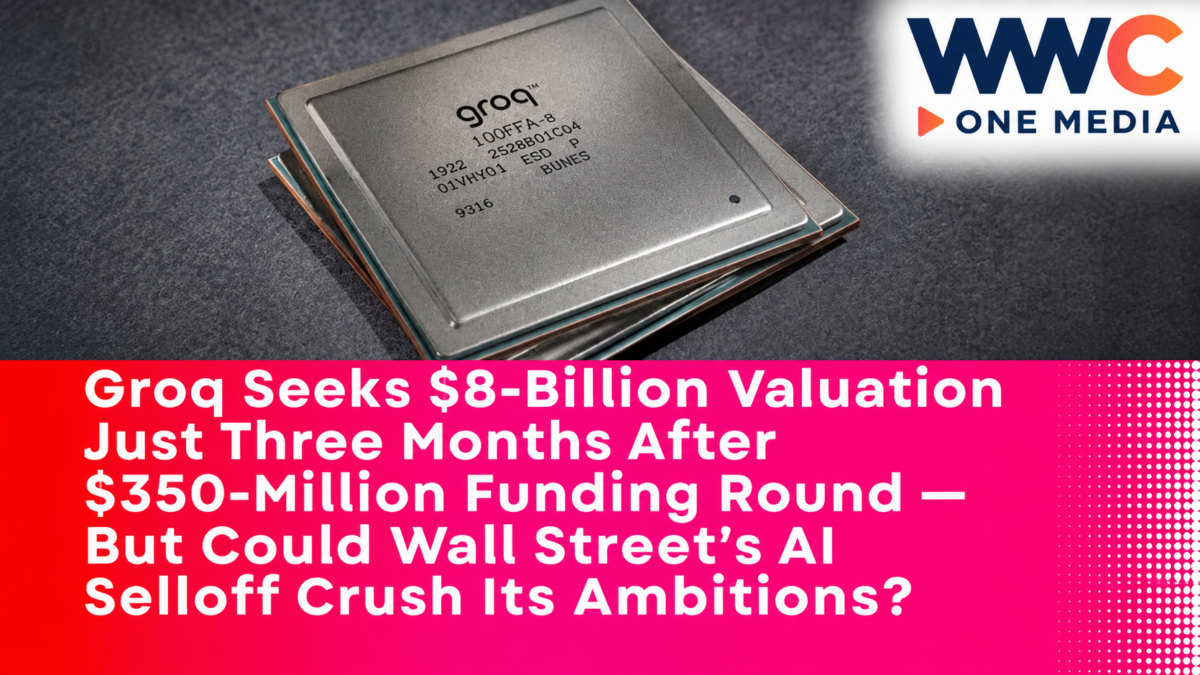
Groq, an AI computing company that has reinvented itself as a specialized cloud infrastructure provider, is reportedly seeking an $8-billion valuation in a new fundraising round—just three months after announcing a $350-million investment at a $3.5-billion valuation.
The proposal represents an extraordinary increase in the company’s targeted value at a time when publicly traded AI infrastructure operators are under intense pressure.
According to Bloomberg’s November 6 report, Groq Executive Chairman Alex Davis has approached investors about a new Series B financing that would value the company at $8 billion before the proceeds of the new investment are included.
The move comes as investors reconsider the risks of financing data centers, buying expensive AI chips and borrowing enormous amounts to build computing capacity.
For Groq, the strategy represents a major bet on the future of AI inference—the computing process that allows trained artificial intelligence models to generate responses and complete tasks.
For investors, the more immediate question is whether its growth potential can justify a dramatically higher valuation.
Could Groq emerge as one of the biggest winners of the AI computing boom—or is its proposed $8-billion price tag arriving just as Wall Street loses patience with companies promising extraordinary future growth?
Groq’s $8-Billion Fundraising Ambition Shakes the AI Market
Bloomberg reported that Alex Davis, Groq’s executive chairman and head of investment firm Disruptive, has begun approaching investors about a new fundraising round.
The proposed transaction would value the company at approximately $8 billion before new capital is invested.
That distinction matters.
An $8-billion pre-money valuation is an estimate of what investors would pay for the company’s equity before the next funding round.
It does not mean Groq is raising $8 billion in cash.
It also does not mean that the company has already completed a deal at that valuation.
The proposed Series B remains subject to investor interest, negotiations and any required closing conditions.
The amount Groq wants to raise in the new transaction has not been independently established in the sources reviewed.
Nevertheless, the proposed valuation reflects remarkable ambitions.
In August, the company announced a $350-million financing round at a $3.5-billion valuation.
Bloomberg’s November report indicates that the earlier valuation was approximately $3.15 billion before that investment.
Comparing the proposed $8-billion pre-money valuation with the earlier $3.15-billion pre-money figure indicates an increase of approximately 154%.
But this remains a proposed valuation increase, not a realized investment return.
Groq Already Announced $1 Billion in Funding During 2026
Groq has attracted significant investor interest during 2026.
On June 22, the company announced that it had raised $650 million to expand its global AI inference cloud.
The financing was led by Disruptive and Infinitum, with participation from investors who chose to reinvest.
On August 17, Groq announced another $350 million in financing, led by Disruptive.
Together, the announcements totaled $1 billion in new funding.
The August transaction placed the company’s reported valuation at $3.5 billion.
The company also said Nvidia planned to participate in the financing and confirmed that Groq was a certified Nvidia Cloud Partner.
However, the August announcement described the financing as subject to customary closing conditions.
The Nvidia participation should therefore not be described as conclusively completed without additional confirmation.
The latest reported fundraising discussions come less than three months after that announcement.
This rapid succession of funding efforts highlights the company’s substantial capital requirements as it expands its computing infrastructure.
Groq’s Transformation From AI Chip Developer to Cloud Provider
Groq was founded in 2016 and became known for developing specialized processors designed to accelerate AI inference.
The company created technology called the Language Processing Unit, or LPU.
Its objective was to provide fast and efficient computing for AI models after those models had been trained.
For years, Groq was discussed as a potential competitor to Nvidia in specialized AI hardware.
But its business direction changed significantly after a December 2025 technology licensing arrangement with Nvidia.
Groq announced a nonexclusive agreement allowing Nvidia to incorporate aspects of Groq’s inference technology into its own products.
Nvidia subsequently introduced technology incorporating that intellectual property.
Groq retained an independent business and shifted its strategic emphasis toward operating large-scale AI cloud infrastructure.
The company now focuses on supplying computing services rather than competing primarily as a standalone chip manufacturer.
Its business strategy is built around an expectation that demand for inference will grow substantially as AI becomes integrated into everyday software and business operations.
Why AI Inference Could Become a Massive Market
Artificial intelligence computing generally involves two major activities.
The first is training.
Training requires extensive computing resources to develop a model capable of understanding patterns and generating useful outputs.
The second is inference.
Inference happens when an already-trained AI model processes a prompt, answers a question, analyzes information or performs another task.
Each use of an AI assistant requires inference computing.
As companies introduce AI into customer support, software development, research, financial analysis and other activities, the number of inference requests could grow dramatically.
Groq’s management believes that inference will become one of the largest segments of the AI infrastructure industry.
The company has argued that demand for inference computing could eventually exceed training requirements by a substantial margin.
That is a company forecast rather than a universally established industry outcome.
But it helps explain why Groq is directing investment toward cloud infrastructure.
If AI applications become more widely used, operators capable of supplying fast and cost-effective inference computing could benefit.
The challenge is determining which providers will earn sustainable profits from that growth.
Groq Reports 13 Data Centers and More Than 6 Million Developers
Groq’s August company announcement provides a snapshot of its operating scale.
The business reported running 13 data centers across North America, Europe, the Middle East and Asia-Pacific.
It also stated that more than six million developers, Fortune 500 enterprises and thousands of AI-focused businesses use its platform.
According to Groq, its infrastructure processes trillions of AI tokens every week.
Those figures suggest considerable activity.
But they need careful interpretation.
A developer using an AI platform is not necessarily a paying enterprise customer.
The number of processed tokens is not equivalent to annual revenue.
And the number of data centers does not establish how efficiently those facilities operate.
For investors, the most meaningful questions include how much revenue customers generate, the company’s operating costs and whether its computing infrastructure produces attractive returns.
Groq has not publicly disclosed sufficient audited financial information to independently establish its current profitability.
Its reported operational footprint provides evidence of expansion, but not a complete picture of financial performance.
Groq Wants to Expand From 54 Megawatts to More Than 200
The company is pursuing an ambitious infrastructure expansion.
In August, Groq said it expected its computing capacity to increase from approximately 54 megawatts to more than 200 megawatts during 2027.
That would represent a substantial increase in electricity capacity.
But megawatts measure electrical power, not revenue or the number of customers.
The expansion requires access to facilities, electrical infrastructure, cooling systems, networking equipment and expensive computing hardware.
Construction and equipment installation can also require significant upfront investment before the facilities generate substantial income.
Groq’s 200-plus-megawatt target is therefore an important indicator of its ambitions.
It is not a completed development.
The company must secure the necessary infrastructure, equipment, financing and customer demand to deliver the expansion.
And that requirement introduces the same financial pressures now affecting other specialized cloud providers.
CoreWeave’s Financing Struggles Reveal the Risks
Groq’s planned fundraising comes as investors question the financial health of some AI infrastructure companies.
CoreWeave, another major provider of specialized AI computing services, has attracted scrutiny over the cost of its expansion and the debt used to finance infrastructure.
Higher borrowing costs and changing investor sentiment have placed pressure on parts of its capital structure.
WWC ONE MEDIA previously examined these concerns in CoreWeave’s $50 Billion Debt Crisis Is Shaking the AI Boom, and Wall Street Is Watching What Happens Next.
The report highlighted the financial risks associated with building AI infrastructure before future demand and profitability are fully established.
Groq and CoreWeave do not have identical operating models or financing arrangements.
However, both depend on the continued expansion of demand for AI computing.
Both also operate in an industry where hardware, electricity and construction can require enormous capital commitments.
A company may demonstrate strong customer interest while still facing pressure from the cost of delivering services.
The central challenge is converting that demand into reliable operating cash flow.
Nvidia’s Relationship With AI Cloud Providers Comes Under Scrutiny
Nvidia has become a central figure in the AI infrastructure economy.
Its processors power many of the systems used to train and operate advanced AI models.
The company also maintains partnerships and investment relationships with infrastructure providers.
Groq’s relationship with Nvidia includes technology licensing and cloud infrastructure collaboration.
Groq’s August announcement also disclosed planned Nvidia participation in its financing.
These arrangements may provide strategic advantages.
Groq can benefit from access to Nvidia’s computing ecosystem, while Nvidia may benefit from additional infrastructure demand.
But interconnected investment relationships raise questions about concentration.
WWC ONE MEDIA examined these issues in AI Giants Are Funding Each Other in a Trillion-Dollar Money Loop — But Global Financial Watchdogs Warn the Boom Could Unravel.
The article explored how AI developers, chipmakers and cloud providers can simultaneously act as suppliers, customers and investors.
Such relationships are not inherently improper.
They may accelerate innovation and infrastructure deployment.
However, investors must consider how much demand comes from independently profitable customers and how much depends on continued external financing.
That distinction becomes increasingly important as valuations rise.
The AI Selloff Makes Groq’s Timing Particularly Bold
Groq is seeking a higher valuation during a difficult period for technology markets.
AI infrastructure stocks have experienced sharp price declines as investors reassess construction costs, debt and future earnings expectations.
Some companies have faced project delays or concerns about electricity availability.
Others have experienced increased scrutiny from customers and financial institutions.
On November 5, Reuters reported that Microsoft had increased its oversight of selected data-center projects involving Nebius, IREN and Nscale.
Shares of several publicly traded specialized cloud operators declined sharply following the report.
WWC ONE MEDIA examined the broader market decline in Asian Stock Markets Plunge as AI Sell-Off Wipes Out US$3 Trillion — South Korea Halts Trading as Chip Giants Face Fresh Pressure.
The selloff has intensified debate over whether projected AI demand can justify the industry’s enormous infrastructure spending.
For Groq, that makes the latest fundraising discussions particularly significant.
A private company seeking a much higher valuation must convince investors that its future growth prospects justify the proposed price despite declines among some publicly traded peers.
But stock-market comparisons have limitations.
Private financing transactions may include special contractual terms and investor protections that affect their economic value.
An announced private valuation is not necessarily equivalent to the price public shareholders would assign to a comparable company.
Banks Are Becoming More Cautious About Data Center Loans
Financial institutions are also reassessing their exposure to AI infrastructure.
Reuters reported on November 6 that Dutch bank ING was seeking buyers for approximately $500 million of data-center loans.
The portfolio included loans connected with several infrastructure operators and a major AI project in New Mexico.
The proposed sale does not establish that the underlying borrowers had defaulted.
Banks can sell loans to manage risk, capital and portfolio concentration.
Nevertheless, the move illustrates how financial institutions are scrutinizing exposure to the rapidly growing data-center industry.
Large computing facilities require significant investment in property, electricity, equipment and supporting infrastructure.
Those costs may be incurred long before a facility generates the expected revenue.
WWC ONE MEDIA previously examined another example of the industry’s financing requirements in Oracle Leads 17-Company Bond Rush With $10-Billion AI Debt Sale Before US Midterms — But Is Wall Street Losing Faith in Big Tech’s Borrowing Boom?.
Oracle and Groq have very different financial profiles.
But both illustrate the capital intensity of the AI infrastructure market.
As lenders become more selective, companies may need to demonstrate stronger customer commitments and clearer paths to profitability.
NEXTDC’s Market Rebound Offers a Different Perspective
Not every data-center investment is experiencing the same market response.
Australian data-center operator NEXTDC recently attracted attention after Goodman Group and Digital Realty pursued a significant minority stake.
The proposed investment helped drive a sharp rebound in the company’s share price despite earlier concerns about delays and reduced earnings forecasts.
WWC ONE MEDIA covered the development in NEXTDC Shares Rocket 46% as Goodman and Digital Realty Launch A$715 Million Stake Raid — But Could a Full Takeover Be Next?.
The situation illustrates how valuations can change rapidly when established investors identify opportunities in infrastructure assets.
But it also highlights another major issue: electricity availability.
Data-center operators cannot generate revenue from computing capacity that remains delayed because of power or construction problems.
For Groq, delivering its planned capacity expansion will be essential to supporting its growth story.
The company must demonstrate not only that customers want its computing services, but also that it can provide those services economically and reliably.
What Would Justify an $8-Billion Valuation?
Investors examining Groq’s proposed financing are likely to focus on several financial and operational questions.
The first is revenue growth.
The company must demonstrate that its increasing platform usage translates into meaningful customer spending.
The second is profitability.
Rapid expansion can require substantial operating expenses, and investor confidence may depend on the company’s ability to improve margins.
The third is infrastructure utilization.
Data centers must attract sufficient demand to justify the capital invested in them.
The fourth is financing discipline.
Investors will examine whether future capacity expansion can be funded without creating an unsustainable debt burden.
The fifth is competitiveness.
AI computing is a rapidly changing industry, with major cloud providers and semiconductor companies developing competing systems.
Groq must demonstrate that its technology, infrastructure and pricing offer customers lasting advantages.
Without independently audited financial data, outsiders cannot conclusively determine whether the proposed valuation is attractive or excessive.
The fundraising outcome may provide a useful market signal, but even a successful financing round would not guarantee future investment returns.
What Could Groq’s Expansion Mean for Asian Technology Companies?
The company’s expansion also has implications for the broader global technology supply chain.
AI cloud providers require advanced semiconductor chips, networking equipment, memory, cooling systems and electricity infrastructure.
Asian manufacturers supply many of these components.
Continued expansion in AI computing could therefore support demand for technology exports and related industrial investment.
But a slowdown in infrastructure spending could have the opposite effect.
For economies connected to semiconductor and electronics manufacturing, uncertainty surrounding AI valuations can influence business expectations.
The Philippines may also benefit indirectly from growing AI adoption through digital services, software development and business-process outsourcing.
However, no confirmed Philippine investment or contract has been directly linked to Groq’s proposed November financing.
Any specific local economic benefit remains uncertain.
Is the AI Investment Boom Entering a New Phase?
The investment environment for AI companies appears to be changing.
Earlier enthusiasm focused heavily on how quickly businesses could build data centers and acquire expensive computing equipment.
Now investors are asking more difficult questions about operating performance.
How much of the infrastructure is actually being used?
How long will the computing equipment remain competitive?
Can customer revenue cover electricity, maintenance and financing costs?
Will AI demand continue expanding quickly enough to justify the capital invested today?
These questions do not mean artificial intelligence has stopped growing.
They suggest investors are becoming more discriminating about which businesses deserve premium valuations.
Some companies may benefit from consolidation and stronger financing.
Others could struggle if their expansion plans depend on consistently favorable capital-market conditions.
Groq’s fundraising ambition will test whether investors view it as one of the stronger candidates.
The Bigger Question: Can Groq Defy Wall Street’s AI Reality Check?
Groq has assembled a compelling growth narrative.
It has transitioned from an AI chip developer into a specialized cloud infrastructure provider.
It has announced $1 billion in funding during 2026.
It reports operating 13 data centers and serving more than six million developers.
Its management expects computing capacity to increase substantially during 2027.
And it maintains important technology and infrastructure relationships with Nvidia.
Now the company is seeking a proposed $8-billion valuation.
But its ambitions are unfolding during an AI market correction that has placed debt, infrastructure spending and future profitability under intense scrutiny.
The reported fundraising talks do not guarantee investors will accept Groq’s proposed price.
Nor do the company’s developer numbers and capacity targets independently establish that it has already achieved the financial performance required to support the valuation.
Its next major test will be converting infrastructure expansion and developer adoption into sustained commercial returns.
As Groq seeks an $8-billion valuation just months after its last funding round, one question could determine its future: Will the company’s bet on AI inference turn it into one of Silicon Valley’s next infrastructure giants—or could Wall Street’s growing skepticism expose another ambitious AI valuation before the promised profits arrive?