NEW YORK / DETROIT / MANILA — November 7, 2026 | WWC ONE MEDIA | Global Business, Banking, Automotive Manufacturing and Credit Markets
A major refinancing deal for an American automotive parts supplier has stalled, adding to concerns that Wall Street investors are becoming increasingly selective about lending to heavily indebted industrial companies.
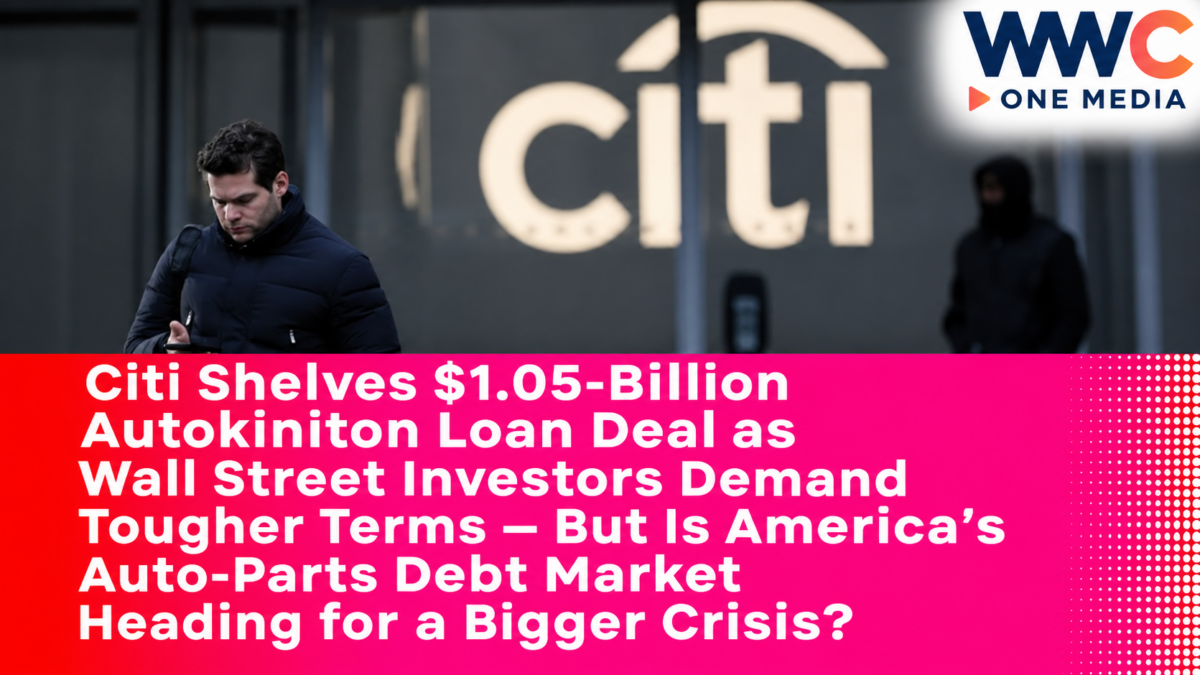
Citigroup has reportedly shelved a proposed amendment and extension of approximately $1.05 billion in leveraged debt for Autokiniton US Holdings, an automotive components manufacturer backed by private equity firm KPS Capital Partners.
The development comes despite attempts to make the financing more attractive to prospective lenders.
According to Bloomberg’s November 6 report, Citi Pulls $1 Billion Loan Deal for Car Parts Supplier Autokiniton, the proposed transaction was revised to include a shorter maturity, a discounted offering price and a higher interest-rate spread.
But those concessions were apparently insufficient to bring the deal across the finish line.
The outcome highlights mounting pressure in the leveraged-loan market, where investors are scrutinizing companies with significant debt obligations and demanding greater compensation for financial risk.
For Autokiniton, the immediate consequence is uncertainty over its effort to extend the maturity of existing debt.
For the wider automotive industry, the episode raises a larger concern: could a more cautious credit market make refinancing increasingly expensive for manufacturers already navigating volatile demand, trade-policy uncertainty and substantial capital requirements?
The key question is whether Autokiniton’s stalled deal represents an isolated financing setback—or an early warning that investors are becoming unwilling to extend credit to riskier industrial borrowers without much stronger protections.
Citigroup Pulls Proposed $1.05-Billion Autokiniton Financing
Citigroup was acting as lead arranger for the proposed loan amendment and extension.
The transaction involved approximately $1.05 billion of Autokiniton’s existing leveraged debt.
An amendment-and-extension transaction generally allows a borrower to negotiate changes to an existing credit agreement, often extending repayment deadlines in exchange for revised pricing or other concessions.
It differs from obtaining an entirely new loan for a major acquisition or expansion.
The company was attempting to adjust the terms of its existing financing rather than necessarily increase its outstanding debt by another $1.05 billion.
According to financial reporting attributed to people familiar with the transaction, the revised terms failed to secure sufficient investor support.
The transaction was consequently shelved.
The source requested anonymity because the discussions were private.
Autokiniton and Citi had not provided public responses in the reporting reviewed, while a spokesperson for KPS Capital Partners declined to comment.
The absence of detailed public company statements makes it particularly important to distinguish the reported withdrawal from a confirmed failure to repay debt.
There has been no independently verified announcement that Autokiniton filed for bankruptcy or defaulted on the loan because of this development.
The Loan Terms Reveal What Investors Were Demanding
The most revealing part of the story concerns the concessions reportedly offered during negotiations.
The revised proposal featured three important changes.
First, the proposed maturity was shortened by one year to 2030.
Second, the loan’s proposed issue price was reduced to 97.5 cents on the dollar.
Third, the interest-rate spread was raised to 4.75 percentage points above the applicable benchmark.
Those terms illustrate how lenders can seek greater compensation when a borrower wants additional financial flexibility.
A loan offered at 97.5 cents on the dollar carries an issue discount relative to its face value.
That discount can enhance the yield available to investors, depending on the full contractual terms and eventual repayment.
The 4.75-percentage-point spread is also significant.
For a floating-rate loan, the total interest rate generally combines the reference benchmark and the contractual credit spread, subject to the loan’s other provisions.
For example, if a hypothetical benchmark were 4%, adding a 4.75-percentage-point spread would produce an illustrative interest rate of 8.75% before accounting for other applicable terms.
That example is not a verified rate charged to Autokiniton.
The actual interest expense would depend on the relevant benchmark, loan documentation and outstanding balances.
The central point is that investors were reportedly being offered more attractive financial terms, yet the refinancing still failed to proceed.
Why Extending Existing Debt Matters
A company’s debt maturity determines when borrowed money must generally be repaid or refinanced.
When large amounts of debt approach maturity, management may attempt to extend repayment deadlines before the obligation becomes urgent.
Doing so can create additional time to generate cash, reduce leverage or improve business performance.
For a manufacturing company, that flexibility can be valuable.
Automotive suppliers must fund equipment, raw materials, wages, engineering, production and other operational requirements.
Those commitments can continue even when vehicle production slows or customer orders change.
A debt extension does not necessarily reduce the principal a company owes.
Instead, it can move repayment obligations further into the future.
If an extension fails, the original credit agreement generally remains relevant unless other changes are negotiated.
The borrower may explore another refinancing proposal, seek different lenders or consider alternative financing arrangements.
But the precise consequences for Autokiniton depend on the terms of its existing debt documents, which were not fully disclosed in the reporting reviewed.
It would therefore be inaccurate to claim that the company faces an immediate $1.05-billion payment solely because the proposed extension was shelved.
Who Is Autokiniton?
Autokiniton is a major North American automotive supplier specializing in engineered metal components and structural assemblies.
Its manufacturing capabilities include metal stamping, welded assemblies, tooling, engineering and related production services.
These components are used in vehicle structures and other automotive applications.
The company’s business is part of the automotive industry’s extensive supplier network.
Vehicle manufacturers depend on specialized suppliers for thousands of components that must meet demanding engineering, quality and delivery requirements.
Autokiniton emerged through an acquisition strategy led by KPS Capital Partners.
In 2018, KPS formed Autokiniton Global Group and acquired L&W Engineering.
The following year, Autokiniton acquired Tower International, significantly expanding its manufacturing operations and customer relationships.
That strategy created a larger integrated supplier capable of serving major vehicle producers.
However, growth through acquisitions can also create financing needs.
Purchases may involve substantial debt, while the enlarged business must fund integration, machinery and ongoing operations.
The company’s current financial position cannot be established from its historical acquisition activity alone.
KPS Capital Partners Is the Private Equity Firm Behind Autokiniton
Autokiniton is a portfolio company of KPS Capital Partners, a private equity firm specializing in manufacturing and industrial businesses.
KPS has built a reputation around acquiring companies and pursuing operational improvements.
Its investment strategy involves businesses in sectors where manufacturing expertise, supply-chain management and production efficiency can influence profitability.
Autokiniton is one of its automotive investments.
Private equity-backed companies frequently use debt alongside investor capital to finance acquisitions and business development.
Borrowing can increase the potential return on invested equity when business performance is strong.
But leverage also introduces risk.
Interest payments and debt maturities can become difficult to manage if earnings weaken or refinancing conditions deteriorate.
The Autokiniton loan withdrawal illustrates the importance of maintaining access to financing markets.
It does not, by itself, establish that KPS has written down its investment, lost control of Autokiniton or committed additional equity to the business.
No such outcome was independently confirmed.
Wall Street’s Leveraged-Loan Investors Are Becoming More Selective
The wider leveraged-loan market is an important part of the story.
Leveraged loans are commonly extended to companies carrying higher debt burdens or lower credit ratings.
Because these loans involve greater credit risk, lenders generally expect higher returns.
Banks often arrange such financing and distribute the resulting debt to institutional investors.
Those investors can include loan funds, collateralized loan obligations and other professional credit managers.
When market conditions are favorable, borrowers may successfully refinance at competitive terms.
When uncertainty increases, investors can demand larger discounts, higher spreads or stronger contractual protections.
Bloomberg’s reporting indicated that only four US leveraged-loan transactions were completed during the week of the Autokiniton withdrawal.
That relatively low level of issuance suggests a difficult period for borrowers seeking to access the market.
However, a single week’s activity is not enough to establish a prolonged credit-market shutdown.
The more meaningful question is whether weak issuance and demanding lender terms continue over subsequent weeks.
Why Wall Street Banks Care About Failed Loan Syndications
Investment banks play a critical role in corporate financing.
When a bank arranges a leveraged loan, it helps coordinate the proposed terms, lender discussions and distribution process.
But a lender’s responsibilities depend on the specific arrangement.
Some transactions involve firm underwriting commitments.
Others are marketed on a best-efforts or differently structured basis.
Consequently, the withdrawal of a financing proposal does not automatically mean the arranging bank has suffered a loss equal to the entire loan amount.
That distinction matters for Citigroup.
The bank’s reported role in Autokiniton’s transaction was as lead arranger.
There is no verified basis to conclude that Citi personally lost $1.05 billion or was required to hold the entire debt because the refinancing was shelved.
The commercial risk facing banks depends on their contractual obligations and how much exposure they ultimately retain.
For borrowers, however, an unsuccessful transaction may still be costly because it delays financial planning and can signal investor skepticism.
Apollo’s $9.6-Billion Financing Deal Reveals a Different Side of the Credit Market
The Autokiniton development comes as private capital firms are becoming increasingly influential in large corporate lending.
Earlier in November, Apollo Global Management was reported to have committed approximately $9.6 billion in debt financing for a proposed acquisition of ADT.
WWC ONE MEDIA examined the arrangement in Apollo Commits $9.6 Billion to ADT Buyout as Private Credit Challenges Wall Street Banks — But Could One Deal Expose a Massive Lending Risk?.
The Apollo transaction and Autokiniton’s refinancing attempt involve different companies and financing structures.
They nevertheless demonstrate two important features of the lending environment.
Large financing commitments remain possible for transactions that lenders believe offer attractive risk-adjusted returns.
At the same time, investors can reject proposals involving borrowers they consider less attractive at the offered terms.
That divergence suggests capital has not disappeared from the market.
Instead, investors may be becoming more selective about which borrowers receive it.
Private Credit Is Also Facing Increased Investor Scrutiny
Traditional bank-arranged leveraged loans are not the only area experiencing pressure.
Private-credit funds have encountered investor concerns about valuations, liquidity and borrowers’ ability to manage debt.
WWC ONE MEDIA previously examined those developments in Private Credit Has Been Hit by Redemptions and AI Fears — But Investors Still Aren’t Walking Away From Alternatives.
The report explored how institutional investors remain interested in alternative credit strategies while becoming more cautious about certain sectors and managers.
Private credit and syndicated leveraged loans are distinct financing markets, although they can compete to lend to similar types of companies.
A borrower that struggles to obtain acceptable terms in the syndicated market might consider a private lender.
But private financing is not automatically cheaper or easier.
Private-credit managers also conduct due diligence and may require higher returns or stronger protections.
The stalled Autokiniton transaction does not establish that a private-credit rescue is being negotiated.
No such alternative financing has been confirmed.
Automotive Suppliers Face Structural Financial Pressures
Autokiniton’s position in the automotive supply chain adds another layer of risk.
Automotive component manufacturers operate in a capital-intensive industry.
They must often invest in machinery, engineering and production capacity before receiving the full economic benefit of customer programs.
Changes in vehicle production schedules can affect revenue and plant utilization.
Raw material costs and wages can influence margins.
Manufacturers also face competition over pricing and quality.
A supplier with significant debt may be especially sensitive to fluctuations in cash flow.
Even a business with long-standing customer relationships can face refinancing challenges when credit markets tighten.
However, these are general financial pressures affecting the industry.
The available November 6 reporting does not establish that Autokiniton lost a particular automaker contract, announced factory closures or experienced a newly disclosed production collapse.
Such claims would require separate company or customer confirmation.
Trump’s Auto Tariff Policies Add Another Source of Uncertainty
North American automotive manufacturing is closely integrated across the United States, Canada and Mexico.
Vehicles and components can cross national borders during different stages of production.
Changes in tariff policy can therefore influence manufacturers’ sourcing decisions, costs and investment plans.
WWC ONE MEDIA examined the potential consequences in Toyota, Honda Face Fresh Tariff Shock as Trump Targets Canadian Auto Imports.
That article discussed how proposed US tariffs on Canadian-built vehicles could affect major automakers with integrated North American manufacturing operations.
Trade uncertainty creates another consideration for automotive suppliers when planning investment and forecasting demand.
But tariff concerns should not be presented as a verified cause of Autokiniton’s financing withdrawal.
Bloomberg’s reported explanation centers on the proposed loan terms and investor demand.
There is no independently established direct causal connection between a specific tariff announcement and Citi’s decision to shelve this transaction.
Could the US Auto Supply Chain Face a Refinancing Problem?
The question extends beyond one manufacturer.
Automotive suppliers differ widely in their financial strength.
Some have strong balance sheets and access to multiple financing sources.
Others depend more heavily on borrowing and may have less flexibility when interest rates rise.
The danger for highly leveraged companies is that refinancing can become more expensive precisely when earnings are under pressure.
A company may remain capable of paying its current interest obligations while struggling to negotiate a maturity extension on acceptable terms.
That can create a difficult financial cycle.
Higher borrowing costs reduce cash available for investment.
Reduced investment may weaken competitiveness.
And lower profitability can make lenders even more cautious.
But the failure of one Autokiniton proposal does not establish a sector-wide debt crisis.
Confirming a broader trend would require additional evidence involving other automotive borrowers, loan pricing, defaults, maturity schedules and lender demand.
The Risk of Credit Problems Spreading Beyond Individual Borrowers
The financial significance of a stalled refinancing depends on how widely the underlying risks are shared.
A single borrower may struggle because of company-specific leverage or earnings concerns.
A more systemic problem would involve multiple borrowers facing reduced access to credit at the same time.
Credit investors watch both possibilities.
They assess earnings, leverage, interest coverage, collateral and the likelihood that loans can be refinanced or repaid.
They also consider whether market prices accurately reflect borrower risk.
WWC ONE MEDIA examined another debt-market challenge in Acrisure’s Secret Spreadsheet Reaches Lenders Before $1.24-Billion Earnings Report — But Did a Data Leak Expose Bigger Debt Risks?.
That episode involved creditor access to sensitive company information rather than a withdrawn automotive refinancing.
But both stories underscore the importance of reliable financial information and lender confidence when companies depend on substantial debt financing.
The connection is the broader credit market, not a business relationship between Acrisure and Autokiniton.
What Could Autokiniton Do Next?
Several potential paths are available to a company whose proposed debt extension does not proceed.
Management could revisit the transaction with revised terms.
It could approach a different group of lenders.
It might explore alternative financing structures or focus on reducing debt through internally generated cash flow.
A financial sponsor could also consider providing additional capital, depending on the company’s needs and investment strategy.
These are general possibilities, not confirmed decisions by Autokiniton.
As of the reporting reviewed, no replacement transaction had been announced.
The company may still be able to operate under its existing debt agreement while considering options.
The timing and urgency of any further financing efforts will depend on the maturity schedule, contractual terms and its financial performance.
Investors will watch for additional information from Autokiniton, KPS Capital Partners and the institutions involved.
What Does This Mean for Philippine Automotive Businesses?
The Philippines is not directly involved in the reported Autokiniton financing proposal.
However, developments in global automotive manufacturing and credit markets can matter for countries participating in international supply chains.
Philippine companies involved in automotive parts, electronics, logistics and manufacturing may be affected by changes in global vehicle production and investment.
Higher financing costs can influence how international manufacturers plan factory expansion and capital spending.
But there is no verified evidence that the withdrawn Autokiniton transaction has caused a disruption to Philippine automotive production or employment.
Any such claim would be speculative.
The broader lesson for businesses is the importance of managing debt maturities, preserving liquidity and avoiding dependence on refinancing at favorable rates.
Companies need financing arrangements capable of supporting operations even when credit-market conditions become less accommodating.
The Bigger Question: Is Wall Street Sending a Warning to Heavily Indebted Manufacturers?
The withdrawal of Autokiniton’s approximately $1.05-billion leveraged-loan extension reveals an important development in corporate lending.
Investors were reportedly offered a discount, a wider interest-rate spread and a shorter maturity.
Even with those concessions, the proposed transaction was shelved.
That suggests prospective lenders were unwilling to accept the risk and return offered under the revised proposal.
For Autokiniton, the immediate challenge is determining how to manage its existing financing obligations.
For Citigroup, the episode illustrates the difficulty of arranging corporate debt when market demand weakens.
For private equity investors, it is a reminder that debt-funded business strategies depend on continued access to willing lenders.
And for the automotive industry, it raises questions about how expensive future refinancing could become.
Still, caution is necessary.
The transaction’s withdrawal does not establish that Autokiniton has defaulted, that Citigroup has suffered a $1-billion loss or that the entire automotive supply industry is in financial distress.
Those would be much stronger claims than the available evidence supports.
As Citi withdraws a proposed $1.05-billion loan extension for KPS-backed Autokiniton despite more attractive pricing for lenders, one question could define the next phase of Wall Street’s debt market: Is this simply a difficult refinancing negotiation—or an early warning that highly leveraged manufacturers could face a much more expensive struggle to keep their financing in place?