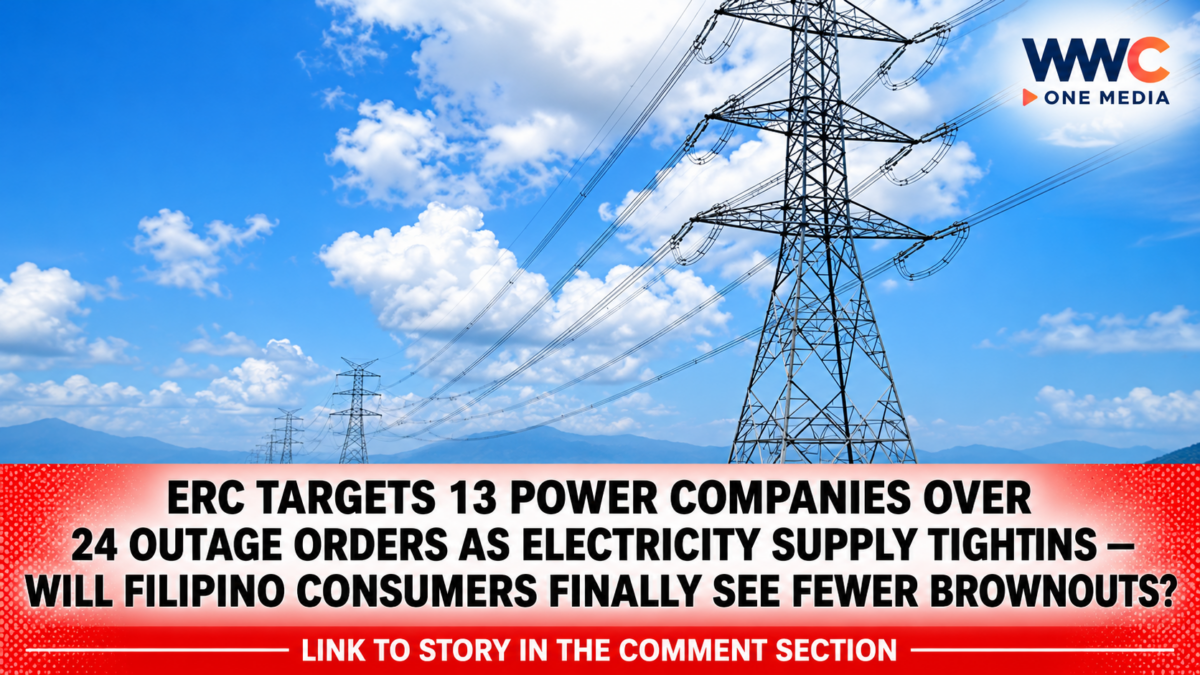
The Energy Regulatory Commission (ERC) has intensified its scrutiny of the Philippine power industry, issuing 24 Show Cause Orders against 13 generation companies whose power plants were identified as exceeding allowable limits for unplanned outages.
The regulatory action comes amid recurring electricity supply disruptions and high power prices in the Visayas and Mindanao, where the unavailability of major generating units has repeatedly tightened operating reserves.
The ERC announced the orders on November 4, 2026, confirming that they were issued on October 14. The companies have been directed to submit verified explanations and supporting documents addressing their reported non-compliance with power plant reliability standards.
The orders do not mean the companies have already been found liable. The commission must still evaluate their responses and determine whether violations occurred before imposing any penalties.
The investigation is significant for households and businesses because prolonged or unexpected power plant outages can reduce available electricity, tighten supply margins and potentially contribute to higher wholesale electricity prices. Energy Regulatory Commission+2
Why the ERC Issued the Orders
The latest enforcement action follows an investigation that began months earlier.
On June 11, 2026, the ERC issued Notices of Non-Compliance with Order to Comply and Explain against 25 generation companies involving 48 generating units.
The notices required the companies to explain reported outage events and provide supporting records. The commission subsequently reviewed their submissions against the applicable reliability standards and allowable outage limits.
After evaluating the records, the ERC determined that further proceedings were warranted against 13 companies, resulting in the 24 show-cause orders.
The figures refer to different stages of the regulatory process: the initial review involved 25 companies and 48 generating units, while the subsequent enforcement action involved 13 companies and 24 orders. Energy Regulatory Commission+2
Which Power Companies Are Facing Scrutiny?
The ERC’s November 4 public statement confirmed the number of companies but did not publish a complete list of their names or identify every generating unit covered by the orders.
The Philippine Star separately reported that the companies included businesses affiliated with major energy groups such as AboitizPower, First Gen, Meralco PowerGen, San Miguel Global Power and Vivant.
Its report named companies including Therma Mobile Inc., Therma Visayas Inc., Cleanergy 9 Power Inc., Energy Development Corp., Bac-Man Geothermal Inc., Toledo Power Inc., Meridian Power Inc. and Excellent Energy Resources Inc.
However, media reports have not presented fully consistent company lists. The ERC’s official release remains the authoritative confirmation of the number of companies and orders, rather than a complete public roster.
Importantly, being covered by a show-cause order does not mean that every facility operated by a company has violated reliability standards. The commission must assess the specific generating units and evidence involved in each proceeding. Philstar.com+1
Mindanao’s September Power Shortage Shows the Scale of the Problem
The ERC’s action is particularly significant for Mindanao, which experienced serious supply constraints in September.
On September 2, the Mindanao grid entered a red-alert condition after available generation capacity fell to approximately 2,526 megawatts against projected peak demand of 2,545 MW, leaving a 19-MW shortfall.
According to the National Grid Corporation of the Philippines (NGCP), seven power plants were on forced outage, while seven others were operating at reduced capacity. The combined unavailable capacity was approximately 855.1 MW.
The unavailability of GNPower Kauswagan Units 1 and 2 and Therma South Unit 2 contributed to the supply shortage.
The September figures are a snapshot of conditions at that time, not the current capacity position. They nevertheless demonstrate how the simultaneous unavailability of major generating facilities can leave Mindanao vulnerable to power interruptions.
WWC ONE MEDIA previously examined the regional problem in Visayas and Mindanao Are Back Under Red Alert — But the Bigger Test Comes When the Next Power Plant Goes Offline. SunStar Publishing Inc.+1
ERC and DOE Inspected Major Mindanao Power Plants
The regulatory scrutiny also follows inspections conducted by the ERC and the Department of Energy (DOE) from September 14 to 18.
The facilities inspected included:
- GNPower Kauswagan Units 2 and 3
- Therma Marine Mobile 1 and Mobile 2
- Therma South Units 1 and 2
The inspections examined operational conditions, available generating capacity, outage circumstances, maintenance work and restoration activities.
The ERC reported that GNPower Kauswagan Unit 2 was undergoing testing and commissioning following turbine blade maintenance. Unit 3 had resumed operations after repairs to a boiler tube leak.
Therma Marine, meanwhile, cited fuel supply constraints and prolonged adverse weather conditions that affected scheduled deliveries of heavy fuel oil.
These findings show that power plant outages can have different causes, including equipment problems, maintenance requirements and fuel-delivery difficulties. Determining whether a particular outage constitutes a regulatory violation requires examining the applicable standards and evidence. SunStar Publishing Inc.
Visayas Also Faces Tight Electricity Reserves
The problem is not confined to Mindanao.
On November 4, the Visayas grid was placed under yellow alert for one hour, from 5 p.m. to 6 p.m., as several generating units remained unavailable or operated below their full capacity.
NGCP reported available capacity of approximately 2,799 MW against projected peak demand of 2,586 MW.
Although supply was higher than projected demand, the operating margin was insufficient to meet the grid’s required contingency reserve.
A yellow alert does not automatically mean that widespread brownouts are taking place. It warns that the grid has limited reserves to respond if another major generating unit suddenly fails.
At the time, 24 power plants were unavailable or operating at reduced capacity. Five were on forced outage during November, while 19 others were running at derated capacity, leaving approximately 695.3 MW unavailable.
Therma Visayas Unit 2 and Palm Concepcion Power Corp. were among the major coal-fired facilities contributing to the tighter supply situation. SunStar Publishing Inc.
For additional context, WWC ONE MEDIA’s report on Cebu’s worsening power crisis explains how forced outages and reduced generating capacity can threaten electricity supply even when demand remains relatively stable.
What Are Equivalent Unplanned Outage Limits?
The ERC’s investigation centers on the allowable Equivalent Unplanned Outage (EOU) limits under its reliability performance rules.
Power plants undergo scheduled maintenance and can experience unexpected equipment failures. Reliability standards recognize that generating units cannot operate without interruption indefinitely.
However, generating companies are expected to maintain their facilities and keep unplanned outages within prescribed limits.
The EOU measure helps regulators assess the extent to which a generating unit’s unexpected unavailability affects its performance over a specified assessment period.
The applicable limits depend on the governing reliability rules and the characteristics of the generating facility.
In July 2026, the ERC adopted Resolution No. 23, Series of 2026, establishing revised reliability rules using historical operating and outage data from 2015 to 2024.
The revised framework strengthens outage monitoring, maintenance planning, reporting requirements and regulatory accountability.
The ERC must apply the correct standards to each generating unit and assessment period before deciding whether a violation has occurred. SunStar Publishing Inc.+1
Why Power Plant Outages Can Affect Electricity Prices
When a generating unit unexpectedly shuts down, the electricity it was expected to supply becomes unavailable.
If other plants can replace that capacity, the immediate effect may be manageable. But when several large facilities are offline simultaneously, grid operators have fewer options to maintain sufficient supply and reserves.
In tighter market conditions, distribution utilities and other buyers may need to rely on replacement electricity that costs more than their original contracted supply.
This can put upward pressure on wholesale electricity prices, although the effect on individual household bills depends on power supply contracts, market exposure, regulated charges and other billing components.
The issue is particularly important in the Visayas and Mindanao, where repeated supply constraints have coincided with concerns about high electricity costs.
WWC ONE MEDIA previously examined the cost side of the problem in ERC Freezes Power Reserve Market as Visayas Electricity Costs Explode — But Will Filipino Consumers Finally Get Relief?.
The report discussed the regulator’s intervention in reserve-market trading and the challenge of securing backup electricity without exposing consumers to excessive costs.
The reserve-market suspension and the latest show-cause proceedings are separate regulatory actions. One addresses reserve procurement and pricing; the other concerns generating companies’ compliance with reliability standards.
Battery Storage and Other Measures Could Help Stabilize the Grid
The government is also pursuing measures to improve electricity reserves and reduce the risk of supply disruptions.
GMA News reported that the DOE had directed NGCP to install more than 250 MW of battery energy storage systems to help strengthen the Visayas grid.
The DOE has also considered using available liquid-fuel facilities to provide additional electricity when supply becomes tight.
Battery energy storage systems can respond quickly when generation drops or demand rises, providing short-term support while other generating units are restored or additional electricity is brought online.
However, storage is not a complete replacement for reliable power generation. The country still needs generating plants that can operate consistently, adequate transmission infrastructure and sufficient reserve capacity.GMA News Online+1
What Happens to the 13 Companies Now?
The companies must submit verified explanations and supporting documents in response to the ERC’s show-cause orders.
The commission will evaluate those submissions alongside the outage records and applicable reliability standards.
If the review establishes violations, the ERC may impose appropriate penalties under its regulatory rules.
However, the commission said on November 4 that it had not yet received the specific verified responses required under the latest orders.
No final penalties were announced.
The ERC also emphasized that the proceedings must observe due process. Each company must have the opportunity to explain its circumstances and present evidence before the commission reaches a decision.
That means the 13 companies should not be described as having already been found guilty of violating reliability standards.
The Bigger Challenge Is Preventing Another Round of Power Shortages
The ERC’s latest enforcement action sends a clear message that power plant reliability is receiving greater regulatory attention.
The 24 orders involving 13 generation companies follow months of electricity supply concerns in the Visayas and Mindanao, including red and yellow grid alerts, unavailable generating units and pressure on electricity prices.
But investigations alone cannot restore unavailable generating capacity.
The government must ensure that power plants complete necessary repairs, companies comply with maintenance and reporting requirements, and additional generation and storage projects are delivered where needed.
For consumers, the ultimate measure of success will be fewer unexpected outages, more dependable electricity and a power system capable of meeting rising demand without repeatedly approaching emergency conditions.
The ERC has started the accountability process. Whether it leads to lasting improvements will depend on the evidence gathered, the decisions made and the industry’s ability to keep generating units operating reliably.
— Could the Investigation Expose Why Electricity Shortages Keep Returning?