
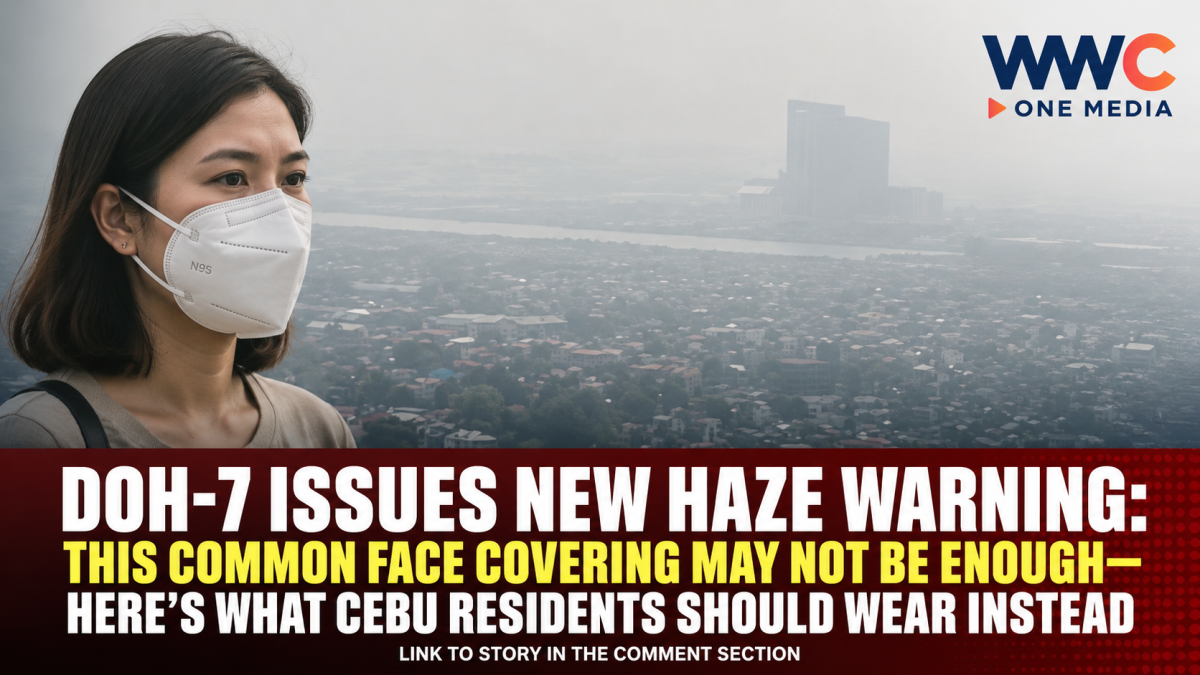
CEBU CITY, Philippines — With air pollution worsening across Metro Cebu, health authorities are urging residents to take stronger precautions outdoors—and to think twice before relying on a wet towel or cloth as protection from the haze.
The Department of Health in Central Visayas (DOH-7) is recommending N95 masks as the preferred protection for people who need to go outside, while discouraging the use of wet towels or cloths as face coverings.
The warning comes as Metro Cebu’s air quality reached the “Acutely Unhealthy” category amid transboundary haze believed to be linked to forest fires in Kalimantan, Indonesia.
DOH-7: N95 is the better choice
DOH-7 Medical Officer Dr. Jeanette Pauline Arellano-Cortes said residents who must venture outdoors should ideally wear an N95 mask, which provides stronger protection against inhaled fine particles.
She specifically discouraged using a wet cloth or face towel as a substitute.
For residents who cannot obtain an N95, DOH-7 said a surgical mask may be used, preferably with two layers or combined with a cloth mask, provided it fits snugly over the nose and mouth.
The fit is important because gaps around the sides can allow polluted air and fine particles to enter.
The advice represents an updated local recommendation amid the worsening haze. An earlier national DOH advisory had mentioned a wet handkerchief or cloth as a temporary alternative when N95 masks were unavailable, but the latest DOH-7 guidance is more specific in discouraging wet towels or cloth as face coverings.
Metro Cebu air reaches ‘Acutely Unhealthy’
The health warning comes as pollution levels climbed sharply across Cebu.
According to the Department of Environment and Natural Resources–Environmental Management Bureau (DENR-EMB), Metro Cebu’s PM2.5 Air Quality Index reached 252 at 11 a.m. on September 3, placing the area in the “Acutely Unhealthy” category.
The reading later eased slightly to 251 at 4 p.m., but remained within the same serious category.
Air quality had already deteriorated throughout the week. On September 1, Metro Cebu readings were in the 152–173 range, classified as “Very Unhealthy.” By September 2, readings had climbed above 200, entering the “Acutely Unhealthy” range.
DENR-EMB officials said the haze is possibly associated with smoke and fine particulate matter transported from ongoing fires in Kalimantan, Indonesia, by prevailing winds.
The situation could worsen further if the fires continue and wind patterns remain favorable for transporting pollutants toward the Philippines.
Children, elderly and other vulnerable groups urged to stay indoors
DOH-7 is particularly concerned about people who may be more vulnerable to the effects of polluted air.
The agency has advised children below five years old, older adults and pregnant women to limit outdoor activities while air quality remains unhealthy.
People with respiratory conditions are also at greater risk because exposure to airborne irritants can aggravate conditions such as asthma and chronic obstructive pulmonary disease.
DOH-7 officials also warned that workers who spend long periods outdoors—including some drivers and people exposed to dust—may face greater exposure to pollutants.
Residents are being urged to reduce unnecessary outdoor activities and avoid strenuous exercise outdoors while the haze persists.
Why PM2.5 is a major concern
The primary pollutant being monitored is PM2.5, or extremely fine particulate matter measuring 2.5 micrometers or smaller.
Because these particles are so small, they can penetrate deep into the respiratory system and potentially enter the bloodstream.
Health officials have warned that exposure can contribute to coughing, breathing difficulties, eye irritation and worsening symptoms among people with existing respiratory illnesses.
DENR-EMB has therefore urged the public to take the haze seriously even if symptoms are not immediately noticeable.
Hospitals placed on heightened alert
The worsening air quality has also prompted DOH-7 to prepare hospitals and other health facilities for a possible increase in respiratory cases.
A draft regional directive calls on hospitals, infirmaries, provincial health offices and other health facilities to prepare their emergency rooms, check medical equipment and medicines, and consider priority lanes if respiratory patients increase.
Facilities have also been advised to ensure that referrals from lower-level health facilities to larger hospitals remain smooth.
DOH-7 said, however, that as of September 3, its Regional Health Emergency Management Office had not recorded respiratory illnesses directly linked to the haze.
Health officials said they are nevertheless monitoring for possible increases in both infectious and non-infectious respiratory conditions.
Cebu could still reach the emergency level
Environmental officials are warning that the situation should not be taken lightly.
DENR-EMB Region VII said Metro Cebu’s air quality could potentially reach the “Emergency” category if wildfire activity in Indonesia intensifies and prevailing winds continue to transport pollutants toward Cebu.
Under the DENR air-quality scale, an AQI of 301 to 500 falls under the Emergency category.
If that level is reached, authorities may advise the population to remain indoors and limit exposure to the polluted air.
Local pollution can make the situation worse
Although the current haze has been strongly associated with transboundary smoke from Indonesia, DENR-EMB officials stressed that local emissions can also add to the concentration of pollutants.
Vehicle emissions, dust and the burning of waste can contribute to poor air quality.
Residents are therefore being urged not to burn garbage or other materials while the haze continues.
Rainfall may temporarily improve air quality by removing some particles from the atmosphere, but officials caution that the improvement may not last if the fires and unfavorable wind conditions continue.
What Cebu residents should do
As the haze continues, authorities recommend:
- Wear an N95 mask when going outdoors, especially in visibly hazy areas.
- If an N95 is unavailable, use a properly fitted surgical mask, preferably doubled or combined with a cloth mask.
- Make sure the mask fits snugly around the nose and mouth.
- Avoid prolonged outdoor exposure.
- Postpone strenuous outdoor activities such as running.
- Vulnerable individuals should limit unnecessary trips outside.
- Avoid burning garbage and other materials.
- Avoid smoking indoors and other sources of indoor air pollution.
- Stay hydrated.
- Seek medical attention if breathing difficulties or other concerning symptoms develop.
The central message from health and environmental authorities is clear: Metro Cebu’s haze is not simply a visibility problem. It involves fine particles that can enter the respiratory system, making proper protection and reduced exposure increasingly important.
For now, residents are being urged to follow updated advisories from DOH-7 and DENR-EMB as air-quality conditions continue to change.




Leave a Reply