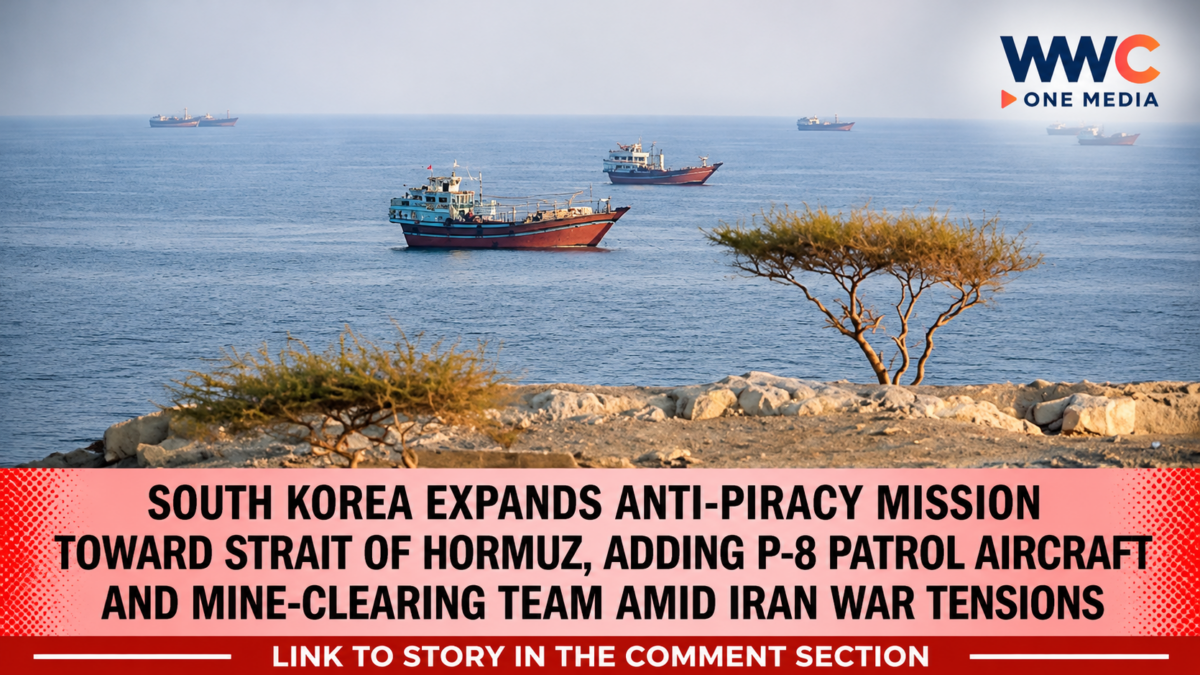
South Korea is preparing to move its naval security operations closer to the strategically vital Strait of Hormuz, expanding the mission of its anti-piracy Cheonghae Unit and adding specialised military assets as tensions involving the United States and Iran continue to threaten commercial shipping across the Middle East.
The proposed expansion would extend the unit’s operating area from its established mission in the Gulf of Aden to waters south of Oman, bringing South Korean forces closer to one of the world’s most important energy corridors. The move is being presented by Seoul as a maritime-security operation focused on protecting commercial vessels, South Korean citizens and national economic interests—not as a decision to join combat operations against Iran. AsiaOne+2
The announcement comes after months of debate over how South Korea should respond to growing international pressure to help protect navigation through the Strait of Hormuz. US President Donald Trump has urged allies and partners to contribute more to efforts surrounding the conflict, while South Korean President Lee Jae Myung has repeatedly indicated that Seoul does not want to become directly involved in the fighting.
South Korea Moves Its Anti-Piracy Operations Closer to Hormuz
South Korea’s Ministry of National Defense has decided to pursue an expanded mission for the Cheonghae Unit, a naval task force that has operated in the Gulf of Aden since 2009.
Under the proposed changes, the unit’s operational area would extend northeast into the Arabian Sea, reaching waters near Oman’s Port of Duqm. The port is approximately 650 kilometres from the Strait of Hormuz.
The expansion would significantly increase the unit’s operating reach, with Yonhap News Agency reporting that the proposed operational radius would roughly double to around 1,930 kilometres.
The revised deployment plan is also expected to increase the unit’s personnel ceiling from approximately 320 to 395, adding 75 personnel to support the expanded mission. The proposal still requires the necessary government and parliamentary approvals before it can be implemented. Yonhap News Agency+2
P-8A Aircraft and Mine-Clearing Equipment to Strengthen the Mission
One of the most significant additions will be a P-8A Poseidon maritime patrol aircraft, designed to monitor large maritime areas and support naval operations.
The aircraft would provide additional surveillance capabilities, helping South Korean forces monitor shipping activity and identify potential threats along important commercial routes.
The expansion also includes an explosive ordnance disposal team and unmanned mine-countermeasure equipment. These capabilities are particularly important because naval mines and other explosive hazards can pose serious risks to commercial vessels and military ships operating in contested waters.
According to reporting by The Korea Times, the proposed additions include unmanned surface and underwater systems, as well as remotely operated underwater equipment designed to help detect and deal with mines.
The reinforcement would therefore go beyond simply sending more personnel. It would give the Cheonghae Unit additional tools for maritime surveillance, mine-related threats and protection of commercial shipping. The Korea Times+2
Seoul Says the Mission Is Not Intended to Join the Iran War
Despite the expanded deployment area, South Korea is drawing a distinction between protecting maritime navigation and participating in military operations against Iran.
Officials have stressed that the proposed mission would remain non-combat in nature and that the Cheonghae Unit would continue operating under South Korean command rather than being integrated into allied combat forces.
Reporting by Al Jazeera, citing Yonhap and Reuters, said the proposed operations would be restricted to open waters south of Oman. The maritime patrol aircraft would not be authorised to target or monitor Iranian territory, Iranian territorial waters or the interior of the Strait of Hormuz.
That distinction is politically important for President Lee’s administration.
Seoul has faced pressure from Washington to contribute more to regional security, but sending South Korean forces into an operation that could be interpreted as joining the war would carry considerable diplomatic and military risks.
The government is therefore attempting to strengthen maritime protection while maintaining limits intended to prevent the deployment from becoming direct participation in the conflict. Al Jazeera+2
Why the Strait of Hormuz Matters to South Korea
The Strait of Hormuz is a critical shipping passage connecting the Persian Gulf with the Gulf of Oman and the wider Indian Ocean.
It is particularly important to South Korea because of the country’s dependence on imported energy.
According to the reporting carried by Reuters and AsiaOne, South Korea obtained approximately 70 per cent of its oil supplies from the Middle East in 2025, with most of those supplies transported through the Strait of Hormuz.
Any prolonged disruption to shipping through the waterway could therefore affect South Korea’s energy security, industrial production and broader economy.
The consequences would not be limited to South Korea. Countries across Asia rely on energy shipments passing through the Gulf, meaning disruptions could contribute to higher oil prices, increased freight expenses and more expensive transportation and manufacturing costs.
For additional background on Seoul’s strategic dilemma, WWC ONE MEDIA previously examined the country’s difficult decision over whether to increase its involvement in maritime security in South Korea Faces a Dangerous Hormuz Choice — And One Wrong Move Could Pull Seoul Deeper Into the Iran War.
The Cheonghae Unit Has Protected Shipping Since 2009
The Cheonghae Unit was established in 2009 to support international anti-piracy operations and protect commercial shipping, particularly in the Gulf of Aden off Somalia.
Its current deployment includes a 4,400-tonne destroyer, a maritime helicopter, high-speed patrol boats and approximately 300 personnel.
The unit’s mission has traditionally focused on preventing piracy, protecting vessels and responding to threats against South Korean citizens and commercial interests at sea.
Its 49th contingent departed from the southeastern port city of Busan on October 2 aboard the destroyer Chungmugong Yi Sun-sin as part of the regular rotation of personnel serving in the region.
The proposed expansion would represent a substantial adjustment to the mission’s geographical reach and operational capabilities, reflecting the growing risks facing shipping routes between the Gulf and the wider Indian Ocean. Yonhap News Agency+2
Trump’s Pressure Adds a Diplomatic Challenge for Seoul
The planned expansion also comes amid strained discussions over the responsibilities of US allies during the Iran conflict.
Trump has criticised South Korea for what he considers insufficient support for Washington’s position. The pressure has placed Seoul in a difficult position: it must maintain its security partnership with the United States while avoiding actions that could expose South Korean personnel to direct retaliation.
South Korea has previously indicated that it is willing to contribute to protecting freedom of navigation, but that does not necessarily mean it will participate in military operations against Iran.
President Lee has emphasised that South Korean forces should not be deployed in a way that draws the country into the conflict.
The proposed Cheonghae expansion appears designed to address both concerns. It would increase South Korea’s contribution to maritime security while placing operational limits on where and how its forces can act.
However, the distinction may not eliminate all risks. Even a mission officially designated as non-combat could face dangerous situations if South Korean vessels or aircraft encounter attacks, mines or other threats while operating near a conflict zone. Al Jazeera+2
Parliamentary Approval Remains a Major Hurdle
South Korea’s overseas military deployments and extensions of existing missions are subject to parliamentary oversight.
The government must complete the required approval process before the revised mandate can take effect. The current Cheonghae deployment is scheduled to expire at the end of 2026, making the proposed extension an important part of the government’s plan.
The expanded mission is also expected to draw scrutiny from lawmakers concerned about the possibility that South Korean personnel could be exposed to retaliation or gradually pulled into a wider regional conflict.
Opposition to the proposal is not simply about the equipment being deployed. It also concerns the broader question of whether expanding an anti-piracy mission toward an active conflict zone could amount to a military commitment beyond its original purpose.
As Al Jazeera reported, critics have questioned whether describing the operation as non-combat adequately addresses the risks of sending additional military personnel and equipment closer to the conflict. Al Jazeera+2
The Wider Impact on Asian Shipping and Energy Markets
The security of the Strait of Hormuz has consequences far beyond the Middle East.
A major disruption could affect oil deliveries, tanker movements, shipping insurance and the cost of transporting goods. Asian economies that depend on imported energy could be particularly exposed to higher international prices.
The Philippines also has an interest in the stability of the waterway. Higher global oil prices can eventually affect domestic fuel costs, transport expenses and the price of goods, even when the country is not directly involved in the conflict.
The human consequences are equally important. Commercial vessels carry multinational crews, including Filipino seafarers, who can be exposed to danger when tensions threaten shipping routes.
WWC ONE MEDIA has previously reported on the wider maritime risks in Two Filipino Seafarers Killed in Strait of Hormuz Attack — Then Authorities Uncovered a Troubling Detail.
The broader confrontation has also raised concerns about threats to energy infrastructure and commercial vessels, as explored in Iran Warns US Gulf Energy Assets Are Vulnerable as Strait of Hormuz Tensions Escalate.
Another WWC ONE MEDIA report, Seoul Weighs a High-Stakes Hormuz Mission, examined the maritime patrol, logistics and mine-clearing options South Korea had been considering before the latest expansion proposal.
A Bigger Naval Role Without a Formal Entry Into the War
South Korea’s planned expansion of the Cheonghae Unit highlights the increasingly difficult balance facing governments whose economies depend on secure international shipping.
Seoul wants to protect its citizens, energy supplies and commercial interests while avoiding a direct military confrontation with Iran. Adding a maritime patrol aircraft, mine-clearing capabilities and more personnel would strengthen its ability to monitor and respond to threats around the Arabian Sea.
But the closer South Korean forces operate to the Strait of Hormuz, the more complicated that balancing act could become.
The proposal does not mean South Korea has formally joined the US-led war against Iran. Its implementation remains subject to the required approval process, and officials have described the mission as non-combat.
The crucial question is whether those limits will be enough to keep South Korea out of a wider confrontation if the security situation deteriorates.
For now, Seoul is preparing to take a larger role in protecting one of the world’s most important shipping corridors. Whether that role remains strictly defensive may depend on what happens next in the waters surrounding Oman and the Strait of Hormuz.