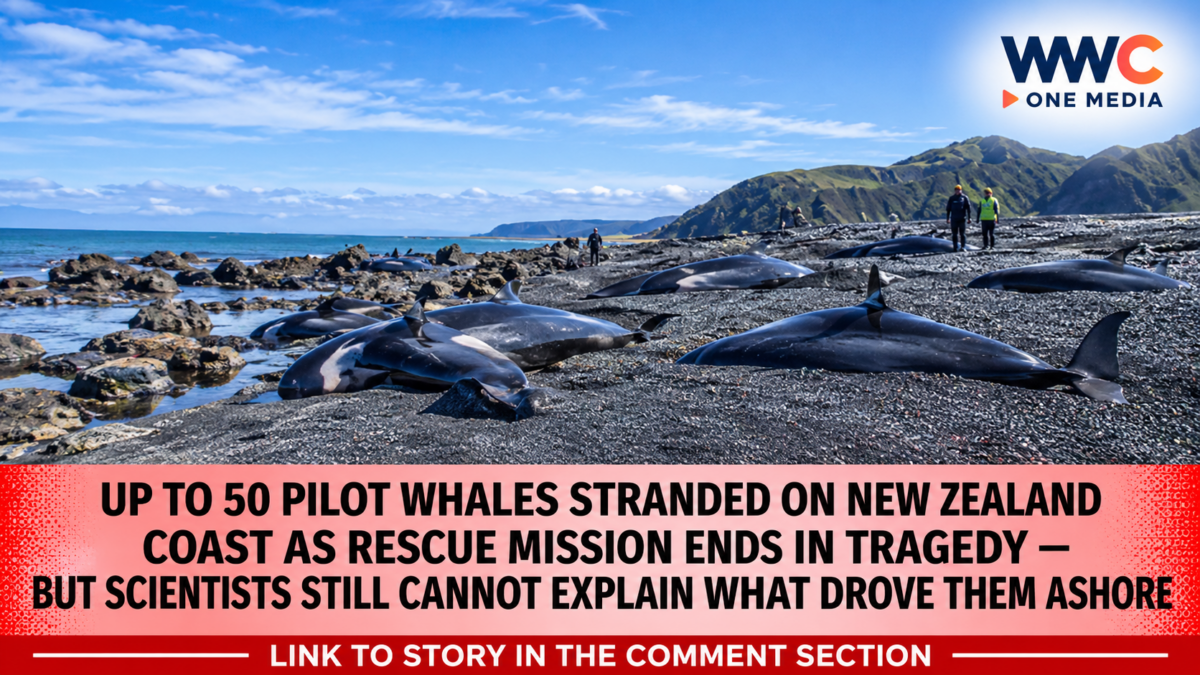
NEW ZEALAND, November 6, 2026 — A heartbreaking mass stranding of pilot whales along New Zealand’s North Island has left dozens of marine mammals dead, despite desperate rescue efforts involving conservation officers, marine specialists, local Māori communities and volunteers.
The whales were discovered along the rocky coastline of Ngawi, near Cape Palliser in the Wairarapa region, after becoming stranded overnight on November 4 and 5.
New Zealand’s Department of Conservation (DOC) initially confirmed that at least 20 pilot whales had become stranded across two separate groups. However, local residents estimated that as many as 50 whales had come ashore along the coastline.
By Thursday, November 5, reports indicated that at least 30 whales had died. Rescuers managed to refloat two surviving animals during high tide, but the rescue operation ultimately ended in tragedy.
According to subsequent reports from Radio New Zealand and international news coverage, the last four whales that had remained alive also died by Thursday evening, including the two animals that had initially been returned to the water.
The incident has renewed concerns about the vulnerability of highly social marine mammals and the challenges conservation teams face when entire whale groups become trapped in shallow coastal waters.
It has also raised questions about why pilot whales sometimes swim into dangerous coastal environments despite their sophisticated navigation abilities.
Two Separate Whale Pods Found Stranded Along Ngawi Coast
The emergency unfolded along the Ngawi coastline near Cape Palliser, close to the southern tip of New Zealand’s North Island.
Residents discovered the stranded whales after the animals apparently came ashore during the night.
The Department of Conservation confirmed that two separate pods had become stranded in the area, with one group containing at least 20 animals and another located farther along the coastline.
The difference between the official count and the higher estimate from residents reflects the difficulty of assessing the full scale of the incident across several kilometres of rugged shoreline.
Unlike a wide sandy beach, the Ngawi coastline contains rocks and uneven terrain that make it difficult for large marine mammals to return to deeper water.
Some whales were already dead or seriously injured when they were discovered.
Residents and volunteers immediately began assisting the surviving animals while waiting for specialist rescue teams to arrive.
Ngawi resident Rob Bargh described the situation as devastating, telling Radio New Zealand that the surviving whales appeared to be close to death.
Fisherman Andrew Sim, who had worked along the coastline for more than four decades, also expressed surprise at the incident, saying he had never witnessed pilot whales coming ashore in that particular area.
The unusual location made the stranding particularly concerning for local residents and conservation workers. Reuters+2
Project Jonah and Māori Communities Join the Rescue Operation
New Zealand’s Department of Conservation coordinated the response with Project Jonah, a marine mammal rescue organisation, and local Māori iwi.
Project Jonah mobilised trained marine mammal medics to assess the surviving whales and determine whether they were healthy enough to be returned to the ocean.
Volunteers used buckets of seawater and wet towels to keep the animals hydrated and cool while specialists prepared for a possible refloating operation.
These measures are critical because stranded whales can suffer from dehydration, overheating, stress and injuries caused by their own body weight pressing against the ground.
The rescue teams also had to consider the condition of each animal before attempting to move it.
Returning a severely weakened whale to the water does not guarantee survival. Animals that have suffered extensive injuries or physical deterioration may be unable to swim properly once released.
Project Jonah initially reported that four whales were still alive in the first pod and that rescuers were preparing to attempt a refloat during the afternoon high tide.
Two animals were successfully returned to the water, but neither survived.
By Thursday evening, all four remaining survivors had died.
The operation therefore ended without a confirmed surviving whale from the stranded groups.
The Department of Conservation and local Māori representatives also planned a traditional karakia, or prayer ceremony, to honour the animals. 1News+2
Why Do Pilot Whales Become Stranded in Large Numbers?
One of the biggest unanswered questions surrounding the New Zealand tragedy is why so many pilot whales ended up trapped along the coastline.
Despite extensive research, scientists still do not have a single explanation for mass whale strandings.
Pilot whales are particularly vulnerable because they are highly social animals that travel in closely connected groups.
Unlike some marine species that regularly separate from one another, pilot whales maintain strong social bonds and often move together in large pods.
This behaviour can become dangerous when one or more members of the group enter shallow water or become disoriented.
Other whales may follow them, even when the surrounding environment becomes increasingly dangerous.
Several possible explanations for mass strandings include:
- Navigation difficulties: Changes in underwater geography and shallow coastal environments may interfere with the whales’ ability to navigate.
- Illness or injury: Sick or injured animals may struggle to maintain their normal swimming patterns.
- Predator avoidance: Whales may move into unfamiliar coastal areas while attempting to escape predators.
- Environmental conditions: Strong currents, unusual weather and changing ocean conditions may influence their movements.
- Human-related disturbances: Underwater noise and other human activities have been investigated as possible contributing factors in some marine mammal strandings.
However, none of these explanations has been established as the cause of the Ngawi incident.
New Zealand’s Department of Conservation has repeatedly emphasised that the reasons behind many whale strandings remain unknown.
Why New Zealand Is a Global Hotspot for Whale Strandings
New Zealand has one of the world’s most significant histories of mass whale strandings.
According to the Department of Conservation, more than 5,000 whale stranding incidents have been recorded around the country’s coastline since 1840.
The agency responds to approximately 85 marine mammal stranding incidents annually.
One of the most notorious events occurred in 1918, when an estimated 1,000 pilot whales became stranded on the Chatham Islands.
Farewell Spit, located at the northern end of New Zealand’s South Island, has also become particularly associated with mass strandings.
Its long, gently sloping coastline and surrounding underwater geography may create navigation challenges for whales that depend on echolocation.
Pilot whales use sound to navigate, locate food and maintain contact with other members of their groups.
When they enter unfamiliar shallow waters, their normal navigation abilities may not be sufficient to prevent them from becoming trapped.
The Cape Palliser incident is particularly unusual because the Ngawi coastline is rocky rather than the gently sloping sandy environment associated with some of New Zealand’s most famous mass strandings. NEWS WIRE+1
Why Rescuing Stranded Whales Is So Difficult
Rescuing a stranded whale is considerably more complicated than simply pushing the animal back into the sea.
Pilot whales can weigh several tonnes, making them extremely difficult to move safely.
Their bodies are adapted to remain supported by water. When stranded on land, their own weight can place tremendous pressure on internal organs and other body structures.
Prolonged exposure to sunlight and warm conditions can also cause overheating and dehydration.
Even when rescuers successfully return a whale to the ocean, the animal may be too weak or injured to swim normally.
There is also another major complication: pilot whales are strongly attached to their pods.
A whale that has been successfully refloated may attempt to return to stranded members of its group rather than swim away independently.
This behaviour makes rescue operations especially challenging because specialists must consider the condition and movements of the entire group.
The Ngawi operation demonstrated how difficult these rescues can become when whales are discovered after spending several hours stranded among rocks.
The deaths of the last four survivors, despite successful initial refloating attempts, highlight the limitations of even well-coordinated rescue efforts.
New Zealand’s Indigenous Māori Communities Treat Whales as Sacred Treasures
The tragedy also carries cultural significance for New Zealand’s Indigenous Māori communities.
Whales are traditionally regarded as taonga, meaning treasured or sacred natural resources.
They hold an important place in Māori cultural traditions, identity and spiritual beliefs.
This connection is reflected in the involvement of local iwi during the rescue operation and the planned karakia to honour the deceased animals.
For many Māori communities, whale strandings are not simply environmental emergencies. They are also deeply meaningful events requiring respect for the animals and their cultural significance.
The participation of local communities in rescue operations demonstrates the important relationship between conservation efforts and Indigenous environmental stewardship.
Previous Whale Rescues Show That Mass Strandings Can Have Different Outcomes
Although the Ngawi incident ended tragically, New Zealand has also experienced successful mass whale rescue operations.
In November 2024, more than 30 pilot whales became stranded at Ruakākā Beach near Whangārei.
Conservation personnel and hundreds of local residents worked together to return most of the animals to the ocean.
Volunteers used sheets to help lift and refloat the whales.
Four animals, including three adults and one calf, died.
The successful rescue of the remaining whales demonstrated how community cooperation and rapid intervention can make a difference when conditions allow.
However, the circumstances of the Cape Palliser incident were considerably more difficult because the whales were trapped along a rocky coastline and many had already sustained serious injuries.
The comparison highlights why no two whale rescue operations are exactly alike. AP News+1
WWC ONE MEDIA Reports on Other Marine Wildlife Emergencies and Conservation Concerns
The New Zealand stranding is part of a broader global conversation about marine wildlife protection, environmental pressures and the importance of responsible human interactions with ocean ecosystems.
WWC ONE MEDIA has previously covered several developments involving endangered marine animals and conservation efforts.
In the Philippines, Adult Dugong Found Dead Off Antique Coast — What Happened to the Threatened Sea Mammal? examined concerns following the discovery of a dead adult dugong in Antique, raising questions about marine wildlife protection and possible environmental threats.
Another report, Bohol Whale Shark Watching Returns This November — But Tourists Must Follow These Strict New Rules, explored the Philippines’ efforts to revive whale shark tourism while introducing stronger protections against feeding, touching and disturbing the animals.
In South Korea, Busan Launches Rescue Mission for Trapped Shark Bukang-i After Hundreds of Thousands Flock to See It documented an unusual rescue operation involving a shark trapped in an artificial canal.
WWC ONE MEDIA also reported on South Korea’s 3-Meter Celebrity Shark Escapes Rescue and Returns to Canal — But Its Next Move Could Decide Its Fate, highlighting the difficulties authorities encountered while attempting to guide the animal back into open waters.
Meanwhile, Iceland Moves Toward a Permanent Whaling Ban — But 80 Fin Whales Have Already Been Killed This Season examined the international debate surrounding commercial whaling and the future of whale conservation.
Together, these incidents demonstrate how marine wildlife faces different threats, ranging from accidental strandings and habitat disruption to human activities and conservation challenges.
What Should People Do When They Discover a Stranded Whale?
New Zealand conservation authorities advise the public to contact trained responders immediately whenever they encounter a stranded whale or dolphin.
Members of the public should not attempt to conduct an independent rescue.
Important safety recommendations include:
- Contact the Department of Conservation through its emergency hotline at 0800 DOC HOT.
- Contact Project Jonah at 0800 4 WHALE.
- Keep a safe distance from the stranded animals.
- Avoid loud noises and unnecessary movement around the whales.
- Keep dogs and children away from the animals.
- Follow instructions from trained marine mammal rescuers.
Even whales that appear dead should not be approached or handled without professional guidance.
The animals may still be alive, and large marine mammals can present safety risks to inexperienced rescuers.
Proper coordination is essential to protect both the stranded animals and the people attempting to help them.
A Tragic Reminder of How Vulnerable Marine Wildlife Can Be
The Cape Palliser mass stranding has ended with the deaths of the surviving pilot whales, despite the extraordinary efforts of conservation workers, Māori communities and local volunteers.
The incident also leaves important scientific questions unanswered.
Why did the whales enter the rocky Ngawi coastline? What caused the initial animals to become stranded? Could environmental conditions or navigation difficulties have contributed to the tragedy?
For now, investigators and conservation authorities have not established a definitive explanation.
What remains clear is that pilot whales’ strong social bonds, combined with the physical challenges of surviving outside their natural marine environment, can turn a single stranding into a devastating event for an entire pod.
The tragedy is another reminder that protecting marine wildlife requires scientific research, rapid emergency responses and stronger understanding of the oceans that sustain these animals.
And as New Zealand mourns the whales lost near Cape Palliser, one critical question remains: Could better understanding of pilot whale navigation and mass-stranding behaviour help prevent another tragedy like this in the future?