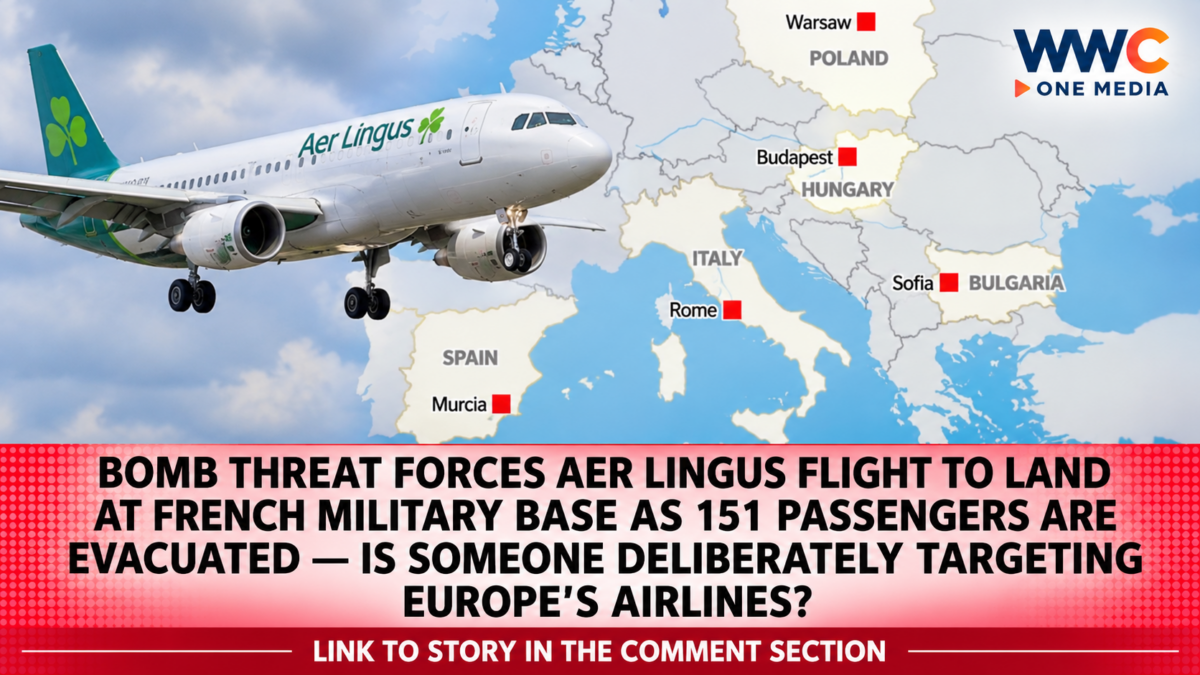
PARIS/DUBLIN, November 6, 2026 — A bomb threat forced an Aer Lingus passenger aircraft travelling from Dublin to Rome to abandon its scheduled route and land at a French military air base, triggering an emergency security response involving fighter jets, bomb-disposal specialists and French authorities.
The Airbus A320, operating as flight EI402, landed safely at Évreux-Fauville Air Base in Normandy on Thursday, November 5, after French authorities ordered the aircraft to divert following a reported security threat.
All 151 passengers and six crew members aboard the aircraft were reported safe. Authorities moved those on board to a secure location while specialist bomb-disposal teams examined the aircraft.
The incident is particularly alarming because it occurred amid a wider wave of suspected bomb threats targeting commercial aircraft across Europe, raising concerns about aviation security, passenger safety and possible coordinated attempts to disrupt air travel.
Aer Lingus confirmed that its Dublin-to-Rome service had been diverted as a security precaution. The airline said the aircraft landed safely and that arrangements would be made to get affected passengers to their intended destination as soon as possible.
Fighter Jets Dispatched as Aer Lingus Aircraft Changes Course
The emergency unfolded after French authorities received information about a potential bomb threat involving the Aer Lingus flight.
According to the French Prime Minister’s Office, fighter aircraft were dispatched to intercept and escort the passenger plane toward Évreux-Fauville Air Base.
Flight-tracking information showed the aircraft approaching the Paris region before making a sharp change in direction and heading toward the military installation.
France’s air force confirmed that military aircraft were deployed as soon as the threat was reported.
French Prime Minister Sébastien Lecornu’s office said the situation was being monitored in real time. A specialist bomb-disposal unit was also sent to examine the aircraft.
The diversion to a military installation rather than an ordinary commercial airport allowed authorities to carry out security procedures in a controlled environment.
However, the incident also drew attention to an additional concern: Reuters reported that Lecornu’s office said the pilot had not cooperated with authorities as expected, although officials did not explain the circumstances behind that statement.
No conclusion about the reason for the pilot’s actions has been established publicly.
151 Passengers and Six Crew Members Safely Evacuated
Despite the dramatic diversion, the aircraft landed without incident.
The French Prime Minister’s Office confirmed that all 151 passengers and six crew members were moved to safety.
Bomb-disposal specialists subsequently examined the plane as part of the security response.
Aer Lingus said it would assist passengers with onward travel arrangements, although the diversion inevitably disrupted the journey for people travelling between Ireland and Italy.
The incident highlights the extensive procedures airlines and aviation authorities must activate whenever a potential explosive threat is reported.
Even when a threat is eventually assessed as a hoax, authorities cannot simply ignore it. Aircraft must be secured, passengers protected and the reported danger investigated before normal operations can resume.
A Wave of Bomb Threats Disrupts Flights Across Europe
The Aer Lingus incident was not an isolated security scare.
On November 5, at least 14 passenger flights across Europe were targeted by bomb threats, according to Irish broadcaster RTÉ. Other reports put the number of affected flights higher, depending on whether additional alerts and aircraft inspections were included.
Airlines and aircraft affected included:
- Ryanair: Three flights heading to Sofia from Madrid, Copenhagen and London were targeted.
- Finnair: A Helsinki-to-Rome flight received a threat and was escorted by fighter jets.
- Wizz Air: Flights involving Milan, Warsaw, Vienna and Bucharest faced security alerts.
- LOT Polish Airlines: A Warsaw-to-Brussels flight underwent security checks.
- Other carriers: Flights operated by Iberia, Air Europa, EasyJet and other airlines also faced disruptions.
Several aircraft were diverted, while others landed at their scheduled destinations under military escort or underwent additional inspections.
Authorities reported no explosives or suspicious materials discovered in the aircraft examined in connection with the reported threats.
Reuters reported that the disruptions affected nearly 30 flights by the end of Thursday, following another wave of threats earlier in the week.
The scale of the incidents has raised concerns about whether someone is deliberately exploiting aviation security procedures to create widespread disruption.
Authorities Investigate Possible Coordinated Hoax Campaign
One of the most concerning aspects of the incidents is the possibility that multiple threats may have been connected.
Reuters reported that an email carrying the subject line “Threat report” was sent to several addresses associated with airlines, airport operators and aviation service providers in Rome and Milan.
The message claimed that explosive devices had been placed aboard incoming flights from Helsinki and Dublin.
However, investigators had not independently established who sent the email or whether the other threats originated from the same source.
The Associated Press also reported that some threatening messages appeared to use language associated with an anti-feminist group calling itself Male State.
The group’s founder, Vladislav Pozdnyakov, denied involvement and said the organisation no longer existed.
These claims have not established responsibility for the incidents.
European officials have also warned against drawing premature conclusions about possible foreign involvement.
Russia has previously faced accusations from European governments over alleged sabotage and hybrid operations, particularly following its invasion of Ukraine. Moscow has denied involvement in such activities.
For now, investigators have not publicly attributed the aviation threats to Russia, Iran or any government.
European Union Transport Commissioner Apostolos Tzitzikostas said it was too early to determine whether the incidents were connected, adding that national investigations were continuing.
Why Aviation Experts Are Concerned About the Growing Threats
Even when bomb threats turn out to be false, their impact on commercial aviation can be substantial.
Every credible report requires authorities and airlines to assess the situation, potentially divert aircraft, evacuate passengers, inspect baggage and secure airport facilities.
The resulting disruption can affect thousands of travellers who have no connection to the original incident.
According to Associated Press reporting, aviation security specialists warned that repeated hoax threats could be intended to test how quickly European governments and airport operators respond to emergencies.
The disruption can also create significant financial losses for airlines through missed connections, aircraft inspections, replacement crews and schedule interruptions.
One aviation security expert cited by the AP estimated that an individual disruption could cost an airline as much as US$250,000.
More importantly, repeated false alarms can place additional pressure on security personnel and complicate the management of genuine emergencies.
The challenge for authorities is to investigate every threat seriously without allowing repeated hoaxes to overwhelm aviation operations.
Similar Airport Security Incidents Highlight Global Aviation Vulnerabilities
The European incidents come amid wider concerns about airport security and the vulnerability of aviation infrastructure.
WWC ONE MEDIA has previously reported on several developments highlighting these challenges.
In the Philippines, a French passenger was arrested at Ninoy Aquino International Airport after allegedly making a bomb-related remark during check-in.
Read: French Passenger Arrested at NAIA After Bomb Joke on September 11 Anniversary.
In Taiwan, an unauthorized drone intrusion near a military air base forced eight fighter jets to divert and disrupted civilian aviation operations.
Read: Drone Breach Shuts Taiwan Air Base, Diverts Eight Fighter Jets and Disrupts Civilian Flights.
Malaysia has also strengthened airport security, introducing full physical screening and comprehensive baggage inspections for selected high-risk flights at Kuala Lumpur International Airport.
Read: KLIA Tightens Security for High-Risk Flights With Full Pat-Downs and 100% Bag Checks.
Meanwhile, Singapore Airlines recently confirmed unauthorised access involving approximately 46,000 booking records through its third-party travel technology provider, Amadeus, highlighting another dimension of aviation security: protecting passenger information.
Read: Singapore Airlines Confirms Data Breach Affecting 46,000 Booking Records.
Although these incidents involve different circumstances, they demonstrate how aviation security extends beyond conventional airport screening to include airspace protection, passenger safety, cybersecurity and emergency response.
What Happens Next for Aer Lingus and European Aviation?
The immediate priority following the Aer Lingus diversion was to complete the aircraft inspection, protect passengers and determine the origin of the threat.
French authorities also opened an investigation into the incident. The Associated Press reported that the pilot and co-pilot were questioned as investigators examined the circumstances surrounding the diversion.
Authorities have not established publicly who was responsible for the threat.
The wider European investigation will also need to determine whether the repeated warnings were coordinated, whether the same individuals or groups were involved and whether aviation systems were deliberately targeted.
For passengers, the incidents are another reminder that flight schedules can change rapidly when security concerns emerge.
Travellers flying through European airports should monitor airline notifications, check flight updates and follow instructions from airport security personnel.
Airlines, meanwhile, must continue coordinating with national aviation authorities and law enforcement agencies to ensure that potential threats are investigated without compromising passenger safety.
The successful landings and safe evacuation of the Aer Lingus passengers demonstrate the importance of established emergency procedures.
But the bigger concern remains unresolved.
If someone can repeatedly trigger emergency responses across multiple European countries using threatening messages, how prepared is the aviation industry for another wave of disruptions?