SINGAPORE, November 6, 2026
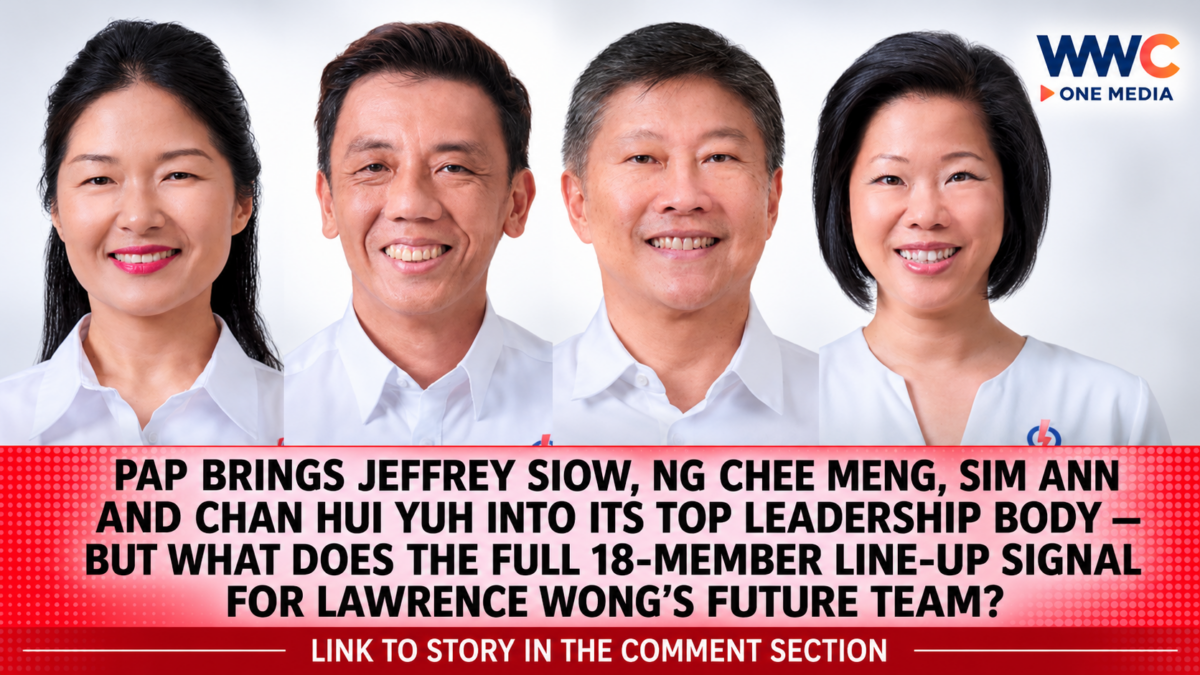
Singapore’s ruling People’s Action Party (PAP) has expanded its top decision-making body to its full 18-member capacity, co-opting four additional figures — Transport Minister Jeffrey Siow, labour chief Ng Chee Meng, Second Minister Sim Ann and former Aljunied GRC candidate Chan Hui Yuh.
The appointments, announced on November 5, complete the membership of the PAP’s 39th Central Executive Committee (CEC), less than two weeks after party cadres elected its initial leadership team.
The move is particularly significant for Siow and Chan, who are joining the CEC for the first time. Ng and Sim, meanwhile, return to the committee after also being co-opted into the previous leadership body.
The latest appointments follow an internal election on October 25, when more than 2,000 PAP cadres voted for 12 members from a list of 19 candidates. Siow and Sim were among those who did not secure enough votes to enter the elected group.
Yet their subsequent co-option shows that the initial ballot was not the final word on the committee’s composition.
The party has also retained its key office-holders, including Prime Minister Lawrence Wong as secretary-general and Education Minister Desmond Lee as chairman.
The result points to a leadership strategy that combines established political figures with additional opportunities for newer and returning members — raising fresh questions about how the PAP intends to prepare its organisation for the next phase of leadership renewal.
Four More Members Join the PAP’s Highest Decision-Making Body
In a statement on November 5, the PAP announced that its 39th CEC had co-opted four additional members.
They are:
- Jeffrey Siow — Minister for Transport
- Ng Chee Meng — Secretary-General of the National Trades Union Congress (NTUC) and Minister in the Prime Minister’s Office
- Sim Ann — Second Minister for Foreign Affairs and Second Minister for Home Affairs
- Chan Hui Yuh — PAP Serangoon branch chairperson and former candidate for Aljunied GRC at the 2025 General Election
The four join 14 members who had already entered the committee through the October 25 election and the two earlier co-options.
The PAP’s constitution allows the CEC to have up to 18 members, including those appointed through co-option. With the latest additions, the committee has reached that maximum.
For Siow, the appointment is especially noteworthy because he was among the candidates who failed to secure a place in the initial vote despite holding a major Cabinet portfolio.
Chan’s appointment also carries political significance. She contested in Aljunied GRC in 2025, where the PAP team lost to the Workers’ Party.
Her inclusion continues the party’s practice of giving some candidates who contested in opposition-held constituencies a place in its central leadership.
Jeffrey Siow’s Appointment Comes After He Missed the Initial Vote
Siow’s entry into the CEC is one of the most closely watched aspects of the latest announcement.
The Transport Minister was among 19 candidates considered during the October 25 internal election. However, he did not secure a place among the 12 members elected by party cadres.
Acting Manpower Minister Jasmin Lau was also not elected in that ballot.
The subsequent co-option of Siow demonstrates that the party leadership can still bring selected individuals into the committee after the elected positions have been filled.
The Straits Times reported that political observers viewed Siow’s inclusion as a significant signal about the PAP’s developing leadership structure.
Analysts noted that he is the only first-term MP on the newly completed CEC. His presence gives him an opportunity to participate directly in the party’s highest decision-making body while continuing to build his standing within the organisation.
However, co-option should not be interpreted as proof that Siow has been designated as a future prime minister or that a formal succession decision has been made.
It establishes his membership of the party’s top committee, not a guaranteed future government position.
WWC ONE MEDIA previously examined the uncertainty surrounding Siow’s political position in Singapore’s PAP Leadership Shake-Up: Lawrence Wong Keeps Political Heavyweights as Rising Stars Jeffrey Siow and Jasmin Lau Miss Out — But Who Will Hold Power Next?.
The latest announcement changes an important part of that story: Siow is no longer outside the CEC.
Ng Chee Meng Returns as a Key Link to Singapore’s Labour Movement
Ng Chee Meng’s appointment brings the NTUC secretary-general back into the PAP’s central leadership body.
Ng also serves as Minister in the Prime Minister’s Office, giving him responsibilities that connect the political leadership with Singapore’s labour movement.
His position is important because the NTUC plays a central role in representing workers, engaging employers and working with the Government on employment and workforce issues.
Ng previously served in the CEC and was also co-opted into the 38th committee in 2024.
His return therefore represents continuity rather than a first entry into the party’s inner leadership circle.
The appointment also highlights the PAP’s continued inclusion of figures whose responsibilities extend beyond conventional ministerial portfolios.
For the party, maintaining a direct connection with the labour movement remains an important part of its political and organisational structure.
Sim Ann Returns to the CEC and Continues Leading the PAP Women’s Wing
Sim Ann, who serves as Second Minister for Foreign Affairs and Second Minister for Home Affairs, is also among the four newly co-opted members.
She previously served on the PAP’s central leadership body and was co-opted into the previous CEC in 2024.
The PAP has also retained her as chair of its Women’s Wing, one of the party’s internal organisations.
Her continued role gives her a platform within both the central committee and the party’s women-focused organisational network.
The appointment also reflects the PAP’s decision to retain experienced members while bringing additional figures into the leadership structure.
Chan Hui Yuh’s Appointment Keeps Aljunied GRC in the Party’s Leadership Conversation
Chan Hui Yuh’s appointment is another notable development.
Chan was part of the PAP team that contested Aljunied GRC during the 2025 General Election. The Workers’ Party retained the constituency.
Despite not entering Parliament through that contest, Chan has continued to hold a role within the PAP’s Serangoon branch.
Her co-option places her inside the party’s highest decision-making body.
The move follows a broader PAP practice of including selected non-MPs and candidates who contested in opposition-held constituencies in its central leadership.
This approach allows the party to maintain organisational involvement and political representation beyond the constituencies it currently holds.
It also means that membership of the CEC is not limited exclusively to sitting Members of Parliament or Cabinet ministers.
Lawrence Wong and the PAP’s Top Leadership Keep Their Positions
While four new members have joined the committee, the PAP has made no changes to its principal office-holder positions.
The confirmed leadership structure is:
| Position | Office-holder |
|---|---|
| Chairman | Desmond Lee |
| Vice-Chairman | Masagos Zulkifli |
| Secretary-General | Lawrence Wong |
| Assistant Secretary-General | Chan Chun Sing |
| Treasurer | Ong Ye Kung |
| Assistant Treasurer | Chee Hong Tat |
| Organising Secretaries | Grace Fu and Edwin Tong |
The continuity is notable because the CEC is the PAP’s highest decision-making body and plays a central role in determining the party’s organisational direction.
Wong remains secretary-general, while Desmond Lee continues as chairman.
The latest appointments therefore expand the committee without changing the leadership positions at its top.
This is consistent with the broader pattern observed during the October 25 internal election, when the party retained much of its established leadership.
In its earlier coverage, WWC ONE MEDIA examined the wider implications of that election in Singapore’s PAP Faces Major Leadership Test as Lawrence Wong Prepares New Team for 2026 — But Which Powerful Figures Could Lose Their Seats?.
The completed CEC now provides a clearer picture of how the party has balanced its existing leadership with additional appointments.
Newer Leaders Take on More Responsibilities Within PAP Organisations
Beyond the four co-options, the PAP also announced appointments to several of its internal groups and organisational positions.
Some of the most notable changes involve newer political office-holders.
Minister for Culture, Community and Youth David Neo has taken over as chair of the PAP Seniors Group, replacing Tan See Leng.
Senior Minister of State Goh Pei Ming has been appointed chair of the PAP Climate Action Group, succeeding Koh Poh Koon.
Minister of State Dinesh Vasu Dash has joined the assistant organising secretaries, alongside Alex Yam and Desmond Tan.
Dinesh replaces Low Yen Ling and Tan Kiat How in the role.
These appointments matter because party leadership is not confined to the CEC’s main office-holder positions.
Internal groups and organisational committees provide platforms for political figures to engage with party cadres, contribute to policy discussions and gain experience in party administration.
The Straits Times reported that analysts viewed these changes as part of a gradual process of leadership renewal, with newer office-holders taking on responsibilities in areas important to voters.
The developments also suggest that the party is creating additional opportunities for newer leaders without immediately replacing its established senior leadership.
Why the October 25 Election Still Matters
The latest co-options cannot be understood without looking back at the PAP’s October 25 internal election.
More than 2,000 party cadres voted in a secret ballot, selecting 12 members from a list of 19 candidates.
The election was the first CEC vote since Lawrence Wong led the PAP through the 2025 General Election as prime minister.
Jeffrey Siow and Sim Ann were among those who did not secure elected positions in the initial ballot. The party subsequently co-opted Tan See Leng and Zaqy Mohamad, followed by the four additional appointments announced on November 5.
The sequence demonstrates how the PAP’s leadership selection process combines cadre voting with the constitutional option to co-opt additional members.
The final committee is therefore broader than the group selected directly by the ballot.
Channel NewsAsia reported before the election that analysts expected gradual renewal rather than a dramatic overhaul.
The final appointments broadly fit that assessment: senior office-holders retained their positions, while selected newer and returning figures were brought into the central leadership.
The Bigger Political Question: How Fast Will the PAP Renew Its Leadership?
The completed CEC raises a larger question about the PAP’s approach to political succession and organisational renewal.
Wong has repeatedly emphasised the importance of developing younger leaders and ensuring that the party remains relevant to Singaporeans across generations.
However, the latest appointments show that renewal is taking place alongside continuity.
The party has not replaced its top office-holders. Instead, it has expanded the committee to its constitutional limit and assigned newer political figures additional responsibilities within its internal structures.
This approach gives the PAP room to introduce emerging leaders while retaining experienced figures who have held senior positions in government and party administration.
WWC ONE MEDIA also examined Wong’s wider political message in Singapore PM Lawrence Wong Warns Against Populism, Defends Unpopular Decisions and Challenges Opposition — But Is the PAP Facing Its Toughest Political Test Yet?.
That debate over public confidence and political leadership remains relevant as the PAP prepares for the next phase of its organisation.
The party’s internal appointments do not automatically determine the Cabinet’s future composition, nor do they establish who will eventually succeed Wong.
But they provide an indication of which figures will have a direct role in shaping the PAP’s direction over the coming years.
What Happens Next for Singapore’s Ruling Party?
With the four new members in place, the PAP’s 39th Central Executive Committee has reached its full 18-member capacity.
The immediate question is no longer who might still enter the committee, but how its members will work together and distribute responsibilities across the party.
The key office-holder positions remain unchanged, while several internal groups have new leaders.
For Siow, the appointment offers a route into the party’s highest decision-making body after he missed the initial election. For Ng and Sim, it marks a return to the committee. For Chan, it represents her first entry into the PAP’s top leadership structure.
The appointments provide a clearer picture of the party’s current priorities: maintain stability at the top, preserve experienced leadership and give selected newer figures more room to participate in party decision-making.
But the larger test lies ahead.
Will this expanded leadership team accelerate the PAP’s generational renewal, or will the party continue to favour a gradual transition that keeps its most experienced figures firmly in place?
For Singapore’s ruling party, the answer may shape more than its internal organisation. It could influence how the PAP prepares its next generation of leaders for the political challenges ahead.