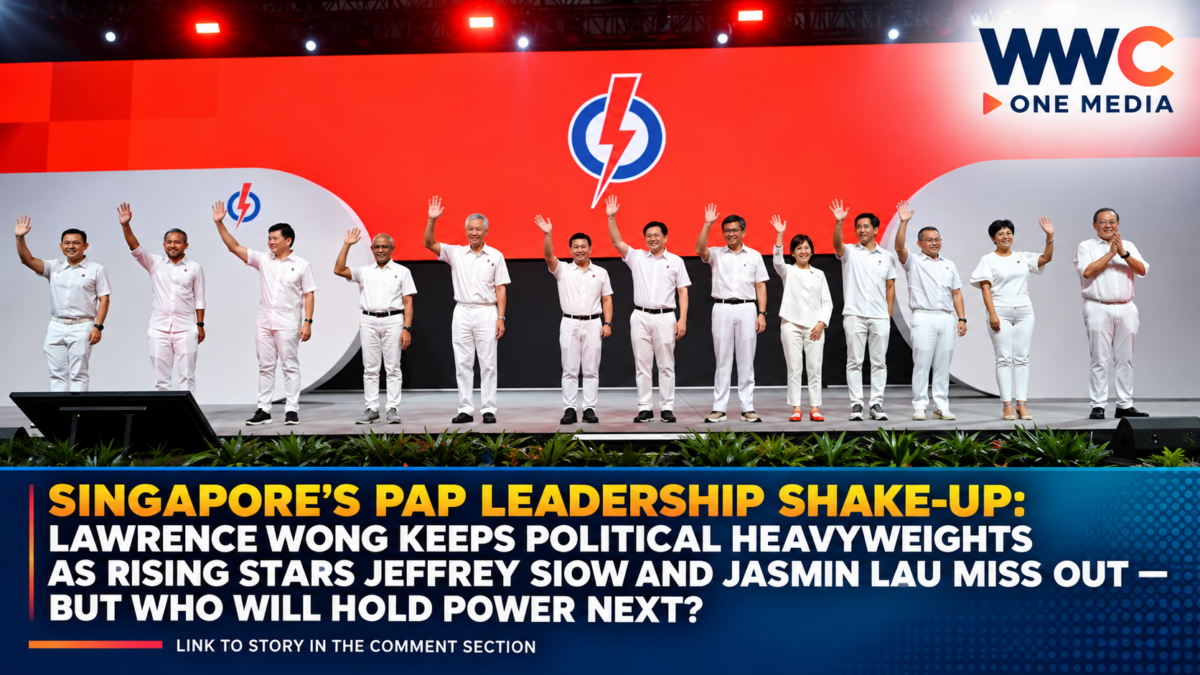
SINGAPORE, October 25, 2026 — Singapore’s ruling People’s Action Party (PAP) has elected its 39th Central Executive Committee (CEC), retaining an experienced leadership team under Prime Minister Lawrence Wong while leaving two rising political figures outside its highest decision-making body.
The results, announced following the party’s biennial conference on Sunday, October 25, revealed that Transport Minister Jeffrey Siow and Acting Manpower Minister Jasmin Lau were among 19 nominated candidates but failed to secure positions in the initial 14-member leadership lineup.
The election represents an important moment for Wong, marking the first PAP leadership contest since he led the ruling party through the 2025 General Election as prime minister.
While established political heavyweights retained their influence, the results raised a significant question about the party’s future: How quickly will Singapore’s next generation of leaders move into positions of greater power?
PAP Retains 14 Senior Leaders in Its Top Decision-Making Body
The PAP’s Central Executive Committee is the party’s highest decision-making body, responsible for overseeing its political direction, internal leadership and organisational priorities.
During Sunday’s election, party cadres selected 12 members through a secret ballot involving 19 candidates.
The elected members are:
- Lawrence Wong — Prime Minister and PAP Secretary-General
- Lee Hsien Loong — Senior Minister
- Desmond Lee — Minister for Education
- Chan Chun Sing — Coordinating Minister for Public Services and Minister for Defence
- Masagos Zulkifli — Minister for Social and Family Development
- K. Shanmugam — Minister for Home Affairs
- Grace Fu — Minister for Sustainability and the Environment
- Chee Hong Tat — Minister for National Development
- Edwin Tong — Minister for Law
- Indranee Rajah — Minister in the Prime Minister’s Office
- Ong Ye Kung — Minister for Health
- Vivian Balakrishnan — Minister for Foreign Affairs
Two additional leaders, Tan See Leng and Zaqy Mohamad, were co-opted into the committee after receiving the 13th- and 14th-highest vote totals.
The lineup underlines the PAP’s preference for leadership continuity, with its most established figures continuing to occupy key positions in the party hierarchy.
Jeffrey Siow and Jasmin Lau Miss Out Despite Securing Nominations
One of the election’s most closely watched developments was the unsuccessful bid by Jeffrey Siow and Jasmin Lau to join the PAP’s top leadership body.
Both were elected to parliament for the first time in Singapore’s 2025 General Election and subsequently took on significant government responsibilities.
Their inclusion on the nomination list indicated that they were among the political figures being considered for higher party responsibilities.
However, neither secured sufficient support to enter the initially announced committee.
Other unsuccessful candidates included Alex Yam, Josephine Teo and Sim Ann.
First-term minister David Neo was not among the nominated candidates.
The outcome does not mean Siow or Lau has lost a government appointment, nor does it establish that either has been permanently excluded from future party leadership.
The PAP’s constitution permits additional members to be co-opted, creating another possible route into the committee.
Nevertheless, the election demonstrates that political advancement within Singapore’s dominant ruling party involves more than holding a government portfolio. Internal party support and leadership calculations also play important roles.
Lawrence Wong’s Leadership Faces a Generational Test
The election comes as Wong continues consolidating his position after succeeding Lee Hsien Loong as prime minister in 2024.
The 2025 General Election gave Wong his first electoral mandate as head of government, making Sunday’s party leadership vote another milestone in his premiership.
According to Channel NewsAsia, seven senior figures were identified as the core leadership team: Wong, Lee Hsien Loong, Desmond Lee, Chan Chun Sing, Masagos Zulkifli, K. Shanmugam and Grace Fu.
The continued presence of Lee Hsien Loong, who served as prime minister for two decades, highlights the role of experienced political leaders in supporting the PAP’s transition to its fourth-generation leadership.
Political observers had anticipated that the election could open opportunities for younger ministers and emerging politicians.
However, the result suggests a gradual approach rather than an immediate generational overhaul.
Chee Hong Tat Moves Into the Elected Leadership Group
Another notable development was Chee Hong Tat’s position among the 12 directly elected committee members.
Chee had previously entered the 38th CEC through co-option.
Mothership reported that Chee took a directly elected position previously held by former Deputy Prime Minister Heng Swee Keat, marking a change in the composition of the leadership’s elected core.
The shift is significant because it demonstrates how the PAP can renew parts of its leadership while keeping much of its established team intact.
Meanwhile, Tan See Leng and Zaqy Mohamad entered the newly announced committee through the co-option process.
More Leadership Appointments Still to Come
Despite the election results, the PAP’s leadership selection process is not yet complete.
The party’s constitution allows up to six co-opted CEC members.
With two already added, as many as four more could potentially join the committee.
The elected committee must also determine its office-bearers, including positions such as party chairman, secretary-general, treasurer and organising secretaries.
These announcements are expected in the coming weeks.
The remaining appointments could reveal how Wong intends to distribute responsibilities among experienced ministers and the party’s emerging generation.
However, the PAP election should not be confused with a Cabinet reshuffle. Membership in the party’s central committee and appointments to the Singapore government are separate matters.
Wong Warns Strong Election Victory Does Not Guarantee Future Support
Addressing party members at Sunday’s conference, Wong emphasised that the PAP cannot rely solely on its past achievements to maintain Singaporeans’ trust.
He acknowledged that younger generations may not share the same historical attachment to the ruling party as older voters.
Wong called on the PAP to reconnect with younger Singaporeans, demonstrate its relevance and continue earning public confidence through effective governance.
His remarks carried particular significance after the ruling party’s victory in the 2025 General Election.
The prime minister’s message was that electoral success should not lead to complacency.
For Singapore’s long-governing PAP, the challenge is not simply maintaining political control but showing that its leadership remains responsive to changing public expectations.
Why Singapore’s PAP Election Matters Beyond Party Politics
Although the vote was an internal party election, its implications extend to Singapore’s broader political environment.
The PAP has governed Singapore continuously since independence in 1965, making its internal leadership decisions particularly consequential.
The composition of its top committee offers clues about the politicians likely to influence the party’s future strategy, candidate development and organisational priorities.
The latest election highlights three major themes: leadership continuity, gradual succession planning and the importance of winning support within the party itself.
The decision to retain senior political figures may provide stability during an uncertain international environment.
At the same time, the absence of newer ministers from the initial lineup leaves questions about the speed of the party’s leadership renewal.
The Bigger Question: Who Will Shape Singapore’s Next Political Era?
For now, Wong’s PAP leadership team appears to favour experience and continuity over a dramatic changing of the guard.
But with additional committee members and senior party appointments still to be announced, the leadership story is far from complete.
Will younger ministers receive another opportunity to enter the party’s inner circle? Could new appointments reveal which politicians are being prepared for greater responsibilities?
Those questions will remain in focus as the PAP finalises the leadership team expected to guide it through the next two years.
For Singapore, the most revealing part of this leadership transition may still be ahead.