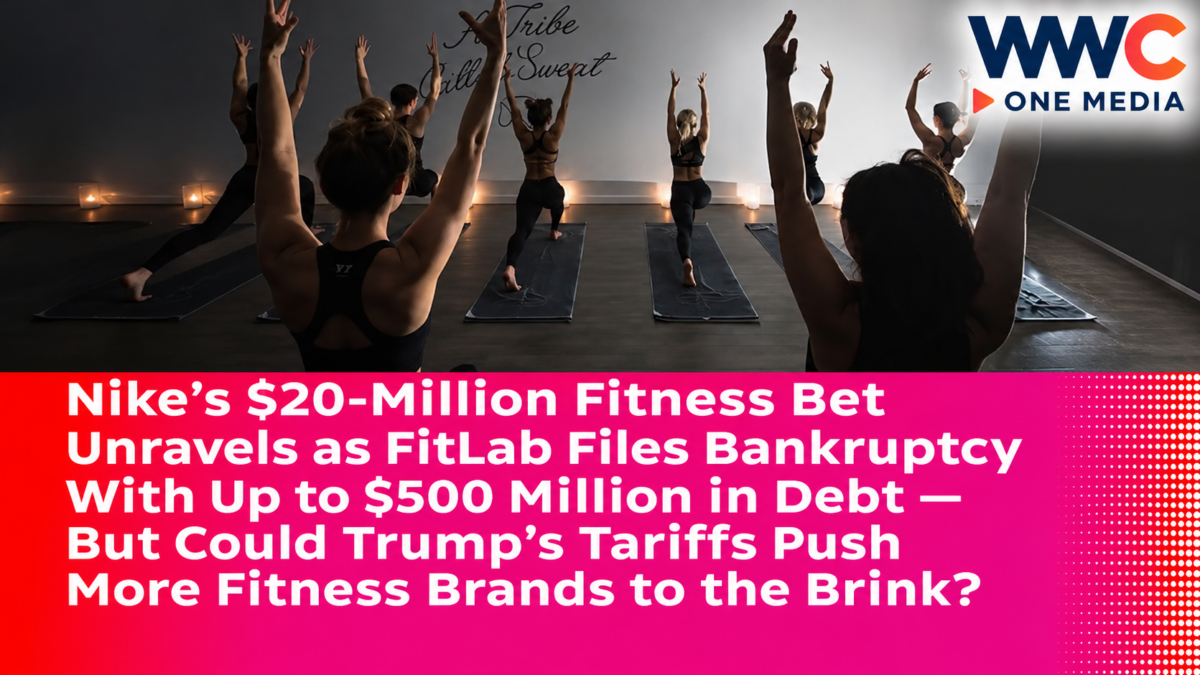
NEWPORT BEACH, CALIFORNIA / MANILA, PHILIPPINES — November 5, 2026 | WWC ONE MEDIA | Global Business, Fitness Industry, Bankruptcy, Retail and US Trade Policy
A once-ambitious American fitness empire is fighting for survival after losing a major partnership with Nike, suffering severe supply-chain disruptions and struggling with the fallout from US tariff policies.
FitLab Inc., the California-based company behind fitness-equipment manufacturer Assault Fitness, endurance-race organizer Ragnar and boutique yoga brand Y7 Studio, has filed for Chapter 11 bankruptcy protection in Delaware.
The company reported estimated liabilities of between $100 million and $500 million, compared with estimated assets of just $10 million to $50 million.
According to Bloomberg’s November 4 report, FitLab Blames Bankruptcy on Loss of Nike Partnership, Trump Tariffs, the company’s financial difficulties intensified after Nike terminated a partnership that had supported the opening of 10 Nike-branded fitness studios.
At the same time, tariffs introduced under President Donald Trump created uncertainty over import costs, while a breakdown in FitLab’s manufacturing arrangements disrupted sales of its popular gym equipment.
The problems converged as the company struggled to integrate businesses acquired during an aggressive expansion strategy.
FitLab’s Chief Restructuring Officer Nicholas Rubin detailed these challenges in a November 4 declaration submitted to the US Bankruptcy Court for the District of Delaware.
The company now intends to sell assets through a court-supervised process, leaving customers, creditors, employees and business partners facing uncertainty over which brands will survive.
The question now is whether FitLab can preserve its strongest businesses through bankruptcy—or whether the collapse of its Nike relationship and years of mounting financial pressure have pushed the fitness empire beyond recovery.
FitLab Files for Chapter 11 Bankruptcy With Up to $500 Million in Liabilities
FitLab officially entered Chapter 11 bankruptcy protection on October 26, 2026.
Its petition was filed in the US Bankruptcy Court for the District of Delaware under case number 26-11681.
The company reported estimated assets between $10 million and $50 million and liabilities between $100 million and $500 million.
It also listed approximately 1,000 to 5,000 creditors.
These figures demonstrate the scale of the company’s financial distress.
However, they are preliminary ranges disclosed at the beginning of the bankruptcy proceedings.
They should not be interpreted as a final audit of its financial position.
Chapter 11 bankruptcy protection allows a company to restructure its operations, negotiate with creditors and potentially sell businesses while operating under court supervision.
It does not automatically mean that every brand must close permanently.
FitLab has indicated that it intends to pursue sales of its assets while exploring ways to preserve viable operations.
That makes the next stage of bankruptcy proceedings especially important for Assault Fitness, Ragnar and other affiliated businesses.
Nike’s $20-Million Investment Becomes a Major Part of the Bankruptcy Story
One of FitLab’s most significant relationships was with Nike, the global sportswear company.
Nike led FitLab’s Series B financing with a $20-million investment.
According to Bloomberg’s account of the bankruptcy declaration, almost all that investment was used to establish and operate 10 Nike-branded fitness studios across Southern California and Austin, Texas.
The partnership was intended to combine Nike’s global brand recognition with FitLab’s experience managing specialized fitness businesses.
The studios offered structured fitness experiences designed around Nike’s athletic identity.
The arrangement also provided FitLab with an opportunity to expand its physical presence in the boutique fitness market.
But the business proved expensive to operate.
Rubin explained in the court declaration that the studios required substantial spending to maintain service levels and meet brand standards.
Those obligations placed pressure on FitLab’s financial resources.
The arrangement became even more difficult when Nike decided to end the partnership.
Nike Ends Its Fitness Studio Deal, Leaving FitLab With 10 Locations
Nike terminated the Nike Studios partnership in early 2026.
The studios had operated for more than two years before the arrangement ended.
According to the bankruptcy declaration, FitLab was left responsible for leases associated with the 10 locations.
That created an immediate financial problem.
FitLab could no longer operate the premises under the Nike Studios name, but it remained exposed to contractual obligations connected to the locations.
The company faced the challenge of managing property costs without the original brand relationship that had supported those operations.
The loss of the partnership also reduced the value of an important component of FitLab’s integrated fitness strategy.
For businesses operating physical studios, property leases can represent substantial continuing expenses.
Rent, maintenance and other contractual commitments may continue even when customer demand weakens or a branded operating arrangement ends.
The bankruptcy filing suggests those commitments contributed to FitLab’s financial deterioration.
However, Nike’s decision to terminate the partnership should not be described as the sole cause of bankruptcy.
The court declaration identifies several additional problems, including acquisition costs, supply-chain disruptions and financing difficulties.
Trump’s Tariffs Disrupt Assault Fitness Equipment Business
FitLab’s troubles were not limited to its fitness studios.
Assault Fitness, one of the company’s major operating brands, also experienced severe disruption.
The business manufactures and sells equipment such as air bikes, treadmills and rowing machines.
Its products are used by gyms, fitness studios, competitive athletes and home-exercise customers.
According to Rubin’s bankruptcy declaration, tariff changes beginning in April 2025 created uncertainty about import costs and customs procedures.
That uncertainty complicated the company’s equipment business.
Imported fitness machinery can involve complex international supply chains, including components and finished products manufactured in Asia.
Changes in tariff policy may affect pricing, inventory planning and the amount of working capital required to move goods into the United States.
But the court filings identify more than tariff uncertainty alone.
Assault Fitness also encountered serious problems with a major manufacturing partner.
Those difficulties forced the company to reorganize production, creating a prolonged interruption during an important selling period.
A Manufacturing Breakdown Takes Assault Fitness Out of the Market for Months
The manufacturing disruption involved Impulse Fitness, a major supplier connected to the Assault Fitness equipment business.
Rubin said FitLab encountered problems with the manufacturer and needed to find a replacement.
The transition took approximately six to eight months.
During that period, Assault Fitness was unable to maintain normal product availability.
The disruption extended into much of the 2025 holiday shopping season, when consumer businesses often depend on strong sales to generate cash.
For a fitness-equipment company, prolonged product shortages can have serious consequences.
Distributors may be unable to replenish inventory.
Retailers may seek competing brands.
Consumers may cancel orders.
And suppliers may become less willing to extend credit.
The effect can continue even after production resumes, because lost sales and damaged customer confidence are difficult to recover.
FitLab’s experience shows how vulnerable an equipment company can become when manufacturing problems coincide with financial stress.
Nearly $3 Million in Unfulfilled Equipment Orders Adds to the Crisis
The November 4 bankruptcy filings provided additional information about customers still waiting for products.
According to Hybrid Fitness Media’s review of the court declaration, FitLab estimated approximately $3 million in liabilities associated with unfulfilled Assault Fitness consumer presales.
These obligations represent purchases for which customers had not received the expected merchandise.
The company also reported that outstanding orders had harmed consumer confidence.
Meanwhile, FitLab had more than $3 million in fully paid inventory at retail value in US warehouses when the bankruptcy petition was filed.
However, the documents did not establish whether that inventory matched the products already ordered by customers.
This creates an important distinction.
Having inventory available does not necessarily mean the company can fulfill all existing orders.
Products may be different models or configurations from those purchased.
They may also require additional shipping arrangements, parts or payments to service providers.
The bankruptcy process will determine how operations and outstanding customer claims are handled.
Supplier Disputes Make the Equipment Crisis Worse
The manufacturing disruption also created financial problems with suppliers.
According to the court declaration, FitLab had previously owed approximately $4 million to Impulse Fitness.
That balance was subsequently reduced to around $1.65 million.
Impulse Qingdao Health Tech was listed among the company’s major unsecured creditors, with a disputed claim of approximately $1.646 million.
The filings did not establish the full basis for the dispute.
Rubin also said issues surrounding the manufacturer affected FitLab’s relationship with China’s export-credit insurer, Sinosure.
As a result, other manufacturing partners began demanding full payment before releasing goods.
That created additional pressure on the company’s cash flow.
Businesses operating under normal credit arrangements may receive inventory before making final payment.
But when suppliers demand payment in advance, companies need more cash to maintain the same level of operations.
For FitLab, that requirement emerged when sales had already been disrupted.
The result was a worsening cycle of product shortages, financial pressure and reduced customer confidence.
FitLab’s Acquisition Strategy Proves Difficult to Sustain
FitLab was founded in 2019 with ambitions to build an integrated fitness ecosystem.
Rather than operating a single gym chain or equipment business, the company sought to combine multiple brands under one organization.
Its portfolio grew to include Assault Fitness, Ragnar, Y7 Studio, Mile High Run Club and other fitness concepts.
The strategy aimed to create opportunities across fitness equipment, boutique studios, endurance events and related services.
But operating businesses with different revenue models can be expensive and complicated.
An equipment manufacturer depends on inventory, suppliers and distribution.
A boutique studio depends on property leases, instructors and recurring customer attendance.
An endurance-race organizer depends on event participation, permits, sponsorships and logistics.
FitLab needed to coordinate these businesses while funding acquisitions and maintaining adequate working capital.
The company’s bankruptcy illustrates the risks of expanding through acquisitions before each component of a business has achieved sustainable profitability.
FitLab’s $14-Million Y7 Studio Acquisition Ends in Closures
FitLab’s acquisition of Y7 Studio became another major point of controversy.
Bloomberg reported that FitLab purchased the boutique yoga business for approximately $14 million.
The acquisition was intended to strengthen the company’s studio portfolio.
But Y7 subsequently experienced serious operating difficulties.
Athletech News reported that its physical studios had closed by September 2026.
Y7 founder Sarah Larson Levey publicly criticized the management decisions made after the acquisition.
She also raised concerns about unpaid staff compensation and the breakdown of expansion plans.
Her statements represent her account of the events and should not be treated as independent court findings against every company involved.
The closure of the studios demonstrates the wider problems FitLab encountered while integrating and financing its acquired brands.
Instead of creating a stable network of complementary businesses, the group faced operational difficulties across several parts of its portfolio.
Ragnar Race Series Could Survive Under New Ownership
Not every FitLab business necessarily faces the same outcome.
Ragnar, the endurance-race organizer known for team relay events, may continue operating through a change of ownership.
Athletech News reported that a separate investment group had funded seven Ragnar events since mid-August 2026.
Ragnar Chief Executive Philip LaHaye told participants that FitLab’s bankruptcy filing was an important step toward completing a proposed acquisition of the race business.
That development suggests there may be buyers interested in preserving specific brands rather than acquiring the entire FitLab organization.
However, funding individual events does not guarantee that a final acquisition has been completed.
Any transfer involving bankruptcy assets may require court approval and compliance with applicable sale procedures.
For athletes and customers, future event schedules will depend on the arrangements made by Ragnar and its prospective owners.
Assault Fitness Could Be Sold as Part of the Restructuring
Assault Fitness may represent one of FitLab’s strongest remaining commercial opportunities.
In the November 4 court declaration, Rubin described the equipment business as the principal source of the group’s revenue and profitability.
The company intends to pursue a comprehensive marketing and asset-sale process led by Hilco.
According to Hybrid Fitness Media, a proposed timeline calls for bids by December 29, 2026, with a potential sale closing by January 24, 2027.
Those dates are proposed targets, not confirmed completed transactions.
A prospective buyer could acquire the brand, equipment designs, inventory and other relevant assets.
But restoring the business would likely require rebuilding manufacturing relationships, repairing customer trust and addressing unresolved order issues.
Any proposed sale would also depend on the terms approved through the bankruptcy process.
The situation remains fluid.
FitLab Seeks Millions in Financing to Continue Operations
FitLab has asked the bankruptcy court to approve financing intended to support operations during restructuring.
Court-related reporting indicates that the proposed debtor-in-possession financing package involves Grizzly Investment Group and related arrangements.
The company is seeking financing of approximately $5.6 million under the broader proposed package, although individual reporting has described a smaller component of approximately $5.15 million.
These figures should not be added together because they refer to related financing arrangements.
Court approval is required before the relevant financing can proceed on the proposed terms.
The funds are intended to help preserve operations and support the planned sale process.
However, financing during bankruptcy does not guarantee that every brand will survive.
It provides potential liquidity while management attempts to recover value for creditors.
The court scheduled a hearing for November 5, 2026, to consider matters arising from the proceedings.
Nike Faces Its Own Difficult Global Turnaround
FitLab’s bankruptcy comes as Nike is undertaking a major restructuring of its own business.
The sportswear company has faced slowing sales, particularly in China, increased competition and pressure on profitability.
Reuters reported in October that Nike was preparing additional job cuts and organizational changes.
The company also forecast a high-single-digit decline in fiscal 2027 revenue.
WWC ONE MEDIA previously examined the restructuring in Nike Plans More Job Cuts as Turnaround Faces Steep Revenue Decline.
Nike’s restructuring program aims to simplify operations and generate approximately $2.5 billion in savings through fiscal 2031.
The fitness studio partnership was only one part of Nike’s wider business activities.
The available reporting does not establish that FitLab’s bankruptcy has caused a material financial crisis at Nike.
The companies face very different financial circumstances.
Nike remains a publicly traded global sportswear company, while FitLab has entered court-supervised restructuring.
Nevertheless, the loss of the partnership highlights the risks faced by smaller businesses that depend heavily on arrangements with larger corporate partners.
Trump Tariffs Remain a Major Supply-Chain Concern
FitLab’s account adds to wider concerns about the effects of changing US trade policy on import-dependent businesses.
Tariffs can increase the cost of bringing products into the country.
They can also create uncertainty when companies do not know which duties will apply when products arrive.
For businesses operating with limited cash reserves, unexpected import costs can complicate inventory purchases and financial planning.
WWC ONE MEDIA previously examined the wider consequences in The Great Lakes Built a $376 Billion Trade Lifeline — Trump’s Tariffs Are Now Putting It Under Pressure.
That report described how tariff disputes can disrupt supply chains that were built around predictable trade conditions.
FitLab’s problem involved fitness-equipment imports rather than North American industrial shipping.
But the underlying business risk is comparable.
Companies that depend on international suppliers may struggle when trade rules change while they are already facing financing or operational difficulties.
The bankruptcy declaration identifies tariffs as one contributing factor, not a government-confirmed determination that trade policy alone caused the company’s failure.
Nike’s Tariff Relief Shows Why the Financial Impact Is Complicated
There is an important additional qualification to the tariff debate.
In February 2026, the US Supreme Court ruled that tariffs imposed under the International Emergency Economic Powers Act exceeded the authority granted by that statute.
The decision created the possibility of refunds for certain previously collected duties.
Nike later recognized a substantial financial benefit related to tariff recovery.
WWC ONE MEDIA covered the development in Nike and Starbucks Get Billions Back From Tariffs — But Wall Street Barely Blinks.
The report discussed Nike’s recognition of approximately $986 million in tariff-related relief.
However, that does not mean FitLab’s earlier operational losses or financing problems were automatically reversed.
Tariff refunds may be subject to different eligibility requirements, timing and accounting treatment.
And companies can experience lasting commercial disruption even when some import duties are subsequently invalidated or recovered.
For FitLab, the manufacturer’s withdrawal, delayed production, supplier financing problems and loss of sales created consequences beyond the immediate tariff rate.
Nike Looks to India as Its Wider Strategy Changes
Nike has also been seeking new growth opportunities outside its struggling markets.
One example is its introduction of a running shoe developed specifically for Indian consumers.
WWC ONE MEDIA examined that strategy in Nike Designs Its First Running Shoe Exclusively for India — But Can a ₹3,795 Sneaker Help Fix Its Global Sales Problem?.
The initiative forms part of Nike’s efforts to strengthen its performance-sports business and respond more closely to local consumer demand.
Nike’s broader strategic shift provides context for its changing business relationships.
However, the company has not publicly established that its India product strategy directly caused the termination of the FitLab studio arrangement.
The two developments should be understood separately.
The Fitness Industry Faces a Broader Financial Reality Check
FitLab’s financial difficulties illustrate the risks of expanding a consumer business through multiple acquisitions while maintaining substantial fixed costs.
Fitness companies face different challenges depending on their business models.
Studios must cover rent, instructors and operating expenses.
Equipment manufacturers must maintain sufficient inventory and stable supplier relationships.
Event organizers must finance venues, staff, permits and logistics before participants arrive.
Companies combining all three models may benefit from shared customers and complementary brands.
But they may also face financial pressure when several businesses encounter problems simultaneously.
FitLab’s experience raises a wider question for investors: Can a group of fitness brands generate enough cash flow to justify the costs of acquiring and operating them?
The answer depends on profitability, financing terms and operating efficiency rather than the number of recognizable brands in a portfolio.
Other Retailers Are Also Facing Financial Distress
FitLab is not the only consumer-facing company confronting a difficult financial environment.
WWC ONE MEDIA recently examined the uncertain future of a major US children’s apparel chain in Children’s Place Faces Possible Liquidation as Sales Plunge 19% and Cash Falls to $7.2 Million — But Can a Last-Minute Buyer Save 514 Stores?.
The two businesses have different operating models and financial histories.
However, both highlight the importance of liquidity, creditor relationships and controlling operating expenses.
For consumer businesses, sales alone are not enough.
Companies must maintain enough cash to pay suppliers, employees, landlords and other obligations.
When access to financing deteriorates, even valuable brands may become vulnerable.
Bankruptcy proceedings can sometimes preserve a viable business through restructuring or sale.
But they can also expose investors and creditors to significant losses.
What FitLab’s Bankruptcy Means for Customers
For customers who purchased Assault Fitness equipment but have not received their orders, the bankruptcy creates immediate concerns.
Hybrid Fitness Media reported that the November 4 filings identified approximately $3 million in liabilities tied to outstanding consumer presales.
The documents did not confirm whether all pending orders will be fulfilled.
Customers should preserve order confirmations, receipts and communications with the company.
Those who paid by credit card may wish to ask their card issuer promptly about applicable dispute procedures and deadlines.
The bankruptcy claims process may also provide a way to seek recovery, depending on the customer’s legal position.
However, a claim does not guarantee full repayment.
Court-supervised distributions depend on available assets and the legal priority of different claims.
Updates to the case and claims process are available through FitLab’s bankruptcy claims administrator.
What Happens Next in FitLab’s Bankruptcy?
Several developments will determine the company’s future.
The bankruptcy court must consider the proposed financing arrangements.
Management and its advisers will continue assessing whether individual brands can be sold as operating businesses.
Potential buyers may evaluate Assault Fitness, Ragnar and other assets.
Creditors will seek information about the company’s financial position and the prospects for recovering amounts owed.
The scheduled November 23 meeting of creditors is another important procedural step.
A proposed asset-sale timetable could lead to bids in late December and a transaction in January 2027.
But the process remains subject to court decisions, financing availability and actual buyer interest.
No final outcome should be assumed before the relevant agreements and approvals are completed.
The Bigger Question: Can FitLab’s Fitness Brands Survive After the Parent Company’s Bankruptcy?
FitLab’s collapse into Chapter 11 protection represents a dramatic reversal for a company that once aimed to create an integrated fitness and performance lifestyle empire.
Nike’s $20-million investment helped launch an ambitious studio partnership.
That relationship later ended, leaving FitLab with costly locations.
Tariff uncertainty and supplier disputes disrupted Assault Fitness equipment sales.
A lengthy manufacturing transition weakened product availability.
Acquisitions created additional operating complexity.
And financial pressure spread across several well-known fitness brands.
Now, FitLab faces the challenge of preserving valuable operations while creditors seek repayment.
Assault Fitness may attract buyers because of its established products and brand recognition.
Ragnar may continue under new ownership.
Other brands have already experienced closures and major disruption.
The bankruptcy case may therefore produce several different outcomes rather than one decision affecting every business equally.
As FitLab enters bankruptcy with up to $500 million in estimated liabilities and its former Nike partnership in ruins, one question could determine the fate of its fitness empire: Will buyers rescue Assault Fitness, Ragnar and the company’s remaining assets—or could the combination of costly expansion, disrupted manufacturing and trade uncertainty become a warning for the entire fitness industry?