
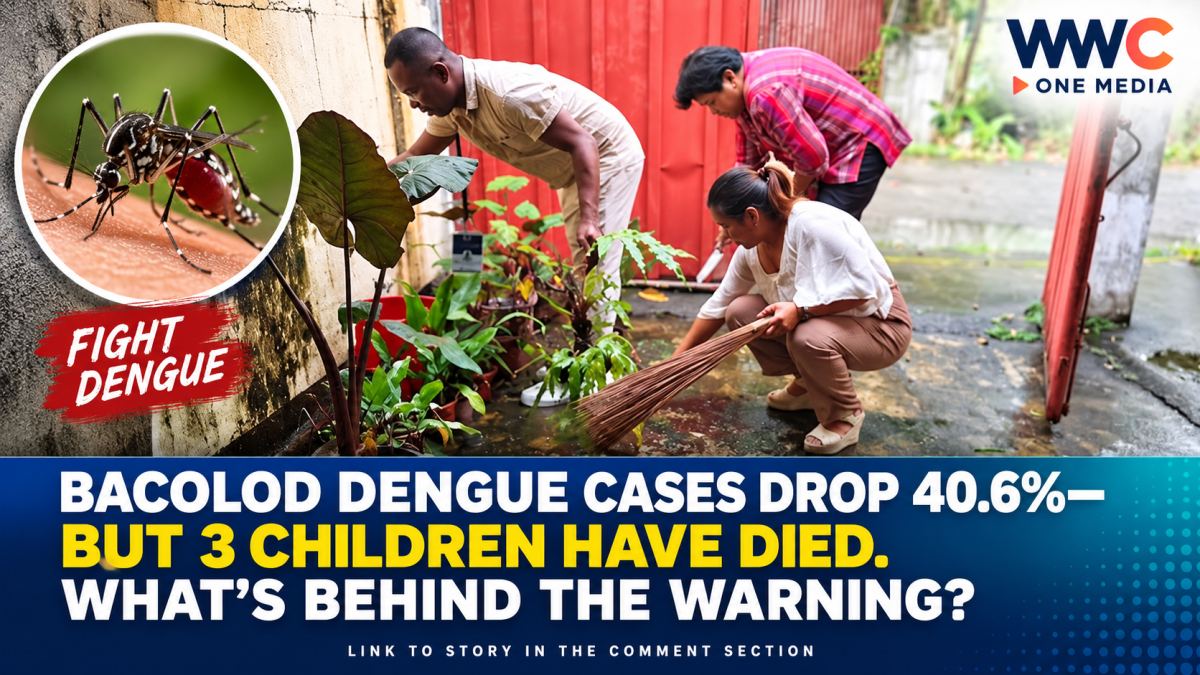
BACOLOD CITY — Dengue cases in Bacolod City have dropped sharply compared with last year, but health officials are warning residents not to let the improvement create a false sense of security after three children have died from dengue-related complications this year.
The Bacolod City Health Office (CHO) recorded 448 dengue cases and three deaths from January 1 through August 22, 2026, according to city surveillance data. That represents a 40.6% decline from the 754 cases recorded during the same period in 2025, when five deaths were reported.
The latest fatalities involved two young girls from Barangays Granada and Mansilingan.
A 5-year-old girl from Barangay Granada was admitted to the Corazon Locsin Montelibano Memorial Regional Hospital (CLMMRH) with dengue fever with warning signs. She died on August 19 after developing severe complications, with pulmonary hemorrhage and acute respiratory failure reported among the causes.
A 4-year-old girl from Barangay Mansilingan was admitted on August 20 with severe dengue and died the following day. Hospital records cited multi-organ dysfunction syndrome, with cardiogenic shock also identified as a contributing condition.
The city’s first dengue-related death this year was an 8-year-old girl from Barangay Villamonte, bringing the total number of dengue fatalities in Bacolod to three.
Cases Are Down, But Several Barangays Remain Hotspots
The CHO data show that dengue transmission is not evenly distributed across the city.
Mansilingan recorded the highest number of cases with 54, followed by Handumanan with 45 and Estefania with 40. Singcang-Airport recorded 30 cases, Banago 29, Alijis 28, while Villamonte and Granada each reported 24. Tangub had 22 cases.
Children continue to make up a substantial portion of reported infections. Daily Guardian reported that 320 of the 448 cases involved people below 20 years old, including 179 children aged 1 to 10 and 133 adolescents aged 11 to 19.
The concentration of cases among younger residents highlights why parents and caregivers should pay close attention to persistent fever and other dengue symptoms.
Why the Decline Should Not Bring Complacency
The latest numbers continue a broader downward trend in Bacolod.
Earlier in the year, the Philippine News Agency reported that the city had recorded only 175 dengue cases from January 1 to May 16, down 50.8% from 356 cases during the comparable period in 2025. Health officials attributed the improvement in part to strengthened community education, early detection and preventive measures.
By August 15, CHO data cited by Digicast Negros showed 389 cases, a 47.6% decrease from 743 cases recorded during the same period the previous year. However, subsequent reports through August 22 brought the cumulative total to 448 cases and three deaths.
The changing figures also demonstrate why dengue surveillance remains important, particularly because case totals can be revised as reports from hospitals and health facilities are received.
Bacolod’s health authorities have repeatedly warned residents against becoming complacent even when cases decline. The city recorded 1,040 dengue cases in 2025, itself a 60.4% decrease from the 2,624 cases reported in 2024.
Health Officials Push Household-Level Prevention
City health officials are urging residents to make dengue prevention part of their daily routine, particularly during the rainy season when stagnant water can provide breeding sites for mosquitoes.
The Department of Health’s dengue strategy emphasizes searching for and destroying mosquito breeding places, using personal protection measures, seeking early medical consultation, and supporting fogging or spraying when indicated. Bacolod health officials have also promoted community cleanup efforts, including the city’s daily 4 o’clock habit, to remove potential breeding sites.
Residents are also encouraged to follow the household 4Ts promoted by local health authorities: taob containers that can collect water, taktak or empty water-holding items, keep them tuyo or dry, and takip or cover containers that must hold water.
Know the Warning Signs
Dengue commonly begins with a sudden high fever that can last several days, accompanied by symptoms such as severe headache, muscle and joint pain, pain behind the eyes, weakness and skin rashes.
But health authorities stress that severe dengue can develop quickly.
Warning signs include persistent abdominal pain, repeated vomiting, bleeding such as nosebleeds, dark or bloody stools and difficulty breathing. Anyone showing concerning symptoms—particularly a child with persistent fever or worsening weakness—should be assessed by a medical professional promptly.
The Bottom Line
Bacolod’s 40.6% decline in dengue cases is encouraging, but the three deaths recorded this year show that the threat has not disappeared.
For households, the message from health authorities is straightforward: fewer cases do not mean zero risk. Eliminating standing water, protecting against mosquito bites and seeking medical attention early remain critical defenses against severe dengue.
As the rainy season continues, the battle against dengue ultimately comes down to what happens in neighborhoods—and inside individual homes.
WWC ONE MEDIA J.M.D




Leave a Reply