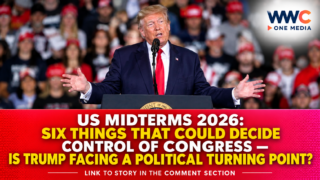
WASHINGTON / MANILA — November 3, 2026. With control of the United States Congress hanging in the balance, President Donald Trump made an unusual final public appeal before the 2026 midterm elections: instead of delivering a conventional campaign speech in a competitive state, he stood before Washington’s Lincoln Memorial Reflecting Pool to celebrate a multimillion-dollar renovation project.
The November 2 appearance came just hours before Americans headed to the polls to decide control of the House of Representatives and Senate.
But the setting quickly became part of the political story.
Rather than concentrating exclusively on inflation, household expenses or the closely contested congressional races, Trump spent much of his approximately 54-minute address discussing the repaired Reflecting Pool, construction materials, Washington monuments and other projects intended to reshape the capital.
According to Reuters, the Associated Press, AFP and Axios, the president praised the renovation, defended his administration’s broader construction agenda and warned voters against electing Democrats.
The speech also revived controversy over the Reflecting Pool itself.
The renovation was originally promoted as a relatively quick and inexpensive repair. Instead, it encountered peeling surfaces, algae problems, repeated closures and a cost that Reuters reported had exceeded $16 million.
Trump nevertheless presented the restored site as evidence of his administration’s ability to improve public infrastructure.
Democrats saw the moment differently.
They argued that the president’s focus on Washington construction projects illustrated a disconnect from voters struggling with food, energy, housing and other living costs.
As Americans prepare to decide whether Republicans should retain control of Congress, the question is whether Trump’s unconventional closing message will energize his supporters — or reinforce the economic frustrations Democrats hope will determine the election.
Trump Turns the Lincoln Memorial Reflecting Pool Into His Final Campaign Stage
The White House selected the Reflecting Pool for Trump’s final major public remarks on November 2.
Located between the Lincoln Memorial and Washington Monument, the pool is one of the most recognizable landmarks in the United States.
The site has historical significance.
From the steps of the Lincoln Memorial overlooking the water, civil rights leader Martin Luther King Jr. delivered his famous 1963 speech during the March on Washington.
The Reflecting Pool also serves as a prominent setting for national commemorations, public gatherings and presidential events.
Trump chose the location to highlight his administration’s renovation work.
The president had previously described the project as an effort to address persistent leaks and improve the landmark’s appearance.
At Monday’s event, he showed photographs illustrating problems with the pool and discussed the repairs in considerable detail.
He also reviewed other construction projects around the capital.
The message reflected a theme of his presidency: portraying physical infrastructure improvements as evidence of executive action and administrative effectiveness.
But selecting the Reflecting Pool rather than a traditional campaign venue attracted criticism because the event occurred on the final day before a consequential national election.
A $16-Million Renovation With a Troubled History
The Reflecting Pool renovation has faced significant difficulties.
Trump originally announced plans to repair the landmark in the spring, with expectations that work would be completed quickly.
The initial project was promoted at a considerably lower cost than later reported expenditures.
However, the renovation encountered complications.
The new pool coating began peeling after the site reopened.
Algae also appeared in the water, requiring further work and additional closures.
The repairs continued well beyond the initial timetable.
By November 2, Reuters reported that the project had cost more than $16 million.
The Washington Post separately reported a total exceeding $14 million, reflecting differences in reporting and the scope or timing of costs included.
The administration defended its approach and maintained that the project had ultimately improved the site.
Critics questioned the speed of the original work, the use of noncompetitive contracting and the additional spending required to correct defects.
These competing accounts form an important part of the controversy.
The renovation’s cost and implementation became political issues rather than remaining routine infrastructure matters.
Trump Revives Vandalism Allegations Despite the Failed Criminal Case
During his November 2 speech, Trump again discussed allegations of vandalism at the Reflecting Pool.
The remarks were controversial because federal prosecutors had previously abandoned a criminal case related to the damage.
Former Olympic canoeist David Hearn had been accused of involvement in vandalism.
However, prosecutors subsequently acknowledged that defective installation contributed to the pool’s problems.
The government dropped its case, and a judge later dismissed the charges in a manner that prevented their revival.
Axios and the Washington Post reported that Trump continued referring to vandalism despite the outcome of the prosecution.
The distinction matters.
There is a difference between a president’s allegation and what investigators or courts have established.
The available reporting does not support treating Hearn as responsible for the renovation defects.
The failed prosecution also created an awkward political moment because the Justice Department operates under the same administration that had initially emphasized vandalism as an explanation for the damage.
A Campaign Speech Dominated by Construction, Not Consumer Prices
Trump’s decision to devote much of his final address to Washington projects contrasted with the issues dominating the election campaign.
Reuters and AP reported that the cost of living remained one of voters’ central concerns.
Energy prices had risen amid the conflict involving Iran, while households continued struggling with higher expenses.
In his speech, Trump defended the economy and promoted his administration’s record.
He also criticized Democrats, presenting their candidates as politically extreme and arguing that Republican victories were necessary to protect his agenda.
But much of the event emphasized infrastructure.
The president discussed the Reflecting Pool’s pipes, surface materials, algae-control efforts and improved appearance.
He also highlighted a White House helipad, landscaping projects and future construction plans.
For supporters, the remarks reinforced Trump’s image as a builder determined to make visible improvements to the capital.
For critics, they suggested that the administration was placing too much emphasis on symbolic construction projects while Americans remained concerned about everyday affordability.
The political significance of the speech will ultimately depend on how voters interpret those competing messages.
Trump Jokes About Renaming the Reflecting Pool
One of the most widely reported moments involved Trump’s suggestion that the pool could bear his name.
During the speech, the president joked about calling it the Trump Reflecting Pool.
He subsequently indicated that the remark was not a serious renaming announcement.
The comment drew attention because the site is associated with Abraham Lincoln and occupies a prominent place within the National Mall.
Trump’s broader plans for Washington have already generated controversy.
Other proposals include a triumphal arch, a White House ballroom and additional changes to federal landmarks and public spaces.
Some projects have attracted support from those who favor restoring aging infrastructure.
Others have generated lawsuits and objections involving design, funding, historic preservation or the use of executive authority.
No official renaming of the Lincoln Memorial Reflecting Pool was established by Monday’s speech.
Democrats Focus on Inflation as Trump Defends His Presidency
Democratic candidates spent the final campaign period emphasizing the economy and living costs.
Their argument centers on the claim that Republican control of Washington has not adequately protected ordinary households from higher expenses.
Trump and Republican candidates have offered a different message.
They emphasize economic growth, immigration enforcement, national security and their administration’s policy priorities.
The president also argues that Democrats would undermine his achievements if they regain congressional control.
The debate reflects sharply different assessments of the country’s direction.
While Trump has promoted improvements in the economy and government performance, surveys cited by AP and Reuters show substantial public dissatisfaction over affordability.
The election will test which arguments resonate most strongly across different states and congressional districts.
However, national polling cannot determine the outcome of every individual race.
Candidate quality, local issues and voter turnout can create results that differ from nationwide trends.
Trump Changes His Final Campaign Strategy
Trump’s Reflecting Pool appearance followed adjustments to his campaign schedule.
He had canceled planned in-person rallies in Kansas and Iowa during the final days before Election Day.
Instead, Republican organizations expanded their use of telephone-based rallies to reach voters across several states.
WWC ONE MEDIA previously examined the strategy in Trump Scraps Kansas and Iowa Rallies Days Before Midterms — Can Phone Campaigns Still Deliver the Republican Votes He Needs?.
The telephone events allowed Trump to reach audiences without traveling to every campaign location.
His final public appearance at the Reflecting Pool therefore became a significant national media event.
The approach may have helped concentrate attention on the president’s chosen message.
However, it also gave Democrats an opportunity to criticize his emphasis on Washington renovations.
Whether that affected voter decisions cannot be established from the speech alone.
Republicans Face a Difficult Battle to Keep Congress
The November 3 election will determine control of the House of Representatives and Senate.
Republicans entered the election defending their congressional majorities.
Political analysts and polling-based forecasts generally viewed Democrats as favored to regain the House, while control of the Senate remained more uncertain.
That assessment reflected voter dissatisfaction, competitive district boundaries and historical patterns in midterm elections.
The president’s party has frequently lost congressional seats during midterms.
Trump acknowledged that historical difficulty during his remarks.
But election forecasts are not results.
Republican candidates could outperform expectations in certain districts, while Democrats could win races in traditionally Republican areas.
The outcome will depend on actual votes counted under each state’s election procedures.
More Than 57 Million Americans Have Already Voted
Early voting has become a major feature of the 2026 midterm elections.
According to the Associated Press, more than 57 million ballots had already been cast across 47 states and Washington, DC, before Election Day.
That represented substantially more early voting than during the comparable stage of the 2022 midterms.
WWC ONE MEDIA previously examined the trend in Record 48 Million Americans Vote Early in 2026 Midterms as Democrats Surge in Key Battlegrounds — But Could Election Day Change Everything?.
The earlier 48-million figure was a snapshot from October 30.
It should not be confused with the larger total reported closer to November 3.
Higher early turnout may indicate strong political engagement.
But it does not establish which party will win.
The final result depends on the combined early, mail and Election Day votes.
California Election Dispute Reaches the Supreme Court
The final campaign period was also marked by legal conflict.
On November 2, the US Supreme Court declined to intervene in the Trump administration’s effort to restrict the handling of disputed mail ballots associated with approximately 20,000 California voter records.
The administration had questioned the eligibility of certain registered voters.
California officials disputed the government’s evidence and opposed the proposed restrictions.
WWC ONE MEDIA covered an earlier stage of the dispute in Trump Loses California Ballot Battle as Court Rejects Bid to Block 20,000 Suspected Voters — But Could the Fight Reach the Supreme Court?.
The Supreme Court’s decision not to grant emergency relief did not amount to a final determination that every disputed voter record was accurate.
It meant the administration did not obtain the requested last-minute intervention.
The case illustrates how election-law disputes can become politically consequential immediately before voting.
Alaska Senate Investigation Adds Another Political Flashpoint
Another controversy involves Alaska’s Senate race.
Federal investigators have been examining allegations concerning a candidate whose name closely resembles that of incumbent Republican Senator Dan Sullivan.
The investigation centers on whether political operatives encouraged a similarly named candidate to enter the race in an effort to confuse voters or affect the election outcome.
WWC ONE MEDIA examined the developing allegations in DOJ Issues New Subpoenas in Alaska Senate Race as ‘Spoiler Candidate’ Allegations Escalate — Could the Investigation Reshape the Election?.
The allegations remain contested.
The existence of subpoenas does not establish criminal wrongdoing.
The Alaska dispute is legally separate from Trump’s Reflecting Pool speech.
However, both developments formed part of a politically intense final campaign period in which questions about government authority, election administration and congressional control attracted national attention.
Trump’s Washington Construction Agenda Could Face Greater Scrutiny
The election could also affect the future of Trump’s capital renovation projects.
Democrats have criticized elements of the administration’s construction agenda and questioned the procedures used to fund or authorize particular projects.
A Democratic-controlled House could conduct investigations or increase oversight through congressional committees.
A change in Senate control could also affect legislative negotiations and executive appointments.
Republicans argue that Trump’s projects represent efforts to improve federal properties and public infrastructure.
Critics counter that major changes to nationally significant landmarks require adequate public consultation, transparent spending and appropriate legal authorization.
Some projects are already subject to litigation.
The final election outcome will influence the political environment in which those disputes unfold.
But the victory of either party would not automatically determine the legal outcome of ongoing court cases.
What the Midterms Mean for the Philippines and Asia
Although the election is being held in the United States, its outcome could affect American relations with countries across Asia.
Congress plays a role in trade policy, federal spending, defense funding and oversight of foreign policy.
For the Philippines, developments involving US trade, security cooperation and regional diplomacy are particularly relevant.
However, it would be premature to forecast specific Philippine policy changes before congressional control is determined.
Many foreign-policy decisions also depend on the executive branch and existing laws.
The immediate significance of the election is that it will determine the balance of power between Trump’s administration and Congress for the remaining two years of his presidency.
The Bigger Question: Did Trump Choose the Right Closing Message?
Trump’s final public speech before the 2026 midterms was unconventional.
Instead of delivering his closing argument from a competitive congressional district, he chose one of Washington’s most recognizable landmarks.
He presented the Reflecting Pool’s restoration as evidence that his administration could improve the nation’s capital.
But the event also revived questions about cost overruns, defective repairs and the failed vandalism prosecution.
At the same time, Democrats continued emphasizing the cost of living and arguing that Trump’s priorities were disconnected from the concerns of ordinary Americans.
The choice highlights the contrast between two campaign narratives.
Trump wants voters to focus on his record and what he describes as a stronger, more successful America.
Democrats want voters to judge the administration’s performance on affordability and other contested policy issues.
Neither message guarantees an electoral outcome.
The answer will emerge from the ballots cast and counted in the November 3 elections.
As Trump ends his midterm campaign beside a Reflecting Pool renovation costing more than $16 million, will voters see a president delivering visible improvements — or could the controversial project become a symbol of misplaced priorities just as Republicans fight to keep control of Congress?