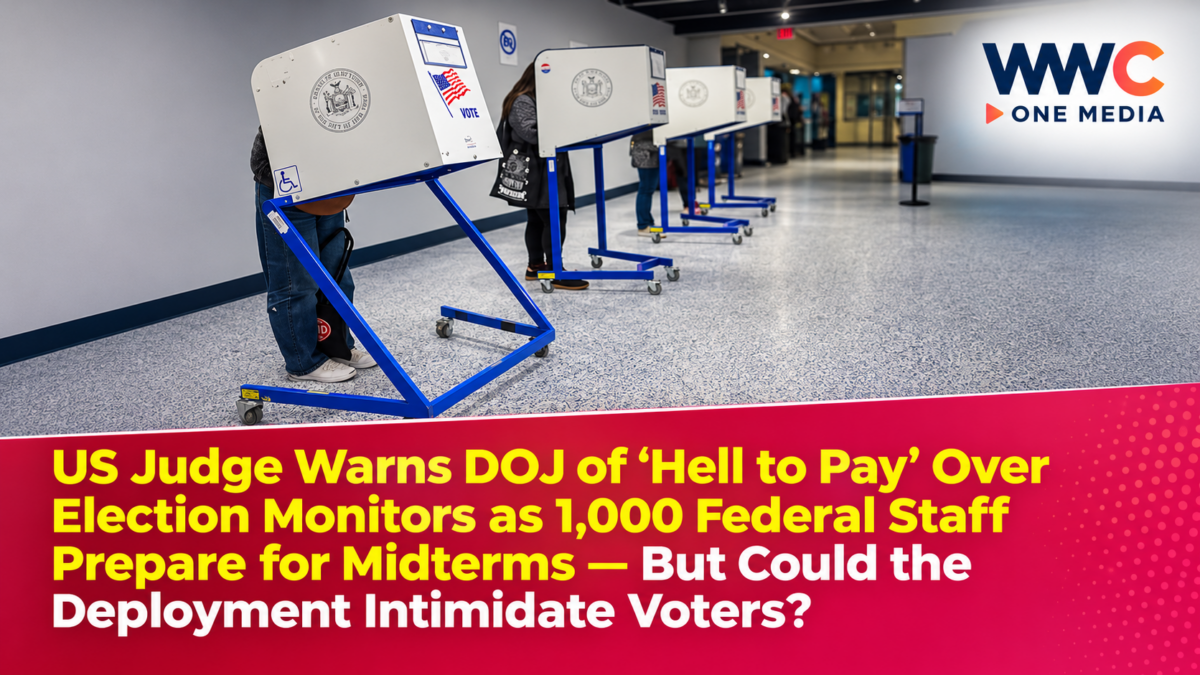
WASHINGTON, United States — November 3, 2026. A federal judge has issued a sharp warning to the Trump administration’s Justice Department over its plans to deploy approximately 1,000 election monitors across the United States, raising the stakes in an emergency legal battle just hours before Americans vote in the 2026 midterm elections.
US District Judge Reggie B. Walton questioned government lawyers on November 2 about whether federal law-enforcement personnel assigned to polling locations would actually perform the limited observational duties described in court filings.
According to Bloomberg’s reporting, Walton warned there would be “hell to pay” if the Justice Department had misrepresented its monitors’ responsibilities.
The warning came during an emergency hearing prompted by the National Association for the Advancement of Colored People (NAACP), which sought to prevent federal law-enforcement personnel from serving as election monitors.
The civil rights organization argued that placing personnel from agencies traditionally associated with criminal investigations and law enforcement inside polling locations could intimidate voters and undermine confidence in the election.
The Justice Department defended the program, maintaining that the monitors would not carry firearms, make arrests, question voters or interfere with election administration.
The confrontation raises a consequential question: Can Washington expand its election-monitoring operation without crossing the line between protecting voting rights and intimidating the people exercising them?
Judge Reggie Walton Questions Justice Department’s Poll-Monitoring Plan
The dispute reached a critical stage on November 2 when Walton convened an emergency hearing in Washington, DC.
Attorneys for the NAACP asked the court to temporarily restrict the Justice Department’s use of federal law-enforcement personnel at polling places.
The government defended its decision to expand the monitoring program, arguing that it needed additional personnel to cover more jurisdictions nationwide.
But Walton pressed government lawyers to explain why employees from law-enforcement agencies were necessary.
During the hearing, Justice Department attorney Kathryn Barragan acknowledged that the use of personnel from those agencies represented an expansion of previous monitoring practices.
When the judge asked why the change had been made, the government pointed to the need for additional volunteers.
Walton also requested clarification about whether monitors would be assigned to particular locations because of their perceived political affiliations.
The attorney said she did not have that information available at the hearing.
The judge requested further written declarations to help determine whether emergency court intervention was justified.
His questions demonstrated concern about the government’s explanations, but they did not establish that the monitoring program was unlawful.
What Does the Justice Department Plan to Deploy?
The Justice Department has outlined a substantially expanded monitoring effort for the November 3 elections.
The program is expected to involve approximately 1,000 personnel across the country.
The DOJ’s Civil Rights Division has traditionally monitored elections to assess compliance with federal voting-rights laws.
Those responsibilities include investigating potential discrimination, accessibility problems and other violations affecting eligible voters.
Monitoring itself is not a new practice.
The controversy concerns the composition and scope of the latest deployment.
In an October 28 declaration, Eric Neff, the acting head of the Justice Department’s Voting Section, confirmed that employees from the following agencies would participate:
- Bureau of Prisons (BOP)
- Drug Enforcement Administration (DEA)
- Bureau of Alcohol, Tobacco, Firearms and Explosives (ATF)
The government said FBI and Immigration and Customs Enforcement employees would not serve as election monitors.
It also represented that participating personnel would not carry weapons or exercise law-enforcement powers while performing election-monitoring duties.
However, critics questioned whether those assurances were sufficient.
Why the NAACP Is Challenging the Federal Monitors
The NAACP argues that the government’s plan marks a concerning departure from established election-monitoring practices.
In its November 2 statement, the organization said personnel associated with federal law-enforcement agencies could have an intimidating effect on voters, particularly members of historically marginalized communities.
The organization’s emergency request sought to prohibit the deployment of federal law-enforcement agents and certain other personnel as monitors.
Alternatively, it sought restrictions preventing armed enforcement activities or the display of law-enforcement authority at polling locations.
The NAACP’s concerns center on the possibility that voters might mistake monitors for officers conducting immigration or criminal investigations.
The presence of intimidating personnel could potentially discourage lawful participation, the organization argues.
But these are allegations advanced by the plaintiffs.
The available evidence does not establish that all federal monitors intend to intimidate voters or that the monitoring program has already produced widespread voter suppression.
The court must evaluate whether the evidence supports the requested emergency restrictions.
DOJ Says Its Monitors Will Be Unarmed and Noninterfering
The Trump administration maintains that the monitoring program is lawful and consistent with federal voting-rights responsibilities.
According to the government’s court declarations, personnel will receive training and must comply with applicable federal, state and local rules.
The DOJ said monitors would primarily observe polling places and document possible violations.
They would not carry firearms while monitoring.
They would also be prohibited from interfering with voters or election officials.
In his declaration, Neff stated that the Civil Rights Division was not assigning personnel to act as armed law-enforcement officers or to exercise arrest powers.
However, the distinction between an employee’s regular law-enforcement status and their limited duties as an election monitor became an important question during the hearing.
Government lawyer Barragan acknowledged that she could not fully guarantee the exclusion of every sworn officer without further clarification.
That uncertainty contributed to Walton’s request for additional declarations.
The judge also acknowledged that properly trained monitors operating under the stated restrictions might not necessarily create a legally actionable threat solely because of their agency affiliation.
Why the Monitoring Expansion Is Unusual
Historically, the Justice Department has sent personnel to selected jurisdictions to monitor compliance with federal election laws.
The number and locations of monitors have varied across election cycles.
CBS News reported that the department deployed 289 personnel during the 2022 midterms.
For the 2024 presidential election, the deployment grew to 714 personnel across 86 jurisdictions in 27 states.
The planned 2026 operation is larger, with approximately 1,000 monitors expected.
A larger deployment is not automatically unlawful.
But it raises practical questions about training, oversight, personnel selection and the reasons particular polling locations are chosen.
The NAACP argues that the government has not adequately explained why personnel from criminal law-enforcement agencies are needed.
The DOJ responds that the broader deployment requires additional staffing.
Those competing positions are central to the court dispute.
Judge Questions Whether the NAACP Has Met the Legal Standard
Although Walton closely questioned the Justice Department, he also expressed doubts about whether the NAACP had established the grounds necessary for emergency relief.
A temporary restraining order is an extraordinary legal remedy.
Courts generally consider factors such as the likelihood of success on the merits, the risk of irreparable harm and the balance of competing public interests.
During the hearing, Walton indicated that some of the plaintiffs’ concerns might not satisfy the legal standard required for immediate intervention.
That distinction is important.
A judge may be concerned about government conduct without concluding that a requested injunction is legally justified.
Similarly, a court’s refusal to issue a restraining order would not necessarily mean that every part of the government’s conduct had been endorsed.
The court’s actual ruling and its specific reasoning would determine the legal consequences.
At the time of the reporting reviewed, Walton had requested additional submissions and was preparing to decide the emergency motion.
The Case Comes Amid Other DOJ Election Disputes
The poll-monitoring controversy is unfolding alongside other legal battles involving the Justice Department and state election officials.
One prominent dispute concerns California.
Federal authorities sought emergency restrictions affecting ballots associated with more than 20,000 voter records that the government believed warranted additional citizenship verification.
California officials challenged the reliability of those records.
Lower courts rejected the administration’s emergency request, and the Supreme Court declined to intervene on November 2.
WWC ONE MEDIA previously reported the lower-court dispute in Trump Loses California Ballot Battle as Court Rejects Bid to Block 20,000 Suspected Voters — But Could the Fight Reach the Supreme Court?.
That case and the poll-monitoring litigation concern different legal questions.
The California dispute involves voter records and ballot-processing procedures.
The NAACP’s lawsuit concerns federal personnel assigned to observe elections.
But both cases illustrate the importance of distinguishing government allegations from verified evidence and actual judicial findings.
Federal Election Investigations Are Drawing More Scrutiny
The Justice Department has also become involved in an investigation surrounding Alaska’s closely contested Senate race.
Federal authorities issued subpoenas while investigating allegations related to the presence of two candidates with similar names on the ballot.
WWC ONE MEDIA examined the controversy in DOJ Issues New Subpoenas in Alaska Senate Race as ‘Spoiler Candidate’ Allegations Escalate — Could the Investigation Reshape the Election?.
The Alaska investigation is separate from the NAACP’s poll-monitoring case.
Nevertheless, it highlights the broader scrutiny surrounding federal election enforcement in 2026.
Supporters of the administration argue that the Justice Department has a responsibility to investigate credible election-law violations.
Critics argue that unusually aggressive federal intervention could undermine trust in state-administered elections.
The existence of an investigation does not establish that a crime occurred.
Likewise, the expansion of election monitoring does not establish voter intimidation unless the relevant facts and legal standards support that conclusion.
Record Early Voting Raises the Stakes
The court confrontation comes as participation in the 2026 midterms reaches unusually high levels.
By October 30, approximately 48 million Americans had reportedly voted early.
WWC ONE MEDIA explored the trend in Record 48 Million Americans Vote Early in 2026 Midterms as Democrats Surge in Key Battlegrounds — But Could Election Day Change Everything?.
Large numbers of voters are expected to participate on November 3 as well.
That places additional responsibility on election administrators to provide orderly voting while protecting lawful access to polling places.
Election rules differ between jurisdictions.
State and local officials generally administer the voting process, while federal authorities may enforce applicable national voting-rights laws.
The challenge is ensuring that federal monitoring does not interfere with the responsibilities of local election workers.
A monitoring program that protects voters from discrimination can support election integrity.
But one that discourages eligible voters from participating could undermine the very rights it is intended to safeguard.
Why Voter Intimidation Concerns Matter Beyond the United States
The broader issue also carries relevance for countries such as the Philippines.
Election administration depends on public confidence, lawful procedures and accurate information.
Security personnel may have legitimate responsibilities involving public order and the protection of polling locations.
But voters must be able to participate without unlawful threats or coercion.
Different countries operate under different election laws, so the American legal framework cannot automatically be applied to Philippine elections.
Nevertheless, the underlying principle is widely relevant.
Government officials must distinguish lawful observation and security duties from actions that could improperly interfere with voting.
WWC ONE MEDIA previously examined a separate challenge involving election information in COMELEC Exposes Fake BSKE Election Date — The Viral Post That Could Mislead Filipino Voters.
That report concerned misinformation about the Philippine barangay and Sangguniang Kabataan election schedule.
The circumstances differ from the US court case.
But both emphasize the importance of protecting electoral participation through reliable information and lawful administration.
What Happens Next?
The immediate question is whether the court will grant any restrictions on the Justice Department’s planned deployment.
Walton requested further declarations clarifying which personnel would participate and what safeguards would govern their conduct.
The DOJ maintains that monitors will remain unarmed and will not interfere with voters or election officials.
The NAACP argues that the involvement of law-enforcement personnel creates an unacceptable intimidation risk.
Any judicial order must be understood according to its specific terms.
A ruling could restrict particular activities without prohibiting all election monitoring.
Alternatively, the court could deny emergency relief while allowing the underlying litigation to continue.
The ruling could also clarify the evidence required to establish imminent voter intimidation.
The final outcome should not be assumed until the court’s decision is available.
The Bigger Question: Who Protects Voters From Improper Election Interference?
The confrontation between Judge Reggie Walton and the Justice Department has become a major test of the boundaries of federal election monitoring.
The government says it wants to expand observation and protect compliance with election laws.
The NAACP argues that the use of personnel from federal law-enforcement agencies could frighten eligible voters and interfere with democratic participation.
The judge has questioned the government’s explanations while also scrutinizing whether the plaintiffs have met the standard for emergency intervention.
Those competing concerns deserve careful legal examination.
Federal monitoring can serve a legitimate public purpose when conducted lawfully and impartially.
But the public must also be able to trust that monitors are not using their positions to threaten voters or influence election outcomes.
As nearly 1,000 federal monitors prepare for the November 3 midterms and a judge warns of serious consequences if the Justice Department has misrepresented their duties, will Washington prove that its expanded operation is lawful and impartial — or could the deployment become another major flashpoint in America’s increasingly contentious election battles?