
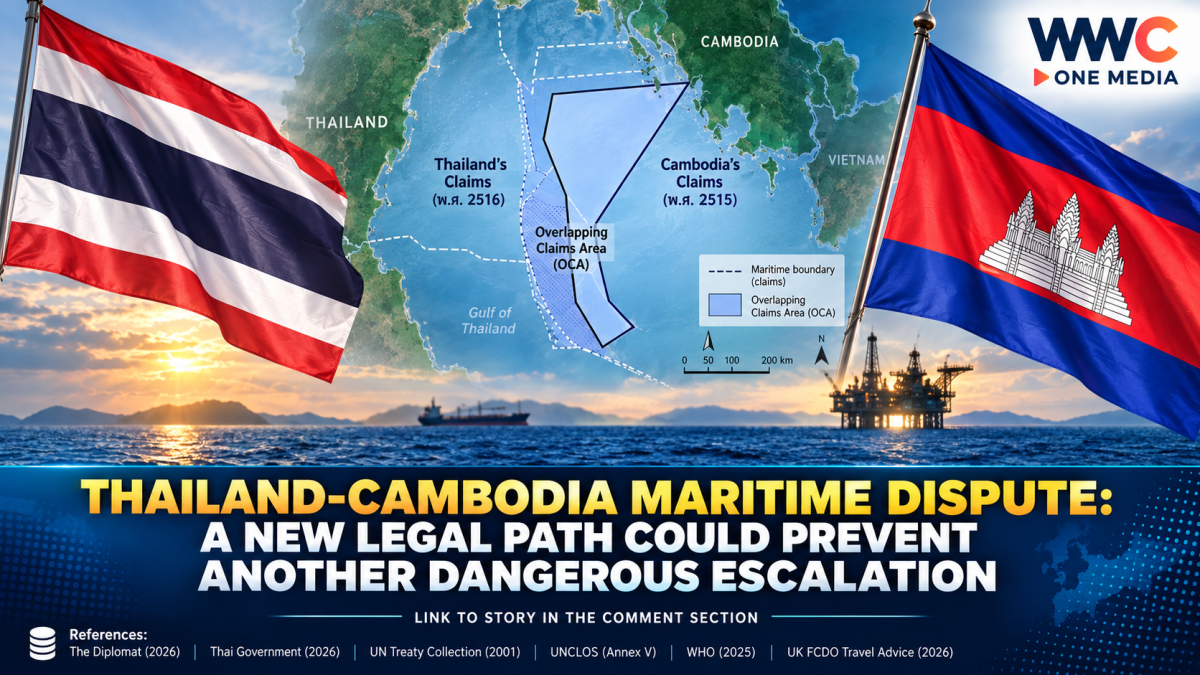
BANGKOK — The fragile relationship between Thailand and Cambodia is entering another critical phase, this time shifting from the battlefield and border checkpoints to the waters of the Gulf of Thailand, where competing maritime claims could put billions of dollars in potential energy resources and a broader regional relationship at stake.
A September 4 analysis published by The Diplomat argues that compulsory conciliation under the United Nations Convention on the Law of the Sea (UNCLOS) could give Bangkok and Phnom Penh a way out of the political escalation that has complicated efforts to settle their maritime dispute.
The dispute centers on the Overlapping Claims Area (OCA) in the Gulf of Thailand, a zone claimed by both countries for decades.
The issue became more complicated after Thailand’s cabinet approved the termination of the 2001 Memorandum of Understanding, commonly known as MoU 44, which had provided a framework for negotiations over the overlapping maritime claims and potential joint offshore energy development.
A decades-old dispute with potentially huge economic stakes
The maritime disagreement is not new.
Thailand and Cambodia have disputed portions of their maritime boundary since the 1970s. The OCA covers roughly 26,000–27,000 square kilometers, depending on the source and delineation used, and is believed to contain significant oil and natural-gas resources.
The 2001 MoU was designed to prevent the dispute from becoming an obstacle to cooperation. It created a framework for discussing both maritime delimitation and possible joint exploration of hydrocarbons in the disputed area. The United Nations Treaty Collection records the agreement as having been concluded in Phnom Penh on June 18, 2001.
But negotiations never produced a final settlement.
Thailand’s government has defended its decision to scrap the agreement, saying that 25 years had passed without sufficient progress and that both countries already have UNCLOS as an internationally recognized legal framework.
Thai officials have also stressed that cancelling MoU 44 does not mean Thailand is abandoning negotiations altogether.
The Thai government said the new approach would rely on UNCLOS while protecting Thailand’s national interests.
Cambodia chooses international legal pressure
Cambodia responded differently.
After Thailand cancelled the 2001 framework, Phnom Penh announced that it would pursue compulsory conciliation under UNCLOS.
That is significant because conciliation is different from a conventional court ruling.
Under Annex V of UNCLOS, a conciliation commission examines the dispute, considers the positions of both sides and can issue recommendations aimed at achieving an amicable settlement. Importantly, the commission’s recommendations are not binding on the parties.
That non-binding character could actually make the mechanism politically useful.
It gives governments room to compromise without necessarily presenting the outcome domestically as a humiliating legal defeat.
The UNCLOS framework also provides procedures for disputes concerning maritime delimitation. Article 298 specifically addresses disputes involving Articles 74 and 83, which concern delimitation of exclusive economic zones and continental shelves.
Why this matters after last year’s border fighting
The maritime dispute cannot easily be separated from the much wider deterioration in Thailand-Cambodia relations.
Their long-running land-border dispute erupted into serious armed clashes in 2025. The fighting displaced large numbers of civilians and pushed bilateral relations to their lowest point in years. A ceasefire reached in December 2025 stopped the large-scale fighting, but tensions have remained.
The United Kingdom’s current travel advice, for example, continues to warn against all but essential travel within 20 kilometers of Cambodia’s land border with Thailand and notes that the border crossings remain suspended.
The political environment has therefore become extremely sensitive.
Every concession involving territory, sovereignty or national resources can quickly become ammunition for nationalist politicians and online campaigns.
That is precisely the problem highlighted by The Diplomat: leaders may find it increasingly difficult to compromise publicly even when compromise is in their countries’ long-term interests.
The Koh Kut question adds another layer
One of the most politically sensitive issues surrounding the maritime dispute is Koh Kut, known as Koh Kood in Thailand.
Thai nationalists have long expressed concern that negotiations under MoU 44 could somehow threaten Thailand’s sovereignty over the island.
However, that political argument should not be confused with the legal status of the island itself.
The maritime negotiations concern overlapping maritime claims, while sovereignty over land territory is a separate question. The Diplomat has previously noted that claims that Thailand could simply “lose” Koh Kut through the OCA negotiations were incorrect.
That distinction is crucial because nationalist narratives can transform a complicated maritime delimitation issue into a much simpler—but potentially misleading—question of whether a country is “giving away” territory.
Could international conciliation provide an escape route?
There is a precedent worth watching.
The Timor-Leste-Australia maritime dispute also went through compulsory conciliation under UNCLOS, with the Permanent Court of Arbitration supporting the process.
Rather than producing an imposed court judgment, the process helped the two governments negotiate a settlement.
In 2017, the two sides reached agreement on a comprehensive package involving permanent maritime boundaries and arrangements concerning the Greater Sunrise gas field. A new maritime boundaries treaty followed in 2018.
That does not mean Thailand and Cambodia will automatically reach the same result.
But it demonstrates why conciliation can be attractive in politically explosive maritime disputes: it can provide a structured forum for negotiation while leaving the final settlement in the hands of the governments.
Under UNCLOS Annex V, a conciliation commission generally reports within 12 months of its constitution, and its recommendations are not legally binding.
The bigger danger: escalation by politics
The immediate danger may therefore be less about offshore drilling than about political escalation.
Thailand has already moved away from the 2001 framework, while Cambodia has sought to place the maritime disagreement within an international legal mechanism.
Neither side appears eager to surrender its core position.
Thailand says UNCLOS provides an alternative framework after MoU 44. Cambodia says international conciliation offers a peaceful, rules-based avenue for resolving the dispute.
The challenge will be ensuring that the maritime dispute does not become another arena for nationalist competition.
If negotiations become a test of who can appear tougher at home, compromise becomes politically dangerous.
If the dispute instead becomes a technical question of maritime boundaries, resource-sharing and international law, there may be considerably more room for both governments to maneuver.
What happens next?
The critical question is whether Bangkok and Phnom Penh can use the UNCLOS process as a circuit breaker rather than another battleground.
The legal mechanism alone cannot repair years of mistrust.
Nor can it guarantee an agreement over the OCA, offshore resources or the wider relationship between the two neighbors.
But it can create something the political environment has increasingly lacked: time, procedure and a neutral framework for difficult negotiations.
That could be especially important after the traumatic land-border clashes of 2025.
The choice facing Thailand and Cambodia is therefore larger than a maritime boundary.
They can allow the Gulf of Thailand dispute to become another symbol of rivalry—or use international law to build a controlled pathway toward cooperation.
And with potentially valuable energy resources beneath the disputed waters, the stakes are far greater than a line on a map.
The next phase of the Thailand-Cambodia dispute may not be decided by who can project the most strength—but by whether either side can find a politically survivable way to compromise.




Leave a Reply