LOS ANGELES, United States — October 31, 2026
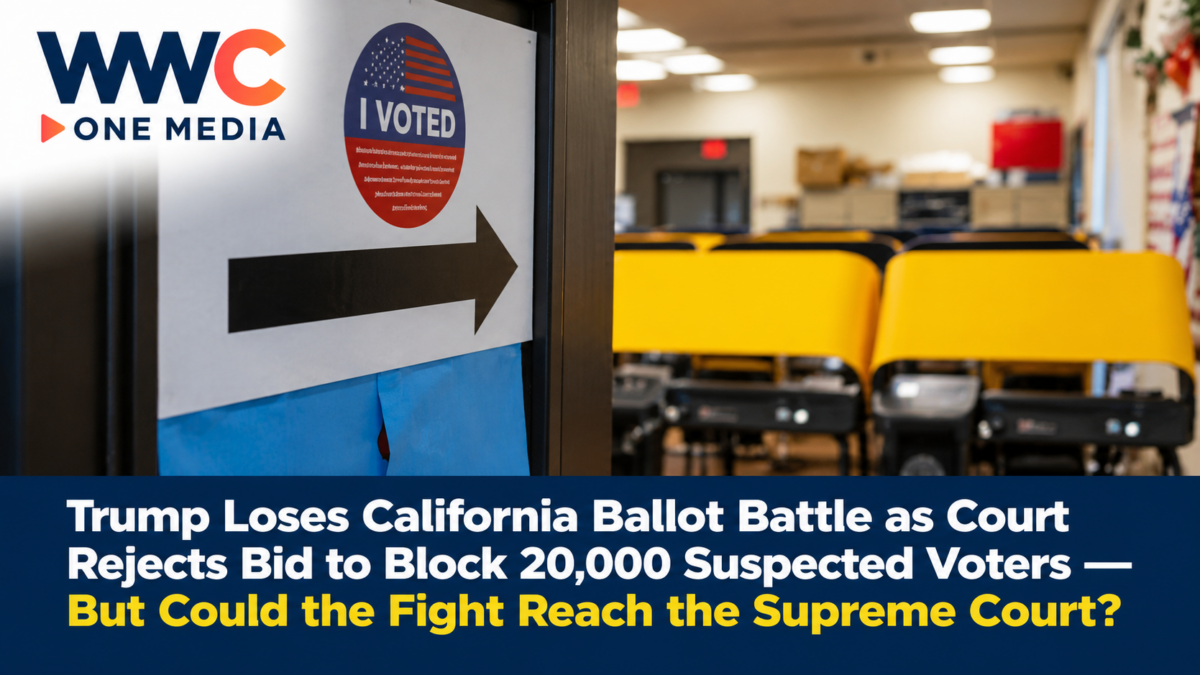
President Donald Trump’s administration has suffered another legal setback just days before the November 3 US midterm elections after a federal appeals court rejected an emergency attempt to prevent California from counting mail-in ballots associated with more than 20,000 registered voters whom federal officials suspect may not be American citizens.
In a 2–1 decision issued Friday, October 30, the US Court of Appeals for the Ninth Circuit denied the Justice Department’s request to require California election officials to separate the disputed ballots and verify voters’ citizenship before counting them.
The judges warned that the federal government’s evidence remained contested and that implementing the proposed restrictions so close to Election Day could prevent eligible American citizens from having their votes counted.
The ruling represents a significant defeat for the administration’s attempt to intervene in California’s election procedures.
However, the judges did not issue a final ruling on the citizenship status of every voter identified by the federal government.
With Election Day approaching and control of Congress at stake, could the Trump administration take its challenge to the Supreme Court—or will the appeals court’s decision prevent a last-minute disruption of California’s vote count?
Appeals Court Rejects Trump’s Emergency Request
The dispute centers on a list of more than 20,000 individuals whom federal authorities classified as likely noncitizens appearing on California’s voter rolls.
The Justice Department wanted election officials to identify ballots associated with those individuals, separate them from other mail-in ballots and withhold them from counting until citizenship could be verified.
But the Ninth Circuit declined to grant the emergency injunction.
Judges Mark Bennett and Gabriel Sanchez formed the majority, while Judge Patrick Bumatay dissented.
The majority concluded that the federal government had not demonstrated that the extraordinary intervention was justified.
The judges also pointed to the potential consequences of ordering California to alter its election procedures immediately before voting concluded.
The ruling means California can continue processing ballots under its existing election rules unless another court issues a different order.
Why the 20,000-Voter Figure Is Controversial
The central factual dispute involves the accuracy of the Justice Department’s list.
Federal authorities maintain that their review of voter registration information and immigration records identified people likely to be noncitizens.
The government argues that allowing ballots from ineligible individuals to be counted could undermine federal election law.
California officials strongly dispute the reliability of the findings.
They warn that some people identified by the federal government may be naturalized American citizens, incorrectly matched to government records or not registered to vote at all.
This distinction is essential.
More than 20,000 people flagged as potentially ineligible does not mean investigators have established that 20,000 noncitizens voted illegally.
The Justice Department has not publicly established that all the individuals on its list returned ballots or that every person identified is ineligible to vote.
The court was therefore being asked to impose sweeping restrictions based on evidence that had not been fully resolved.
Federal Judge Warned the Order Could Disrupt the Election
The latest appeals court decision followed an October 28 ruling by US District Judge David O. Carter.
Carter denied the Justice Department’s request for a temporary restraining order.
He warned that the proposed restrictions could severely disrupt election administration and potentially prevent thousands of eligible voters from participating.
The Justice Department immediately appealed.
On October 30, the Ninth Circuit reviewed the administration’s emergency application and again declined to intervene.
This was not the first appellate setback in the dispute.
An earlier request had also failed because of procedural and jurisdictional problems.
The latest decision addressed the renewed attempt to obtain emergency relief after the district court’s ruling.
Trump’s Justice Department Says Federal Voting Laws Must Be Enforced
The federal government’s position rests on a basic legal principle: noncitizens generally cannot vote in US federal elections.
Under 18 U.S.C. § 611, voting by noncitizens in federal elections is prohibited, subject to limited statutory exceptions.
The Justice Department argues that election officials have a responsibility to prevent ineligible ballots from being counted.
Federal authorities say their investigation identified possible violations requiring immediate attention.
In its October 15 lawsuit, the department named the State of California, Secretary of State Shirley Weber and Los Angeles County Registrar-Recorder Dean Logan.
The administration sought court intervention after California declined to implement the requested ballot restrictions.
The federal government’s argument is that enforcing citizenship requirements is essential to protecting the integrity of elections.
That concern is legitimate as a matter of election law.
However, courts must also examine whether the government has provided sufficiently reliable evidence and whether the requested remedy would improperly affect eligible voters.
California Argues the Government’s Data Cannot Be Trusted
California Attorney General Rob Bonta and other state officials argue that the federal government’s list contains serious inaccuracies.
State election administrators say their voter registration systems already include safeguards intended to prevent ineligible individuals from voting.
They also maintain that the proposed emergency measures would interfere with procedures established under state law.
A central concern involves naturalized citizens.
Someone who previously appeared in immigration records as a noncitizen may subsequently have become a US citizen.
If databases are outdated or incorrectly matched, that person could be wrongly identified as ineligible.
California officials argue that a voter should not lose the opportunity to have a ballot counted because of an unresolved database discrepancy.
The dispute therefore concerns both election integrity and the protection of lawful voting rights.
Local Election Officials Report Problems With Federal Lists
Independent reporting by CalMatters provides important evidence about the data controversy.
In Butte County, election official Keaton Denlay reviewed a list containing 47 individuals whom federal authorities wanted examined.
According to his account, 32 were not on the county’s active voter rolls and had not been sent ballots.
Seven others lacked sufficient identifying information to be confidently matched with the county’s voter records.
Six names appeared to involve individuals who might be ineligible, but the county official said the information supplied did not meet the evidentiary standard required for further action.
The findings do not resolve the status of every individual statewide.
However, they illustrate why California officials and the courts questioned whether the federal list could support an emergency order affecting thousands of people.
Other election administrators described receiving incomplete or difficult-to-read lists.
These problems complicated attempts to verify identities before Election Day.
A Divided Court Reveals the Legal Stakes
The Ninth Circuit’s decision was not unanimous.
Judge Patrick Bumatay dissented, arguing that the federal government should have been allowed to pursue temporary safeguards while officials investigated the disputed registrations.
The dissent emphasized the importance of enforcing federal voting requirements and preventing potentially unlawful ballots from being included in election totals.
The majority took a different view.
Judges Bennett and Sanchez concluded that the administration had not met the legal requirements for an emergency injunction.
They emphasized the danger of preventing eligible voters from having their ballots counted.
The disagreement highlights a major constitutional question.
How should courts balance the government’s responsibility to enforce election laws against the risk of restricting lawful voting through uncertain evidence?
The appellate decision resolves the immediate emergency request, but it does not necessarily end the underlying lawsuit.
Could the Case Reach the Supreme Court?
The administration could seek additional emergency relief from the US Supreme Court.
But filing a request would not guarantee that the justices would accept the government’s position.
The Supreme Court would need to consider the legal arguments, evidentiary record and potential consequences of intervention close to Election Day.
Federal courts have traditionally been cautious about ordering major changes to election procedures shortly before voting.
That concern is often associated with the principle that last-minute judicial interventions can create confusion for election officials and voters.
The administration may argue that enforcing citizenship requirements justifies emergency action.
California would likely emphasize the risk of disenfranchisement and the disputed reliability of the evidence.
As of October 31, the Ninth Circuit’s October 30 ruling remains the controlling development verified for this report.
No subsequent Supreme Court order changing that result has been established here.
Justice Department Subpoenas Add Pressure to California Election Officials
The administration’s efforts extend beyond the immediate lawsuit.
Reuters and NBC News reported that the Justice Department issued subpoenas seeking election-related records from Los Angeles County officials.
The requests concern procedures for identifying ineligible voters and responding to federal warnings.
The investigation has raised concerns among some election administrators about federal pressure.
Los Angeles County Registrar-Recorder Dean Logan has said election officials are following applicable laws and conducting their responsibilities professionally.
The Justice Department maintains that it is investigating possible violations of federal voting laws.
A subpoena is an investigative tool.
It does not establish that an election official committed a crime.
Any criminal allegation would require its own evidentiary and legal process.
Noncitizen Voting Is Illegal, but Evidence Shows It Is Rare
Noncitizen voting in federal elections is prohibited under US law.
That fact is not disputed.
The central disagreement concerns the scale of unlawful voting and whether the evidence supports the administration’s particular allegations.
Election researchers and independent news organizations have repeatedly found that proven noncitizen voting is rare.
Mistakes can occur in voter registration systems, and authorities have a responsibility to investigate credible evidence.
But a registration record associated with an immigration database is not automatically evidence of an unlawful vote.
Likewise, an allegation of potential ineligibility does not establish that a ballot was cast.
These distinctions are especially important during a closely contested election, when unsupported claims can spread quickly and undermine public confidence.
Another Election Investigation Is Unfolding in Alaska
The California dispute comes amid heightened federal election enforcement activity elsewhere in the United States.
WWC ONE MEDIA recently reported on a separate investigation in Trump’s DOJ Floods Alaska Senate Race With 40-Plus Subpoenas Over Two Candidates Named Dan Sullivan — But Could the Investigation Change the Election?.
The Alaska case concerns allegations that political operatives attempted to influence a Senate race through a similarly named candidate.
The Justice Department has sought records as part of its investigation.
The circumstances are entirely different from California’s voter-registration dispute.
However, both cases illustrate the heightened legal and political scrutiny surrounding the November elections.
In each case, allegations must be distinguished from proven wrongdoing.
Why the November Midterms Matter
The November 3 elections will determine control of the US House of Representatives and influence the composition of the Senate.
The result could affect the balance of power between the Trump administration and Congress.
That makes election procedures politically significant.
Disputes involving eligibility, ballot processing and official oversight are likely to attract intense national attention.
But the fact that an election is closely contested does not change the evidentiary standard required to establish unlawful voting.
Election administrators must follow applicable law while preserving access for eligible voters.
Courts, meanwhile, must determine whether requested emergency interventions are legally justified.
Voting Rights and Democratic Confidence Are Under Pressure
The California dispute also reflects wider concerns about democratic institutions and public confidence in elections.
WWC ONE MEDIA previously examined those concerns in US Democracy Hits a 50-Year Low — And the Global Consequences Could Be Bigger Than Anyone Expected.
That report discussed international assessments of democratic performance, including the rule of law, institutional accountability and election credibility.
These concerns extend beyond any single president or political party.
Democratic systems depend on accurately identifying eligible voters, counting lawful ballots and providing transparent procedures for resolving disputes.
They also depend on avoiding unsupported claims that might lead citizens to distrust legitimate election outcomes.
The California litigation illustrates how difficult that balance can become when political and legal conflicts intensify immediately before an election.
The Philippines Faces Its Own Election Misinformation Challenges
The controversy also carries lessons for countries such as the Philippines.
Election administrators must respond to misinformation while maintaining accurate voter records and protecting lawful participation.
WWC ONE MEDIA recently covered a Philippine example in COMELEC Exposes Fake BSKE Election Date — The Viral Post That Could Mislead Filipino Voters.
The article examined false online posts about the scheduled barangay and Sangguniang Kabataan elections.
The Philippine controversy concerns election-date misinformation, not alleged noncitizen voting.
Nevertheless, both demonstrate the importance of verifying claims through official records rather than relying exclusively on political statements or viral posts.
The principle is straightforward.
Election-related allegations should be investigated, but conclusions must be supported by reliable evidence.
Courts Play a Critical Role in Election Disputes
In democratic systems, legal challenges can arise over voter eligibility, election dates, administrative rules and constitutional responsibilities.
WWC ONE MEDIA previously examined the role of judicial review in COMELEC Ready to Act if Supreme Court Intervenes in BSKE Postponement.
That report concerned a different legal issue: the postponement of Philippine barangay and youth council elections.
But it highlights the broader role courts play when election laws and administrative decisions are contested.
A court ruling must be understood according to what it actually decides.
For example, rejecting an emergency injunction does not necessarily establish that every underlying government allegation is false.
Likewise, allowing a legal investigation to continue does not establish that the allegations are true.
The scope of the ruling matters.
What Happens Next in California?
The immediate focus is the November 3 election.
California officials are expected to continue administering voting and ballot processing under applicable procedures.
The Justice Department may pursue further legal remedies, including a possible request to the Supreme Court.
The underlying investigation into voter eligibility may also continue.
However, no future judgment should be assumed.
For voters, the most important immediate issue is that lawful ballots are processed according to valid election rules.
For election administrators, the challenge is maintaining accurate records while responding to legal demands.
For courts, the question is whether the government has presented reliable evidence sufficient to justify extraordinary restrictions.
The Bottom Line
The Trump administration lost its renewed attempt to force California to segregate and withhold mail-in ballots associated with more than 20,000 people federal authorities suspect may be noncitizens.
In its October 30 ruling, the Ninth Circuit rejected the emergency request by a 2–1 vote.
The majority warned that the federal government’s evidence was disputed and that the proposed action could prevent eligible voters from having their ballots counted.
Judge Patrick Bumatay dissented, emphasizing federal enforcement of voting requirements.
California maintains that its election safeguards are robust and that the government’s data are unreliable.
The ruling does not establish that 20,000 illegal votes were cast, nor does it finally resolve every issue in the litigation.
As the United States approaches its November 3 midterm elections, one critical question remains: Will the Trump administration take its California ballot fight to the Supreme Court—or will federal judges continue blocking emergency measures they believe could endanger the voting rights of eligible Americans?