
MANILA, Philippines — October 31, 2026
Gotianun-led East West Banking Corporation is facing a growing test of its lending strategy after reporting a sharp decline in profit despite stronger revenues, expanding loans and improving operating efficiency.
The Philippine lender’s net income fell approximately 24% to ₱5 billion during the first nine months of 2026, from ₱6.6 billion in the same period last year.
But the biggest surprise was not weaker lending activity.
It was the rising cost of protecting the bank against potential borrower defaults.
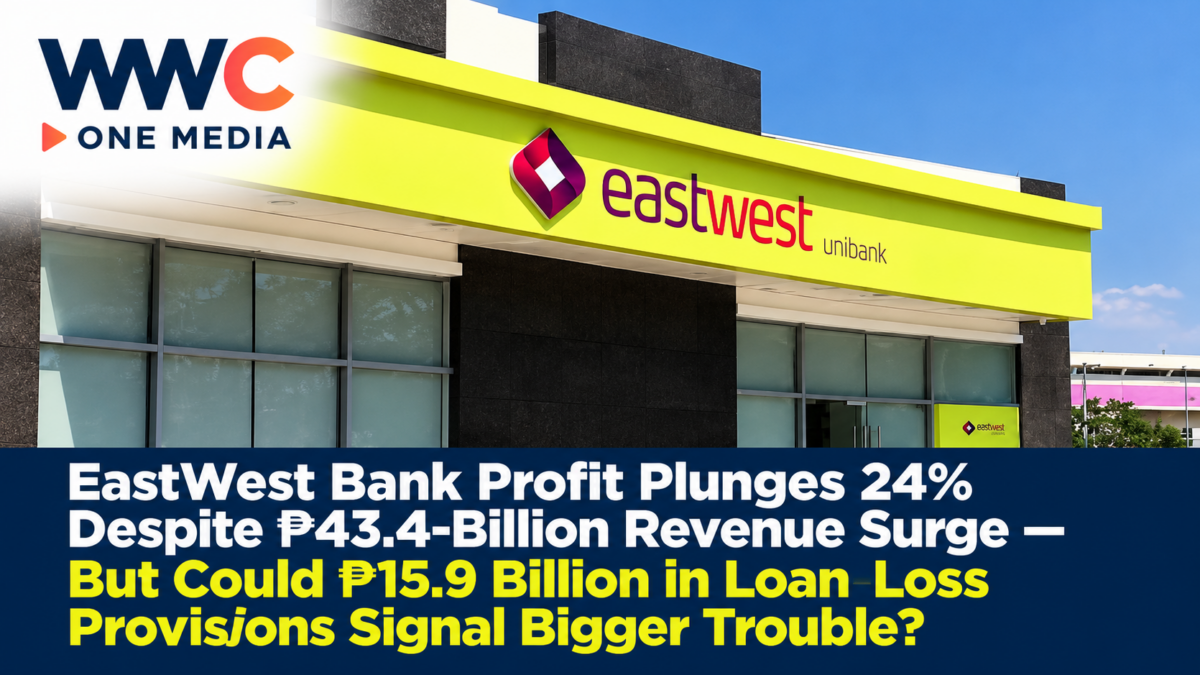
According to EastWest’s latest financial disclosures and October 30 reports from Bilyonaryo, Daily Tribune and Bankero, the bank recorded ₱15.9 billion in provisions for expected credit losses, up approximately 61% from ₱9.9 billion a year earlier.
The substantial increase overwhelmed otherwise strong financial performance.
Net revenues climbed 16.3% to ₱43.4 billion, while pre-provision operating profit surged 24% to ₱22.4 billion.
The results reveal an increasingly important question for the Philippine banking industry: how much growth can lenders pursue before rising credit risks begin eroding their earnings?
For EastWest, the answer could influence its lending strategy, investor confidence and proposed ₱9-billion stock rights offering.
As the bank expands its loan portfolio while setting aside billions against potential losses, could stronger revenues eventually produce a profit recovery—or is the toughest phase of its credit cycle still ahead?
EastWest’s ₱5-Billion Profit Reveals a Growing Credit Problem
EastWest remained profitable through September 2026, but its bottom line weakened significantly.
Net income fell from approximately ₱6.6 billion to ₱5 billion, a decline of about 24%.
The primary cause was the increase in expected credit-loss provisions.
These charges reflect the bank’s assessment of potential losses from loans and other credit exposures.
They are an important part of banking risk management because institutions must recognize expected losses rather than waiting until every borrower has formally defaulted.
However, provisions are not the same as completed loan write-offs.
The ₱15.9-billion charge does not establish that EastWest has already suffered actual cash losses of that amount.
It does show that the bank has recognized considerably greater credit risk than in the comparable period last year.
For investors, that distinction matters.
A bank can continue collecting interest income while simultaneously reducing reported profit because it expects some borrowers may have difficulty repaying their obligations.
Why Revenue Grew 16% While Earnings Fell 24%
EastWest’s operating results reveal a clear contradiction.
The bank generated ₱43.4 billion in net revenues, up 16.3%.
Net interest income increased 22% to ₱36.2 billion as its interest-earning asset portfolio expanded.
Service charges, fees and commission income also grew 10% to ₱5.8 billion.
At the same time, operating expenses increased by approximately 10%, slower than revenue growth.
That allowed pre-provision operating profit to rise 24% to ₱22.4 billion.
The problem emerged when additional credit-loss provisions were recognized.
The bank generated stronger operating earnings before provisions, but the higher provisions sharply reduced the amount flowing to final profit.
This is why headline revenue growth does not always translate into higher net income.
For banks, lending profitability depends not only on how much interest is collected but also on the quality of borrowers and the eventual cost of credit losses.
Loan-Loss Provisions Jump 61% to ₱15.9 Billion
EastWest’s expected credit-loss provisions increased by approximately ₱6 billion year on year.
The increase was substantial relative to the bank’s reported earnings.
It reflects heightened credit risks and economic uncertainty, according to management.
The Philippines has experienced pressure from higher consumer prices, borrowing costs and changes in household purchasing power.
These conditions can affect borrowers’ ability to meet credit card, personal loan and other repayment obligations.
However, it would be inaccurate to attribute the entire increase in EastWest’s provisions to any one economic factor.
The bank’s detailed credit-risk disclosures are needed to establish the precise contribution of different loan categories, borrower groups and changes in risk assumptions.
The broader challenge is that fast loan growth can generate attractive interest income while introducing additional credit exposure.
If borrowers experience financial difficulty, the cost of lending can rise after the loans have already been booked.
EastWest Previously Warned That Credit Costs Could Remain Elevated
The latest results follow warnings issued earlier this year.
In August, EastWest chief executive Jerry Ngo told investors that the bank was moderating loan growth after several years of rapid expansion in consumer lending.
The Philippine Star reported that the bank expected loan growth to settle in the high-single-digit to low-teens range during 2026.
Management also indicated that it was tightening lending standards and directing more attention toward secured or lower-risk borrowers.
These measures included reviewing credit-score requirements, income qualifications and exposure to riskier accounts.
At that time, Ngo said it was too early to determine whether credit-loss provisions had reached their peak.
The October results reinforce the importance of that warning.
EastWest’s underlying lending business remains active, but the bank is attempting to balance future growth with stronger credit discipline.
Loans Reach Nearly ₱400 Billion Despite Rising Risks
EastWest’s balance sheet continued expanding even as profit declined.
Total assets increased 14% to ₱631.8 billion as of September 2026.
The loan portfolio grew 11% to ₱399.9 billion.
Deposits increased 12% to ₱466.4 billion.
These figures indicate that customers continued borrowing and depositing funds with the bank.
They also suggest that EastWest has maintained meaningful business momentum despite weaker earnings.
But loan growth brings responsibilities.
Each additional loan creates an opportunity to earn interest.
It also creates exposure to the risk that a borrower cannot repay.
That is especially important for a consumer-focused institution with substantial credit card and personal lending operations.
The key measure of success will not simply be how quickly EastWest expands its loan book.
It will be whether the new loans generate sustainable returns after accounting for credit losses.
EastWest’s Operating Efficiency Actually Improved
One of the more encouraging figures in the bank’s report was its cost-to-income ratio.
The measure improved from 51.4% a year earlier to 48.4%.
In general, a lower cost-to-income ratio indicates that a bank is spending a smaller proportion of operating revenues on its operating expenses, before relevant risk charges.
EastWest’s operating expenses rose approximately 10% to ₱21 billion, below the growth rate of its net revenues.
That suggests the bank achieved greater operating efficiency during the period.
However, better cost efficiency cannot fully compensate for a sharp rise in expected credit losses.
The results show that EastWest’s challenge is not limited to ordinary operating expenses.
Credit quality has become a major determinant of its profitability.
A Wider Philippine Banking Challenge
EastWest’s experience illustrates a core issue facing lenders across the Philippines.
Banks are competing to expand lending, develop digital services and attract customers.
At the same time, they must maintain strong credit underwriting, regulatory compliance and adequate capital.
Other financial institutions are also adjusting their business strategies.
WWC ONE MEDIA recently examined developments at another Philippine lender in Security Bank Wins Three Golden Arrows for Corporate Governance — But Can Its Leadership Deliver on the Trust Behind the Award?.
That report explored the role of corporate governance, loan-risk oversight and financial transparency in maintaining investor and customer confidence.
Security Bank and EastWest have different loan portfolios, ownership structures and business strategies.
Their earnings figures should not be directly equated.
Nevertheless, the comparison demonstrates why credit-risk management remains central to banking performance.
EastWest’s Consumer Lending Strategy Faces a Critical Test
EastWest has historically maintained a strong position in consumer lending.
Its products include credit cards, personal loans, auto loans and residential mortgages.
Consumer loans can offer attractive yields, but different products carry different credit characteristics.
Unsecured personal loans and credit cards, for example, generally lack the collateral associated with conventional secured lending.
That means losses can become more costly when borrowers fail to pay.
EastWest has indicated that it intends to pursue a more balanced lending mix, including greater attention to secured products and selected business lending opportunities.
The strategic objective is to preserve growth while improving portfolio quality.
But such changes take time.
Existing loans remain on the balance sheet until they are repaid, sold, written off or otherwise resolved.
The bank’s future credit costs will therefore depend partly on the performance of loans originated in previous periods.
EastWest Priority Wealth Business Grows 35%
Despite pressure on consumer lending, EastWest’s wealth management business continued expanding.
Assets under management at EastWest Priority increased 35% to ₱145 billion.
This represents a potentially important source of business diversification.
Wealth management can generate fee income from investment-related services and other client relationships.
That may reduce reliance on the profitability of traditional lending over time.
However, assets under management should not be confused with the bank’s own assets or revenue.
The ₱145-billion figure represents client assets managed or administered under the relevant business arrangements.
It is not ₱145 billion in additional profit or cash available for the bank to spend.
EastWest’s success will depend on converting growth in client relationships into sustainable earnings while meeting the responsibilities associated with wealth management.
Digital Banking Competition Is Intensifying
Technology is another important part of the bank’s future.
Philippine lenders are investing in mobile platforms, digital onboarding, payment services and technology-driven customer experiences.
These investments can improve efficiency and customer access.
But they also require cybersecurity controls, technology spending and appropriate risk management.
WWC ONE MEDIA examined a related development in Security Bank Targets Apple Pay and Google Pay Integration for Cards by 2027.
That article discussed how Philippine banks are preparing for changes in digital payment services.
EastWest’s strategy differs from Security Bank’s, and the latter’s proposed payment integrations are not EastWest initiatives.
Nevertheless, digital banking competition provides important context for EastWest’s capital-raising plans.
Banks must invest in technology while maintaining financial strength and managing lending risks.
EastWest Prepares a ₱9-Billion Stock Rights Offering
EastWest is pursuing a major capital-raising initiative.
Its board approved a proposed stock rights offering of up to ₱9 billion on August 27, 2026.
According to the bank’s official announcement and Philippine Stock Exchange disclosure, the proceeds are intended to support business expansion, technology investment and the strengthening of its capital base.
A stock rights offering generally gives eligible existing shareholders the opportunity to purchase additional shares under specified terms.
The transaction can provide a company with new capital.
However, it can also affect existing shareholders’ ownership percentages if they do not participate, depending on the final structure and terms.
The proposed EastWest offering remains subject to applicable approvals and completion requirements.
It should therefore not be reported as ₱9 billion already raised.
The distinction is especially important as investors evaluate the bank’s financial resilience.
Does EastWest Still Have Enough Capital?
EastWest reported a capital adequacy ratio of 12.2% and a common equity Tier 1 ratio of 11.4%.
The bank stated that both measures remained above applicable regulatory minimums.
Capital ratios are essential indicators of a bank’s capacity to absorb losses and support its operations.
They help regulators, depositors and investors evaluate financial resilience.
But a ratio above the minimum does not remove all risk.
Banks must continually assess their capital needs in relation to loan growth, asset quality and changing economic conditions.
EastWest’s proposed rights offering could provide additional capacity to support future operations.
For now, its reported figures do not justify describing the bank as insolvent or unable to meet its obligations.
The financial issue is weaker profitability and elevated credit-risk charges, not a demonstrated collapse of the institution.
The Filinvest Connection Adds Broader Business Significance
EastWest is part of the Gotianun-led Filinvest Group.
Filinvest Development Corporation has interests across banking, property, hospitality, infrastructure and other industries.
The banking business represents an important component of the group’s operations.
Strong earnings can contribute to the group’s broader financial performance.
Conversely, weaker bank profits may influence how investors assess the earnings mix of the conglomerate.
However, EastWest’s financial results should not be treated as identical to those of its parent company.
Other Filinvest businesses have their own revenue sources, operating costs and risks.
The bank’s performance is therefore one important part of a more diversified corporate group.
Why Governance and Management Discipline Matter
The increasing importance of risk management has also become apparent across the Philippine banking sector.
WWC ONE MEDIA recently covered organizational changes in Security Bank Confirms Job Cuts as New CEO Victor Lee Restructures Operations — But Is a Bigger Banking Shake-Up Coming?.
That report described how a separate lender was realigning its organization around new strategic priorities.
There is no verified basis to suggest that EastWest has announced the same workforce measures or that the two banks are undertaking identical restructuring programs.
But both developments reflect the importance of management decisions when financial institutions face changing economic and competitive conditions.
EastWest’s leadership must determine how to balance loan growth, credit underwriting, technology investment and profitability.
These choices could shape the bank’s financial performance for several years.
International Partnerships Could Influence Philippine Banking Competition
Philippine lenders are also operating within an increasingly interconnected banking environment.
Foreign financial institutions continue to develop relationships with domestic banks through strategic investments, commercial partnerships and specialized services.
WWC ONE MEDIA examined one example in MUFG Put ₱36.9 Billion Into Security Bank 10 Years Ago — Now Its Manila Branch Can Do Much More, But the Two Banks Say They’re Not Merging.
That development concerns Security Bank and Japan’s MUFG, not EastWest.
Its relevance lies in the broader competitive environment.
Banks need sufficient capital, reliable technology and strong management to compete effectively as financial services evolve.
For EastWest, the proposed rights offering represents one way to support its own future expansion.
What EastWest Investors Should Watch Next
The bank’s October disclosure raises several questions that future financial reports may clarify.
One concerns the trajectory of credit-loss provisions.
If the bank’s loan portfolio stabilizes and credit costs decline, improved operating earnings could support stronger net profit.
If provisions remain elevated, profitability may continue facing pressure.
Another issue is asset quality.
EastWest reported a non-performing loan coverage ratio of 90%.
That indicates the relationship between specified loan-loss reserves and non-performing loans under the bank’s reporting methodology.
It does not mean 90% of all outstanding loans are performing or that only 10% are at risk.
Investors should also monitor the non-performing loan ratio, changes in overdue accounts, the performance of different lending segments and updates to the proposed rights offering.
The detailed third-quarter financial filing will be important for understanding whether credit conditions are stabilizing.
The Bigger Question: Can Strong Revenue Growth Finally Translate Into Higher Profit?
EastWest’s latest results contain genuine signs of operational progress.
Net revenues are growing.
The loan portfolio continues expanding.
Deposits are increasing.
The cost-to-income ratio has improved.
And the bank remains profitable.
But those positive developments are being overshadowed by the financial cost of potential loan defaults.
The ₱15.9-billion provision figure has become the central issue for the bank’s earnings outlook.
Management’s ability to bring credit costs under control will likely determine whether operating improvements can produce a meaningful profit recovery.
The proposed ₱9-billion capital raise could strengthen the bank’s financial position, but it cannot by itself guarantee better loan performance.
The Bottom Line
East West Banking Corporation reported ₱5 billion in net income for the first nine months of 2026, down approximately 24% from ₱6.6 billion a year earlier.
The decline occurred despite 16.3% growth in net revenues to ₱43.4 billion and a 24% increase in pre-provision operating profit.
The primary pressure came from expected credit-loss provisions, which surged 61% to ₱15.9 billion.
The lender continued expanding its assets, loans, deposits and wealth management business, while maintaining reported capital ratios above regulatory minimums.
It is also preparing a proposed ₱9-billion stock rights offering to support future growth.
These developments suggest that EastWest’s underlying business remains active, but its profitability is being tested by higher credit risks.
As the Gotianun-led bank earns more from lending but sets aside billions against potential defaults, one question could define its next financial chapter: Can EastWest restore confidence and rebuild profit growth—or will the rising cost of credit turn its expanding loan portfolio into an even bigger earnings challenge?










