WASHINGTON, United States — October 31, 2026
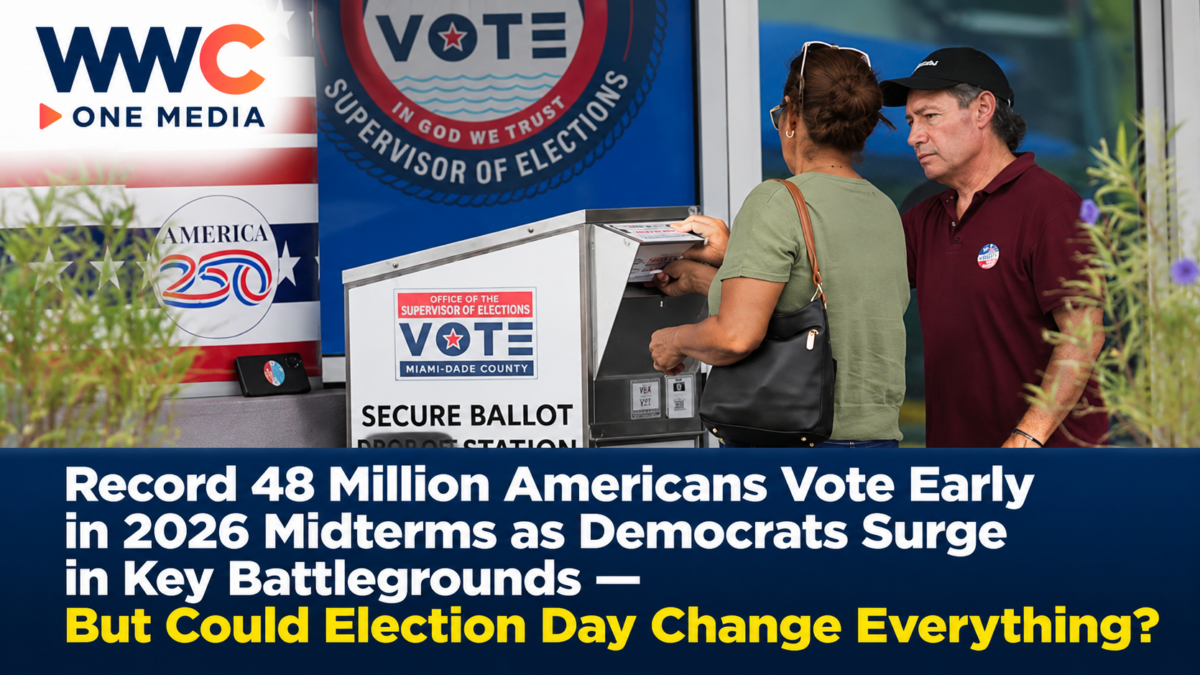
The battle for control of the United States Congress has entered an extraordinary final stretch as nearly 48 million Americans cast their ballots before Election Day, smashing the previous midterm early-voting record and raising the stakes for President Donald Trump and both political parties.
According to figures from the University of Florida Election Lab, approximately 47.9 million Americans had already voted in person or returned their mail ballots by midday Friday, October 30.
That surpassed the 45.9 million early votes recorded during the entire 2022 midterm election, even though the November 3, 2026, election was still four days away.
The surge has been particularly pronounced in states holding competitive Senate races, including Texas, North Carolina, South Carolina and Kansas.
Registered Democrats are accounting for a larger share of early voters than Republicans in states that disclose party affiliation.
However, election analysts warn that the apparent Democratic advantage does not necessarily predict which party will win.
Republicans have historically relied more heavily on Election Day voting in some recent election cycles, while independent voters and shifting turnout patterns could still influence the final results.
With control of the House of Representatives and Senate at stake, the record early participation has transformed the closing days of the campaign into a high-pressure battle for remaining voters.
But as Democrats celebrate signs of strong early participation and Republicans intensify their final push, one question now dominates Washington: Could the record-breaking turnout produce a political earthquake — or will Election Day deliver a surprise?
US Early Voting Breaks Historic Midterm Record
The University of Florida Election Lab’s figures represent a major milestone in American election participation.
By midday October 30, the organization had recorded 47,922,669 early ballots nationwide.
The figure exceeded the approximately 45.9 million early ballots cast during the entire 2022 midterm elections.
That means the previous record was broken before the final weekend of early voting and before millions of Americans were expected to cast ballots on November 3.
The growth reflects the increasing use of advance in-person voting and mail ballots across the United States.
Early voting can help people participate when work schedules, travel, health conditions or other commitments make voting on Election Day difficult.
However, a record number of early ballots does not automatically mean total election turnout will reach a record.
Some voters who previously waited until Election Day may simply have voted earlier this year.
The final turnout rate can only be assessed after the election, once all eligible ballots have been counted and voter participation is measured against the eligible population.
Democrats Lead Early-Vote Registration Figures — But the Election Is Far From Decided
One of the most closely watched developments is the party affiliation of early voters.
In states that report party registration, University of Florida Election Lab figures showed approximately 44% of early voters registered as Democrats.
Republicans accounted for about 31%, while unaffiliated and minor-party voters made up approximately 25%.
The figures suggest substantial early participation among registered Democratic voters.
However, they do not establish that Democratic candidates have received 44% of the vote.
Party registration and actual ballot choices are different.
A registered Democrat may vote for a Republican candidate, and a registered Republican may support a Democrat.
Independent voters also represent a substantial share of the electorate.
In addition, not every state publicly reports party affiliation for early voters.
The available breakdown therefore cannot be interpreted as a complete nationwide count of votes for each party.
Political analysts have also noted that Republicans in recent elections have often generated stronger turnout on Election Day itself.
The early-voting advantage may narrow, disappear or translate into electoral victories depending on how remaining voters participate.
Texas Early Voting Surges Past Six Million Ballots
Texas has emerged as one of the most closely watched states in the 2026 midterm election.
More than six million Texans had already voted by the final days of October.
According to reporting based on official state figures, in-person early participation was running approximately 50% ahead of the comparable stage of the 2022 midterm election.
The increase is significant because Texas has traditionally been a Republican stronghold, but statewide contests have attracted growing attention from both parties.
Democrats see opportunities to challenge Republican control in competitive races, while Republicans are seeking to maintain their advantage by mobilizing conservative and independent voters.
High early participation has also been reported in heavily Hispanic communities along the Texas-Mexico border.
However, demographic turnout patterns alone cannot establish how those voters cast their ballots.
The final outcome will depend on the combined early, mail and Election Day vote.
North Carolina Sees Sharp Increase in Early Participation
North Carolina is another important state in the battle for the US Senate.
The state’s competitive race has attracted national attention as Democrats seek to expand their representation and Republicans attempt to maintain control of the chamber.
State election data showed a significant increase in early voting compared with the same stage of 2022.
AFP reported that North Carolina’s advance voting was running nearly 37% ahead of the comparable point four years earlier.
The contest has also drawn direct involvement from President Trump.
WWC ONE MEDIA previously examined his campaign messaging in Trump Targets Democrats on Crime and ‘Communism’ as He Campaigns for GOP Senate Candidate in North Carolina.
That report described Trump’s efforts to support Republican nominee Michael Whatley against Democratic former Governor Roy Cooper.
The candidates have emphasized competing positions on economic conditions, crime, public policy and the direction of the country.
The extraordinary early participation suggests that both campaigns face a highly engaged electorate.
But it does not establish which candidate is leading.
South Carolina and Kansas Become Major Turnout Battlegrounds
Strong early participation has also been recorded in South Carolina and Kansas.
In South Carolina, early voters surpassed the state’s entire 2022 early-voting total several days before the end of advance polling.
In Kansas, early voting was running substantially ahead of the comparable stage of the previous midterm election.
These developments demonstrate that turnout growth is not confined to traditionally Democratic states.
Republican-leaning states are also experiencing increased participation.
For Republican campaigns, mobilizing supporters remains critical as Democrats seek to turn high engagement into competitive election results.
In Kansas, Republican Senator Roger Marshall is seeking reelection against Democratic challenger Adam Hamilton.
The race has attracted attention as both parties evaluate which states could influence control of the Senate.
The unusually large early-voting numbers make turnout models more difficult to interpret, particularly when participation patterns differ from previous elections.
Trump Changes His Final Campaign Strategy as Voting Accelerates
President Trump has been campaigning for Republican candidates across the country.
However, the final days of the midterm campaign have brought adjustments to his schedule.
The president canceled planned in-person appearances in Kansas and Iowa, with Republican organizations shifting toward telephone-based campaign rallies.
WWC ONE MEDIA covered the development in Trump Scraps Kansas and Iowa Rallies Days Before Midterms — Can Phone Campaigns Still Deliver the Republican Votes He Needs?.
The campaign strategy aims to reach supporters across multiple states without requiring the president to travel to every location.
Trump has continued emphasizing economic policies, immigration, national security and his administration’s political priorities.
Republicans are also seeking to ensure that their supporters participate on Election Day rather than assuming the result has already been decided.
The record early-voting figures could complicate campaign calculations because traditional turnout patterns may no longer provide reliable guidance in every state.
Alaska Senate Race Faces Election Investigation Amid Voting Surge
The election in Alaska has become especially controversial because of a federal investigation involving two similarly named Senate candidates.
The Justice Department has intensified an inquiry into allegations that political operatives encouraged a second candidate named Dan Sullivan to enter the race against the Republican incumbent.
WWC ONE MEDIA reported on the matter in DOJ Issues New Subpoenas in Alaska Senate Race as ‘Spoiler Candidate’ Allegations Escalate — Could the Investigation Reshape the Election?.
The investigation concerns allegations that the candidacy of Daniel J. Sullivan Jr. could confuse voters who intend to support Republican Senator Dan S. Sullivan.
Democratic candidate Mary Peltola has denied knowing about the alleged recruitment effort.
The second Sullivan has also denied being recruited by her campaign.
The allegations remain under investigation, and the existence of subpoenas does not establish criminal wrongdoing.
The controversy highlights the importance of clear election procedures and voter confidence during a closely contested race.
It also demonstrates why high turnout alone cannot resolve questions about election integrity or the legality of particular campaign activities.
Why the 2026 Midterms Matter for Trump’s Presidency
The November 3 elections will determine control of the US House of Representatives and Senate for the remaining two years of Trump’s current presidential term.
Republicans currently control both chambers of Congress.
The party holds a 53–47 advantage in the Senate, counting independents who caucus with Democrats in the Democratic total.
Democrats are attempting to gain enough seats to take control of one or both chambers.
A change in congressional control could affect the administration’s ability to advance legislation, obtain confirmations and manage congressional investigations.
The House has important authority over government spending legislation and oversight.
The Senate plays a central role in confirming federal judges and senior executive officials.
A divided Congress could result in more difficult negotiations over budgets, taxation and other policy priorities.
However, different combinations of House and Senate control would produce different political outcomes.
The early-voting record establishes high participation, not the eventual balance of power.
Economic Promises Could Influence the Final Vote
Affordability, inflation and government spending remain important issues in the midterm campaign.
Trump has promoted proposals intended to encourage support for Republican candidates, including a potential $5,000 payment to eligible American adults if Republicans retain congressional control.
WWC ONE MEDIA examined the proposal in Trump Promises Every US Adult $5,000 If Republicans Win Midterms — But $1.3 Trillion Plan Faces Major Questions.
The proposed payments would require congressional action and a financing mechanism, and they are not guaranteed benefits.
Democrats have focused on competing economic criticisms and policy priorities, including household expenses and the administration’s record.
Voters may weigh these issues differently depending on their personal circumstances and state.
The extraordinary turnout could reflect engagement over multiple subjects rather than one national political message.
Why Record Early Voting Does Not Guarantee a Democratic Victory
Early-voting figures are useful for evaluating participation, but they have important limitations.
First, voting early does not necessarily create additional turnout.
Some people may simply be shifting from Election Day voting to advance voting.
Second, party-registration data do not reveal actual candidate preferences.
Third, election procedures differ substantially between states.
Some jurisdictions allow extensive mail voting, while others rely more heavily on in-person voting.
Fourth, reporting schedules vary.
A national aggregation may include states whose latest information comes from different dates or times.
Finally, political preferences among voters who have not yet participated remain unknown.
These limitations are why election analysts warn against treating early-voting statistics as confirmed election results.
The 2026 record demonstrates considerable engagement.
It does not establish whether Democrats or Republicans will control Congress.
Could America Break the Overall Midterm Turnout Record?
The 2018 midterm election produced one of the highest modern participation rates in a US congressional midterm, with voter turnout reaching approximately 50% of the voting-eligible population.
University of Florida political scientist Michael McDonald has suggested that the 2026 election could potentially surpass that benchmark.
However, turnout varies considerably by state and demographic group.
A high number of ballots cast early does not guarantee that total participation will exceed 2018.
The final turnout rate will depend on how many additional Americans vote on November 3, whether outstanding mail ballots are accepted and how the eligible-voter population is measured.
It may take time after Election Day for reliable nationwide participation statistics to become available.
Any claim that the 2026 election has already produced the highest total midterm turnout in modern US history would therefore be premature.
What Happens on November 3?
Election Day will take place on Tuesday, November 3, 2026.
Millions of Americans who have not voted early are expected to visit polling locations.
State and local election officials will administer the vote according to their jurisdictions’ procedures.
Mail-ballot processing and counting rules differ across states.
Some jurisdictions may release results relatively quickly after polls close.
Others may require additional time to count eligible mail ballots, provisional ballots or ballots subject to administrative review.
In closely contested races, official results may not be immediately available on election night.
Election projections issued by media organizations are also separate from certified results announced by the relevant election authorities.
For voters, the most reliable information about polling locations, deadlines and ballot rules comes from their state and local election offices.
The Bigger Question: Is America Witnessing a New Era of Political Participation?
The early-voting record represents a major development in American democratic participation.
Nearly 48 million people had already cast ballots before Election Day, surpassing the previous midterm advance-voting total.
The surge is especially notable in states with competitive Senate races.
Strong participation among registered Democrats has encouraged speculation about possible gains for the party.
Republicans, meanwhile, are emphasizing the importance of mobilizing supporters on November 3.
The competing expectations illustrate why turnout statistics must be interpreted carefully.
Voters may be participating in unusually large numbers because of dissatisfaction with the government, support for their preferred candidates, concern over national policies or the growing convenience of early voting.
The record alone cannot determine which explanation is most important.
The Bottom Line
The United States has broken its midterm early-voting record ahead of the November 3, 2026, elections.
University of Florida Election Lab figures show approximately 47.9 million ballots cast by midday October 30, exceeding the entire 2022 early-vote total of approximately 45.9 million.
Texas, North Carolina, South Carolina and Kansas are among the states reporting particularly strong participation.
Democrats hold an advantage in early-voter party-registration figures from states that provide that information, but the numbers do not reveal how voters actually voted.
Republicans are preparing for a final Election Day turnout push, while both parties compete for control of Congress.
As millions more Americans prepare to vote, the question is no longer whether the 2026 midterms will generate historic early participation — that record has already been broken. The real question is whether the unprecedented rush to the polls will reshape Washington’s balance of power, or whether Election Day will deliver an outcome that defies the early numbers.