MENLO PARK, California — October 31, 2026
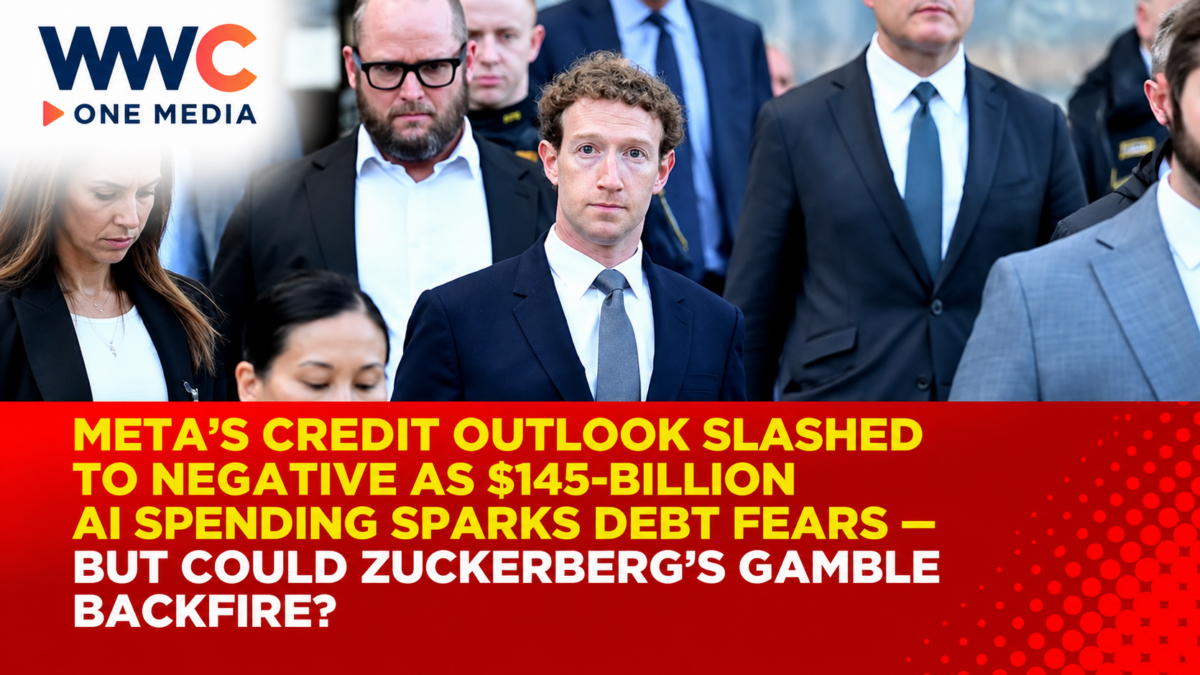
Meta Platforms, the technology giant behind Facebook, Instagram and WhatsApp, is facing a new financial warning as S&P Global Ratings revised its credit outlook to negative, raising concerns that Chief Executive Mark Zuckerberg’s aggressive artificial intelligence spending could weaken one of Silicon Valley’s most powerful balance sheets.
The October 30 decision comes as Meta prepares to spend as much as $145 billion on capital expenditures in 2026, with much of that investment directed toward artificial intelligence infrastructure, advanced computing chips and massive data centers.
S&P’s warning adds pressure to a technology industry already struggling to convince investors that its unprecedented AI investments will eventually generate sufficient financial returns.
According to Bloomberg and Reuters, the ratings agency cited growing uncertainty over Meta’s ability to finance its expansion while maintaining the strong cash flow traditionally associated with its advertising business.
Meta’s long-term credit rating remains at AA−, but its outlook has shifted from stable to negative.
That distinction matters because the company has not yet suffered an actual credit-rating downgrade.
However, the negative outlook suggests that S&P sees an increased possibility of a future downgrade if financial conditions deteriorate.
The warning raises a question extending far beyond Meta’s headquarters:
Could the race to dominate artificial intelligence ultimately threaten the financial strength of the very technology giants financing it?
S&P Warns Meta’s AI Spending Is Becoming a Financial Risk
S&P Global Ratings announced the outlook revision on Friday, October 30, citing uncertainty surrounding the duration and scale of Meta’s investment program.
The company has committed enormous resources to developing advanced artificial intelligence systems, expanding computing capacity and building infrastructure capable of supporting next-generation AI applications.
But the timing of the financial returns remains uncertain.
S&P said Meta faces greater challenges than some of its technology peers in directly monetizing its AI investments.
Companies such as Microsoft, Amazon and Alphabet operate substantial cloud computing businesses that sell infrastructure and computing services to external customers.
Meta, by comparison, primarily generates revenue from advertising across Facebook, Instagram and its other platforms.
Although AI can improve advertising effectiveness and create new commercial opportunities, the relationship between infrastructure spending and directly attributable revenue is less straightforward.
Meta is betting that investments in more sophisticated AI models, recommendation engines, advertising tools and digital assistants will strengthen its business over time.
S&P’s concern is that the benefits may take longer to materialize than the costs.
The ratings agency also indicated that Meta’s financial leverage could exceed the level compatible with its current AA− rating as early as 2027.
If that occurs and financial conditions fail to improve, the company could face additional credit-rating pressure.
Meta’s $145-Billion Spending Plan Raises Questions Across Wall Street
The scale of Meta’s investment plans has become one of the defining financial stories of the AI boom.
For 2026, the company projects capital expenditures of approximately $135 billion to $145 billion.
These investments include technology infrastructure, computing equipment and facilities required to train and operate increasingly powerful AI models.
The spending represents an extraordinary commitment, even for a company with Meta’s resources.
According to S&P-related analysis, the agency expects Meta’s capital spending to rise beyond $225 billion in 2027 and reach approximately $252 billion in 2028.
Those figures are forecasts by the ratings agency, not finalized expenditure commitments announced by Meta.
Nevertheless, they illustrate the potential financial burden of sustaining Meta’s AI expansion.
The issue is part of a much larger industry trend.
WWC ONE MEDIA previously examined the financial implications in its report, Big Tech’s $750-Billion AI Gamble Shakes Wall Street as Core Businesses Slow — But Will the Spending Ever Pay Off?.
Technology leaders including Microsoft, Alphabet, Amazon, Meta and Oracle are investing heavily in the chips, infrastructure and electricity needed to support the AI economy.
But the investment race has created a new dilemma.
Companies may risk falling behind if they spend too little on AI infrastructure, yet spending too aggressively could damage profitability, cash flow and financial flexibility.
Meta’s revised credit outlook illustrates that tension.
Meta’s Free Cash Flow Turns Negative Despite Strong Revenue Growth
The latest credit warning is especially significant because Meta’s core business continues to generate substantial revenue.
According to financial analysis reported by Investing.com, Meta’s third-quarter 2026 revenue increased approximately 26.1% from the corresponding period a year earlier.
Advertising revenue rose approximately 25.9%, underscoring the strength of the company’s primary commercial engine.
However, strong revenue growth has not prevented growing pressure on cash flow.
Meta reported negative free cash flow of approximately $2.12 billion during the third quarter, compared with positive free cash flow in the corresponding period of 2025.
Capital expenditures reached approximately $34.9 billion during the quarter.
Free cash flow generally refers to the cash remaining after a company accounts for capital expenditures, although individual accounting definitions and rating-agency adjustments may differ.
A negative figure means capital investment and other relevant cash requirements exceeded the cash generated under that measure during the period.
This does not necessarily mean a company is unprofitable or unable to meet its obligations.
But sustained negative free cash flow can increase dependence on external financing or existing cash reserves.
For Meta, that prospect is particularly important because its infrastructure commitments extend over several years.
The company is simultaneously investing in AI research, custom silicon, data centers, computing resources and new consumer applications.
The central financial question is whether future cash generation can keep pace with those commitments.
S&P Forecasts Major Cash Flow Shortfalls Through 2028
The ratings agency’s forecasts show why Meta’s spending has become a credit concern.
S&P expects Meta to face substantial free operating cash flow deficits as capital expenditure accelerates.
For 2027, the agency projects a deficit of approximately $71 billion.
Its analysis also indicates that negative cash flow could persist beyond 2028 if spending remains elevated.
These projections depend on assumptions about future investment, advertising revenue, operating performance and financing arrangements.
They should not be treated as guaranteed financial outcomes.
Nevertheless, they highlight how quickly the economics of the AI infrastructure race are changing.
For years, large technology companies were celebrated for their ability to generate extraordinary profits without requiring the same level of capital investment as traditional industrial businesses.
Artificial intelligence is challenging that model.
Data centers require physical buildings, specialized processors, networking equipment, cooling systems and reliable power supplies.
Many of these assets must be acquired or contracted before they generate their expected returns.
As infrastructure investment grows, technology companies face financial considerations historically associated with telecommunications, utilities and other capital-intensive industries.
That transition may reshape how investors evaluate the sector.
Instead of focusing primarily on revenue growth and software margins, analysts are increasingly examining debt, cash flow, capital expenditure and returns on invested capital.
Meta’s Debt and Financing Plans Face Greater Scrutiny
S&P’s decision also follows a sharp increase in attention to Meta’s financial obligations.
Reuters reported that the company had approximately $80.92 billion in long-term debt as of September 30, 2026.
Investing.com also reported that Meta’s future lease obligations reached approximately $355.7 billion at the end of September.
Lease commitments differ from conventional debt and may extend over many years, but they still represent contractual financial obligations.
Their scale is relevant when evaluating the company’s long-term commitments.
Meta has also outlined plans to raise substantial equity financing to support its AI expansion.
According to Reuters, the company announced a program totaling approximately $97.5 billion in stock-related financing.
Separate reporting indicates that the plan involves a combination of common equity, mandatory convertible preferred shares and a future at-the-market stock sale program.
Equity financing can help a company obtain capital without assuming the same fixed repayment obligations associated with conventional debt.
However, issuing additional shares may dilute existing shareholders, depending on the structure and timing of the transactions.
For investors, Meta’s financing strategy has therefore become a balancing act between preserving financial flexibility and maintaining shareholder value.
This broader shift toward capital-market funding is also evident at other technology companies.
In a related report, WWC ONE MEDIA examined Microsoft’s $25-Billion Bond Sale as AI Spending Explodes — But Is Big Tech’s Debt Gamble Getting Dangerous?.
Microsoft’s borrowing and Meta’s financing strategy differ, but both demonstrate the extraordinary financial demands of competing in artificial intelligence.
Why Meta Faces Different Challenges From Microsoft, Google and Amazon
S&P’s assessment raises an important question about the commercial strategies of major AI investors.
Microsoft sells cloud computing and enterprise software through its Azure and Microsoft 365 businesses.
Amazon operates Amazon Web Services, one of the world’s largest cloud computing platforms.
Alphabet generates revenue from Google Cloud alongside its advertising and digital services businesses.
These companies can sell computing capacity and AI-related services directly to outside customers.
Meta’s business model is different.
The company uses artificial intelligence primarily to improve its existing platforms and develop products intended to expand user engagement and future monetization opportunities.
Its AI investments support areas such as advertising optimization, personalized recommendations, automated content creation, consumer assistants and smart devices.
These applications can create substantial value.
For example, improved advertising systems could help businesses reach customers more efficiently and increase advertiser spending.
Better recommendation engines could encourage users to spend more time on Meta’s applications.
AI-powered assistants and wearable devices could eventually open additional commercial markets.
But there is a fundamental difference between improving an existing revenue stream and charging customers directly for an identifiable computing service.
S&P appears concerned that Meta’s indirect monetization model creates greater uncertainty about when its spending will deliver measurable financial returns.
Meta has challenged the agency’s assessment, arguing that artificial intelligence presents substantial commercial opportunities and that its credit profile remains strong.
The debate reflects competing expectations about how quickly AI infrastructure investment will become profitable.
Zuckerberg Is Betting on AI Assistants, Smart Glasses and New Digital Experiences
Meta’s strategy goes beyond building larger data centers.
The company wants artificial intelligence to become an integral part of everyday digital activity.
Its efforts include AI assistants, advanced recommendation systems, advertising tools and connected devices.
Meta has also continued promoting smart glasses and other wearable technologies as potential platforms for interacting with AI systems.
These products could eventually allow consumers to receive information, communicate and interact with digital services through increasingly sophisticated interfaces.
The company is pursuing AI agents capable of performing tasks on behalf of users rather than simply responding to questions.
These ambitions form part of Zuckerberg’s wider effort to position Meta as a leader in consumer artificial intelligence.
WWC ONE MEDIA previously covered these developments in Meta Doubles Down on Wearable AI and Muse as Zuckerberg Pushes Back Against AI Doom.
The investment thesis is straightforward.
If Meta can use AI to strengthen advertising, increase user engagement and create commercially successful new products, today’s extraordinary infrastructure spending could eventually become a competitive advantage.
The risk is equally significant.
If adoption, monetization or technical performance falls short of expectations, Meta could be left supporting a much more expensive infrastructure base without sufficient corresponding financial returns.
Could Meta’s Credit Rating Actually Be Downgraded?
A negative outlook does not mean a credit downgrade is inevitable.
S&P’s October 30 decision left Meta’s AA− rating unchanged.
That rating remains within the high-grade investment category, reflecting the company’s substantial financial resources and established business operations.
However, the outlook indicates increased downside risk.
S&P has identified financial leverage as a particularly important consideration.
According to the agency, Meta’s adjusted leverage could rise above 1.0 times as early as 2027.
That level is significant because it approaches or exceeds a threshold relevant to maintaining the company’s current credit rating.
A future downgrade could become more likely if leverage remains elevated and free operating cash flow fails to recover as expected.
By contrast, stronger operating results, slower capital spending or earlier-than-expected AI monetization could ease the pressure.
The effect of any future downgrade would depend on the size of the rating change, financial-market conditions and investors’ assessment of Meta’s overall financial position.
A lower credit rating can increase borrowing costs, although the relationship is not automatic.
For now, the company continues to hold a strong investment-grade rating.
The immediate significance of S&P’s decision is the warning it sends about the financial consequences of Meta’s expanding AI commitments.
AI’s Growing Debt Burden Is Becoming a Global Concern
Meta’s outlook revision comes amid growing scrutiny of the capital required to finance the artificial intelligence industry.
Banks, institutional investors and credit-rating agencies are increasingly examining whether the revenue generated by AI systems will justify the cost of building their infrastructure.
That issue is especially important for data centers requiring massive upfront investments.
The growth of AI computing has created demand for specialized facilities, electrical infrastructure and sophisticated cooling systems.
But these projects often depend on assumptions about future customer demand and long-term computing requirements.
In a related analysis, WWC ONE MEDIA reported on HSBC’s Warning Over the $4.1-Trillion AI Debt Boom as Data Center Investments Soar — But Not Every Project May Survive.
The report explored concerns that some heavily financed AI infrastructure projects may struggle to generate sufficient returns.
Meta is financially different from smaller infrastructure developers because it has an established global advertising business and significant financial resources.
Nevertheless, the ratings outlook revision demonstrates that even the industry’s largest companies are not immune to concerns over investment discipline.
What Meta’s Credit Warning Means for Global Technology Investors
The immediate significance of S&P’s decision extends beyond Meta shareholders.
It may influence how investors assess companies spending extraordinary amounts on artificial intelligence.
Until recently, markets often rewarded aggressive AI investment as evidence of long-term technological ambition.
That enthusiasm has become more complicated as the cost of infrastructure expansion increases.
Investors are increasingly examining whether AI expenditure produces measurable returns.
For Meta, several indicators will be especially important over the coming quarters.
These include advertising revenue growth, free cash flow, capital expenditure, financial leverage and the performance of new AI-powered products.
Credit markets will also be watching whether the company’s financial obligations expand faster than its ability to generate operating cash.
The wider technology sector faces similar questions.
AI could create enormous commercial opportunities through automation, productivity improvements, new digital services and more sophisticated software.
But successful technological innovation does not automatically guarantee attractive financial returns for every company financing it.
An industry can experience substantial growth while individual businesses struggle with excessive spending or disappointing margins.
Meta’s revised outlook serves as a reminder that technological leadership and financial discipline must ultimately operate together.
The Bigger Question: Can Meta Spend Its Way to AI Dominance?
Meta’s strategy reflects the growing belief that the companies controlling advanced computing infrastructure and AI applications could gain enormous influence over the digital economy.
Zuckerberg has made clear that artificial intelligence is central to the company’s future.
The company possesses important advantages, including an enormous global user base, extensive advertising relationships, established technology platforms and significant engineering resources.
These advantages could help Meta turn AI innovation into additional revenue and improved operational performance.
However, the financial requirements are becoming increasingly substantial.
S&P’s decision highlights the possibility that the industry’s investment race may continue accelerating before the full commercial benefits become clear.
For Meta, the challenge is no longer simply developing competitive artificial intelligence technology.
It is demonstrating that the company’s expanding financial commitments can be supported by durable revenue, sustainable cash generation and manageable leverage.
The Bottom Line
S&P Global’s decision to revise Meta’s credit outlook to negative marks a significant warning about the financial consequences of the artificial intelligence boom.
The company retains its AA− credit rating and remains supported by a powerful advertising business.
Yet its projected capital expenditure of up to $145 billion in 2026, negative third-quarter free cash flow and expanding infrastructure commitments have increased concerns about its future financial flexibility.
Meta believes AI can transform advertising, digital services and consumer technology.
S&P is questioning whether the financial returns will arrive quickly enough.
As Zuckerberg commits unprecedented resources to artificial intelligence, one question now hangs over Silicon Valley: Will Meta’s massive AI gamble build the foundation for its next era of dominance — or could the cost of winning the AI race become its biggest financial weakness?