
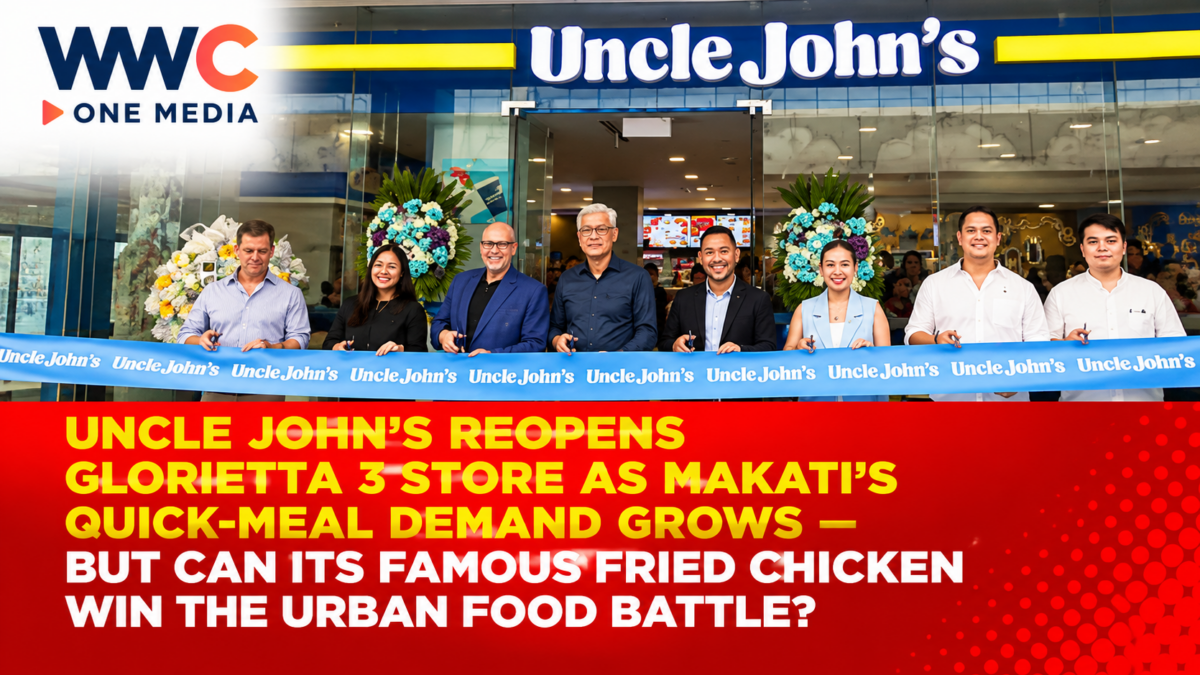
MAKATI CITY, PHILIPPINES — October 31, 2026. Uncle John’s is strengthening its position in one of Metro Manila’s busiest shopping and business districts, reopening its renovated Glorietta 3 store as demand for convenient, ready-to-eat meals continues to shape the Philippine retail industry.
The convenience-store chain, operated by Gokongwei-led Robinsons Retail Holdings Inc. (RRHI), reopened the branch on October 21, bringing its signature fried chicken, rice meals, snacks, beverages and everyday essentials back to a prominent location in Ayala Center.
Located on Level 1 along Glorietta 3 West Street, the outlet serves office workers, shoppers, commuters and visitors seeking quick food options during their daily routines.
The development reflects a wider change in convenience retail.
Stores that once focused primarily on packaged goods are increasingly competing for customers who want complete meals without spending too much time inside a restaurant.
For Uncle John’s, the business opportunity is clear: turn convenient locations and recognizable food products into frequent purchases.
But the challenge is equally significant.
Can the chain use its well-known fried chicken and affordable meal positioning to capture more of Makati’s fast-moving food market—or will growing competition make customer loyalty harder to maintain?
Uncle John’s returns to Glorietta 3 with a refreshed store
The reopened branch is situated within Glorietta 3, one of the shopping centers in Makati’s Ayala Center complex.
Its location provides access to customers moving between offices, retail establishments and transport connections.
The October 21 reopening was confirmed in coverage by Cosmopolitan Philippines, while InsiderPH and BusinessMirror reported the company’s broader strategy on October 29–31.
Unlike an entirely new branch, the Glorietta 3 outlet is an existing store that has been renovated and returned to operation.
That distinction matters when evaluating the company’s expansion.
A refreshed location may improve the shopping experience and strengthen customer access, but it does not automatically represent an additional store in the national network.
The brand has not disclosed how much it invested in the renovation or the branch’s expected sales contribution.
Why Makati’s workforce is a valuable customer base
Makati’s central business district brings together a diverse mix of employees, residents, shoppers and visitors.
Office professionals may need quick meals between meetings or during limited lunch breaks.
Commuters may purchase snacks, coffee or food to take home.
Mallgoers may seek an inexpensive alternative to full-service dining.
For convenience stores, this creates multiple purchasing occasions throughout the day.
A customer might visit in the morning for coffee, return at lunchtime for a rice meal and make another stop for an evening snack.
However, the commercial value of these opportunities depends on actual foot traffic, transaction frequency and spending per customer.
The company has not released branch-level data demonstrating that the renovation has already increased customer visits or sales.
The more accurate conclusion is that Uncle John’s is positioning itself to compete for those spending opportunities.
Fried chicken remains central to the brand’s identity
One of Uncle John’s most recognizable offerings is its signature fried chicken.
The Glorietta 3 location carries the product alongside other ready-to-eat food.
Fried chicken helps distinguish Uncle John’s from convenience retailers that emphasize packaged snacks and beverages.
It can also attract customers who are specifically looking for a quick meal rather than a general shopping stop.
The menu includes Toppers rice meals, which offer another option for customers seeking a complete food purchase.
Other products include snacks, bottled drinks, coffee and everyday necessities.
The combination allows the store to serve several different customer needs.
But the popularity of a signature product does not automatically guarantee overall store profitability.
The business must manage ingredient costs, food preparation, product availability, staffing and competition.
Robinsons Retail sees foodservice as a convenience-store growth opportunity
Uncle John’s General Manager Donna Leoncio has described Glorietta as a strategically important commercial destination.
In its public announcement, the company emphasized the role of convenient locations in serving customers with busy daily schedules.
The reopened outlet reflects an approach that combines grocery-style retail with prepared meals.
This matters because ready-to-eat food can create a more frequent reason to visit than occasional purchases of household products.
Customers may not need to buy everyday essentials daily, but many purchase meals and drinks throughout the week.
The company is seeking to capture those regular transactions.
Foodservice can also help distinguish a brand when competing stores offer many of the same packaged products.
Nevertheless, ready-to-eat meals introduce costs and operational risks that must be managed carefully.
Food safety, preparation time and inventory turnover are particularly important.
Robinsons Retail already operates hundreds of Uncle John’s stores
The Glorietta 3 reopening is part of a much larger retail network.
In its March 2026 public disclosures, Robinsons Retail reported 415 Uncle John’s stores as of December 31, 2025.
The group also operated 157 Robinsons Supermarket stores, 159 Robinsons Easymart outlets, 38 The Marketplace branches and 16 Shopwise stores at that reporting date.
These figures provide historical context rather than a confirmed October 2026 store count.
The company’s food segment generated approximately ₱125.8 billion in net sales during 2025, a 4.6% increase from the preceding year.
Food-segment EBITDA rose 5.9% to about ₱11.2 billion.
Those results show that food retail is an important part of Robinsons Retail’s operations.
However, they cover the entire food segment rather than Uncle John’s alone.
It would be inaccurate to attribute the full ₱125.8 billion to the convenience-store chain.
A renovated store must still win the fight for repeat customers
Convenience retailers have an important advantage: accessibility.
Customers often select a store because it is close to the office, home, transport connection or shopping destination.
But location is not enough.
Price, product availability, service speed and food quality influence whether customers return.
In business districts such as Makati, shoppers can choose between convenience stores, fast-food chains, cafes, supermarkets and food courts.
That gives consumers multiple ways to purchase meals.
For Uncle John’s, the challenge is to build customer loyalty through consistent quality and value.
The company must also manage product selection according to local demand.
A store serving office workers may have different peak buying periods from one serving a residential community.
The commercial success of the renovated Glorietta 3 branch will depend on how effectively it meets those needs.
Robinsons Retail is investing across multiple grocery formats
The Uncle John’s reopening comes amid broader efforts by Robinsons Retail to strengthen its food business.
The company operates different store formats targeting specific customer segments.
Its premium supermarket chain, The Marketplace, has been expanding in southern Metro Manila.
WWC ONE MEDIA examined the strategy in Gokongwei’s The Marketplace Opens Two New South Metro Supermarkets With Up to 50% Off — But a Bigger Grocery Battle Is Heating Up.
The Marketplace focuses on specialty groceries, imported brands and premium shopping experiences.
Uncle John’s occupies a different position.
Its core proposition centers on fast purchases, prepared meals and convenient access.
The two brands target different customer needs, but both compete in an industry where shoppers increasingly value speed and accessibility.
Shopwise’s makeover reveals a similar strategy
Robinsons Retail has also renovated its Shopwise hypermarket in Alabang.
WWC ONE MEDIA covered the development in Shopwise Reboots Its First Alabang Store With Global Brands and Bigger Aisles — But Value-Conscious Shoppers May Decide Whether the Makeover Works.
That renovation focused on wider aisles, improved store navigation and a broader product selection.
While Shopwise and Uncle John’s serve different purposes, their recent changes reflect a common business priority.
Physical stores need to remain convenient, relevant and attractive as consumer habits evolve.
For a hypermarket, that may involve easier shopping and a wider assortment.
For a convenience store, it means reducing the time customers spend purchasing a meal or essential product.
In both cases, the goal is to encourage repeat visits.
The impact must ultimately be measured through sales performance and profitability rather than renovation announcements alone.
Robinsons Retail is adapting as consumer preferences change
The group has also demonstrated a willingness to discontinue formats that no longer fit its business strategy.
In March 2026, Robinsons Retail announced plans to close its 11 standalone No Brand stores by the end of June.
Management cited changing consumer preferences and the need to match retail formats to customer demand.
That decision provides useful context for the Uncle John’s reopening.
Robinsons Retail is not pursuing every possible store concept indefinitely.
It is evaluating which formats offer sustainable commercial opportunities.
The Glorietta 3 renovation indicates continued investment in Uncle John’s urban foodservice positioning.
But the company has not disclosed whether the renovation will be replicated across a specific number of branches.
Any claim of an approved nationwide remodeling program would require additional evidence.
Other Robinsons stores are adapting to different locations
Retail strategy also depends on geography.
Robinsons has pursued investments beyond Metro Manila, including a supermarket opening in Panglao, Bohol.
WWC ONE MEDIA reported on the project in Robinsons Makes Its Big Bohol Bet: First Panglao Supermarket Opens — And Tourism Is the Real Prize.
The Panglao store serves a different customer base and operates under a separate Robinsons banner.
But the development illustrates how the group is tailoring retail locations to distinct consumer environments.
Tourism destinations create demand from visitors and residents.
Business districts create demand from workers, commuters and shoppers.
Each location requires a different product mix, store design and operating strategy.
The Glorietta 3 branch is an example of that location-focused approach.
Banking and everyday retail are also converging
Robinsons Retail’s stores increasingly serve purposes beyond traditional shopping.
The group has expanded cooperation with the Bank of the Philippine Islands to make selected financial services available within participating retail outlets.
WWC ONE MEDIA examined the partnership in 90 Years After Their Grandfathers Signed a Deal, Robina Gokongwei and Rally Jereza Recreate a Business Connection That Began in 1936.
That report discussed the expansion of barcode-based banking transactions through participating Robinsons Retail locations.
The partnership should not be interpreted as confirmation that every Uncle John’s store, including Glorietta 3, provides those services.
It demonstrates a broader retail trend: stores can become convenient access points for multiple everyday needs.
For operators, the opportunity is to make physical outlets more useful to customers.
For consumers, the benefit depends on which services are actually offered at a particular branch.
Makati’s convenience-food market is highly competitive
The reopening occurs in a crowded commercial environment.
Convenience stores compete with fast-food restaurants, supermarkets, cafes, food kiosks and delivery platforms.
Customers often make decisions based on how quickly they can obtain a meal and how much they are willing to spend.
Uncle John’s has an established product identity through its fried chicken and rice meals.
That may help it compete against other quick-service alternatives.
But customers can change their preferences quickly.
Retailers must balance portion sizes, quality and pricing while coping with labor, ingredient and rental expenses.
Makati’s commercial locations can provide strong customer exposure, but operating costs may also be significant.
The company has not disclosed the financial performance of its Glorietta 3 outlet.
A reasonable business assessment should therefore treat its potential success as an opportunity rather than a confirmed outcome.
What the reopening means for Makati consumers
For customers working or shopping around Ayala Center, the renovated Uncle John’s store provides another quick-meal option.
Its menu includes the familiar products associated with the brand.
The location also offers packaged goods and everyday necessities for customers making a brief shopping stop.
The benefit is primarily convenience.
Customers may be able to purchase food or other products without traveling far from their workplace or shopping route.
However, affordability is relative.
No independent comparison was provided demonstrating that Uncle John’s offers the lowest prices among Makati’s competing meal providers.
Customers should assess individual products, portion sizes and prices.
The reopened store expands available choices but does not establish that all food options in the area have become cheaper.
The bigger question: Can Uncle John’s turn convenience into lasting growth?
The Glorietta 3 reopening reflects a wider transformation in Philippine retail.
Convenience stores are increasingly competing as food destinations rather than relying primarily on packaged snacks and household goods.
Robinsons Retail is responding by placing familiar prepared meals in strategically located urban stores.
Uncle John’s benefits from brand recognition, an established retail network and products such as fried chicken and Toppers rice meals.
But maintaining growth requires more than a popular menu.
The company must deliver consistent quality, manage costs and attract customers who return regularly.
The renovated Makati branch gives it another opportunity to test that approach.
Uncle John’s has returned to Glorietta 3 with a refreshed store and its signature meals. But the crucial question is whether the chain can turn the growing demand for quick, convenient food into sustained sales—or whether tougher competition in Makati will force convenience retailers to rethink what value really means.










