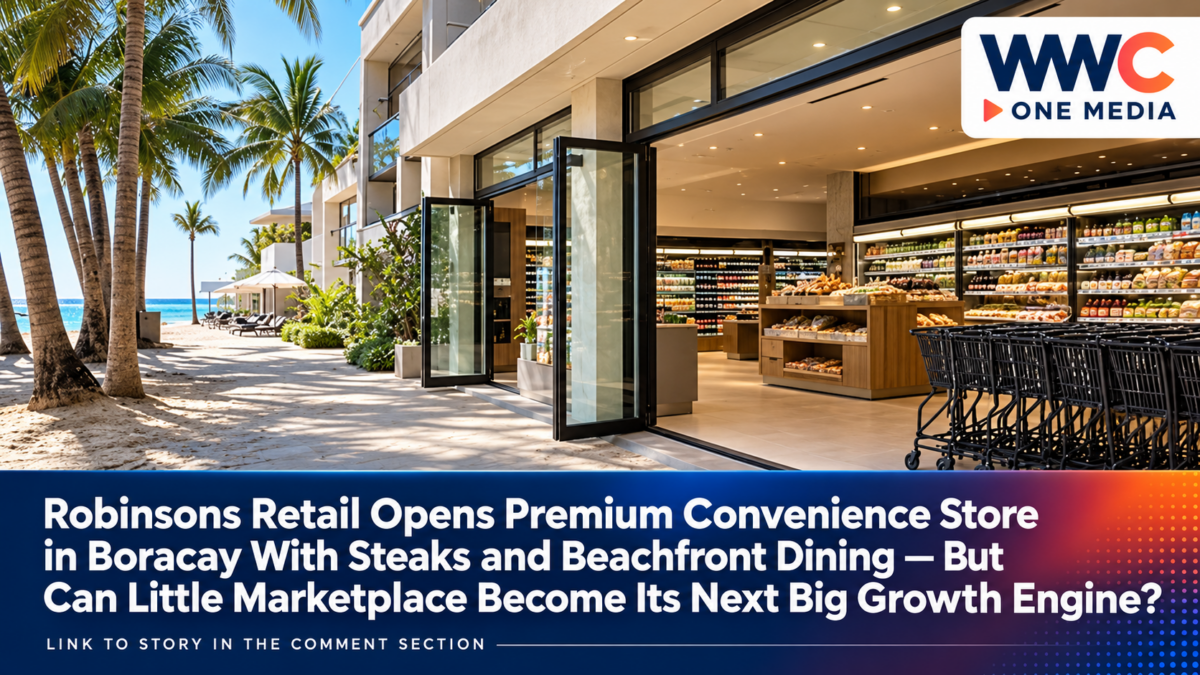
BORACAY, AKLAN, PHILIPPINES — October 31, 2026. Robinsons Retail Holdings Inc. is taking a fresh approach to convenience shopping, launching a boutique grocery-and-dining concept in Boracay that could become the Gokongwei-led group’s next retail expansion opportunity.
The company, through its premium supermarket brand The Marketplace, opened Little Marketplace on October 30 at Henann Crystal Sands Resort in Station 1.
Unlike a conventional convenience store focused mainly on snacks, drinks and everyday necessities, the new outlet brings together imported groceries, ready-to-eat meals, freshly prepared steaks, travel essentials and an in-store bar.
The concept is designed for tourists and residents who want a combination of quick shopping and casual dining in a compact retail space.
But the Boracay opening is more than a new place to buy groceries.
It is a test of whether Robinsons Retail can expand The Marketplace into smaller, high-traffic locations without sacrificing the premium identity that distinguishes the brand.
The biggest question is whether Little Marketplace can turn a beachfront experiment into a commercially sustainable format for other Philippine tourism and lifestyle destinations.
Robinsons Retail enters premium boutique convenience shopping
The October 30 opening marks The Marketplace’s entry into boutique convenience retail.
The outlet is located at Henann Crystal Sands Resort, a beachfront property along Boracay’s Station 1.
Its product selection includes imported food items, locally available essentials, fresh products, beverages and prepared meals.
The store combines those grocery offerings with services normally associated with restaurants and leisure establishments.
According to Robinsons Retail’s announcement, the format is intended to serve visitors and residents while responding to changing consumer preferences for accessibility, convenience and shopping experiences.
Little Marketplace operates daily from 7 a.m. to 10 p.m., based on its announced schedule.
The company has positioned Boracay as the pilot market for the concept.
However, management has not disclosed how many additional stores it intends to open or when a broader rollout might begin.
From grocery shelves to freshly grilled steaks
One of Little Marketplace’s defining features is its Pick & Grill service.
Customers can select premium meat cuts and have them prepared for dining at the location.
Offerings announced for the concept include Canadian ribeye and Greater Omaha steaks from the United States.
The format creates an additional reason for customers to enter the store beyond ordinary grocery shopping.
A traveler might buy drinks and vacation essentials during the day, then return for a prepared meal in the evening.
The outlet also includes the Little Marketplace Bar, featuring beverages such as cocktails, wines and draft beer.
These services are meant to establish a more experience-oriented retail environment.
For Robinsons Retail, the potential benefit is the ability to generate spending from multiple shopping occasions.
However, the company has not published the store’s average transaction value, profit margin or sales forecasts.
Any claim that the format is already more profitable than conventional convenience retail would therefore be premature.
Why Boracay is the ideal testing ground
Boracay is one of the Philippines’ best-known tourism destinations.
Its concentration of resorts, restaurants and leisure activities creates demand for convenient access to food, beverages and travel-related products.
Station 1, in particular, is associated with beachfront accommodation and hospitality establishments.
Little Marketplace’s location allows the company to test how tourists and permanent residents respond to a store offering premium groceries and casual dining.
The commercial logic is straightforward: a traveler may value immediate access to essentials and prepared food without having to visit a larger supermarket.
But tourism-led retail also involves uncertainties.
Customer traffic can fluctuate with holiday seasons, travel costs and weather.
A store in a prime beachfront location may also face different rental and staffing expenses from a neighborhood outlet.
These factors make Boracay an attractive but demanding test market.
Robinsons executives see room for a new shopping experience
The Marketplace Deputy General Manager Diana Prince Ang has described Little Marketplace as an effort to create a more curated and experiential convenience-store format.
The concept reflects how the company expects tourists and local customers to combine food purchases, shopping and leisure activities.
Christine Tueres, Robinsons Retail’s managing director for food segments–big formats, has likewise highlighted opportunities in combining convenience retail with food and beverage services.
Their comments suggest management is looking beyond standard store expansion.
The company is testing a format that may be adaptable to places where a full-size supermarket would be impractical but demand exists for specialty products and prepared food.
However, no final expansion schedule has been announced.
Boracay remains a pilot location, and future stores will depend on management’s evaluation.
Little Marketplace is not Robinsons Retail’s first convenience business
The launch requires an important clarification.
Robinsons Retail is already a major Philippine retailer with operations across several different formats.
Its portfolio includes Robinsons Supermarket, The Marketplace, Shopwise, Robinsons Easymart and Uncle John’s.
The newest concept therefore represents an extension of The Marketplace brand rather than the group’s first entry into convenience retail.
This distinction matters because the business is not starting without operating experience.
Robinsons Retail already has capabilities in sourcing, distribution, merchandising and food retail.
But Little Marketplace will still need to establish its own commercial identity.
Its premium groceries and foodservice offerings may appeal to a different customer segment from traditional convenience stores.
The challenge is determining whether customers are willing to pay for those differences regularly.
The Marketplace is also expanding in Metro Manila
The Boracay launch follows another wave of activity by The Marketplace.
In October, Robinsons Retail expanded its premium supermarket network in southern Metro Manila.
New locations included Evia Lifestyle Center in Las Piñas and BF Homes in Parañaque.
WWC ONE MEDIA covered the expansion in Gokongwei’s The Marketplace Opens Two New South Metro Supermarkets With Up to 50% Off — But a Bigger Grocery Battle Is Heating Up.
Those outlets target established residential markets, with imported food products, premium meats, fresh produce and specialty grocery selections.
Little Marketplace follows a different strategy.
Instead of emphasizing the broad assortment available in a conventional supermarket, it combines selected products with prepared meals in a smaller space.
Together, the openings demonstrate how Robinsons Retail is experimenting with formats designed around different customer needs.
Shopwise is getting a makeover as competition increases
Robinsons Retail’s efforts are not limited to The Marketplace.
Its Shopwise chain recently refreshed its original Alabang branch at Festival Mall.
The upgraded store features wider aisles, improved navigation and expanded selections of local and international merchandise.
WWC ONE MEDIA examined the development in Shopwise Reboots Its First Alabang Store With Global Brands and Bigger Aisles — But Value-Conscious Shoppers May Decide Whether the Makeover Works.
The Alabang renovation reflects a broader trend in retail.
Physical stores increasingly need to provide reasons for customers to visit beyond simply purchasing products.
For Shopwise, that means improving the overall supermarket experience.
For Little Marketplace, it means combining grocery convenience with casual dining.
Both strategies involve additional investment, making repeat customer demand essential to their long-term success.
Tourism destinations are becoming important to Robinsons’ expansion
The Boracay project follows another Robinsons Retail investment in a major Philippine tourist destination.
In September, Robinsons Supermarket opened its first Bohol location at Bellemar Lifestyle Center in Tawala, Panglao.
WWC ONE MEDIA reported on the development in Robinsons Makes Its Big Bohol Bet: First Panglao Supermarket Opens — And Tourism Is the Real Prize.
The Panglao branch is a conventional supermarket, unlike the new Little Marketplace format.
However, both projects illustrate a strategy of serving communities where tourism spending overlaps with local household demand.
Resort destinations can attract customers seeking everyday essentials, international products and convenient food options.
But the needs of those customers differ.
A full supermarket may be better suited to regular household shopping, while a compact convenience-and-dining outlet may appeal to travelers seeking immediate purchases.
Robinsons Retail’s expansion suggests it sees opportunities for multiple store types rather than a single format.
The premium retail strategy extends beyond traditional groceries
The Marketplace has also sought to attract shoppers through specialty products and curated experiences.
Its October 2026 Wine Fair at Shangri-La Plaza brought together international products, promotional offers and consumer-focused retail activities.
WWC ONE MEDIA covered the event in The Marketplace Wine Fair Showcases Global Favorites With Up to 50% Discounts — But Its Bigger Retail Strategy Goes Beyond the Sale.
The event was separate from the Boracay launch, but it illustrates the brand’s broader approach to attracting customers through product discovery and shopping experiences.
Little Marketplace brings that philosophy into a permanent store.
By offering specialty products alongside dining and convenient grocery purchases, the company hopes to develop a distinctive position in the market.
However, customer experience alone does not determine profitability.
The store must also maintain efficient inventory, consistent product quality and competitive operating costs.
Premium convenience retail comes with new risks
Little Marketplace’s business model introduces operating challenges beyond those of a traditional convenience store.
Fresh meats require proper storage and handling.
Prepared meals require trained staff, suitable equipment and food-safety procedures.
Imported grocery products may be affected by exchange rates and supply-chain disruptions.
The beachfront location also exposes the business to tourism-related changes in customer demand.
These challenges do not mean the format is financially unattractive.
They mean its commercial potential must be assessed through actual performance.
Premium positioning can help distinguish a store from mass-market competitors.
But a more complex operation may also require higher sales to cover its expenses.
Without disclosed financial results for Little Marketplace, investors and consumers cannot yet determine whether the concept offers better profitability than Robinsons Retail’s established store formats.
Could Little Marketplace eventually expand nationwide?
Robinsons Retail has indicated that the format may be adapted to additional tourism and lifestyle destinations.
That possibility creates interest in whether Little Marketplace could appear in other popular destinations or selected urban neighborhoods.
But no specific cities or sites have been formally confirmed as part of a rollout in the reviewed announcements.
The company has also not disclosed an investment budget or a target number of stores.
Future decisions will likely depend on customer response, operational performance and the economics of the Boracay pilot.
A concept that performs well in a major beachfront tourism location may require modification before operating successfully elsewhere.
Different communities have different purchasing habits, rental costs and spending capacities.
The format will need sufficient flexibility to adapt without losing the features that make it distinctive.
What the opening means for Filipino consumers
For travelers visiting Boracay, Little Marketplace provides another option for quick grocery purchases, prepared meals and specialty food products.
For island residents, the store adds another retail choice.
However, the premium positioning means affordability may vary depending on the products purchased.
The new concept is unlikely to replace conventional supermarkets, neighborhood stores or other convenience retailers.
Instead, it serves a more specialized purpose.
Its value to customers will depend on accessibility, product selection, service quality and pricing.
The arrival of another retailer may increase consumer choice, but the actual benefit will become clearer as the store operates over time.
The bigger question: Can a Boracay pilot become Robinsons Retail’s next success story?
Little Marketplace represents another step in Robinsons Retail’s effort to develop store formats that respond to changing consumer habits.
The company has an established grocery business, a significant distribution network and experience managing different retail brands.
Its newest concept combines those capabilities with foodservice and an emphasis on the shopping experience.
Boracay provides a high-profile setting to test the strategy.
But expansion will depend on more than an attractive store design or a successful opening weekend.
The company must establish consistent demand, manage foodservice costs and determine whether the concept can work in different locations.
Robinsons Retail has introduced a premium convenience store that blends groceries, steaks and dining in one of the Philippines’ most famous tourist destinations. But the question is whether Little Marketplace can become a profitable new national retail format—or remain an appealing Boracay experiment that proves difficult to duplicate.