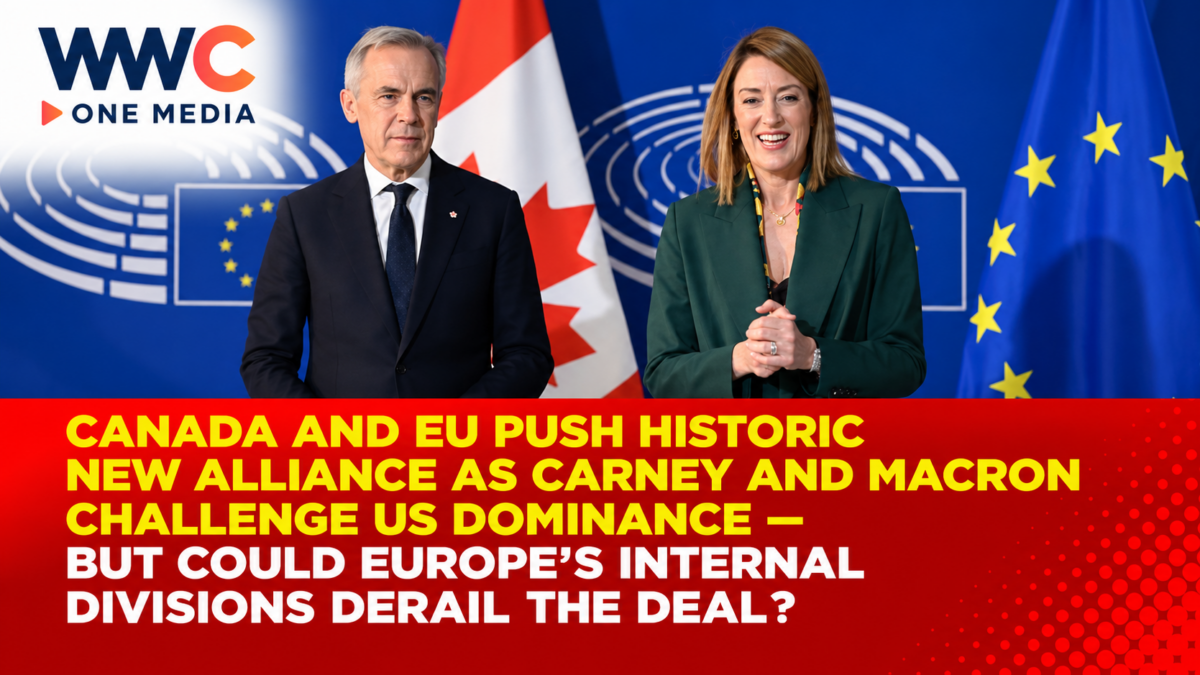
MONTREAL / BRUSSELS / PARIS — October 30, 2026. Canada and the European Union are attempting to forge an unprecedented strategic partnership that could reshape trade, investment and security cooperation across the Atlantic, as Prime Minister Mark Carney seeks to reduce Ottawa’s dependence on the United States and European leaders pursue greater independence in an increasingly unpredictable global order.
The October 29–30 Canada–EU summit in Montreal is a major test of those ambitions.
Preparatory documents outline plans for closer economic integration, defense cooperation, critical-mineral supply chains, digital technology and energy security.
The initiative comes against the backdrop of US trade tensions, competition with China and Europe’s growing concerns about strategic dependence on outside powers.
French President Emmanuel Macron has been among the strongest advocates of European strategic autonomy, while Carney has made closer relations with Europe a central part of his government’s foreign-economic strategy.
But enthusiasm for a stronger transatlantic partnership does not automatically guarantee agreement on its final form.
Some EU governments have reportedly questioned the proposed terminology surrounding Canada’s special relationship with the bloc, while practical challenges involving trade barriers, investment and national sovereignty remain unresolved.
The bigger question is whether Canada and Europe can build a genuinely new economic and security partnership—or whether political differences will prevent the alliance from delivering the transformation its supporters envision.
Montreal summit tests Canada’s ambitious European strategy
The Montreal gathering brings together Canadian and European Union leaders during a period of significant geopolitical uncertainty.
Prime Minister Mark Carney is seeking a stronger relationship with the 27-member European Union as Canada attempts to diversify its international economic and political partnerships.
The EU is represented at the summit by European Commission President Ursula von der Leyen and European Council President António Costa.
The initiative builds on an already substantial relationship involving trade, investment, defense and diplomacy.
A leaked preparatory statement described plans for an Alliance for the Future—a framework intended to deepen cooperation well beyond conventional trade relations.
The proposed partnership would focus on stronger supply chains, increased investment and closer cooperation in strategically important industries.
However, a draft statement should not be confused with a final legally binding agreement.
At the time of this report, the exact text and legal consequences of any final October 30 summit declaration had not been independently established.
Carney wants Canada to depend less on the United States
Canada’s economic relationship with the United States remains exceptionally important.
The two countries share deeply integrated manufacturing industries, energy networks, transportation systems and financial relationships.
But recent trade disputes have demonstrated the risks of relying heavily on a single foreign market.
The Trump administration’s tariff measures and confrontational approach toward Canada have encouraged Ottawa to strengthen relationships with other major economies.
Carney’s European strategy seeks to create additional opportunities for Canadian exporters, manufacturers, investors and technology companies.
The aim is diversification rather than the immediate replacement of the United States.
Canadian businesses cannot simply reconstruct decades of North American integration overnight.
Geography, existing infrastructure and commercial relationships will continue making the US an essential economic partner.
But closer cooperation with Europe could create alternative sources of investment, export demand and industrial collaboration.
Macron’s vision of European independence meets Carney’s diversification push
French President Emmanuel Macron has repeatedly argued that Europe needs greater strategic autonomy.
His position is that the EU must strengthen its ability to defend its economic and security interests without depending excessively on decisions made in Washington or Beijing.
That includes developing its own industrial capabilities, improving competitiveness and reducing vulnerabilities in critical supply chains.
Carney’s agenda overlaps with this vision.
Both leaders see advantages in cooperation among democratic economies that want to preserve control over strategic decisions.
But their priorities are not identical.
Macron is primarily concerned with strengthening Europe’s capacity to act independently.
Carney is focused on protecting Canadian sovereignty and creating alternatives to excessive dependence on the United States.
The alliance will succeed only if those objectives translate into practical policies that also satisfy other EU member governments.
Importantly, Macron’s political influence does not mean France alone can determine the outcome of an EU–Canada agreement.
Canada’s proposed EU association faces political questions
One of the most closely watched elements of the negotiations is the possibility of establishing a distinctive association between Canada and the European Union.
Preparatory reporting has referred to Canada potentially receiving an associate status unlike the EU’s existing relationships with other countries.
The concept has attracted attention because it could allow significantly closer cooperation without conventional EU membership.
But the terminology itself has reportedly generated disagreement.
The Globe and Mail reported that several EU member states, including Germany, had raised objections to describing Canada as an associate member in the summit’s proposed communiqué.
That does not mean Germany opposes all closer cooperation with Canada.
A government may support stronger economic and security ties while resisting language that creates confusion about the EU’s institutional structure.
The distinction is essential.
Canada is not automatically becoming an EU member, joining the single market or obtaining free movement rights merely because leaders discuss an unprecedented partnership.
Those outcomes would require separate agreements and legal arrangements.
CETA already provides the foundation for closer trade
Canada and the EU are not starting from zero.
The Comprehensive Economic and Trade Agreement, known as CETA, has been provisionally applied since September 21, 2017.
According to the European Union’s official trade information, CETA eliminated duties on approximately 98% of tariff lines.
The agreement also addresses services, investment, procurement and regulatory cooperation.
However, CETA does not eliminate every commercial obstacle.
Businesses still face differences in standards, certification requirements, logistics and domestic regulations.
Some provisions also depend on separate legal or ratification processes.
The question for the Montreal summit is how the two sides can move beyond existing trade liberalization.
Greater cooperation might involve improved investment conditions, digital trade rules, industrial partnerships or better coordination in strategically important sectors.
Those opportunities could produce meaningful benefits.
But they require implementation rather than simply a new political declaration.
Global trade tensions are making economic diversification more urgent
The effort to deepen EU–Canada ties reflects wider changes in the international trading system.
Countries are increasingly concerned about tariffs, national-security restrictions and growing geopolitical competition.
WWC ONE MEDIA previously examined the issue in The WTO Says the Global Trade Order Is Facing Its Biggest Disruption in 80 Years — And the Worst-Case Cost Could Be Nearly 7% of World GDP.
The report explored warnings about the potential economic costs of severe trade fragmentation.
For Canada and Europe, the challenge is to diversify trade without creating new barriers that undermine efficiency.
Greater integration between trusted partners could reduce exposure to some geopolitical risks.
But it cannot completely shield their economies from global trade disruptions.
The United States, China and other major markets will remain important participants in international supply chains.
The new alliance therefore needs to be economically practical rather than purely symbolic.
Defense cooperation becomes a central priority
Security and defense are another major component of the relationship.
At the June 2025 summit in Brussels, Canada and the European Union formally established a Security and Defence Partnership.
The agreement created a framework for cooperation on international security challenges, defense industries, crisis management and related matters.
European parliamentary reporting in March 2026 also referred to Canada’s participation in arrangements connected to the EU’s Security Action for Europe, or SAFE, initiative.
The program is designed to support European defense-industrial capacity and joint procurement.
For Canadian companies, closer cooperation may create opportunities in manufacturing, research and defense technology.
For Europe, Canada offers an established NATO partner with substantial industrial and natural-resource capabilities.
But participating in defense procurement arrangements is not equivalent to becoming an EU member.
It also does not mean the European Union has replaced NATO or Canada’s existing security relationships.
Critical minerals could become a major economic prize
Canada possesses substantial deposits of minerals important to batteries, clean energy, industrial manufacturing and advanced technology.
European companies are seeking more secure supplies of raw materials as geopolitical competition intensifies.
Cooperation could involve mining investment, processing facilities, supply-chain standards and research.
The European Union and Canada already maintain a strategic partnership on critical raw materials.
The Montreal initiative could build upon that relationship.
But announced ambitions must eventually translate into commercially viable projects.
Mines can take years to develop and may face financing, environmental, infrastructure and permitting challenges.
The value of a critical-minerals partnership will therefore depend on whether it helps produce reliable supplies at competitive costs.
The agreement would be judged by operational projects, not simply the number of sectors mentioned in a summit statement.
Energy security creates another opportunity—and another challenge
Energy is also expected to feature prominently in the discussions.
Canada has substantial resources in conventional energy, hydroelectricity, nuclear technology and renewable power.
Europe has sought to diversify energy supplies and strengthen resilience following major disruptions involving Russia and the wider international energy market.
Potential cooperation could include liquefied natural gas, electricity technology, nuclear energy and renewable infrastructure.
However, large energy projects are not created instantly through diplomatic commitments.
LNG export facilities require substantial investment, infrastructure and customer agreements.
Electricity interconnections and clean-energy projects also face financial and technical constraints.
The economic case must be evaluated project by project.
Political alignment can create opportunities, but commercial demand determines whether many of those investments proceed.
The alliance may also reshape industrial investment
The EU and Canada are considering stronger cooperation in advanced manufacturing, finance, digital technology and strategic industries.
That could help companies diversify production networks.
A more integrated investment environment might encourage businesses to expand operations on both sides of the Atlantic.
But industrial policy can be complicated by government subsidies, domestic political priorities and competing national interests.
WWC ONE MEDIA explored these pressures in Global Steel Market Fractures as Trade Barriers Force a New Industry Playbook.
That report examined how trade restrictions and shifting industrial policies are forcing manufacturers to adjust their strategies.
The lesson applies to Canada and Europe.
Building stronger trade relationships requires more than reducing tariffs.
It also involves regulatory predictability, competitive costs and access to finance.
Without those conditions, businesses may hesitate to make the long-term investments policymakers want.
European economic pressures could complicate the plan
Closer cooperation also arrives at a difficult time for some European governments.
Public debt, borrowing costs and fiscal constraints have increased pressure on budgets.
These financial conditions can complicate commitments involving defense, infrastructure and industrial support.
WWC ONE MEDIA previously examined the issue in Europe’s Debt-Heavy Governments Bow to Bond Market Pressure — But a Bigger Fiscal Reckoning Could Be Ahead.
That report explored the limits of government borrowing amid investor concerns about fiscal sustainability.
A deeper Canada–EU partnership could attract private investment and support growth.
But some ambitions may still require substantial public financing.
Member states may disagree over how much spending should be financed collectively and how costs should be distributed.
These questions will influence whether the partnership delivers significant new economic capacity.
France’s fiscal challenges highlight the political pressure
Macron’s support for a stronger Europe must also be considered alongside France’s domestic financial position.
Rising borrowing costs and public debt have constrained the country’s fiscal flexibility.
WWC ONE MEDIA examined the risks in France’s Borrowing Costs Near 5% as Central Bank Chief Sounds Alarm — But the Bigger Threat Is a Debt Trap Politics May Struggle to Escape.
Fiscal pressure does not prevent France from supporting a new international partnership.
But it can influence how quickly governments implement costly industrial and security initiatives.
Other EU members also have different priorities and financial constraints.
This creates an institutional challenge that Canada does not face in the same way when negotiating with a single national government.
Ottawa needs to build agreement not only with European Commission officials but also with relevant member states.
What does the partnership mean for the United States?
The EU–Canada initiative is partly motivated by uncertainty over American trade and foreign policy.
However, it would be misleading to describe the new relationship as a complete break with Washington.
Canada remains geographically and economically closely integrated with the United States.
European companies also maintain substantial transatlantic trade and investment relationships with American businesses.
The partnership is better understood as an attempt to create alternatives and strengthen negotiating flexibility.
More diversified supply chains may reduce vulnerability to trade disruptions.
But they will not eliminate the importance of the US market.
The geopolitical significance lies in demonstrating that Canada and European governments want additional capacity to act independently when their interests differ from those of Washington.
Could China face greater competition from a united Canada and Europe?
The initiative also has implications for China.
Beijing is a major supplier of industrial products and an important participant in global technology and mineral supply chains.
Canada and Europe may seek closer cooperation in sectors where excessive dependence on concentrated foreign supply poses risks.
That could encourage investment in alternative suppliers or regional processing facilities.
However, diversification does not necessarily mean ending trade with China.
Many European and Canadian companies continue to rely on Chinese manufacturing and consumer markets.
A practical strategy would need to balance supply-chain resilience with the economic benefits of international commerce.
The consequences for China will depend on the actual policies and projects adopted.
What this could mean for the Philippines and Southeast Asia
The Philippines and other Southeast Asian economies may be affected indirectly by changes in transatlantic trade and investment.
A closer Canada–EU partnership could create new international supply-chain patterns in critical minerals, digital technology, manufacturing and energy.
Businesses considering expansion may evaluate whether new regulations or investment incentives make some locations more attractive.
But there is no verified basis to claim that the Montreal summit has already produced specific new investments in the Philippines.
For Philippine exporters, the broader lesson concerns the importance of maintaining diverse international markets.
Concentrating too heavily on any one trading partner can create vulnerability when political or economic conditions change.
The EU–Canada discussions illustrate why many governments are reconsidering how to balance integration, competitiveness and economic security.
What must happen after the Montreal summit?
The decisive test will be implementation.
Canada and the EU will need to clarify the legal meaning of any proposed association arrangement.
They must identify which trade and investment barriers can realistically be reduced.
Defense cooperation will require procurement rules, financing and industrial coordination.
Critical-mineral projects will need investment and regulatory approvals.
Energy and digital initiatives will require technical agreements and commercial participation.
Political support alone will not guarantee success.
Any commitment to define the partnership further in 2027 would also mean that important details remain unresolved rather than completed.
The pace of progress may be influenced by domestic politics, international trade disputes and the broader global economy.
The bigger question: Can Carney and Macron turn geopolitical ambition into lasting change?
Canada and the European Union share a strong existing foundation.
They already have a major trade agreement, a security partnership and extensive diplomatic cooperation.
The latest summit is an attempt to build something more ambitious.
Carney wants to diversify Canada’s international relationships and reduce vulnerability to external pressure.
Macron wants Europe to develop greater strategic independence.
Other European leaders see opportunities in trade, investment, energy and defense.
But the proposed relationship must satisfy different governments, legal systems and economic interests.
A historic announcement may attract headlines. Turning that announcement into productive investment, improved market access and stronger security will be the more difficult task.
The Montreal summit could mark the beginning of an unprecedented Canada–EU partnership. But the real question is whether Carney’s diversification strategy and Macron’s vision of a more independent Europe can overcome institutional disagreements and deliver an alliance powerful enough to change the transatlantic economic landscape—or whether the most ambitious promises will remain unfinished.