NEW YORK — The artificial intelligence boom is entering a tougher phase on Wall Street. Investors are no longer impressed by massive spending plans alone. They increasingly want proof that technology companies can turn their AI investments into sustainable revenue and, crucially, cash.
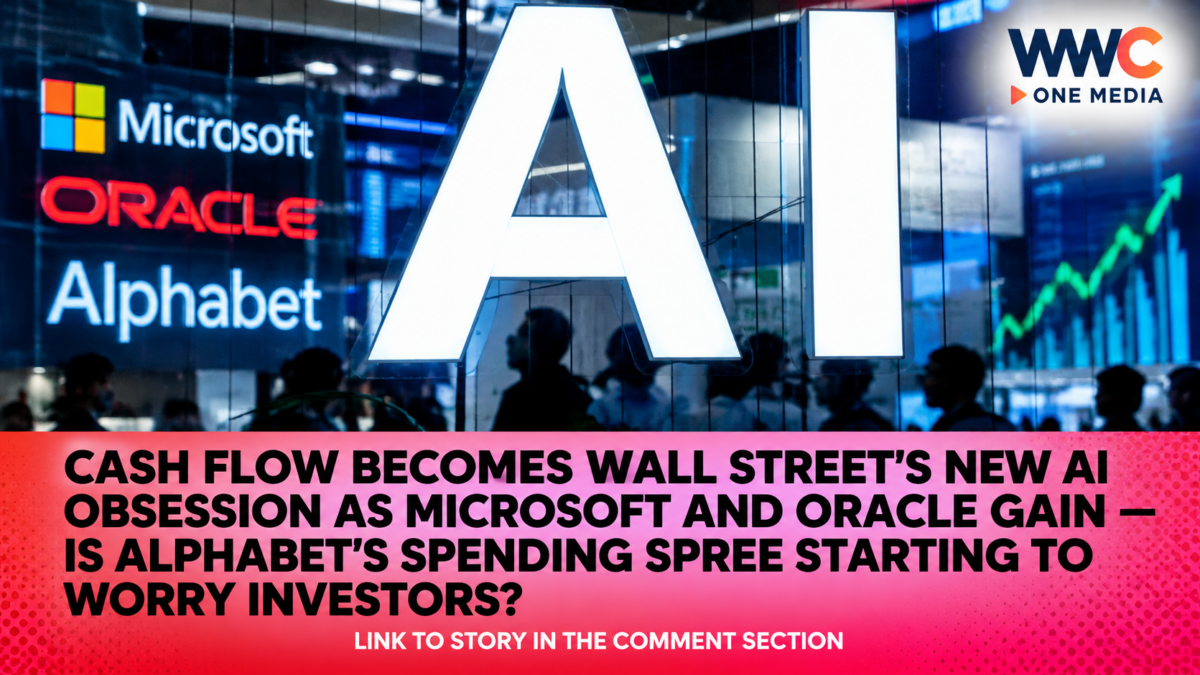
That shift was clear after the latest earnings reports from some of the world’s biggest technology companies. Microsoft and Oracle received a warmer market response, while Alphabet, Google’s parent company, faced a sharp sell-off as investors questioned the cost of its AI expansion and slower-than-expected growth in its core search business.
Microsoft shares rose more than 3% in after-hours trading on Wednesday, October 28, while Alphabet fell nearly 10%. In premarket trading on Thursday, Microsoft remained higher and Alphabet was down close to 11%, according to Reuters reporting carried by AsiaOne and other outlets. AsiaOne+2
The contrast reflects a changing investment mood: the market still wants AI growth, but it is becoming much more selective about how companies pay for it.
Alphabet’s AI ambitions collide with a cash-flow test
Alphabet is investing heavily to expand its AI capabilities, including data centres and computing infrastructure. But the scale of that spending is attracting greater scrutiny.
The company devoted 121.4% of its operating cash flow to capital expenditure in the September quarter, according to the Reuters report. That means its infrastructure spending exceeded the cash generated by its operations during the period, leaving less internally generated cash available for other uses.
Microsoft’s comparable ratio was 68%, excluding finance leases.
The difference matters because cash left over after infrastructure investment can support dividends, share buybacks, debt repayment and future projects. When spending exceeds operating cash flow, a company may need to draw on reserves or seek outside financing.
Alphabet’s search business added to investor concerns. Search revenue grew 12% in the September quarter, below analysts’ expected 14.7% increase. Chief executive Sundar Pichai nevertheless said search queries were growing at their fastest pace in five years.
The concern is not that Google Search is suddenly disappearing. It is that AI chatbots and AI agents could change how people find information, potentially challenging the business that has long helped finance Alphabet’s expansion.
Alphabet’s Google Cloud business is growing rapidly, with quarterly revenue more than doubling to US$30.71 billion. But investors are weighing that progress against the enormous cost of building the infrastructure needed to compete in AI. The company’s capital spending could reach as much as US$205 billion this year, according to the report. AsiaOne+2
For a wider look at the financing risks behind the AI buildout, WWC ONE MEDIA has examined how technology companies are increasingly connected through investments, supply agreements and financing arrangements in the trillion-dollar money loop powering the AI boom.
Microsoft demonstrates the value of generating cash while investing
Microsoft offered investors a more reassuring picture.
The company generated US$18.6 billion in free cash flow in its fiscal first quarter, nearly US$10 billion above Wall Street expectations, while spending US$45.2 billion to expand its computing infrastructure.
Its Azure cloud business also delivered strong growth, with revenue rising 48% — better than expected. Microsoft forecast faster-than-anticipated cloud growth for the current quarter, reinforcing the view that businesses continue to demand AI computing capacity.
The figures suggest Microsoft is finding customers beyond a small group of major AI companies, including OpenAI, whose computing needs have helped drive the infrastructure expansion.
Chief executive Satya Nadella also indicated that the market is moving beyond experimentation with the newest AI models. More businesses are beginning to commit to longer-term contracts and practical deployments.
That distinction is important for investors. AI enthusiasm can generate headlines and product demonstrations, but recurring customer demand is more useful when assessing whether infrastructure investments can eventually pay for themselves. AsiaOne+1
Oracle gains favour after promising tighter financing discipline
Oracle also benefited from the market’s growing focus on financial discipline.
The company’s shares climbed nearly 11% during regular trading on Wednesday after it outlined plans to place a ceiling on external financing and said it expected to become cash-flow positive in the second half of fiscal 2028.
The message appeared to reassure investors that Oracle was seeking to manage the funding burden of its cloud infrastructure expansion rather than relying indefinitely on new borrowing and other external capital.
That does not mean Oracle’s spending risks have disappeared. Its plans still depend on continued demand for cloud and AI capacity, and its future cash-flow target is a forecast rather than a result already achieved.
The market reaction nevertheless suggests that investors are beginning to distinguish between companies that can explain how they will finance their AI ambitions and those whose spending is running ahead of the cash their businesses generate. CNA+1
Meta’s experience shows that strong revenue may not be enough
Meta provided an earlier example of this changing attitude.
Last week, the company’s better-than-expected revenue growth and upbeat outlook were overshadowed by concerns about its cash burn. Investors appeared increasingly uncomfortable with the prospect of enormous AI-related investments continuing without clear evidence of sufficiently strong returns.
The broader message is that revenue growth alone may no longer protect technology shares from a negative market reaction. Investors are examining the cost of producing that growth, the financing required and how quickly AI services can generate meaningful returns.
WWC ONE MEDIA has also explored the infrastructure side of this debate in its report on HSBC’s warning over the US$4.1 trillion AI debt boom. The concern is not simply how much money is being invested, but whether future demand and revenue will justify the commitments being made today.
The AI investment race is far from over — but the rules are changing
The latest earnings reactions do not prove that the AI boom is ending. Demand for cloud computing remains strong, and companies are continuing to invest in data centres, servers, chips and networking equipment to support increasingly sophisticated AI services.
But the financial stakes are rising.
A Reuters analysis published in July estimated that five major technology infrastructure spenders — Microsoft, Alphabet, Amazon, Meta and Oracle — could collectively spend more on capital expenditure than they generate in free cash flow by 2027, based on then-current market estimates.
That analysis covered broader capital expenditure, not exclusively AI spending, and its forecasts may change. Still, it illustrates why investors are paying closer attention to the relationship between infrastructure costs and cash generation. Investing.com
The pressure is also relevant to companies and investors across Asia. The region is attracting substantial investment in data centres, semiconductor manufacturing and AI-related infrastructure. WWC ONE MEDIA recently examined Toshiba’s planned expansion of AI-related storage manufacturing in the Philippines, highlighting how the global AI buildout is creating opportunities beyond the largest US technology companies.
For investors, the latest market reaction offers a clear warning: a company can be spending heavily because it believes AI will transform its business, but that ambition alone does not guarantee attractive returns.
The next test will be whether AI revenue grows quickly enough to cover the cost of the infrastructure race — without leaving companies overly dependent on debt or outside financing.
Wall Street is still betting on artificial intelligence. It is simply becoming less willing to give every AI spender the benefit of the doubt.