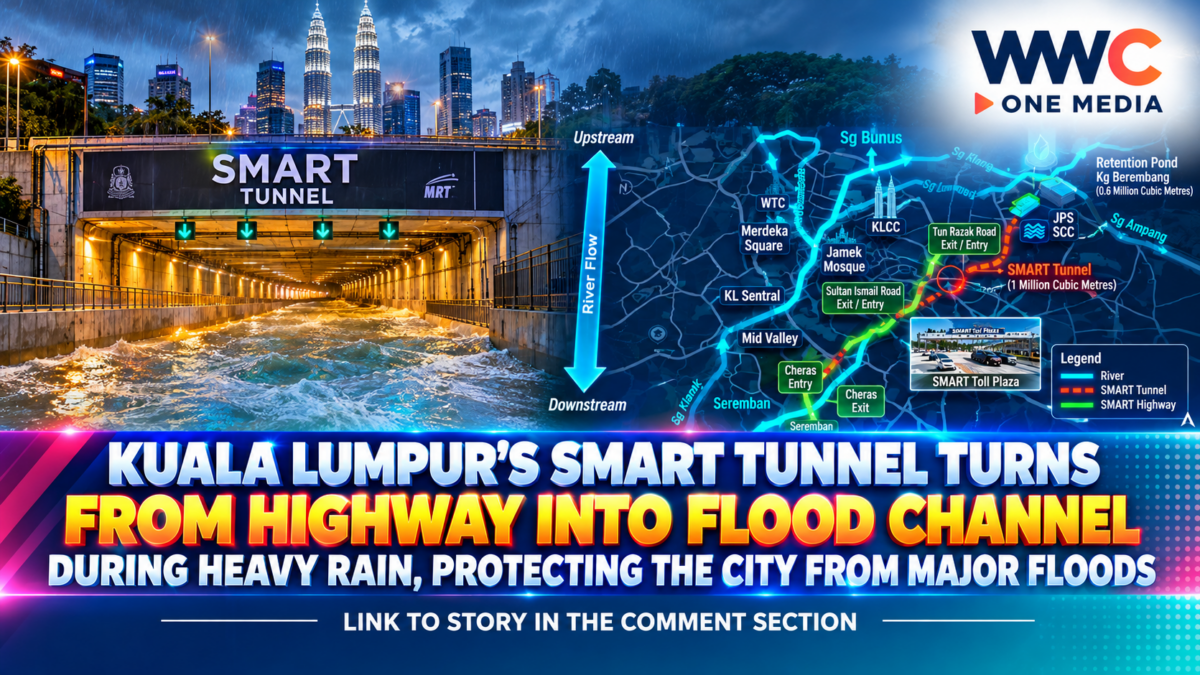
A highway that transforms into a river when heavy rain strikes may sound like something from the future, but Malaysia has been operating this remarkable engineering system for nearly two decades.
Kuala Lumpur’s Stormwater Management and Road Tunnel, better known as the SMART Tunnel, is one of the world’s most distinctive infrastructure projects, combining a motorway and a massive flood-control system within a single underground structure.
For motorists, the tunnel provides a faster route towards Kuala Lumpur’s city centre. But when severe storms threaten the Malaysian capital, its purpose changes dramatically: the same underground passage used by vehicles can become a channel for diverting enormous volumes of floodwater away from vulnerable parts of the city.
Stretching approximately 9.7 kilometres, the SMART Tunnel was designed to address two major problems affecting Kuala Lumpur: recurring flash floods and heavy traffic congestion.
The system has a combined water-storage capacity of approximately three million cubic metres, equivalent to around 1,200 Olympic-sized swimming pools.
According to Amanat Lebuhraya Rakyat (ALR), which oversees the tunnel concessionaire, the system has recorded 685 flood-mode operations since it began operating.
The infrastructure project cost approximately RM1.93 billion, making it one of Malaysia’s most significant flood-mitigation investments.
Why Kuala Lumpur Needed a Highway That Could Become a Flood Channel
Kuala Lumpur has experienced devastating floods throughout its history, with major flooding events recorded in 1926 and 1971.
More recent incidents in 2001, 2002 and 2003 also affected several areas, including Jalan Ipoh, Jalan Gombak, Jalan Munshi Abdullah and Dataran Merdeka.
Rapid urban development, increasing paved surfaces and intense rainfall have placed additional pressure on the city’s drainage systems.
The idea behind the SMART Tunnel emerged in 2001 when the Malaysian government began exploring ways to reduce flooding around the Klang and Ampang river catchments while improving traffic conditions along the southern approach to the capital.
Engineering company Gamuda, together with engineering consultants Sepakat Setia Perunding and Mott MacDonald, developed the flood-diversion concept.
The project subsequently incorporated a motorway component through a partnership involving Gamuda and MMC Corporation.
Construction began in 2003, and the tunnel officially opened to motorists in 2007.
Its dual-purpose design allowed Malaysia to combine major transportation infrastructure with an extensive urban flood-control system.
How the SMART Tunnel Diverts Millions of Cubic Metres of Water
The SMART Tunnel operates as part of a larger drainage network designed to intercept excess water from the Klang and Ampang rivers.
When heavy rainfall causes river levels to rise, the system diverts excess water near Kampung Berembang before transporting it through the underground tunnel towards a holding pond in Taman Desa.
The water is temporarily stored before being released into Sungai Kerayong.
The entire system has three major water-storage components:
- Kampung Berembang holding pond: 600,000 cubic metres.
- SMART Tunnel: 1 million cubic metres.
- Taman Desa holding pond: 1.4 million cubic metres.
Together, these facilities provide approximately three million cubic metres of storage capacity.
Two separate control centres coordinate the operation.
The Department of Irrigation and Drainage (DID) monitors rainfall, river conditions and water levels before determining when floodwater diversion should begin.
Meanwhile, the motorway control centre manages traffic operations, including closing the highway, clearing vehicles and coordinating the cleaning and reopening process.
This coordination is essential because the motorway must be completely cleared before it can safely carry floodwater.
The Four Operating Modes That Allow the Tunnel to Change Its Purpose
One of the most impressive features of the SMART Tunnel is its ability to operate in four different modes depending on weather conditions and the severity of flooding.
Mode 1: Normal Highway Operations
During ordinary weather conditions, the motorway operates normally.
Motorists can use the road as they would any conventional underground highway, while the flood-control system remains on standby.
Mode 2: Heavy Rain Without Closing the Highway
When moderate rainfall causes river levels to rise, the system diverts excess water through a lower channel beneath the motorway.
This allows floodwater to move through the tunnel while vehicles continue using the road above.
According to the tunnel’s operating guidelines, this mode is activated when the monitored flow rate reaches approximately 70 to 150 cubic metres per second.
Mode 3: Highway Closed as a Precaution
When authorities forecast a major storm and river flows reach approximately 150 cubic metres per second or more, the motorway is closed.
Vehicles are evacuated, and the tunnel is prepared for possible floodwater diversion.
However, an important distinction is that closing the highway does not automatically mean the motorway section will be flooded.
If rainfall weakens or conditions improve, the tunnel may remain dry and eventually reopen without entering the next operating mode.
Mode 4: The Highway Becomes a Flood Channel
This is the most dramatic stage of the system.
If severe rainfall continues, authorities activate Mode 4, allowing floodwater to enter the motorway compartments after all vehicles have been evacuated.
The motorway effectively becomes part of the city’s flood-control channel, carrying excess water towards the downstream storage facilities.
During this operation, the highway remains closed until the water has been drained and the entire facility has undergone cleaning, inspection and restoration.
Since the tunnel began operating in 2007, Mode 4 has been activated 11 times.
What Happens Inside the Tunnel After Floodwater Enters?
The work does not end when the rain stops.
After a Mode 4 operation, the tunnel must undergo an extensive recovery process before motorists can safely return.
Floodwater can leave behind mud, sediment, rubbish, branches and other debris. The force of the water can also damage lighting systems, road fixtures and other infrastructure.
The recovery process involves several important stages.
First, the Department of Irrigation and Drainage monitors the water levels and notifies the motorway operator when conditions allow recovery work to begin.
Next, large pumps remove the accumulated floodwater.
Workers then conduct safety inspections to identify potentially dangerous gases and other hazards before cleaning operations proceed.
Specialised machinery is used to remove mud, sediment and debris from the motorway compartments.
After cleaning, electrical systems, ventilation equipment and other infrastructure are checked and restored.
A final safety inspection must be completed before the highway can reopen.
The recovery process takes an average of approximately two days, although authorities have a reopening target of up to four days depending on the extent of flooding and repairs required.
The system also includes five large pumps housed in a pump room approximately 30 metres underground.
These pumps play a critical role in removing water trapped inside the tunnel following major flood operations.
685 Flood Operations and RM4.94 Billion in Potential Damage Avoided
The SMART Tunnel has become an important part of Kuala Lumpur’s flood-management strategy.
According to ALR, the system has recorded 685 flood-mode incidents, consisting of:
- 556 Mode 2 operations.
- 118 Mode 3 operations.
- 11 Mode 4 operations.
ALR estimates that the system has helped avoid approximately RM4.94 billion in potential flood damage.
This figure represents estimated losses that could potentially have occurred without the flood-mitigation system. It is not a direct calculation of money recovered or damage independently verified in every incident.
Nevertheless, the number illustrates the potential economic importance of preventing floodwater from overwhelming vulnerable parts of Kuala Lumpur.
Flooding can damage homes, commercial properties, vehicles, roads and critical infrastructure while disrupting businesses and transportation networks.
By diverting excess water away from vulnerable urban areas, the SMART Tunnel helps reduce the risk of widespread disruption during severe rainfall.
220 CCTV Cameras and Emergency Systems Monitor the Tunnel
Because the SMART Tunnel serves two very different purposes, its safety infrastructure is considerably more sophisticated than that of an ordinary motorway.
The facility is equipped with approximately 220 CCTV cameras monitored around the clock.
Other safety features include:
- Variable-message traffic signs to warn motorists about closures.
- 42 emergency telephones.
- 16 radio communication units.
- Watertight flood-control doors.
- 10 emergency exits and escape routes.
- Ventilation and air-quality monitoring systems.
- Automated gates operated through hydraulic mechanisms.
Emergency passages between the motorway decks are also provided at regular intervals, allowing motorists to escape if an emergency occurs.
These systems help ensure that vehicles and passengers are safely evacuated before the tunnel changes into a floodwater channel.
Why the SMART Tunnel Is Important for Malaysia’s Future
The SMART Tunnel demonstrates how cities can combine transportation infrastructure with climate adaptation and flood-risk management.
As extreme rainfall and urban flooding become growing concerns across Southeast Asia, infrastructure that serves multiple purposes could become increasingly valuable.
Malaysia’s experience offers an example of how engineering, drainage management and traffic planning can work together to address the challenges of a densely developed capital city.
The project also highlights the importance of maintaining existing infrastructure. Its effectiveness depends not only on its original engineering design but also on continuous monitoring, pumping systems, maintenance and coordination between government agencies and operators.
For Kuala Lumpur, the SMART Tunnel is much more than an underground shortcut.
It is a major flood-defence system capable of temporarily sacrificing its motorway function to protect the city when severe storms arrive.
And while motorists may only see a dark underground road during ordinary journeys, the infrastructure beneath them is ready to perform an entirely different job when the next major downpour threatens Malaysia’s capital.