
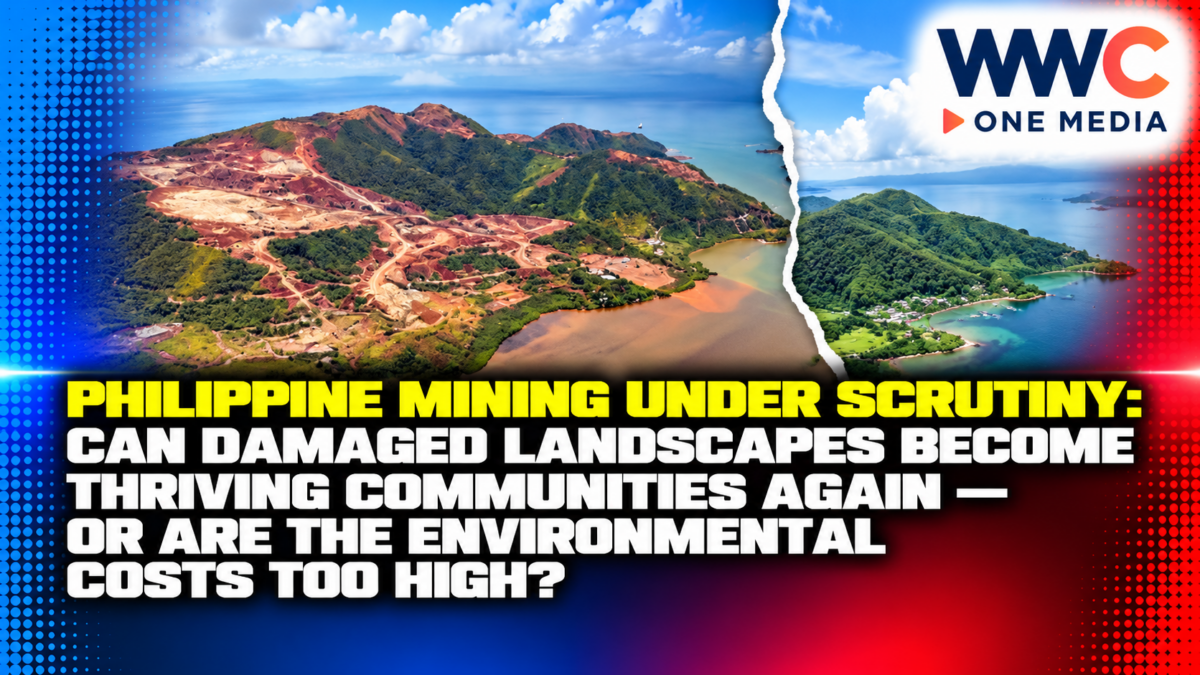
MANILA, PHILIPPINES — Mining has long divided the Philippines. To supporters, it provides essential minerals, employment opportunities, government revenue and investment in remote communities. To critics, it threatens forests, waterways, biodiversity and the ancestral lands of Indigenous peoples.
But a new debate is emerging over how the country should judge the industry’s long-term impact.
In an October 29 opinion column published by InsiderPH, former business journalist and current Nickel Asia Corporation communications executive Karl Ocampo argued that mining should not be evaluated solely through the environmental scars visible during extraction.
Instead, he urged the public to examine the entire life of a mining project, including rehabilitation, community development and what remains after operations end.
The argument raises an important question: Can a heavily disturbed mining landscape eventually become productive, ecologically stable land again?
And if rehabilitation is possible, how can the public determine whether mining companies are genuinely fulfilling their promises?
The answer matters not only to investors and regulators, but also to farmers, fisherfolk, Indigenous communities and families whose futures are tied to the land.
A controversial argument about mining’s environmental image
Mining often leaves visible marks on the landscape.
Open pits, cleared vegetation, roads, extraction areas and waste facilities can transform large sections of land.
These changes help explain why mining attracts strong public criticism.
Ocampo argues that focusing exclusively on what a mine looks like during production can obscure the industry’s eventual rehabilitation obligations and socioeconomic contributions.
His central point is that responsible mining should be judged across its full operating life.
That is a legitimate question for public debate.
However, the environmental impacts of mining cannot be reduced to appearance alone.
Deforestation, sedimentation, water contamination, habitat fragmentation and changes in land use can cause measurable environmental and social consequences.
A fair assessment must examine both the industry’s contributions and its documented impacts.
Why the author’s industry affiliation matters
The original InsiderPH article is an opinion column.
Its author, Karl Ocampo, previously worked as a business journalist for the Philippine Daily Inquirer and now serves as media and communications manager at Nickel Asia Corporation.
Nickel Asia is a Philippine mining company whose operations and environmental commitments feature in the column.
The affiliation is disclosed in the original publication.
Readers should understand that the piece presents an industry-connected perspective rather than the findings of an independent environmental investigation.
This does not automatically invalidate its arguments.
But claims about rehabilitation success and community benefits still require corroborating evidence.
Mining contributes billions to the Philippine economy
The mining industry plays a measurable role in Philippine production and exports.
According to the Mines and Geosciences Bureau, mining production value reached approximately ₱316.3 billion in 2024.
The agency also reported employment of 291,672 workers in the minerals industry for that year.
Mineral exports include nickel, gold, copper and other products that support industrial supply chains.
But mining’s importance should also be placed in perspective.
Philippine Statistics Authority figures cited by the Philippine Institute for Development Studies show mining and quarrying accounted for about 0.7% of gross domestic product in 2025.
The sector is valuable, but it is not one of the largest contributors to the economy by GDP share.
Economic contribution alone is therefore insufficient to settle debates over environmental costs.
Minerals remain important to modern technology
Minerals support many aspects of daily life.
Copper is used extensively in electrical equipment and infrastructure.
Nickel is used in stainless steel and certain rechargeable battery technologies.
Other minerals support construction, telecommunications, industrial machinery and energy systems.
Demand for critical minerals is increasingly linked to electrification and advanced manufacturing.
But the importance of minerals does not mean every proposed mining site is environmentally or socially acceptable.
Governments must still evaluate location-specific risks, alternative sources, responsible sourcing and efficient material use.
Recycling and resource efficiency should also be part of the long-term strategy.
The Philippines wants more local mineral processing
On October 28, the Philippine News Agency reported that the Department of Environment and Natural Resources was pushing the country to move beyond exporting raw minerals.
Officials highlighted an August 2026 executive order establishing a policy framework for critical mineral processing, industrialization and greater domestic value addition.
The objective is to capture more economic value from mineral resources within the Philippines.
Processing and refining could create additional industrial opportunities.
However, these activities also require capital, reliable electricity, appropriate technology and strict pollution controls.
Plans for local processing should not be confused with completed investments or guaranteed new jobs.
Can mining really be temporary land use?
One central claim in the InsiderPH column is that mining can be a temporary use of land.
Mining projects generally have defined production lives, and Philippine regulations require environmental management and mine closure planning.
However, ending extraction does not automatically return a landscape to its original ecological state.
Restoration can take years, and some changes may persist for much longer.
A former mine can potentially be stabilized, revegetated or converted to an agreed productive land use.
But a newly planted area is not necessarily equivalent to the mature forest or ecosystem that existed before extraction.
The quality of rehabilitation must be evaluated through measurable results.
Philippine mining laws require rehabilitation
Under the Philippine Mining Act of 1995 and its implementing regulations, mining projects are subject to environmental requirements.
Depending on the project, these can include an Environmental Compliance Certificate, an Environmental Protection and Enhancement Program, annual rehabilitation measures and a Final Mine Rehabilitation and Decommissioning Plan.
Environmental rehabilitation must be planned and funded rather than treated as an optional corporate donation.
Regulations also provide mechanisms for mine rehabilitation funds and related financial safeguards.
The DENR’s 2015 rules coordinate environmental compliance, monitoring and rehabilitation planning between government agencies.
But the existence of legal requirements does not prove that all mining operators comply with them.
Effective enforcement and transparent monitoring remain essential.
Berong mine offers an example of rehabilitation in progress
In July 2026, Daily Tribune reported on rehabilitation at the former Berong nickel mine in Quezon, Palawan.
The operator reported that approximately 100 hectares of 137 hectares disturbed by mining had been rehabilitated.
Its restoration program includes slope stabilization, topsoil replacement, erosion control, drainage management and planting indigenous trees.
The company reported spending around ₱160 million on rehabilitation and planting nearly 352,000 seedlings.
It is targeting completion of its rehabilitation program in 2027.
The figures suggest substantial restoration activity.
However, the project remains in progress.
The reported seedling survival rate and land area treated should not be interpreted as proof that the site’s original biodiversity or ecosystem functions have been completely restored.
Environmental recovery needs more than trees
Rehabilitation is often represented through photographs of newly planted trees.
But ecological recovery involves more than vegetation cover.
A former mining area must be stable and safe.
Water quality should meet applicable standards.
Soil conditions must support appropriate vegetation.
Native plant and animal communities need opportunities to recover.
Erosion and drainage risks must be controlled.
The rehabilitated site should also be suitable for its approved long-term use.
These outcomes may require monitoring long after extraction stops.
For the public, credible rehabilitation reports should include independently verifiable indicators rather than photographs alone.
Rio Tuba’s educational programs demonstrate community investment
The original column highlights Rio Tuba Nickel Mining Corporation’s support for education in Bataraza, Palawan.
This includes a robotics and automation program at Leonides S. Virata Memorial School.
Palawan News independently reported that robotics training began on April 20, 2026, with support from Rio Tuba Nickel, RTN Foundation and Coral Bay Nickel Corporation.
The initiative involved teachers and students learning about robotics, automation and emerging technologies.
The program also received support from educational and government partners.
The project is an example of how mining-related organizations can contribute to technical education in remote communities.
However, educational sponsorship should be assessed separately from a mining operator’s environmental performance.
One benefit does not erase or settle concerns about another.
Bataraza shows why community development matters
In locations such as Bataraza, the mining industry has been associated with employment, infrastructure and social development programs.
Companies may support schools, healthcare facilities and livelihood activities.
Such contributions can be significant where access to public services is limited.
However, communities should not be forced to choose between essential services and environmental protection.
Healthcare, education and clean water are public interests that deserve protection regardless of whether a mining operation is present.
The long-term question is whether community programs remain viable after mineral extraction ends.
A successful mine closure should leave communities with opportunities beyond dependence on a single employer.
Manicani Island raises questions about long-term impact
The original column also mentions Manicani Island in Eastern Samar as a community where mining has influenced local economic activity.
But experiences in mining communities are not uniform.
Residents may disagree about a project’s economic benefits and environmental consequences.
Some may value employment and infrastructure.
Others may be concerned about fisheries, farmland, water supply or the future of local livelihoods.
These perspectives deserve independent examination.
Claims of community improvement should be supported by evidence on income, health, education, infrastructure and environmental conditions.
The Marcopper disaster remains a warning
Any discussion of responsible mining in the Philippines must also recognize the industry’s history of environmental failures.
In 1996, a major mine tailings spill from Marcopper’s operations in Marinduque contaminated waterways and devastated communities.
The disaster remains a powerful example of how mining-related environmental harm can persist long after an incident.
In September 2026, Daily Tribune reported that rehabilitation and settlement-related issues were still unresolved three decades later.
The case demonstrates why regulators and communities insist on effective safeguards and financial accountability.
A mine’s promise to rehabilitate land after closure is not enough if damage occurs during operations and affected communities wait decades for recovery.
Indigenous peoples face particular risks
Mining developments can overlap with ancestral domains and culturally significant landscapes.
Environmental reporting published by Eco-Business and Mongabay in September 2026 highlighted concerns about the Philippine government’s critical-minerals expansion strategy.
The report cited an environmental legal group’s estimate that around 424,830 hectares, or 54% of the country’s existing approved mining area, potentially overlap with ancestral domains.
The estimate reflects possible geographic overlap, not a finding that every project has violated Indigenous peoples’ rights.
Nevertheless, it illustrates why Indigenous participation and consent are central issues.
Community concerns must be heard before decisions are finalized, not merely after operations begin.
Environmental criticism is not simply visual bias
The InsiderPH column argues that mining is often judged harshly because open pits and disturbed landscapes are visually unappealing.
But public criticism also arises from documented environmental disasters, land conflicts and concerns about regulatory enforcement.
Many communities depend directly on forests, rivers and coastal ecosystems for food and livelihoods.
Their concerns cannot be dismissed as reactions to unattractive scenery.
Likewise, mining’s economic benefits should not be ignored simply because active sites are visually disruptive.
A credible public discussion must consider evidence on both sides.
How can the Philippines measure responsible mining?
A more meaningful assessment should answer several questions.
Are companies meeting environmental requirements?
Are mine rehabilitation funds sufficient and properly managed?
Is water quality monitored and publicly disclosed?
Are damaged areas being stabilized and restored?
Have affected communities participated in relevant decisions?
Are Indigenous rights being respected?
Do workers receive safe employment and meaningful opportunities?
Will livelihoods remain after the mine closes?
These questions shift the debate away from corporate publicity and political slogans toward measurable performance.
Why independent monitoring matters
Government regulation is essential, but transparency also matters.
Environmental assessments become more credible when data can be reviewed by qualified independent parties.
Public reporting should allow communities to understand what is being monitored, what standards apply and whether violations have occurred.
Monitoring should continue beyond the productive life of a mine when necessary.
Community participation is especially important because local residents may be among the first to observe changes in water quality, agriculture or ecosystem conditions.
Responsible mining requires accountability throughout the full project life.
Mining companies must prove their claims
Mining firms often emphasize the economic value of mineral development, their rehabilitation programs and their community contributions.
These activities can be real and beneficial.
But industry claims should be assessed using consistent evidence.
A company that reports planting thousands of trees should also disclose survival, biodiversity and land-stability outcomes.
A company that highlights local employment should explain the quality and duration of those jobs.
A company that promises a productive post-mining landscape should specify what that outcome means and how success will be verified.
The burden of demonstrating responsible performance belongs to the organizations carrying out the activity.
What independent sources confirm
The original October 29 InsiderPH opinion column establishes the industry argument and the examples selected by its author.
The Mines and Geosciences Bureau provides official statistics on production, exports and industry employment.
The Philippine Institute for Development Studies offers economic context on mining’s contribution to GDP.
Palawan News independently documents the Rio Tuba-supported robotics training initiative.
Daily Tribune reports on Berong’s ongoing rehabilitation program and the unresolved legacy of the Marcopper spill.
Eco-Business and Mongabay provide perspectives from environmental advocates and Indigenous communities concerned about mining expansion.
Philippine News Agency reporting covers the government’s emerging industrial policy for critical minerals.
Philippine mining regulations explain the environmental obligations that should apply throughout the life of a mine.
Together, these sources show why the debate cannot be reduced to a simple choice between mining and environmental protection.
The bigger question: What should remain when mining ends?
The Philippine mining industry faces an important test.
Its minerals help support infrastructure, industrial production and technologies used in modern life.
Its operations can also create jobs and fund services in remote communities.
But those contributions do not cancel the environmental risks of extraction.
Nor does the existence of a rehabilitation program guarantee that damaged ecosystems will fully recover.
The stronger argument is not that mining should be judged by appearance alone or that its environmental effects should be overlooked.
It is that every project should be evaluated across its full life: before extraction, during operation and long after closure.
A mine’s true legacy should be measured by environmental recovery, community welfare, public accountability and whether local people are better positioned for the future when the minerals are gone.
And as the Philippines prepares to expand its role in the global critical-minerals economy, one question remains:
Can the country turn mining’s economic potential into lasting community progress and genuine ecological recovery—or will future generations inherit the environmental costs after the profits disappear?










