
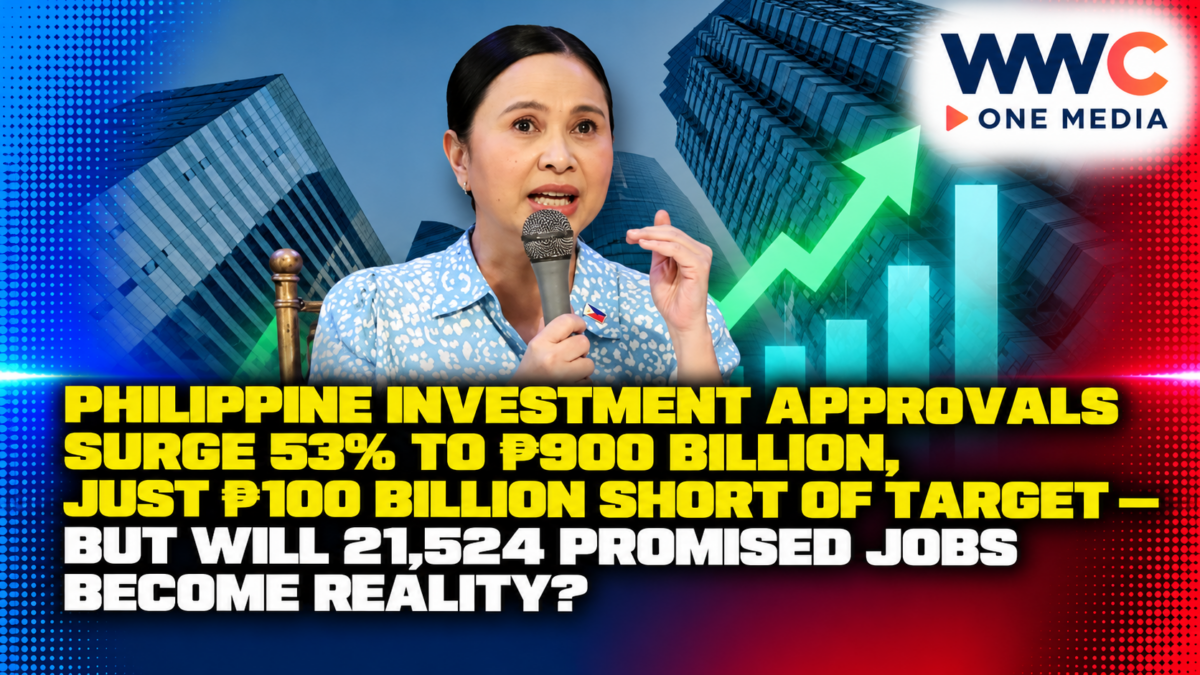
MANILA, PHILIPPINES — The Philippines is moving closer to a major investment milestone after the Board of Investments (BOI) approved ₱900.06 billion worth of projects in the first nine months of 2026, putting the agency within striking distance of its ₱1-trillion full-year target.
Investment approvals surged 53.05% from the same period in 2025, driven largely by renewable energy, power infrastructure and other capital-intensive developments.
The approvals cover 207 projects expected to generate 21,524 employment opportunities if successfully implemented.
Even more striking, September alone contributed ₱278.21 billion in approved investments, nearly five times the amount recorded in September last year.
Trade Secretary and BOI Chairperson Ma. Cristina Roque welcomed the performance as a sign of growing investor interest in the Philippines.
But despite the impressive figures, one major question remains.
Can the government turn these massive investment commitments into operating businesses, reliable electricity and real employment for Filipinos—or will some projects remain promises on paper?
BOI REACHES 90% OF ITS ANNUAL INVESTMENT TARGET
According to data released on October 27, the BOI recorded ₱900.06 billion in investment approvals from January through September 2026.
The figure represents approximately 90% of the agency’s ₱1-trillion full-year objective.
Only ₱99.94 billion in additional approvals is required to meet the target.
The strong nine-month performance places the BOI in a favorable position entering the final quarter.
However, exceeding the target is not guaranteed.
The remaining projects must still complete the necessary approval or registration process before December 31.
The agency’s optimism reflects its current pipeline rather than an already completed annual achievement.
APPROVALS SURGE 53% COMPARED WITH 2025
The BOI’s nine-month total increased 53.05% year over year.
In the comparable period of 2025, the agency approved approximately ₱588.08 billion in investments.
That means approvals increased by nearly ₱312 billion over the corresponding period.
The growth indicates a substantial increase in the value of projects entering the BOI’s investment registration system.
However, investment approval is an administrative and business commitment milestone.
It does not establish that the full investment amount has already entered the Philippine economy through construction, equipment purchases or operating expenditures.
Actual capital deployment occurs as approved projects move forward.
SEPTEMBER ALONE DELIVERS ₱278.21 BILLION
September became a particularly important month for investment approvals.
The BOI registered ₱278.21 billion during the month, compared with ₱56.49 billion in September 2025.
That represents a 392.5% increase.
The September approvals covered 27 projects projected to create at least 2,068 jobs.
The large monthly contribution helped bring the agency significantly closer to its full-year target.
However, a sharp increase in one month can reflect the timing of approvals for several large projects.
It does not necessarily mean investment activity will continue increasing at the same rate every month.
207 PROJECTS COULD CREATE 21,524 JOBS
The nine-month investment total covers 207 approved projects.
These developments are projected to generate approximately 21,524 employment opportunities.
The figure is relevant to the government’s efforts to attract businesses and improve economic opportunities.
But the jobs are projected rather than confirmed as already filled.
Their creation depends on the approved companies proceeding with their developments.
Some projects may require several years before reaching full commercial operations.
Construction-related employment can also differ from permanent operating positions.
The BOI’s announcement does not establish that all projected jobs will be available immediately or that all of them are permanent.
ENERGY DOMINATES WITH ₱740 BILLION IN APPROVALS
Energy-related investments account for the largest share of the BOI’s approved projects by value.
Electricity, gas, steam and air-conditioning supply registered approximately ₱740.14 billion.
That represents 82.23% of the total January-to-September investment approvals.
The sector’s approved investment value increased approximately 75.2% from ₱422.34 billion a year earlier.
Major projects involve hydropower, solar, wind and other energy developments.
Energy infrastructure typically requires substantial capital for equipment, construction and transmission connections.
That helps explain why the sector contributes such a large share of the overall investment value.
However, the projects are not necessarily operational yet.
WHY ENERGY INVESTMENT MATTERS TO FILIPINO CONSUMERS
Electricity is an essential input for households, factories, transportation systems and digital infrastructure.
Additional generation capacity may help support long-term energy security.
Renewable energy projects can also diversify the country’s power supply.
But approved investments do not automatically reduce electricity bills.
Actual power prices depend on generation costs, fuel markets, electricity supply and demand, transmission charges, distribution costs and applicable regulations.
Projects must also secure permits, financing and grid connections before they can contribute electricity.
The real impact will become measurable when approved facilities begin operating and delivering power.
THE ₱740-BILLION ENERGY BOOM CREATES RELATIVELY FEW JOBS
One of the most revealing findings concerns employment.
Although energy represents more than four-fifths of the approved investment value, projects in the sector are expected to generate approximately 1,903 jobs.
That is less than 9% of the total 21,524 projected jobs.
The contrast reflects the capital-intensive nature of major energy developments.
Large power projects may require billions of pesos in infrastructure while employing relatively few permanent workers once operational.
This does not mean energy investments have little economic value.
They may support industrial activity, suppliers and future electricity requirements.
But the figures illustrate why investment value alone cannot measure employment impact.
REAL ESTATE SECURES ₱46.66 BILLION
Real estate is another major sector in the nine-month approvals.
The BOI recorded approximately ₱46.66 billion in approved investments.
Property development can create demand for construction services, materials and related businesses.
Completed developments may also contribute to commercial and residential activity.
However, the precise benefits depend on the type, location and implementation of the registered projects.
Approved real estate investments should not be confused with completed buildings or properties already sold.
TRANSPORTATION AND STORAGE ATTRACT ₱36.47 BILLION
Transportation and storage projects received approximately ₱36.47 billion in approved investments.
This category is relevant to logistics, supply chains and the movement of goods.
Improved transport and storage capacity can potentially help businesses move products more efficiently.
However, benefits will depend on which projects are completed and how they are used.
The available BOI summary does not provide sufficient details to attribute the entire amount to a specific port, expressway, airport or warehouse network.
INFORMATION AND COMMUNICATION INVESTMENT RISES SHARPLY
Information and communication received approximately ₱18.36 billion in approved investments.
That represents an increase of 96.47% year over year.
The category is important as businesses become more dependent on technology and digital connectivity.
Investment in these activities can potentially support the country’s growing digital economy.
However, the BOI figures do not establish that the entire amount is dedicated to artificial intelligence or data centers.
Those claims would require project-level evidence.
MANUFACTURING RECORDS ₱14.86 BILLION
Manufacturing approvals reached approximately ₱14.86 billion.
The sector remains strategically important because manufacturing activity can create opportunities for workers, suppliers and exporters.
But its investment value was much smaller than the amount approved for energy.
This contrast raises questions about the distribution of investment across Philippine industries.
Manufacturing projects may contribute to long-term industrial development even without dominating total approved capital.
Their economic significance depends on actual production, employment and linkages with local businesses.
TOURISM-RELATED INVESTMENTS ALSO INCREASE
Accommodation and food services registered approximately ₱8.13 billion in approved investments.
The value increased 265.5% from the comparable period in 2025.
The sector includes activities associated with hospitality and food services.
Its growth may contribute to tourism-related employment and regional commercial activity.
However, the BOI announcement does not identify all projects or establish that each is already operating.
Investment approvals remain plans until successfully implemented.
WATER AND WASTE MANAGEMENT SHOW STRONG GROWTH
Water supply, sewerage and waste management approvals increased to approximately ₱6.75 billion.
That compares with roughly ₱209.73 million a year earlier.
The sharp rise shows increased commitments to a sector essential to public health and environmental management.
However, growth rates can appear especially large when the previous year’s investment base was relatively small.
The approved amount should therefore be interpreted alongside actual project implementation.
DOMESTIC INVESTORS ACCOUNT FOR NEARLY 90%
Filipino investors continued to dominate the value of approved projects.
Domestic investment commitments reached approximately ₱808.96 billion, or 89.88% of the overall total.
This represented a 60.5% increase compared with ₱503.95 billion in the first nine months of 2025.
The figures indicate that much of the approved investment pipeline is being driven by domestic businesses.
That is an important distinction from headlines suggesting that the entire investment surge is caused by foreign capital.
Domestic investment can support new facilities, expand established businesses and strengthen economic activity.
But the outcome still depends on project execution.
FOREIGN APPROVALS REACH ₱90.40 BILLION
Foreign investment approvals reached approximately ₱90.40 billion.
Singapore was the largest identified source, with ₱42.71 billion.
South Korea followed with ₱27.44 billion.
Other reported sources included China at ₱4.07 billion, Japan at ₱3.11 billion and the Netherlands at ₱2.15 billion.
These amounts indicate continued interest among foreign investors in Philippine projects.
However, they represent approved commitments recorded by the BOI.
They should not be confused with actual foreign direct investment inflows measured by the Bangko Sentral ng Pilipinas.
Different agencies track different investment concepts and reporting periods.
CORDILLERA LEADS REGIONAL INVESTMENT APPROVALS
The Cordillera Administrative Region recorded the largest value of approved projects at approximately ₱218.48 billion.
The Ilocos Region followed with ₱199.75 billion.
Central Luzon ranked next at ₱130.81 billion.
These figures indicate substantial approved capital outside Metro Manila.
However, a high regional investment total does not automatically mean that the region has created the most jobs.
Large energy projects may account for much of the investment value.
Employment outcomes depend on the specific projects and their stage of development.
EASTERN VISAYAS AND CALABARZON ATTRACT BILLIONS
Eastern Visayas recorded approximately ₱76.84 billion in approved investment commitments.
CALABARZON registered ₱58.37 billion.
These regions have different industrial and geographic advantages.
Investments may support infrastructure, energy or other priority activities depending on the project mix.
The figures provide a useful view of where planned capital is being registered.
But the BOI summary does not establish that the entire amounts have already been spent in those regions.
WESTERN VISAYAS APPROVALS JUMP 296%
Western Visayas reported a particularly strong increase.
Approvals reached approximately ₱42.77 billion, up 296.5% from ₱10.79 billion in the same period of 2025.
The growth is significant for a region that includes major commercial and agricultural centers such as Iloilo and Bacolod.
Additional projects may provide opportunities for local suppliers and communities.
However, the reported approval total should not be converted into a claim that new employment and business income have already increased by the same percentage.
Those effects will depend on implementation.
CARAGA POSTS THE FASTEST REPORTED GROWTH
Caraga registered approximately ₱16.94 billion in approved investments.
That represents an increase of 1,731.5% from the comparable period a year earlier.
It was the strongest reported regional percentage increase.
But very high growth rates can reflect a low comparison base.
A large percentage change does not necessarily make the region the largest investment destination in absolute pesos.
Cordillera remained the leader by approved investment value.
TRADE SECRETARY CRISTINA ROQUE SEES STRONG MOMENTUM
Trade Secretary and BOI Chairperson Cristina Roque described the nine-month performance as evidence of growing investor interest in the Philippines.
She emphasized the government’s goal of attracting investments in priority sectors.
According to the DTI, these priorities include strengthening industrial capabilities, supporting technology development and creating higher-value employment.
The government’s challenge is to maintain a business environment in which approved projects can proceed.
However, confidence reflected in project registrations must eventually translate into operational results.
BOI MANAGING HEAD CEFERINO RODOLFO LOOKS TO YEAR-END
Trade Undersecretary and BOI Managing Head Ceferino Rodolfo also expressed optimism about fourth-quarter performance.
With only ₱99.94 billion needed to reach the annual target, additional large approvals could push the agency beyond ₱1 trillion.
But timing remains important.
Projects that are still completing documentation or approvals may be registered in a later reporting period.
The BOI’s year-end result therefore depends on the completion of the approval pipeline.
A projection of success should not be reported as an already achieved result.
WHY THE 2026 TARGET IS LOWER THAN LAST YEAR’S APPROVALS
An important piece of context comes from the BOI’s earlier target announcement.
The agency set its 2026 goal at ₱1 trillion despite recording approximately ₱1.56 trillion in approved investments during 2025.
The 2025 total had fallen short of its own ₱1.75-trillion target.
The BOI explained that its 2026 strategy would place greater emphasis on implementing previously registered projects while attracting investments in mineral processing, infrastructure and higher-value manufacturing.
Some of those industries involve smaller capital requirements per project than major renewable energy developments.
Therefore, even if the BOI reaches ₱1 trillion this year, the total would still be below its 2025 full-year approved-investment figure.
Meeting a lower target should not automatically be presented as an all-time record.
PEZA HAS ALREADY SURPASSED ITS SEPARATE TARGET
Another development provides context for the wider Philippine investment environment.
The Philippine Economic Zone Authority announced on October 22 that it had approved approximately ₱309.63 billion worth of investments from January through October 2026.
That exceeded PEZA’s ₱300-billion full-year target.
The total was 76.56% higher than the comparable period of 2025.
However, PEZA and BOI are separate investment promotion agencies.
Their reporting periods also differ.
The October PEZA total should not be added casually to the September BOI figure and presented as a verified single government total without checking reporting definitions and potential overlaps.
The important point is that both agencies have reported stronger investment approvals.
INVESTMENT APPROVALS ARE NOT THE SAME AS FOREIGN DIRECT INVESTMENT
This distinction is central to understanding the latest figures.
An approved project represents an investment proposal accepted or registered under the relevant agency’s system.
Foreign direct investment inflows, as reported by the central bank, reflect a different measure of cross-border investment transactions.
Actual capital expenditure reflects money deployed as projects are developed.
A project can be approved before construction begins.
It may take time to obtain financing, complete permits, purchase equipment or hire workers.
Some projects may be delayed, revised or canceled.
Therefore, the ₱900.06-billion figure should not be described as money already injected into the economy.
WHAT MUST HAPPEN BEFORE THE PROJECTS CREATE JOBS?
The next stage is implementation.
Developers and investors must complete the necessary commercial and regulatory requirements.
These may include financing, permits, land arrangements, equipment procurement and construction.
Energy projects may also need transmission connections and other sector-specific approvals.
Companies must then recruit workers and begin operations.
The time required differs by project.
A large hydropower development, for example, may have a much longer implementation period than a smaller service-sector expansion.
The BOI’s projected 21,524 jobs therefore should be monitored over time rather than treated as immediate employment gains.
WHAT OTHER NEWS OUTLETS CONFIRM
InsiderPH reported the BOI’s strong nine-month performance on October 28.
GMA News independently confirmed the ₱900.06-billion total, 53.05% increase, 207 projects and 21,524 potential jobs.
BusinessMirror reported the same figures and emphasized that the agency needed roughly ₱100 billion more to meet its annual target.
The Philippine Star documented the investment breakdown, including the dominance of domestic capital.
Context.ph provided additional analysis of the energy sector’s disproportionate share of investment value compared with its projected employment contribution.
The Philippine Star’s February reporting confirms that the BOI set a lower ₱1-trillion target after approving approximately ₱1.56 trillion in 2025.
Separately, PEZA’s official October announcement verifies its own ₱309.63-billion approved-investment total.
Together, these sources confirm that investment registrations have accelerated.
However, the individual news reports largely rely on the same BOI dataset.
They do not establish that every approved project is already operational or that projected jobs have all been created.
THE BIGGER QUESTION: CAN THE PHILIPPINES TURN APPROVALS INTO REAL ECONOMIC GROWTH?
The BOI’s latest performance demonstrates significant momentum in the country’s investment registration pipeline.
Approvals reached ₱900.06 billion during the first nine months of 2026.
September alone contributed more than ₱278 billion.
Energy projects accounted for the overwhelming majority of planned capital, while domestic investors provided nearly 90% of the total.
Several regions outside Metro Manila also recorded substantial approved investments.
The figures show that businesses are preparing major projects across the country.
But the government’s most important challenge lies ahead.
It must help ensure that approved developments proceed to construction, create productive enterprises and provide meaningful jobs.
The true measure of investment success will not be the number of billions approved, but the number of projects completed, workers employed and economic benefits delivered to Filipino communities.
And as the BOI moves within ₱100 billion of its annual investment target, one question remains:
Will the Philippines turn its ₱900-billion investment pipeline into a wave of new businesses and thousands of jobs—or will delays and rising project costs leave the country’s biggest investment promises waiting to become reality?










