
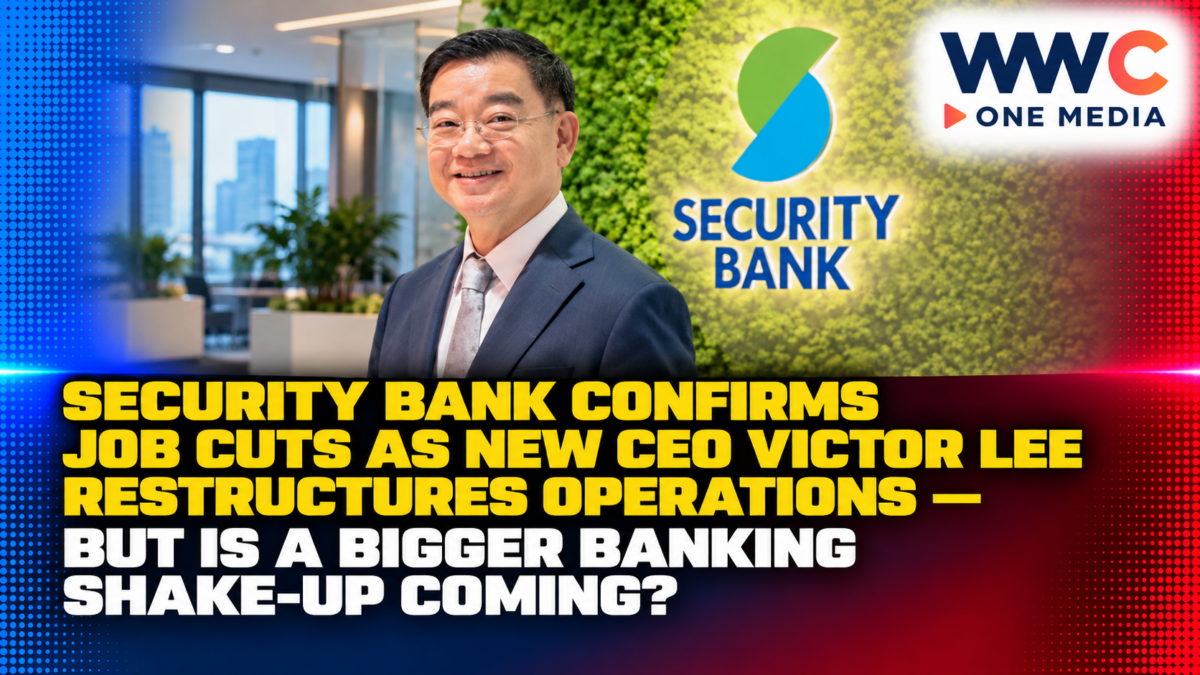
MANILA, PHILIPPINES — Security Bank Corporation has confirmed targeted organizational changes affecting certain positions, marking a significant development in the leadership overhaul being implemented by its new president and chief executive officer, Victor Lee.
The bank acknowledged the workforce-related changes in an October 27 statement to InsiderPH but declined to reveal how many employees were affected or which departments were involved.
The announcement follows a broader restructuring of senior management that began in September, including the planned departures of retail banking chief Rahul Rasal and deposits business head Jonathan Diokno.
Lee, who assumed leadership in January 2026, has been repositioning the bank around a three-year strategy focused on wealth management, entrepreneur banking, and corporate and institutional clients.
The changes come as Security Bank attempts to accelerate growth while maintaining stronger operating efficiency.
Although the lender remained profitable during the first half of 2026, earnings growth slowed to 4%, while its loan portfolio expanded by just 1% year over year.
But as organizational changes begin affecting employees, one major question remains: Can Victor Lee make Security Bank more competitive without undermining workforce confidence, customer service and the lender’s long-term growth?
SECURITY BANK ACKNOWLEDGES TARGETED WORKFORCE CHANGES
Security Bank confirmed that certain positions had been affected by organizational adjustments.
In its statement to InsiderPH, the lender described the action as targeted changes intended to align resources with current business priorities.
The wording indicates that the bank is adjusting its workforce structure rather than merely renaming positions.
However, the disclosure leaves several significant questions unanswered.
The bank did not identify how many jobs were affected.
It also did not specify the departments involved, employee seniority levels, affected locations or separation arrangements.
No complete public timetable for the changes was provided.
Consequently, any claim that hundreds or thousands of workers have been laid off would be unsupported by the information currently available.
REPORT OF JOB CUTS FOLLOWS ONLINE EMPLOYEE DISCUSSION
InsiderPH reported that information about workforce reductions surfaced in an online discussion titled “Security Bank Lay-offs” on Reddit.
The publication subsequently obtained the bank’s acknowledgment of targeted organizational changes.
The online discussion helped bring attention to the matter.
However, anonymous social media accounts should not be treated as independently verified evidence of the number of employees affected.
Such posts may reflect individual experiences, secondhand information or incomplete accounts.
The bank’s statement provides stronger confirmation that organizational changes involving specific roles are taking place.
But it still does not establish the full scale of the job cuts.
CONSULTING FIRM DELOITTE MENTIONED IN REPORT
InsiderPH also cited an unnamed industry source who said Security Bank had engaged Deloitte for a review before the workforce changes.
The report did not establish the exact scope of the alleged engagement.
It also did not confirm whether Deloitte had recommended job reductions or participated in decisions affecting individual employees.
This distinction matters.
Consulting firms may be hired for numerous purposes, including operational reviews, organizational design, technology planning and business strategy.
An engagement does not automatically mean the firm advised a client to dismiss workers.
Until the parties provide further information, Deloitte’s alleged involvement should be described as an unverified account attributed to the publication’s source.
VICTOR LEE TOOK OVER IN JANUARY 2026
Victor Lee Meng Teck assumed the presidency and chief executive role at Security Bank on January 5, 2026.
He succeeded Sanjiv Vohra, who had led the lender since 2019.
Security Bank announced the transition in September 2025, describing Lee as a Singaporean banking executive with more than 30 years of leadership experience across Asia.
Before joining Security Bank, Lee served as chief executive of CIMB Singapore and led growth markets for CIMB Bank Berhad.
His previous experience includes business expansion, customer service improvements and operational transformation.
Security Bank selected him to lead its next stage of development as the institution marked its 75th anniversary.
However, his prior accomplishments do not guarantee that a similar strategy will produce the same results in the Philippine banking market.
BANK’S LEADERSHIP RESTRUCTURING STARTED BEFORE THE JOB CUTS
The October workforce disclosure follows an extensive management reorganization approved by Security Bank’s board on September 29.
The changes covered 14 senior executives whose responsibilities, designations or reporting relationships were being revised.
Four changes were scheduled to become effective on October 1, with 10 additional changes taking effect on January 1, 2027.
The restructuring involved customer coverage, financial markets, lending, treasury, technology and operations.
Security Bank said the objective was to improve accountability and align management responsibilities with its strategic priorities.
However, those 14 executive role changes must not be confused with the number of employees affected by the later workforce reductions.
They are different developments.
RETAIL BANKING CHIEF RAHUL RASAL IS LEAVING
Among the most significant executive developments is the departure of Rahul Rasal, Security Bank’s executive vice president and retail banking segment head.
The bank announced that Rasal would formally leave on December 31, 2026.
He began transitioning out of his responsibilities on October 1.
The company’s regulatory disclosure described his departure as a voluntary resignation for personal reasons.
Victor Lee assumed interim oversight of retail banking to maintain continuity while the bank manages the transition.
Rasal’s resignation should not be reported as a layoff.
The disclosed reason for his departure is different from the bank’s separate acknowledgment of targeted workforce changes.
DEPOSITS EXECUTIVE JONATHAN DIOKNO ALSO RESIGNS
Security Bank also announced the resignation of senior vice president Jonathan Diokno, head of its deposits business group.
His departure is scheduled to take effect on November 1, 2026.
The bank likewise described the resignation as being for personal reasons.
Together, the two senior executive departures represent important changes within the retail and deposits businesses.
But there is no verified evidence that either resignation was caused by the subsequent workforce adjustments.
The company’s public disclosures identify the resignations as voluntary.
Responsible reporting must preserve that distinction.
MORE EXECUTIVES RECEIVE NEW RESPONSIBILITIES
Security Bank’s September leadership changes included appointments and revised roles across several business functions.
Hirofumi Umeno was designated chief customer officer for wholesale banking.
Ma. Patricia Tan was designated chief customer officer for retail.
Leslie Cham and Yvonne Joanna Marcelo were assigned leadership responsibilities covering branches and wholesale clients.
Other changes involved investment products, financial markets, treasury, retail lending sales and wealth relationship management.
The bank also announced updated responsibilities in technology, payments and customer experience.
These changes suggest a move toward a more specialized management structure.
However, their effect on efficiency, customer service and profitability will need to be evaluated over time.
SECURITY BANK’S NEW STRATEGY TARGETS THREE BUSINESS AREAS
On September 1, Security Bank presented a three-year growth strategy.
The lender identified three priority segments:
- Wealth management
- Entrepreneur banking
- Corporate and institutional banking
The approach emphasizes areas where the bank believes it can compete effectively.
Wealth management involves financial products and services for customers with investment and asset-management needs.
Entrepreneur banking focuses on businesses and their owners.
Corporate and institutional banking serves larger organizations with financing, cash management and other financial requirements.
By concentrating on selected customer groups, the bank hopes to strengthen relationships and improve the use of its resources.
But a sharper strategic focus may also require changes to staffing, technology, distribution channels and internal processes.
The company has not specified how many workforce reductions are directly connected to each strategic priority.
FIRST-HALF PROFIT GROWS 4% TO ₱6.1 BILLION
Security Bank reported approximately ₱6.1 billion in net income for the first six months of 2026.
This represented a 4% increase from the previous year.
More precisely, net income attributable to the parent company reached approximately ₱6.08 billion, compared with ₱5.86 billion in the first half of 2025.
The lender remained profitable despite slower growth and elevated credit-related expenses.
Second-quarter net income increased 11% year over year to approximately ₱3.4 billion.
These results show that Security Bank was not reporting a net loss when it acknowledged the organizational changes.
The job cuts therefore should not automatically be described as a response to financial collapse.
The company’s stated rationale involves aligning resources with business priorities.
REVENUE CLIMBS TO ₱34.9 BILLION
Security Bank generated approximately ₱34.9 billion in total revenues during the first half of 2026.
Revenue increased 11% from the previous year.
However, this was slower than the 23% growth reported for the comparable period a year earlier.
The deceleration provides context for management’s emphasis on efficiency and disciplined growth.
Net interest income increased to approximately ₱32.4 billion.
The bank also reported service charges, fees and commissions of approximately ₱4.2 billion.
These results indicate that the lender continues generating substantial revenue from its operations.
But slower growth may create pressure to evaluate where resources are being deployed.
LOAN GROWTH SLOWS TO JUST 1%
One of the more striking financial developments is the slowdown in lending.
Security Bank reported net loans of approximately ₱675 billion at the end of June 2026.
That represented year-on-year growth of about 1%.
A year earlier, the bank had recorded substantially stronger loan growth of approximately 16%.
Slower lending can reflect changes in customer demand, market conditions, credit risk assessments or management strategy.
Security Bank described its approach as focusing on higher-quality lending and more disciplined credit management.
However, the available data do not establish that job reductions were necessary to achieve the new lending strategy.
Nor do they establish that reduced loan growth was directly caused by the restructuring.
OPERATING EXPENSES RISE ONLY 3%
Security Bank’s first-half results also show improved operating efficiency.
Operating expenses increased approximately 3% year over year, well below the 11% growth in revenue.
Its cost-to-income ratio improved to 55.7% from 59.6% a year earlier.
The ratio indicates how much operating expense the bank incurred relative to its income under the relevant calculation.
A lower ratio generally suggests greater operating efficiency.
But the figures cover January to June 2026.
They predate the October disclosure of workforce changes.
It would therefore be inaccurate to credit the latest job cuts for the already-reported first-half efficiency improvement.
CREDIT-LOSS PROVISIONS REMAIN SIGNIFICANT
Security Bank reported approximately ₱7.6 billion in provisions for credit losses during the first half.
These provisions reflect the bank’s assessment of potential losses associated with loans and other credit exposures.
The lender also reported that its gross nonperforming loan ratio improved to 3.04% from 3.16% a year earlier.
Reserve cover strengthened from 79% to approximately 85%.
These indicators provide context for the bank’s efforts to manage lending risks.
However, provisions do not mean that all the corresponding loans have been written off or that the entire amount represents realized losses.
Banking financial statements distinguish provisions, write-offs, recoveries and other credit-related items.
SECURITY BANK’S ASSETS REACH ₱1.19 TRILLION
Security Bank reported total assets of approximately ₱1.19 trillion as of June 30, 2026.
Its liquidity coverage ratio stood at 206%, while its net stable funding ratio reached 145%.
The bank reported a Common Equity Tier 1 capital ratio of 12.6% and a total capital adequacy ratio of 13.5%.
These figures are relevant because banks must maintain sufficient capital and liquidity to meet financial obligations and regulatory requirements.
The company’s reported ratios were above applicable regulatory minimums.
However, strong capital and liquidity metrics do not make a bank immune to business challenges.
They also do not resolve questions about the treatment of employees affected by restructuring.
MUFG REMAINS AN IMPORTANT STRATEGIC PARTNER
Japan’s MUFG Bank remains a major strategic investor in Security Bank, holding an approximately 20% stake.
The institutions marked a decade of strategic partnership in 2026.
Security Bank and MUFG also announced continued cooperation following MUFG Manila’s upgrade to a universal banking license.
Both institutions have stated that they will continue operating independently.
Their relationship gives Security Bank access to a broader international banking network and potential opportunities for client collaboration.
However, the October workforce announcement does not identify MUFG as directing the job cuts.
It would be unsupported to suggest that the Japanese shareholder ordered the restructuring.
WILL CUSTOMERS BE AFFECTED?
Customers may be concerned that changes to staffing and senior leadership could affect service quality.
Potential areas of interest include branch operations, loan processing, customer assistance and digital banking support.
However, Security Bank has not announced a specific service interruption resulting from the targeted organizational changes.
The bank’s September reorganization was presented as a measure to improve accountability and customer coverage.
For customers, the practical question is whether service standards are maintained while responsibilities are reassigned.
Any claim that branches are closing, deposits are at risk or customers will lose access to their accounts because of the workforce changes would require evidence not provided in the reports reviewed.
WHAT ABOUT EMPLOYEE RIGHTS AND SEPARATION BENEFITS?
Workforce restructuring raises important questions about labor rights.
Philippine labor law recognizes certain authorized grounds for employment termination, including redundancy and retrenchment, subject to applicable legal requirements.
These mechanisms are not interchangeable.
Redundancy generally involves positions considered unnecessary because of legitimate business requirements.
Retrenchment involves reducing personnel to address or prevent qualifying business losses and is subject to distinct legal standards.
Applicable procedures may include written notices, good-faith implementation and statutory separation benefits.
However, Security Bank has not publicly specified the legal basis used for each affected position.
It would therefore be premature to conclude that every separation constitutes redundancy, retrenchment or another specific legal category.
Affected employees should review their individual documents and seek appropriate professional or government labor assistance where necessary.
WHY TRANSPARENCY ABOUT JOB CUTS MATTERS
A company may have legitimate reasons for revising its organizational structure.
But workforce changes also create uncertainty for employees who remain with the business.
Questions may arise about job security, workload, career development and the future distribution of responsibilities.
Investors may want to know the financial impact of restructuring, including potential separation expenses and future efficiency gains.
Customers may want reassurance that service quality will be maintained.
Clear communication can help address these concerns.
Security Bank’s public statement confirms that changes are being made, but it does not provide enough information to assess the full workforce impact.
WHAT DIFFERENT NEWS OUTLETS CONFIRM
InsiderPH reported the job cuts on October 27 and obtained Security Bank’s acknowledgment of targeted organizational changes.
This is the principal source for the workforce reduction itself.
The Philippine Star independently reported the September leadership overhaul, including Rahul Rasal’s resignation, Jonathan Diokno’s planned departure and the redesignation of 14 senior executives.
GMA News separately documented the same management restructuring.
Context.ph reported Lee’s interim oversight of the retail banking segment.
The Philippine Star also independently covered Security Bank’s first-half earnings.
Security Bank’s own official financial release confirms the ₱6.1-billion profit, ₱34.9-billion revenue and balance-sheet figures.
Its September strategy announcement provides primary evidence of the bank’s priorities under Lee.
Together, these sources establish the broader corporate and financial context.
However, independent reporting on the September reshuffle does not independently confirm the scale of the October layoffs.
The number of affected employees remains undisclosed.
WHAT INVESTORS SHOULD WATCH NEXT
For Security Bank shareholders, the restructuring introduces questions about future operating expenses and business execution.
A more focused management structure could potentially improve decision-making.
Workforce adjustments may also alter costs.
But any financial savings would need to be weighed against separation expenses, implementation costs and possible disruption.
Investors should monitor future disclosures for restructuring charges, staffing trends and improvements in operating performance.
They should also examine loan growth, credit quality, deposit trends and the profitability of the bank’s targeted customer segments.
No quantified financial benefit from the October job cuts has been established.
THE BIGGER QUESTION: CAN VICTOR LEE DELIVER A SUCCESSFUL RESET?
Victor Lee has been leading Security Bank for less than a year, yet the lender has already announced major changes to its management structure and acknowledged workforce-related adjustments.
The strategy reflects a desire to sharpen priorities and improve operational execution.
The bank remains profitable, with substantial assets and capital resources.
But its lending growth has slowed, and management faces pressure to translate strategic plans into stronger business results.
For employees, the immediate concern is the effect of organizational changes on their positions and future opportunities.
For customers, the priority is dependable banking service.
For investors, the challenge is balancing cost discipline with sustainable revenue growth.
The real test will be whether Security Bank’s restructuring produces measurable improvements without creating lasting damage to employee confidence, customer relationships or organizational stability.
And as Victor Lee implements one of the bank’s most closely watched leadership transitions, a difficult question remains:
Will Security Bank’s workforce changes and management overhaul unlock a more competitive institution—or will the undisclosed job cuts signal the beginning of a much wider transformation that could reshape the bank’s future?










