
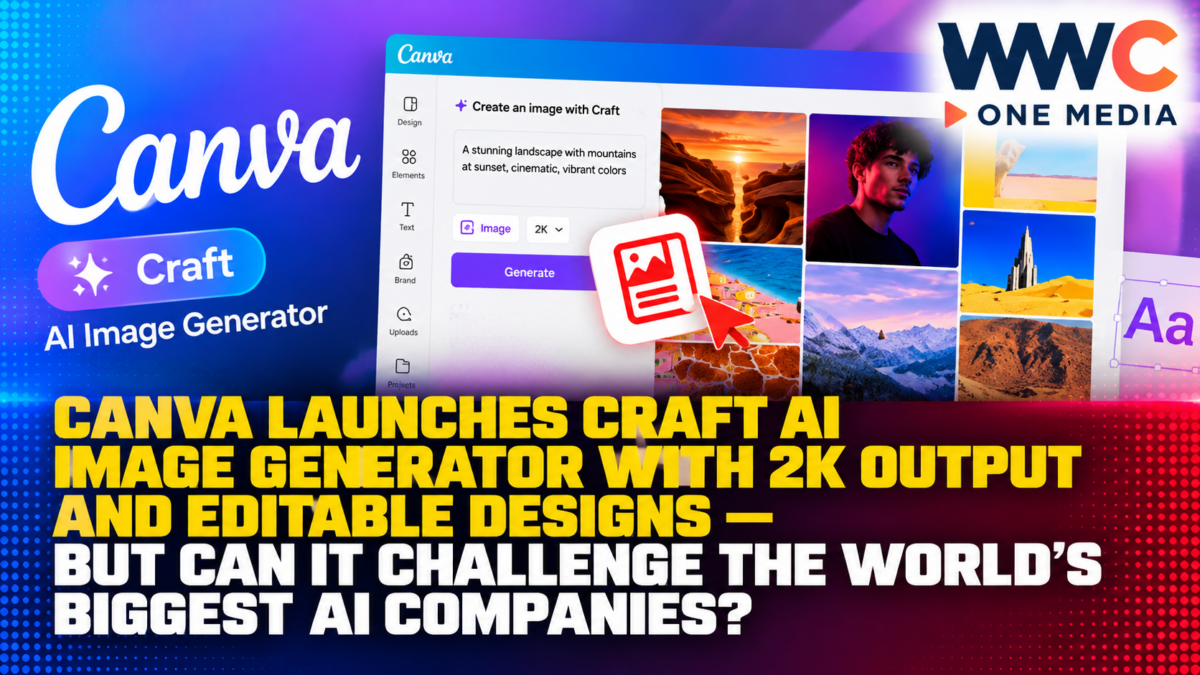
MANILA, PHILIPPINES — Global design platform Canva is making a major move in the artificial intelligence race with the launch of Canva Craft, its first proprietary AI image-generation foundation model, putting the company into more direct competition with leading AI developers.
The new system, unveiled on October 22, 2026, can produce images at up to 2K resolution, supports more than 30 aspect ratios and is designed to generate text in 55 languages.
But what makes Craft different is not simply the ability to create pictures from written prompts.
Canva says its AI first plans how a design should look before generating the image itself.
This two-stage approach aims to address persistent problems in AI-generated marketing graphics: misplaced objects, inconsistent layouts, difficult-to-read text and the need to recreate entire images when making small changes.
The technology is already accessible through Canva’s Dream Lab and its public developer API.
For Filipino designers, entrepreneurs, content creators and marketing teams, the launch could introduce a more integrated way to produce advertisements, product visuals and social media content.
But the bigger question is whether Canva can turn its strength in design software into a meaningful advantage against OpenAI, Google and other major AI companies.
CANVA BUILDS ITS FIRST PROPRIETARY IMAGE-GENERATION FOUNDATION MODEL
According to InsiderPH’s October 27 report, Canva developed Craft through Canva Research, its in-house artificial intelligence laboratory.
The launch represents a significant change from the company’s earlier approach of integrating image-generation technology developed by outside providers.
Instead of relying entirely on external models, Canva now has a model created and trained by its own research organization.
TechCrunch independently reported that Canva developed the system with contributions from researchers associated with Leonardo.Ai, the generative AI company Canva acquired in 2024.
Owning its image model could give Canva greater control over quality, speed, product development and the cost of generating images.
That matters because AI processing expenses can become substantial when millions of users create visual content.
However, developing an in-house model also requires continuing investment in computing infrastructure, research and engineering.
The commercial success of Craft will depend on more than its initial launch.
HOW CANVA CRAFT’S TWO-STAGE AI SYSTEM WORKS
Traditional prompt-to-image systems often generate a picture directly from a user’s description.
Craft uses a different workflow that separates planning from rendering.
In the first stage, the system interprets the user’s instructions and creates a composition plan.
That plan considers the position of objects, their relative sizes, the visual hierarchy and the text that should appear.
In the second stage, a dedicated rendering model transforms that plan into a finished image.
This is especially relevant to marketing and graphic design, where placement can be just as important as visual quality.
A poster may need space for a headline, a product photograph, a call to action and company branding.
If the AI places those elements incorrectly, the design can become difficult to use.
Canva says Craft’s planning architecture is intended to make the generated output more consistent with the original instructions.
However, the method does not guarantee that every layout or word will be correct.
2K IMAGES AND MORE THAN 30 ASPECT RATIOS
Craft supports image output at resolutions of up to 2K.
It also provides more than 30 aspect-ratio options, making it suitable for a variety of creative formats.
These include social media graphics, presentations, posters, product images, advertising materials and website visuals.
For businesses, the flexibility could reduce the need to redesign assets manually for different channels.
A marketing team might need a landscape image for a website, a square graphic for social media and a portrait visual for a mobile campaign.
Craft’s wide range of supported formats makes it easier to generate material tailored to those uses.
However, an output resolution of 2K does not mean the system automatically produces print-ready artwork at every physical size.
Print suitability still depends on image dimensions, intended print size and production requirements.
TEXT GENERATION IN 55 LANGUAGES COULD HELP INTERNATIONAL BRANDS
Canva says Craft supports text generation in 55 languages.
Accurate text rendering is particularly important in graphic design because AI image generators have historically struggled with spelling, typography and consistent letter placement.
A beautiful promotional image can become unusable if its headline contains obvious errors.
By training Craft around design composition and typography, Canva hopes to improve the reliability of words appearing inside generated images.
For Philippine businesses, this could support the production of marketing materials intended for different audiences.
However, the published materials do not establish perfect spelling or equally strong results across all 55 languages.
Marketing teams should still review generated text, especially prices, product claims, promotional dates and legal disclaimers.
Human proofreading remains essential.
CANVA TRAINED THE MODEL USING HUMAN-DESIGNED TEMPLATES
One of Craft’s most distinctive features is its training approach.
According to TechCrunch and The Verge, Canva trained the model using large numbers of human-created designs from its content library.
These include posters, presentations, menus, infographics, social media graphics and layouts containing substantial typography.
The objective is to teach the model how design elements relate to one another, rather than focusing only on the appearance of photographic subjects.
For example, the relative size of a title, supporting description and product image can determine whether a promotional graphic is effective.
Canva’s approach attempts to incorporate that understanding into the generation process.
However, the company has not disclosed every detail of the dataset, its licensing arrangements or all potential limitations.
Questions about training data and creative ownership remain important across the AI industry.
MAGIC LAYERS COULD MAKE GENERATED IMAGES EASIER TO EDIT
An important part of Canva’s strategy involves editable designs.
Many AI image generators produce a single flattened image.
Changing a small detail can require generating an entirely new picture, potentially altering other elements that the user wanted to preserve.
Canva is connecting Craft with its Magic Layers technology, which is intended to transform generated images into editable design components.
The approach could make it easier to adjust text, reposition elements or modify parts of a layout without discarding the entire composition.
For professional designers, this may be more useful than simply generating an attractive image.
However, the existence of Magic Layers does not mean that every generated image will automatically be converted into perfectly editable components.
The results depend on the complexity of the image and the capabilities of the editing system.
CANVA CRAFT DEBUTS FOURTH ON DESIGNARENA
Canva highlighted Craft’s performance on DesignArena, a crowdsourced AI design and image-generation evaluation platform.
At launch, Craft ranked fourth overall among image-generation models on the benchmark.
Canva also reported that it ranked first in the people-and-portraits category among 87 models and first for landscapes and nature among 85 models.
Other reported rankings included second for abstract images and patterns and fourth for products.
Those results are notable for a company’s first publicly launched proprietary image-generation model.
However, rankings depend on the benchmark, the models evaluated and the preferences of participating reviewers.
They are not proof that Craft is universally superior to every alternative.
The company’s claim that Canva Research is the world’s second most advanced image-generation laboratory is based specifically on the referenced DesignArena rankings.
It should not be presented as an independent judgment across every area of artificial intelligence.
INDEPENDENT TESTING FINDS ROOM FOR IMPROVEMENT
While Canva’s benchmark results are promising, independent product testing offers additional perspective.
Business Insider compared Craft with image-generation systems from other major AI companies using several practical tasks.
The publication found that Craft could create competent images but sometimes struggled with precise typography and other requested details.
In a birthday-card example, the system omitted a requested decorative pattern and encountered text-related problems.
Other tests showed limitations in photorealistic details and the placement of edited objects.
These findings do not establish that Craft performs poorly in every situation.
They demonstrate that high benchmark rankings do not guarantee flawless results on individual prompts.
For designers and marketers, the practical lesson is to review outputs rather than assuming that an AI-generated image is immediately ready for publication.
CANVA EXPANDS BEYOND ITS OWN DESIGN PLATFORM
Craft is not restricted to the Canva website.
The company has also made the model available through its public API.
This allows developers to integrate image-generation functions into other applications.
Potential uses include marketing platforms, e-commerce systems, advertising tools and print services.
For example, an online seller could incorporate AI-generated product campaign backgrounds into an internal workflow.
A marketing agency could build a tool for creating visual concepts based on client briefs.
However, actual integration depends on API availability, developer work, usage limits and applicable pricing.
The Canva developer community confirmed that Craft can be selected through its image-generation endpoint.
The API operates under a preview arrangement, meaning its technical behavior and availability may change.
AI ASSISTANT INTEGRATIONS ARE STILL COMING
Canva also plans to connect Craft to AI assistants and automated workflows through the Canva Model Context Protocol Server.
This would allow compatible assistants to request images as part of larger tasks.
For example, an AI assistant might eventually help prepare a presentation or marketing campaign that includes newly generated graphics.
However, Canva’s October announcement describes this specific MCP integration as coming soon.
It would be inaccurate to imply that every planned connection is already available to users.
The distinction between launched and forthcoming features matters for businesses evaluating whether they can deploy the technology immediately.
FASTER AND CHEAPER CRAFT MODELS ARE IN DEVELOPMENT
Canva is developing additional versions named Craft-fast and Craft-ultrafast.
These variants are intended to lower processing costs and improve generation speed.
The company says its research team has already reduced the number of processing steps required by the original model through optimization techniques.
For a platform serving hundreds of millions of users, inference efficiency is commercially important.
Even a small reduction in the cost of generating one image can produce significant savings at large scale.
However, the faster versions were described as upcoming at the October launch.
Their final pricing, availability and performance should not be treated as confirmed until Canva provides the relevant details.
WHAT THIS MEANS FOR FILIPINO CONTENT CREATORS AND BUSINESSES
Canva has become a widely used tool for social media graphics, presentations, educational content and business marketing.
For Filipino entrepreneurs, Craft could make it easier to experiment with visual concepts without commissioning every initial draft from a specialist.
A small retailer could create promotional image concepts.
A restaurant could test different menu-poster layouts.
A content creator could generate background illustrations for video thumbnails.
Marketing teams could explore campaign directions before moving into final production.
However, using AI does not eliminate the need for design judgment.
Businesses still need accurate branding, readable text, genuine product information and appropriate image rights.
Generated visuals may also require additional editing to match a company’s brand standards.
AI IMAGES RAISE QUESTIONS ABOUT ACCURACY AND TRUST
As generated visuals become more realistic, audiences may find it harder to distinguish authentic photographs from synthetic content.
This issue is particularly important in news, politics, public safety and commercial advertising.
AI-generated images should not be presented as documentary photographs of events that never occurred.
For advertisements, businesses should avoid creating misleading impressions about products, customers or results.
Canva says Craft is covered by its existing safety framework, including input and output moderation, privacy controls and reporting mechanisms.
However, safety systems can make mistakes and require continued evaluation.
The responsibility for publishing accurate and lawful material remains with the organization using the technology.
WHAT MULTIPLE NEWS OUTLETS CONFIRM
InsiderPH’s October 27 article focuses on Craft’s two-stage design architecture, 2K output, multilingual text rendering and developer availability.
Canva’s October 22 official announcement confirms those core specifications.
TechCrunch independently reports that Canva developed the technology with contributions from Leonardo.Ai researchers and that the company is seeking greater control over its AI costs.
The Verge highlights Craft’s training on human-created templates and its focus on composition.
Digital Trends explains why design planning may be useful for advertising graphics and typography-heavy projects.
Business Insider’s hands-on comparison provides a counterbalance to promotional claims by documenting examples where Craft still fell short.
Taken together, these sources establish a significant product launch without proving that the model has already surpassed all competitors.
THE BIGGER QUESTION: CAN CANVA BECOME AN AI LEADER?
Craft represents a strategic milestone for Canva.
The company is moving beyond providing a design interface built around other organizations’ AI models.
It is now developing foundational image-generation technology intended for use inside and outside its own platform.
The launch could strengthen its position among businesses and creators who need more than realistic pictures.
Editable layouts, predictable composition and efficient production workflows may prove valuable in commercial design.
But the competition is intense.
OpenAI, Google, Meta and other developers continue improving their generative image technologies.
The companies will compete not only on image quality but also on editing capabilities, reliability, cost, speed and ease of integration.
Canva Craft’s first public release demonstrates that the design platform is becoming a more serious AI developer. Whether it becomes an industry leader will depend on how consistently its technology performs in real-world work.
And as Canva challenges some of the world’s biggest technology companies, one question remains:
Will Craft’s design-first AI become the breakthrough that changes how millions of businesses create visual content — or will the next generation of OpenAI and Google models keep Canva chasing the competition










