
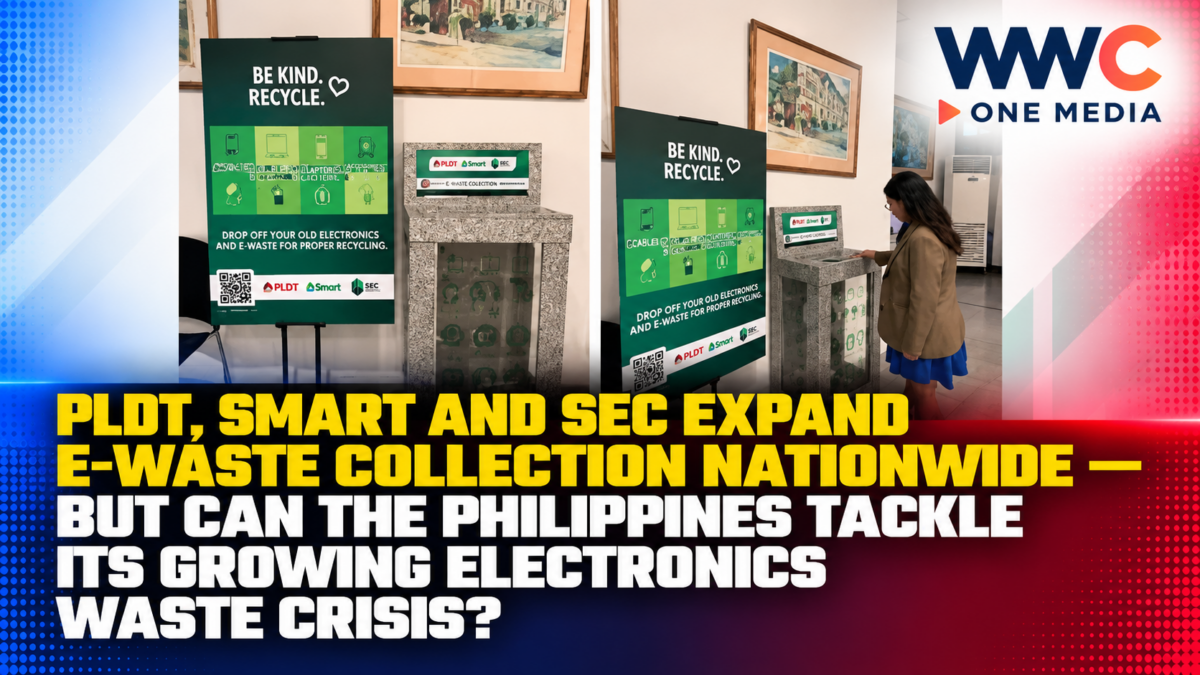
MANILA, PHILIPPINES — Two of the Philippines’ leading telecommunications companies are joining forces with the country’s corporate regulator to confront a growing environmental challenge: what happens to millions of old mobile phones, broken chargers, outdated routers and other discarded electronic devices after consumers stop using them?
PLDT Inc. and its wireless subsidiary Smart Communications Inc. have entered into a partnership with the Securities and Exchange Commission (SEC) to expand access to responsible electronic waste collection and recycling.
The initiative will bring the companies’ “Be Kind. Recycle.” collection bins to SEC offices nationwide, creating additional disposal channels for employees and stakeholders.
The partnership was announced by October 20 and subsequently reported by InsiderPH on October 27.
It builds on PLDT and Smart’s existing network of more than 200 e-waste collection points across the Philippines.
Since 2023, the companies say they have collected and recovered approximately 42.5 metric tons of discarded electronics through the program.
But the figures reveal an enormous challenge.
The Philippines generated an estimated 537,000 metric tons of electronic waste in 2022 alone, according to the United Nations’ Global E-Waste Monitor.
For PLDT, Smart and the SEC, the partnership represents another step toward responsible disposal. For the country, the bigger test is whether voluntary collection programs can expand fast enough to address an enormous and persistent waste problem.
PLDT AND SMART BRING E-WASTE RECYCLING TO SEC OFFICES
Under the agreement, PLDT and Smart will install dedicated electronic waste collection bins in Securities and Exchange Commission offices nationwide.
The bins will support the collection of used and broken electronic devices associated with telecommunications and digital services.
The initiative will also include educational activities explaining why discarded electronics should be handled separately from ordinary household and office waste.
The objective is to make responsible disposal more accessible within government workplaces while encouraging environmental awareness.
The SEC’s involvement is significant because the commission oversees corporate regulation and promotes sustainability reporting among Philippine businesses.
However, the announcement does not specify the exact number of new bins, their complete locations or the date when every SEC office will begin collecting e-waste.
The partnership establishes the planned expansion, not confirmation that all collection stations are already operational.
MORE THAN 200 COLLECTION POINTS ALREADY OPERATE NATIONWIDE
PLDT and Smart’s environmental initiative is not starting from zero.
Their “Be Kind. Recycle.” program already involves more than 200 collection points nationwide.
These collection channels were established through partnerships with businesses, educational institutions, local government units, cooperatives, professional organizations and other groups.
The companies have also worked with commercial establishments to make e-waste drop-off options more accessible.
For ordinary consumers, convenience can determine whether an old device is properly disposed of or left in storage for years.
Collection points located near workplaces, schools or shopping centers can make participation easier.
However, the 200-plus figure refers to the broader existing nationwide network.
It does not mean that 200 new collection stations are being installed at SEC offices.
The actual additional capacity resulting from the SEC partnership has not yet been disclosed.
42.5 METRIC TONS OF E-WASTE RECOVERED SINCE 2023
One of the program’s most important reported accomplishments is the collection and recovery of 42.5 metric tons of electronic waste since 2023.
That is equivalent to approximately 42,500 kilograms of discarded devices and electronic materials.
The figure demonstrates that the initiative has already handled a measurable quantity of waste.
However, it is a cumulative program result rather than the amount collected through the new SEC partnership.
The reporting also does not provide a complete independent breakdown of the materials recovered, final recycling rates, or disposal outcomes for every category.
Those details would be useful for assessing the program’s environmental performance.
Collecting electronic waste is an important first step, but proper treatment and material recovery ultimately determine what happens to it.
COMPANIES REPORT 17.3 METRIC TONS OF AVOIDED CARBON EMISSIONS
PLDT and Smart estimate that their e-waste recovery activities have avoided approximately 17.3 metric tons of carbon emissions.
The companies compare that amount with the carbon absorbed by 286 tree seedlings grown over ten years.
The estimate provides an indication of potential climate-related benefits.
However, the calculation methodology and full underlying assumptions were not independently established in the published coverage.
The figure should therefore be attributed to the companies.
It should not be described as an independently audited reduction in national greenhouse gas emissions.
Electronic waste recycling can reduce environmental impacts when it allows materials to be recovered and processed appropriately.
But those benefits depend on the collection, transport, recycling and disposal methods actually used.
WHERE WILL THE COLLECTED ELECTRONICS GO?
A key feature of the partnership is the commitment to send collected electronics to authorized treatment, storage and disposal facilities.
PLDT and Smart say these facilities are responsible for handling the waste in accordance with applicable environmental requirements.
This matters because electronic devices can contain both recoverable materials and potentially hazardous substances.
Improper dismantling, burning or disposal can expose workers and nearby communities to harmful chemicals.
Formal processing facilities are intended to manage these risks through appropriate procedures, equipment and controls.
However, not every component of an electronic device can necessarily be recycled.
Some materials may require specialized treatment or safe disposal.
The partnership does not establish that 100% of every collected device will be converted into reusable material.
THE SEC SAYS SUSTAINABILITY MUST BECOME PART OF CORPORATE PRACTICE
SEC Chair Francis Lim welcomed the initiative as part of the commission’s continuing efforts to promote responsible business practices.
The program forms part of the SEC Sustainability Week activities.
These initiatives encourage companies to improve environmental, social and governance practices, often referred to as ESG.
The SEC has also been promoting sustainability reporting and the adoption of standards aligned with international frameworks.
Its participation highlights the relationship between environmental action and corporate accountability.
Companies are increasingly expected to explain how their operations affect the environment and how they manage relevant risks.
However, sustainability reporting and actual environmental outcomes are different measures.
A company may publish extensive sustainability information without necessarily achieving every stated environmental objective.
Credible disclosure should therefore be supported by measurable results.
MANUEL V. PANGILINAN BACKS THE RECYCLING PARTNERSHIP
PLDT and Smart chairman and CEO Manuel V. Pangilinan described the agreement as part of the companies’ shared commitment to reducing the environmental effects of electronic waste.
The initiative also supports the idea of a circular economy.
Under a circular-economy approach, businesses and consumers seek to reduce unnecessary waste, extend product life and recover useful materials where practical.
For telecommunications providers, the concept is relevant because network development and consumer services depend on electronic equipment.
Mobile phones, routers, modems, chargers and other digital devices eventually reach the end of their usable life.
A more responsible system aims to prevent those items from automatically becoming unmanaged waste.
SMART ACKNOWLEDGES THE TELECOM INDUSTRY’S RESPONSIBILITY
PLDT and Smart chief sustainability officer Melissa Vergel de Dios emphasized that the group recognizes its role in the growth of electronic waste.
Although the companies do not directly manufacture every device used by their customers, their services encourage the use of telecommunications equipment.
Network upgrades also require newer technologies and supporting hardware.
These activities can contribute to the replacement and disposal of older equipment.
The group says its responsibility includes providing appropriate recovery and disposal options for electronic waste associated with its products and services.
This acknowledgement is important because responsibility for electronic waste extends beyond the final consumer.
Manufacturers, distributors, retailers, service providers, recycling companies and public authorities all influence how discarded electronics are managed.
THE PHILIPPINES GENERATED 537,000 TONS OF E-WASTE IN ONE YEAR
The size of the national problem puts the partnership into perspective.
According to the Global E-Waste Monitor 2024, the Philippines generated approximately 537 million kilograms of electronic waste in 2022.
That is equivalent to 537,000 metric tons, or roughly 4.7 kilograms per person.
The figure placed the country among Southeast Asia’s largest generators of discarded electronics.
The Department of Environment and Natural Resources’ Environmental Management Bureau has also cited these figures in educational materials.
Importantly, this is an estimate for 2022, not a verified total for 2026.
The 42.5 tons recovered by PLDT and Smart since 2023 cannot be directly compared as if they represented the same period.
Nevertheless, the difference in scale illustrates why many more collection and processing initiatives would be needed to address the national waste stream.
GLOBAL E-WASTE REACHES 62 MILLION TONS
The Philippines is part of a much larger global challenge.
The United Nations’ Global E-Waste Monitor estimated that the world generated 62 million metric tons of electronic waste in 2022.
Only 22.3% of that waste was documented as formally collected and recycled in an environmentally sound manner.
The report warned that electronic waste generation was increasing much faster than formally documented recycling.
This reflects the rapid turnover of phones, computers, household appliances and other electronic products.
As devices become more widely used, the volume of discarded equipment is likely to remain a significant environmental challenge.
The global figures demonstrate that the problem cannot be solved by a single company or government agency.
It requires coordinated action throughout the electronics supply chain.
WHY ELECTRONIC WASTE CAN BE DANGEROUS
Discarded electronic equipment may contain substances that can harm people and the environment when handled improperly.
Depending on the device and its components, these may include lead, mercury and other hazardous materials.
Unsafe dismantling practices can expose workers to dust, fumes or contaminated components.
Open burning of electronic waste can release dangerous pollutants.
Improper disposal may also allow harmful substances to contaminate soil and water.
Children and workers involved in informal waste processing can be particularly vulnerable.
At the same time, electronic equipment contains valuable materials that may be recovered through appropriate recycling methods.
Responsible collection therefore serves two purposes: reducing potential environmental harm and supporting the recovery of usable resources.
PHILIPPINE HAZARDOUS WASTE RULES ALREADY APPLY
The Philippines has existing laws and regulations governing hazardous waste.
Republic Act No. 6969, the Toxic Substances and Hazardous and Nuclear Wastes Control Act of 1990, provides a regulatory framework for hazardous substances and waste.
The DENR Environmental Management Bureau oversees relevant rules involving waste generators, accredited transporters and authorized treatment, storage and disposal facilities.
Hazardous electronic waste must be handled according to applicable classifications and requirements.
However, not every discarded electronic product is automatically subject to exactly the same waste-handling rules.
Requirements depend on the waste type and relevant regulatory classification.
The SEC partnership’s commitment to authorized treatment and disposal facilities is therefore an important operational feature.
ENVIRONMENTAL GROUPS WANT STRONGER ELECTRONICS RECYCLING POLICIES
BusinessMirror reported on October 18 that environmental organizations, including EcoWaste Coalition, have raised concerns about the Philippines’ fragmented electronic waste recovery system.
The groups warn that some discarded electronics enter informal recycling channels where workers may lack suitable protective equipment and pollution controls.
They have called for stronger collection systems and clearer producer responsibility arrangements for electronic products.
This issue is distinct from the Philippines’ Extended Producer Responsibility Act.
Republic Act No. 11898 focuses on plastic packaging obligations for covered companies, rather than establishing a comprehensive mandatory take-back program for every category of consumer electronics.
Consequently, the growth of voluntary industry programs does not remove the need to evaluate gaps in national electronic waste policy.
A stronger system may require better collection coverage, processing capacity, recordkeeping and enforcement.
SMART ALSO WORKS WITH DEVICE MAKERS AND RETAIL PARTNERS
The SEC partnership forms part of a wider set of initiatives.
Smart says it works with device manufacturers that use recycled materials and offer trade-in or trade-up arrangements.
Such programs can encourage consumers to return older devices through formal channels.
PLDT and Smart have also partnered with SM Cares to expand access to electronics collection facilities in shopping centers.
A 2024 Manila Bulletin report documented that earlier partnership, which was launched during Earth Day activities.
The companies have also supported collection initiatives involving schools and other organizations.
These collaborations may help make proper disposal more accessible in communities where specialized facilities are limited.
However, consumers should verify which types of electronics each participating collection point accepts.
A general e-waste bin should not be treated as permission to dispose of every hazardous or damaged device without checking specific handling instructions.
WHAT FILIPINO CONSUMERS SHOULD DO WITH OLD GADGETS
For households, responsible disposal begins before visiting a recycling station.
Old phones and computers may still contain personal information, photographs, financial accounts and saved passwords.
Consumers should back up important data, sign out of accounts and use appropriate device-reset or data-erasure procedures before surrendering their electronics.
Removable memory cards and SIM cards should be handled separately where appropriate.
Battery safety also matters.
Swollen, damaged or leaking batteries may require special handling.
Consumers should avoid puncturing or dismantling them.
The safest approach is to contact an authorized collection point to confirm the types of items accepted and any preparation requirements.
These simple steps help protect both personal information and the people who handle discarded electronics.
ARE SEC COLLECTION BINS OPEN TO THE GENERAL PUBLIC?
The announced partnership specifically refers to SEC offices and collection opportunities for employees and stakeholders.
It does not establish that every SEC office will operate as a public walk-in electronics recycling facility.
Access arrangements may vary according to office security rules and operational procedures.
Members of the public should therefore confirm accepted items and opening arrangements before attempting to deliver e-waste to an SEC office.
PLDT and Smart’s broader network includes other collection points through commercial establishments and partner organizations.
Consumers may find those locations more convenient.
However, individual drop-off points and accepted materials should be verified before visiting.
WHAT INDEPENDENT REPORTING CONFIRMS
InsiderPH reported the partnership on October 27, emphasizing the expansion of collection bins into SEC offices and the companies’ existing recycling network.
Newsbytes.PH reported the agreement earlier, on October 21, and confirmed that the initiative had been announced on October 20.
AI Times PH separately reported the planned bins, awareness campaigns and authorized waste-handling arrangements.
A detailed October 21 account published by iTech Solution reproduced the SEC partnership information, including statements attributed to SEC Chair Francis Lim and PLDT–Smart executives.
PLDT’s publicly available corporate filings independently document the company’s longer-running recycling program and its reported 42.5-ton recovery figure.
For wider context, the United Nations, DENR-EMB and BusinessMirror provide separate evidence of the scale of the Philippines’ e-waste problem.
Together, these sources confirm the partnership, while also demonstrating why its eventual impact will need to be assessed through actual collection and recycling results.
THE BIGGER QUESTION: CAN THE PROGRAM GROW FAST ENOUGH?
PLDT and Smart’s partnership with the SEC is a practical step toward expanding responsible electronic waste collection.
Government offices can provide institutional collection points, while the telecommunications companies contribute an existing recycling program and links to authorized waste facilities.
The initiative may also encourage other businesses to improve the management of their discarded electronics.
But the scale of the national challenge remains enormous.
The Philippines generated an estimated 537,000 metric tons of e-waste in 2022 alone.
Against that backdrop, the reported 42.5 tons recovered since 2023 represents a relatively small share of the country’s overall waste challenge.
That does not make the program insignificant.
It shows that collection networks must expand considerably if they are to make a measurable difference.
Future reporting should identify how many additional collection points become operational, how much waste they receive and what portion is properly recycled or disposed of.
The real success of the SEC–PLDT–Smart partnership will depend not on the number of recycling bins announced, but on how much discarded electronics are safely recovered and kept out of harmful disposal channels.
As Philippine households and businesses continue replacing their digital devices, one important question remains:
Will PLDT, Smart and the SEC’s expanding recycling network help transform the Philippines’ electronic waste problem — or will millions of discarded gadgets continue overwhelming the country’s limited collection and recycling systems?










