
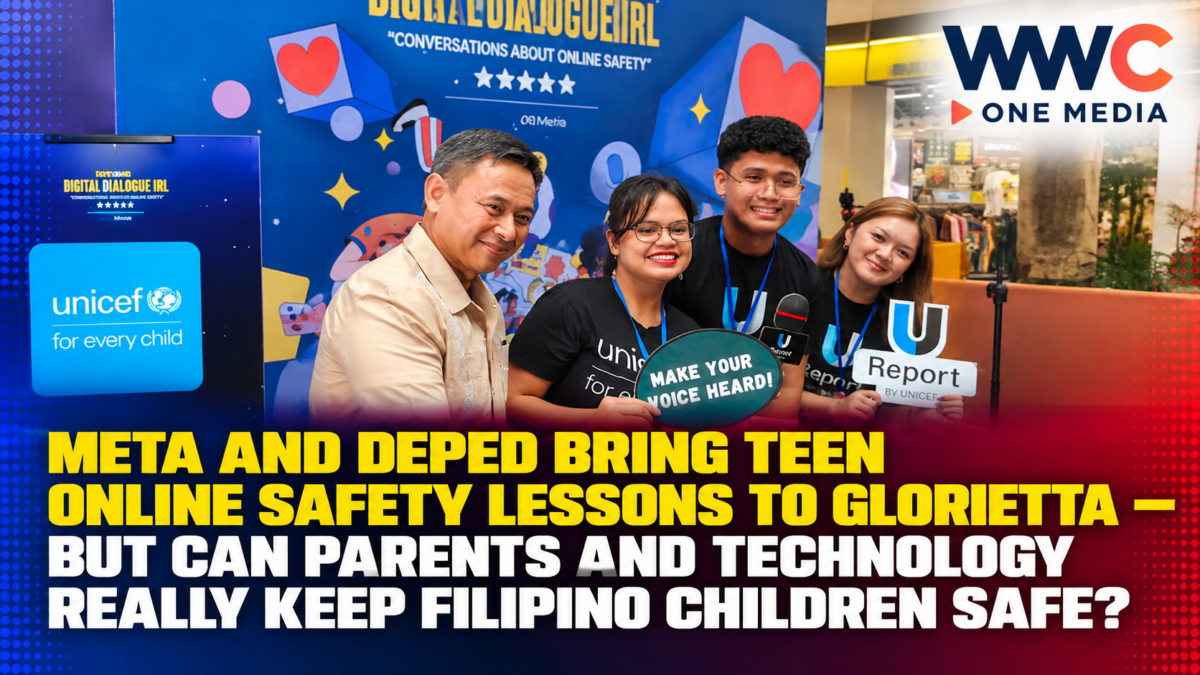
MAKATI CITY, PHILIPPINES — As the Philippines debates stricter rules on children’s social media access, Facebook and Instagram parent company Meta is taking online safety education beyond the smartphone screen through a free interactive exhibition designed to help Filipino teenagers, parents and teachers recognize digital threats.
The initiative, called Digital Dialogue In Real Life: Safety Starts with Conversation, opened on October 26 at Ayala Malls Glorietta in Makati City and runs until October 30, 2026.
The campaign brings together Meta, the Department of Education (DepEd), the Cybercrime Investigation and Coordinating Center (CICC), the National Youth Commission and child protection organizations.
Its mission is to equip families with practical knowledge about social media privacy, cyberbullying, potentially harmful content, online interactions and reporting mechanisms.
But the exhibition also arrives during a much bigger national debate.
Lawmakers are considering restrictions on children’s access to social media, while technology platforms face growing pressure to demonstrate that their existing safeguards genuinely protect young users.
The central question is whether better safety settings and stronger family conversations can protect Filipino children—or whether the country needs tougher rules to address risks that technology companies have struggled to eliminate.
META TAKES ONLINE SAFETY EDUCATION INTO THE REAL WORLD
Meta’s Digital Dialogue IRL initiative was launched through a multisectoral forum on October 26 at the Glorietta Palm Drive Activity Center.
The exhibit features interactive activities, guided demonstrations and educational resources explaining common online risks.
Parents and teenagers can learn about privacy settings, digital behavior and methods for reporting potentially harmful content.
The event is free to attend.
According to Marketing-Interactive, the public exhibition is open from October 27 to 30, between 11 a.m. and 7 p.m. daily, on Glorietta’s first level.
The organizers want families to discuss their online experiences in a physical space rather than addressing social media issues only through digital warnings.
The approach reflects a growing recognition that online protection depends on a combination of platform design, informed users and support from trusted adults.
DEPED SECRETARY SONNY ANGARA CALLS FOR GREATER PARENTAL INVOLVEMENT
Education Secretary Sonny Angara emphasized that protecting children online requires the same seriousness parents apply to their safety in public spaces.
Speaking at the launch, Angara urged parents and teachers to understand what young people encounter on social media.
He stressed that adults should be prepared to discuss children’s online experiences, including the emotions those experiences may create.
His remarks highlight a critical problem.
Young people may experience online bullying, unwanted contact, harassment or disturbing content without immediately informing their parents.
Some may fear punishment or losing access to their devices.
Others may not know how to explain what happened.
For online safety education to be effective, children must be able to seek help without feeling that reporting a problem will automatically lead to blame.
META SHOWCASES TEEN ACCOUNT SAFETY FEATURES
One of the exhibition’s main attractions is a demonstration of Meta’s Teen Accounts.
The company has been expanding youth safety settings across Instagram, Facebook, Messenger and Threads.
The available protections include:
- Default privacy controls designed to limit unwanted access to younger users’ accounts.
- Messaging restrictions intended to reduce unsolicited contact.
- Sensitive-content restrictions that limit exposure to certain inappropriate material.
- Restrictions on who can tag or mention teenage users.
- Filters that help screen offensive language, including terms used in Filipino.
- Daily notifications reminding teenagers about their time on the platform.
- A Sleep Mode designed to reduce notifications during nighttime hours.
These tools are intended to create a more age-appropriate experience.
However, the exact settings and supervision requirements can depend on the platform, the teenager’s age and the features available to the account.
Not every product has an identical set of controls.
THE 60-MINUTE REMINDER IS NOT AN AUTOMATIC BAN
Meta’s Teen Accounts include a reminder after approximately 60 minutes of daily use.
This feature is intended to encourage teenagers to reflect on their screen time.
However, the reminder does not automatically mean that access to Facebook or Instagram is disabled after one hour.
Parents should distinguish between notifications, optional supervision settings and mandatory limits.
A teenager may receive an alert without being completely locked out of an application.
This matters because families could develop a false sense of security if they assume that a time reminder automatically prevents excessive use.
Parents may still need to establish household routines and discuss suitable screen-time practices.
SLEEP MODE QUIETS NOTIFICATIONS AT NIGHT
Another feature demonstrated through the campaign is Sleep Mode.
Under the announced settings, notifications are muted between 10 p.m. and 7 a.m.
Automatic responses may also be sent to direct messages during the scheduled quiet period.
The feature aims to reduce interruptions during hours normally associated with rest.
However, it does not guarantee that a teenager will stop using a phone or accessing other applications.
Sleep Mode is therefore a tool for reducing distractions, not a complete solution to nighttime screen use.
Families may still need separate conversations about device use, sleep and daily routines.
PARENTAL APPROVAL APPLIES TO CERTAIN SETTINGS
Meta says younger teenagers require parental permission to make specified safety protections less restrictive.
The company’s June 2026 rollout of enhanced Teen Accounts in the Philippines particularly emphasized safeguards for users aged 13 to 15.
Such settings can help parents supervise key changes involving privacy, messaging and content exposure.
However, parental supervision tools do not provide unlimited access to a child’s private communications.
For example, Meta’s separate AI supervision feature allows parents using the relevant tools to review topics discussed with Meta AI over a recent period without providing the full conversation transcripts.
The objective is to provide visibility into potential concerns while retaining boundaries around private conversations.
Parents should review what each tool actually permits rather than assuming it reveals every online interaction.
CYBERBULLYING, GROOMING AND ONLINE EXPLOITATION REMAIN MAJOR CONCERNS
The initiative addresses a range of problems that can affect young internet users.
Cyberbullying can involve repeated harassment, humiliation or threatening messages.
Online grooming may involve someone building trust with a child for exploitative purposes.
Other risks include impersonation, scams, unwanted exposure to disturbing material and pressure to share private information.
These problems do not always occur publicly.
Some begin through private messages or interactions with people who initially appear friendly.
For this reason, parents and educators are being encouraged to discuss warning signs and reporting options.
But recognizing a problem is only the first step.
Children also need accessible ways to obtain help, preserve relevant evidence and report harmful conduct to appropriate authorities.
CICC EMPHASIZES THE IMPORTANCE OF REPORTING CHANNELS
CICC Executive Director Renato “Aboy” Paraiso highlighted the need for young people to know where they can seek help when experiencing online abuse or exploitation.
The CICC’s involvement brings a government cybercrime-response perspective to the campaign.
Reporting channels are especially important when harmful interactions involve threats, coercion, fraud or potential criminal behavior.
However, reporting an account on a social media platform is not necessarily the same as filing a complaint with law enforcement.
Platform reports may lead to content review or account action.
Potential crimes may require appropriate government investigation.
Families should therefore understand the distinction and seek the proper help for the situation.
If a child faces an immediate threat, responsible adults should prioritize the child’s safety and contact appropriate emergency or law-enforcement services.
CHILD PROTECTION GROUPS JOIN THE EXHIBITION
The Stairway Foundation is among the organizations participating in the initiative.
Its child protection specialist Ace Diloy emphasized the importance of collaboration between technology platforms, families, government agencies and communities.
The foundation is presenting educational materials connected to its Kaagapay Programme.
Other participating organizations include the Psychological Association of the Philippines and the National Youth Commission.
Their presence reflects the different dimensions of child online safety.
Technology controls may help restrict certain content or contact.
Education can help young users recognize risks.
Psychological support can help children manage harmful experiences.
Government authorities can investigate conduct that may violate the law.
No single organization can address every aspect independently.
THE CAMPAIGN BUILDS ON SCREEN SMART PHILIPPINES
Digital Dialogue IRL follows Meta’s Screen Smart Philippines initiative launched in June 2026.
The earlier campaign introduced updated Teen Account protections and sought to improve awareness among Filipino families.
At the June event, Meta discussed additional content restrictions modeled on age-appropriate entertainment ratings.
It also highlighted filtering tools intended to reduce exposure to bullying and offensive language.
The company worked on localized protections capable of recognizing harmful expressions in Philippine languages.
This is important because bullying and harassment do not always occur in English.
However, automated filters can miss context, fail to recognize certain expressions or incorrectly flag harmless language.
The tools require ongoing improvement and should not be treated as perfect safeguards.
AGE VERIFICATION REMAINS A SERIOUS CHALLENGE
One of the most important issues is whether online platforms can accurately identify underage users.
At the October forum, Meta Philippines public policy head Gio Tingson acknowledged that minors can sometimes bypass age restrictions by entering false birth dates.
This problem matters because age-based protections depend partly on determining the user’s real age.
If younger children register with incorrect information, they may not receive the safeguards intended for them.
Age assurance technologies and account verification can help address the issue, but they also create questions about privacy, accuracy and access.
The challenge is developing effective protections without requiring excessive collection of sensitive personal information.
CONGRESS CONSIDERS TOUGHER SOCIAL MEDIA AGE RESTRICTIONS
The exhibit opened during a major legislative debate over children’s social media use.
On October 12, Reuters reported that the Philippine House of Representatives had approved a measure restricting access for children under 13.
The Senate had approved a stricter proposal covering minors under 18.
The two chambers’ approaches still needed reconciliation before any final measure could be sent to the President.
These proposals illustrate the debate over how far the government should go in limiting online access for younger users.
Supporters of stricter rules argue that age restrictions can reduce children’s exposure to harmful material and exploitative interactions.
Critics of sweeping prohibitions warn that bans may encourage young people to hide their online activity or move to less-regulated platforms.
The legislative debate remains unresolved in the verified reporting reviewed for this article.
It would be inaccurate to describe the proposed nationwide restrictions as a fully enacted law.
META FAVORS AGE-APPROPRIATE CONTROLS OVER BLANKET BANS
Meta has argued that online protections should reflect differences between younger children and older teenagers.
The company favors tiered restrictions and parental involvement rather than treating every minor identically.
Its public policy representatives have expressed concern that blanket prohibitions may be ineffective when children find ways around them.
This is Meta’s policy position, not an independently established conclusion that bans never work.
Other policymakers argue that stronger access restrictions may be necessary because voluntary platform safeguards have not fully prevented harmful experiences.
A credible policy debate must evaluate both the effectiveness of restrictions and the consequences they may create.
Evidence about enforcement, privacy, age verification and children’s well-being will be important in deciding the final approach.
META AND ROBLOX PREVIOUSLY AGREED TO STRONGER SAFETY MEASURES
The October initiative also follows earlier discussions between the Philippine government and major technology companies.
In August 2026, Reuters reported that Meta and Roblox had agreed to strengthen child safety measures sought by Philippine officials.
Those commitments included age verification, parental controls, faster removal of harmful material and closer cooperation with law enforcement.
The discussions reflected increasing government scrutiny of platforms used by minors.
However, agreeing to introduce or strengthen safeguards is not the same as independently demonstrating that online harm has declined.
The effectiveness of those commitments will depend on implementation, enforcement and measurable outcomes.
WHAT INDEPENDENT REPORTING CONFIRMS
InsiderPH’s October 27 report identifies the free Glorietta exhibit, participating organizations and key Teen Account safeguards.
ABS-CBN News independently covered the October 26 launch and emphasized the call for stronger family communication.
Marketing-Interactive confirmed the exhibition schedule and detailed the activities at Glorietta.
GMA News and The Philippine Star previously documented the introduction of enhanced Teen Account protections in June.
Reuters provides separate context about the government’s legislative debate and earlier discussions with Meta and Roblox.
Together, these sources establish that the event is real and that the safety tools exist.
However, the current coverage does not establish how many visitors the exhibit will attract or whether participation will produce a measurable reduction in cyberbullying or online exploitation.
Those results have not yet been demonstrated.
WHAT FILIPINO PARENTS CAN DO NOW
Parents do not need to attend the exhibition to begin discussing online safety at home.
They can review privacy settings with their teenagers and identify which social media accounts are public or private.
Families can also discuss the difference between online friends and people they know personally.
Children should understand that requests for private photographs, passwords, location details or money may signal potential risks.
Parents can encourage teenagers to report threats or harassment without fear of immediate punishment.
It is also useful to establish household expectations for screen time and nighttime device use.
However, monitoring should be balanced with trust, age-appropriate independence and respect for privacy.
A supportive relationship can make children more willing to ask for help.
THE BIGGER QUESTION: CAN EDUCATION AND TECHNOLOGY KEEP CHILDREN SAFE?
Meta’s Digital Dialogue IRL initiative demonstrates an effort to bring online safety education into everyday family conversations.
The free exhibition offers practical demonstrations, interactive activities and information about tools designed to protect younger users.
Its partnerships with DepEd, the CICC and child protection organizations reflect the need for cooperation.
But the broader challenges are significant.
Teenagers may still encounter harmful content despite safety settings.
Age verification can be circumvented.
Online abuse may occur through private conversations that automated systems do not immediately detect.
And parents may struggle to keep pace with rapidly changing digital platforms.
The Philippines must therefore assess both educational approaches and appropriate regulatory safeguards.
The success of this initiative should ultimately be measured not by publicity surrounding the exhibit, but by whether families gain practical knowledge and children receive more effective protection online.
And as lawmakers debate the future of social media access for minors, one question remains:
Will Meta’s parental controls, interactive safety education and stronger government cooperation be enough to protect Filipino teenagers—or will the next major online safety crisis expose the limits of voluntary platform safeguards?










