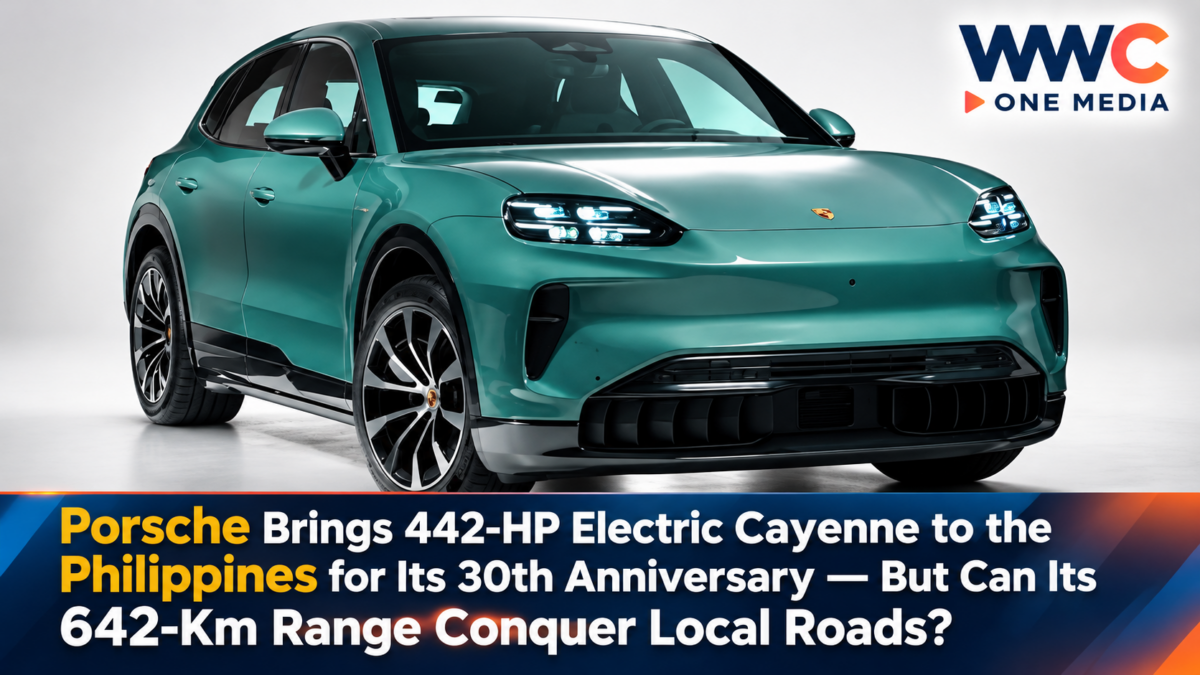
MANILA, PHILIPPINES — German luxury sports carmaker Porsche is accelerating its electric vehicle ambitions in the Philippines with the launch of the all-new Cayenne Electric, a battery-powered version of its popular performance SUV that promises the acceleration of a sports car and the practicality of a family vehicle.
The Philippine introduction coincides with Porsche’s 30th anniversary in the country, marking a milestone for the brand’s local distributor as the automotive industry continues its transition toward electric mobility.
With up to 442 horsepower, 835 Newton-meters of torque and a claimed range of 642 kilometers under standardized testing conditions, the Cayenne Electric aims to challenge the perception that electric SUVs must compromise driving excitement to deliver efficiency.
The vehicle can accelerate from zero to 100 kilometers per hour in just 4.8 seconds when Launch Control is activated.
Its 113-kilowatt-hour battery also supports charging power of up to 400 kilowatts when connected to suitable DC fast-charging equipment.
But Porsche’s new offering enters a Philippine market where public charging availability, high-powered charging infrastructure and consumer confidence remain important barriers to electric vehicle adoption.
The question is whether cutting-edge technology can convince luxury SUV buyers to make the switch—or whether the practical limitations of electric mobility will keep many customers loyal to gasoline and hybrid vehicles.
PORSCHE CELEBRATES 30 YEARS IN THE PHILIPPINES
Porsche Philippines’ 30th anniversary marks three decades of the German performance brand’s official local presence, which began in 1996.
The company has developed a market for its sports cars and SUVs through its authorized local distribution operations.
Porsche Philippines president and CEO Roberto Coyiuto III and managing director Stephen Recinto presented the new electric Cayenne as part of the company’s ongoing product expansion.
Earlier in 2026, Porsche also commemorated its Philippine anniversary with special displays featuring the 911 Targa 4 GTS and 911 Turbo S.
The introduction of the Cayenne Electric now adds a different dimension to the anniversary.
Rather than relying only on the heritage of its combustion-powered sports cars, Porsche is highlighting how its performance identity can extend into battery-powered vehicles.
The strategy reflects a broader transition in the global automotive industry, where manufacturers are balancing electric technology with existing gasoline and hybrid demand.
THE FIRST FULLY ELECTRIC CAYENNE ARRIVES IN THE COUNTRY
The Cayenne has long been one of Porsche’s important SUV nameplates.
Its combination of performance, comfort and practicality helped the brand reach customers who wanted a Porsche suitable for everyday travel.
The all-electric Cayenne represents a major change in how that concept is delivered.
Instead of a conventional gasoline engine, the standard electric version uses two electric motors driving all four wheels.
A high-voltage battery is integrated into the vehicle’s floor structure.
This arrangement allows Porsche to package the propulsion system differently while maintaining the vehicle’s luxury SUV character.
Importantly, the company has not announced that it is eliminating gasoline-powered and plug-in hybrid Cayennes from the Philippine market.
The electric model is being introduced alongside those alternatives, allowing buyers to choose the powertrain that best suits their circumstances.
UP TO 442 HORSEPOWER AND 835 NM OF TORQUE
Porsche’s electric SUV is designed to demonstrate that battery-powered vehicles can deliver strong acceleration.
The standard Cayenne Electric develops 408 horsepower in its normal rated configuration, with output rising to 442 horsepower when Launch Control is activated.
Maximum torque reaches 835 Newton-meters.
The dual-motor all-wheel-drive system distributes power to the wheels to support traction and acceleration.
Porsche claims that the SUV can accelerate from zero to 100 km/h in 4.8 seconds.
That figure places it firmly in the performance-oriented SUV category.
However, the acceleration number is a manufacturer’s specification, not the result of a locally conducted independent road test.
Actual performance can vary with road conditions, battery temperature, vehicle load and other factors.
642-KILOMETER RANGE TARGETS LONG-DISTANCE TRAVEL
One of the most important specifications is the Cayenne Electric’s claimed driving range.
Porsche states that the standard model can travel up to 642 kilometers on a single charge under the Worldwide Harmonised Light Vehicles Test Procedure, commonly known as WLTP.
This test method provides a standardized basis for comparing vehicle efficiency and range.
However, WLTP results do not guarantee that drivers will achieve the same distance during actual Philippine journeys.
Highway speeds, air-conditioning use, traffic conditions, hills, weather and driving behavior can affect battery consumption.
A vehicle carrying more passengers and luggage may also consume additional energy.
For Filipino buyers, the 642-kilometer rating is therefore a useful benchmark rather than a promise that every full charge will deliver exactly that distance.
The real test will be how the vehicle performs during everyday city driving and interprovincial travel.
400-KW FAST CHARGING PROMISES SHORTER STOPS
The Cayenne Electric uses a high-voltage electrical architecture designed to accommodate rapid battery charging.
Porsche reports support for peak DC charging power of up to 400 kilowatts.
Under favorable conditions and with suitable equipment, the battery can charge from 10% to 80% in less than 16 minutes.
This capability is intended to address one of the concerns frequently associated with electric vehicles: lengthy charging stops.
However, the vehicle’s maximum supported power does not mean that every public charging station can supply 400 kilowatts.
Actual charging performance depends on the station’s output, battery temperature, state of charge and system operating conditions.
The highest charging rate is also not maintained throughout the entire charging session.
For Philippine buyers, the presence of compatible chargers along intended routes will be important when deciding whether the technology meets their travel needs.
HOME CHARGING IS ANOTHER IMPORTANT FACTOR
The Cayenne Electric includes an 11-kilowatt onboard AC charger.
This supports charging from a compatible home or destination charging system.
For owners who can install suitable charging equipment at home, overnight charging may be more convenient than relying exclusively on public stations.
However, installation requirements will depend on the property’s electrical system, available capacity and applicable safety standards.
An 11-kilowatt onboard charger does not mean that every ordinary household electrical socket can deliver that charging rate.
Owners should consult qualified installers and the authorized dealer regarding appropriate charging equipment.
For condominium residents or households without dedicated parking, access to dependable charging arrangements may be more complicated.
MORE SPACE FOR PASSENGERS AND LUGGAGE
Electric vehicle architecture has also allowed Porsche to redesign the Cayenne’s cabin proportions.
The new model has a wheelbase of 3,023 millimeters, nearly 130 millimeters longer than that of the combustion-powered Cayenne.
The additional length between the axles provides more space for rear passengers.
The second-row seats offer powered adjustment, including up to 150 millimeters of forward and backward movement.
The seatbacks can also recline by up to 18 degrees.
This flexibility allows owners to prioritize passenger comfort or cargo capacity depending on their needs.
Published specifications indicate a luggage compartment capacity of 781 liters, expanding to 1,588 liters when the rear seats are folded.
There is also a 90-liter front storage compartment.
These features position the electric Cayenne as a practical luxury SUV rather than a vehicle focused exclusively on performance.
PORSCHE INTRODUCES ITS CURVED OLED FLOW DISPLAY
The Cayenne Electric features a redesigned digital cockpit.
Its centerpiece is Porsche’s Flow Display, a curved OLED touchscreen integrated into the central dashboard.
The design creates a larger interactive surface for vehicle controls and information.
The cabin also includes a 14.25-inch OLED digital instrument display.
An optional 14.9-inch screen can be installed for the front passenger.
The separate passenger display is intended to provide access to entertainment and navigation-related functions while limiting interference with the driver’s primary display.
Porsche has retained physical controls for certain frequently used functions, including climate settings and audio volume.
This combination reflects an effort to balance digital features with controls that remain convenient during driving.
ADAPTIVE SUSPENSION TARGETS COMFORT AND HANDLING
The electric Cayenne comes with adaptive air suspension and Porsche Active Suspension Management.
These systems adjust suspension characteristics to help balance ride comfort and handling.
For a large SUV, suspension tuning is particularly important because the vehicle must manage its weight while remaining responsive to steering inputs.
The model also offers optional rear-axle steering.
At lower speeds, rear-wheel steering can help improve maneuverability in tight spaces.
At higher speeds, it can contribute to handling stability.
Other available chassis systems are designed to control body movement during cornering and changes in road conditions.
However, specific equipment availability can depend on the variant and configuration.
Buyers should confirm which features are standard and which require additional options.
SAFETY TECHNOLOGY INCLUDES DRIVER ASSISTANCE
The Cayenne Electric also offers several modern driver-assistance features.
Reported equipment includes adaptive cruise control, lane-change assistance, parking cameras, automated parking functions and driver attention monitoring.
These technologies are intended to support drivers in selected situations.
However, driver-assistance systems are not substitutes for attentive driving.
Their performance can depend on weather, visibility, road markings, sensor conditions and other factors.
Buyers should also distinguish between standard equipment and optional systems.
The presence of advanced technology does not eliminate the need to follow road safety rules.
MORE POWERFUL TURBO VARIANT IS PART OF THE ELECTRIC CAYENNE RANGE
The global Cayenne Electric lineup also includes a high-performance Turbo version.
Published Philippine automotive reporting describes a peak output of up to 1,156 horsepower with Launch Control.
The Turbo Electric is capable of accelerating from zero to 100 km/h in approximately 2.5 seconds under the manufacturer’s claimed conditions.
This version is distinct from the standard 442-horsepower Cayenne Electric.
The numbers should not be mixed when comparing performance or driving range.
Early local reporting also indicates that the SUV body style is the initial focus of the Philippine rollout, with additional body styles and variants following separately.
Some publications describe a wider four-model range, but individual showroom availability and ordering arrangements should be confirmed with Porsche Philippines.
PHILIPPINE BUYERS CAN VIEW THE ELECTRIC CAYENNE AT DEALERSHIPS
Local automotive publication CarGuide.PH reported that the Cayenne Electric is available for viewing at Porsche showrooms in Greenhills, Bonifacio Global City, Alabang and Cebu.
This provides prospective buyers with an opportunity to examine the vehicle’s design and technology in person.
However, showroom display availability should not be confused with guaranteed immediate delivery of every variant.
Inventory, customization options and delivery schedules may differ.
Prospective buyers should confirm these details directly with Porsche’s authorized Philippine sales network.
HOW MUCH DOES THE PORSCHE CAYENNE ELECTRIC COST?
Pricing is one of the important details not established by the original InsiderPH report.
The October 26 story focused on the vehicle’s technology and 30th-anniversary debut rather than a specific Philippine selling price.
Other automotive coverage indicates that prices depend on the selected variant and customization options.
A consistent, independently confirmed final retail price for the standard Philippine-specification Cayenne Electric was not established from the reporting reviewed.
For publication accuracy, it would be misleading to provide an exact peso price without an official current quotation.
Customers interested in purchasing the vehicle should request a written quotation from an authorized Porsche dealer.
The total purchase cost may also depend on selected options, insurance and other applicable charges.
WHY CHARGING INFRASTRUCTURE MATTERS IN THE PHILIPPINES
Electric vehicle adoption depends on more than vehicle technology.
A luxury SUV may offer substantial range and rapid charging capability, but owners still need dependable charging arrangements.
Within Metro Manila and other major urban centers, access to charging facilities can be more practical than in some remote destinations.
Long-distance travel requires careful route planning, particularly where high-powered charging equipment is limited.
Charging station availability can also change.
A station may be occupied, undergoing maintenance or operating below its advertised maximum power.
For the Cayenne Electric, the practical benefit of its 400-kilowatt capability depends on whether compatible facilities are accessible.
Home charging could address routine daily use for some buyers.
But the broader question is whether Philippine infrastructure can support the convenience expected from a high-end electric vehicle.
THE LAUNCH REFLECTS PORSCHE’S MULTI-POWERTRAIN STRATEGY
Porsche is not immediately abandoning combustion-powered vehicles.
Instead, it is expanding the choices available to customers.
The Cayenne Electric joins gasoline and plug-in hybrid versions in the broader lineup.
This approach allows the company to respond to different levels of EV readiness across markets.
A buyer with reliable home charging and predictable travel patterns may find an electric SUV practical.
Another customer frequently traveling through areas with limited charging infrastructure may prefer a gasoline or hybrid vehicle.
For Porsche, offering several powertrain options may help preserve customer choice while investing in new technology.
The strategy also reflects uncertainty about how quickly different countries will adopt electric mobility.
WHAT INDEPENDENT AUTOMOTIVE REPORTING CONFIRMS
InsiderPH’s October 26 report describes Porsche’s Philippine anniversary launch and the main specifications of the Cayenne Electric.
CarGuide.PH independently reported the Philippine introduction on October 7, documenting the powertrain, charging capability, interior features and initial dealership displays.
Esquire Philippines also covered the October 8 media presentation, providing additional context about the brand’s strategy to continue offering different powertrains.
GadgetMatch and Speed published reports on October 27 confirming the principal vehicle specifications.
The Philippine Star also carried a detailed launch report, although that page explicitly identifies its content as externally supplied material rather than independent newsroom reporting.
The cross-checked sources confirm that the Cayenne Electric has been introduced locally.
However, many technical performance claims originate from Porsche’s own published specifications.
Independent Philippine road tests would be needed to establish actual range, charging times and performance under local conditions.
WHAT THE NEW CAYENNE MEANS FOR THE LUXURY EV MARKET
The arrival of the Cayenne Electric gives Philippine luxury vehicle buyers another battery-powered SUV option.
It also increases attention on the relationship between vehicle capability and supporting infrastructure.
A high-performance electric SUV can demonstrate technological progress, but its long-term market success depends on factors beyond acceleration.
Potential buyers will consider pricing, charging access, battery warranty coverage, service support, reliability and resale value.
For Porsche, the model also serves as a demonstration of how it intends to preserve its performance identity during the shift toward electrification.
However, the company has not disclosed verified Philippine sales targets or reservation numbers for the Cayenne Electric in the reports reviewed.
Any prediction of record local sales would therefore be speculative.
THE BIGGER QUESTION: IS THE PHILIPPINES READY FOR PORSCHE’S ELECTRIC FUTURE?
Porsche’s 30th anniversary in the Philippines is being marked by a vehicle that represents a major technological shift for the German brand.
The all-electric Cayenne combines an advanced battery system, strong acceleration, sophisticated suspension and a spacious luxury interior.
Its claimed 642-kilometer driving range may help address concerns about electric vehicle practicality.
Its high-voltage charging architecture also offers the potential for much shorter charging stops when suitable equipment is available.
But these benefits will not be identical for every buyer.
Electricity access, charging availability, actual driving range and ownership costs will shape the everyday experience.
By retaining gasoline and plug-in hybrid alternatives, Porsche is acknowledging that customers may transition toward electric mobility at different speeds.
The Cayenne Electric proves that Porsche can build a battery-powered luxury SUV with impressive published performance figures. The next test is whether those capabilities translate into convenient, reliable ownership on Philippine roads.
And as the automaker enters its fourth decade in the country, one question remains:
Will the Porsche Cayenne Electric’s combination of power, luxury and long-range capability convince Filipino buyers that the future is electric—or will charging limitations and the realities of local travel keep traditional luxury SUVs ahead?