Singapore is strengthening its energy security through a major partnership with Saudi Arabia that will see Saudi crude oil stored underground on Jurong Island from the second half of 2027, as both countries seek greater protection against global oil supply disruptions.
The announcement was made on October 26, 2026, by Singapore’s Ministry of Energy, Trade and Industry and Saudi Arabia’s Ministry of Energy during the Singapore International Energy Week.
Under the proposed arrangement, Saudi Arabian Oil Company, better known as Saudi Aramco, will store crude oil at Singapore’s Jurong Rock Caverns, an underground petroleum storage facility designed to hold large quantities of liquid hydrocarbons.
The agreement marks an important development in Singapore’s efforts to strengthen its energy resilience while reinforcing Saudi Arabia’s ability to supply customers across Southeast Asia.
Singapore’s Energy Market Authority (EMA) and JTC Corporation exchanged a memorandum of understanding (MOU) with Saudi Aramco as the first step towards establishing the arrangement.
Energy Minister Tan See Leng said negotiations are expected to be concluded within the coming months, with storage operations targeted to begin in the second half of 2027.
The actual volume of Saudi crude to be stored and the financial terms of the arrangement have not yet been publicly disclosed.
Why Saudi Arabia Is Choosing Singapore
The partnership comes at a time when global energy markets are facing significant uncertainty following severe disruptions to oil shipments through the Strait of Hormuz.
The strategic waterway is one of the world’s most important energy transportation routes, connecting major Middle Eastern oil producers with international markets.
Disruptions linked to the ongoing US-Israeli war with Iran have exposed the vulnerability of Asian economies that depend heavily on Middle Eastern energy supplies.
Before the conflict, approximately two-thirds of Asia’s oil imports came from the Middle East, making the region particularly vulnerable to interruptions along critical shipping routes.
By storing crude oil closer to major Asian markets, Saudi Arabia can improve the flexibility of its supply network and respond more efficiently to changing market conditions.
Saudi Energy Minister Prince Abdulaziz bin Salman said bringing supplies closer to key Asian markets would strengthen supply flexibility and improve preparedness against potential disruptions.
For Saudi Arabia, the arrangement also provides another strategic storage location in a region that remains central to global oil consumption.
Inside Singapore’s Massive Underground Oil Storage Facility
The Jurong Rock Caverns will play a central role in the agreement.
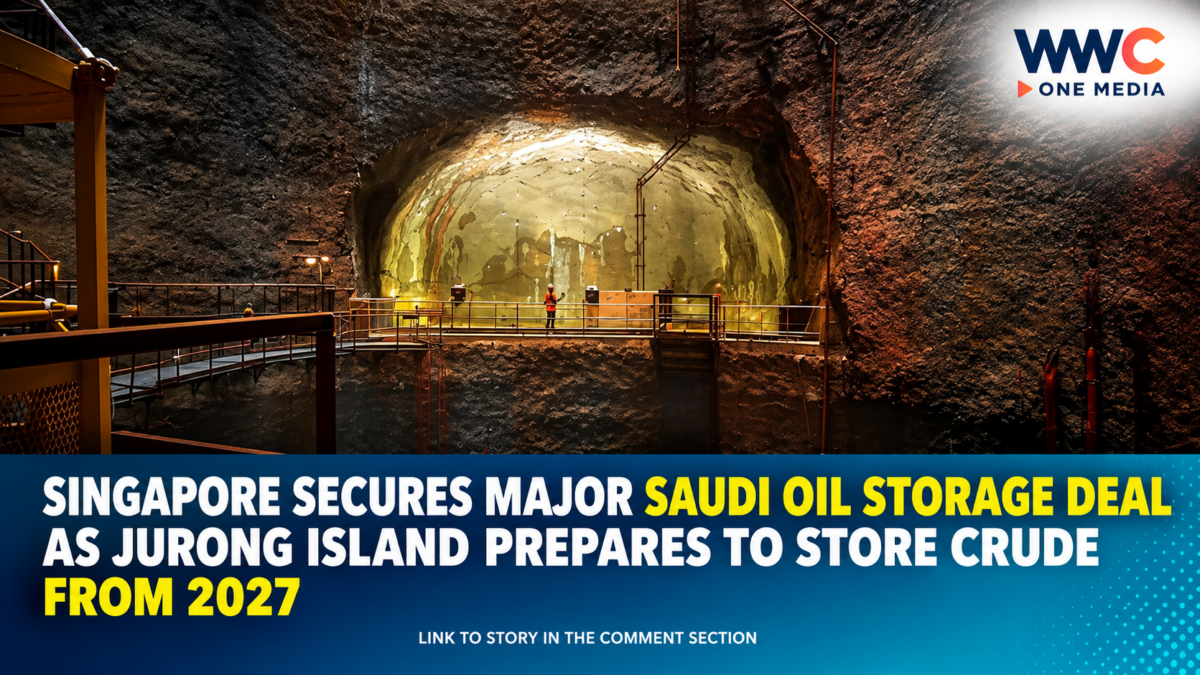
Located approximately 150 metres beneath Jurong Island, the underground facility is Singapore’s first commercial underground liquid hydrocarbon storage complex.
According to JTC Corporation, the caverns have a total storage capacity of approximately 1.47 million cubic metres, equivalent to around nine million barrels of liquid hydrocarbons.
The facility was developed to provide secure storage for products such as crude oil and condensate while making more efficient use of Singapore’s limited land resources.
Its underground location also offers an alternative to conventional above-ground petroleum storage facilities, allowing Singapore to expand its energy infrastructure without requiring large additional areas of surface land.
However, the nine-million-barrel figure represents the facility’s overall capacity, not the amount allocated to Saudi Arabia under the proposed agreement.
Saudi Arabia Already Has Oil Storage Partnerships in Asia
The Singapore arrangement is part of Saudi Arabia’s broader strategy of establishing crude oil storage partnerships in important Asian markets.
Saudi Aramco already maintains overseas crude storage arrangements in Japan and South Korea.
In Japan, the company has worked with the Japan Organization for Metals and Energy Security to maintain crude oil storage capacity in Okinawa. The arrangement allows Japan preferential access to the stored supplies during emergencies while providing Saudi Arabia with a strategic distribution location.
In South Korea, Aramco signed an agreement in 2023 with Korea National Oil Corporation covering the storage of approximately 5.3 million barrels of Saudi crude oil in facilities at Ulsan over five years.
The Singapore partnership would further expand this regional network and strengthen Saudi Arabia’s presence in one of the world’s busiest energy trading and refining centres.
Singapore Is Strengthening Its Energy Defences
The Saudi oil storage agreement is not Singapore’s only initiative to protect its energy supply.
The government has been expanding its energy partnerships, diversifying fuel sources and developing additional infrastructure to reduce exposure to international supply shocks.
Singapore relies heavily on imported energy, particularly natural gas for electricity generation. Approximately 95 per cent of its electricity is generated using natural gas, making reliable fuel imports essential to the country’s economy.
In his Singapore Energy Lecture on October 26, Tan See Leng also highlighted the importance of diversifying gas supplies and expanding liquefied natural gas infrastructure.
The country’s second LNG terminal is expected to increase its LNG throughput capacity by 50 per cent when it becomes operational by 2030.
Singapore is also preparing to expand its electricity generation capacity through five new power plants expected to come online between 2026 and 2031. These facilities are projected to increase overall generation capacity by 26 per cent.
Separately, Singapore’s GasCo signed an MOU with Thailand’s PTT to explore cooperation in areas such as LNG supply optimisation, adding another layer to its regional energy partnerships.
These initiatives reflect a broader government strategy to ensure that households and businesses can continue receiving reliable energy even when international supply chains face unexpected disruptions.
A Strategic Move With Regional Implications
The Saudi-Singapore agreement could have implications beyond the two countries.
Singapore serves as a major regional centre for oil trading, refining, petroleum storage and maritime transportation. Its location along important international shipping routes makes it a strategic destination for energy companies seeking access to Asian markets.
Having Saudi crude stored in Singapore could improve the efficiency of regional supply arrangements and provide another option when conventional transportation routes encounter difficulties.
However, the agreement does not automatically guarantee lower petrol prices, cheaper electricity or an immediate increase in available fuel for consumers. Its primary objective is to strengthen supply-chain resilience and improve preparedness for potential shortages.
The proposed arrangement also does not mean that Singapore will own the Saudi crude oil. The oil will remain part of Saudi Arabia’s supply arrangements, with the specific commercial and operational terms still subject to negotiations.
With operations targeted for the second half of 2027, the partnership represents a significant step in Singapore’s long-term energy planning.
As geopolitical tensions continue to expose weaknesses in global energy supply chains, Singapore and Saudi Arabia are positioning themselves to build a more flexible and resilient oil network across Asia.