MANILA, Philippines — October 25, 2026
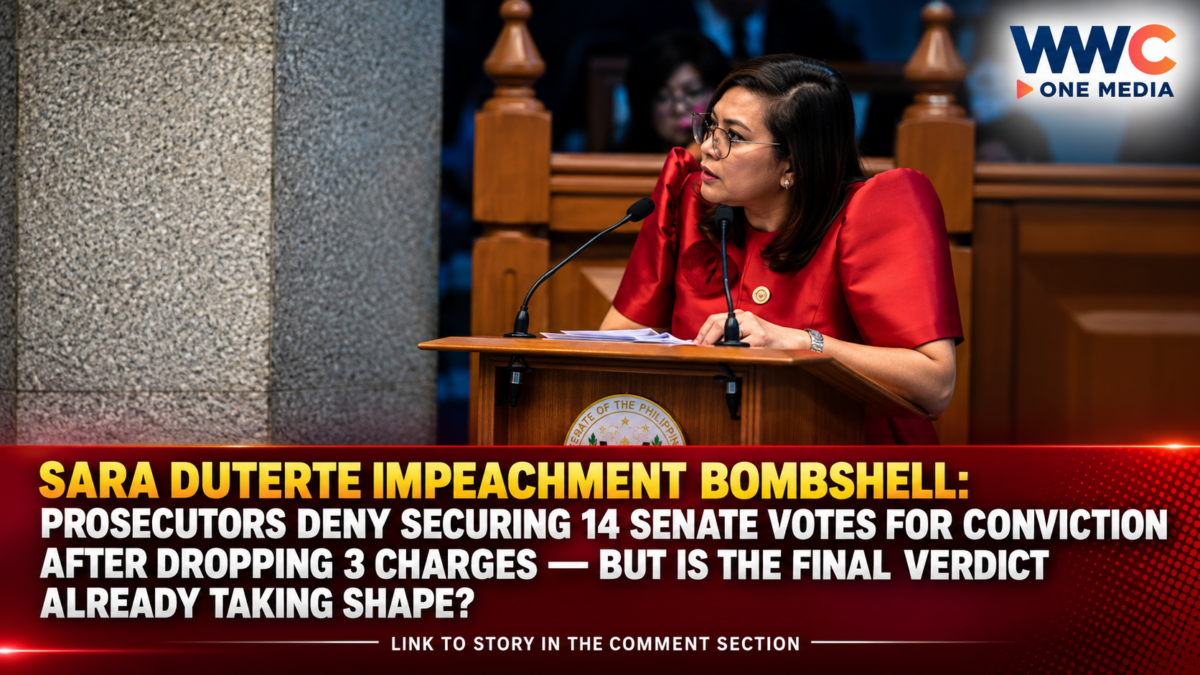
The impeachment trial of Vice President Sara Duterte has entered another critical phase after House prosecutors rejected claims that they had already secured enough votes in the Senate to convict her, fueling fresh questions about the political maneuvering, legal strategy, and possible outcome of one of the Philippines’ most consequential impeachment proceedings.
The denial comes as prosecutors narrow their case to a single impeachment charge involving alleged unexplained wealth, following their decision to withdraw three other charges against the vice president.
With Duterte’s political future and potential 2028 presidential candidacy at stake, public attention is shifting from the accusations themselves to a crucial question: Can prosecutors convince enough senator-judges to vote for conviction based on the remaining evidence?
Prosecution Denies Having a Guaranteed Senate Majority
House lead prosecutor Batangas Representative Gerville “Jinky” Luistro has dismissed suggestions that the prosecution’s decision to streamline its case was driven by assurances that enough senators would vote to convict Duterte.
Speaking in an earlier interview with NewsWatch Plus, Luistro denied that prosecutors possessed inside knowledge of how senator-judges would eventually vote.
“We totally deny that because, as a matter of fact, we’re not privy at all,” Luistro said.
She emphasized that the prosecution’s duty is to present evidence before the impeachment court, while the responsibility for determining guilt or acquittal rests with the senator-judges.
Her remarks directly challenge speculation that withdrawing multiple impeachment charges signaled a prearranged political outcome.
The prosecution has maintained that its strategy is based on the strength of its evidence rather than any guaranteed voting arrangement.
Three Charges Dropped, One Major Allegation Remains
On October 13, the Senate impeachment court approved the prosecution’s withdrawal of three of the four articles of impeachment against Duterte.
The withdrawn allegations involved:
- Article I: Alleged misuse of confidential government funds.
- Article III: Alleged bribery involving Department of Education officials.
- Article IV: Alleged threats against President Ferdinand Marcos Jr., First Lady Liza Araneta Marcos, and former House Speaker Martin Romualdez.
This leaves Article II, concerning alleged unexplained wealth, as the sole remaining charge for the impeachment court to decide.
Prosecutors contend that evidence supporting the remaining article is sufficient to justify Duterte’s removal from office.
According to Reuters and the Associated Press, the withdrawal was intended to shorten the proceedings, reduce the number of witnesses required, and allow the impeachment court to concentrate on a narrower set of allegations.
The defense, however, has challenged the decision.
Chief defense lawyer Sheila Sison described the withdrawal as unfair, arguing that the prosecution had already presented testimony concerning allegations that Duterte’s lawyers would no longer have the same opportunity to contest during the trial.
The dispute raises important questions about procedural fairness and how the Senate should evaluate the remaining evidence.
Duterte has denied wrongdoing.
Senate’s Controversial 14-Vote Threshold Changes the Stakes
Another major development came on September 23, when the Senate impeachment court revised its interpretation of the number of votes required to convict Duterte.
Under the previous interpretation, conviction required 16 votes, representing two-thirds of the full 24-member Senate.
The impeachment court subsequently ruled that its calculation should instead be based on senators legally and factually capable of participating in the proceedings.
With four senator-judges unable to participate under the circumstances reported at the time, the required number fell to 14 votes out of 20 eligible senator-judges.
The decision was adopted by a 13-1 vote, with six senator-judges not participating in that ruling.
However, the revised threshold does not mean 14 senators have committed to convicting Duterte.
Senate President Win Gatchalian previously stressed that a senator’s position on how the constitutional voting requirement should be calculated does not necessarily reflect how that senator would vote on Duterte’s guilt or innocence.
The threshold ruling has also faced legal challenges, making the rules governing the eventual judgment an important part of the proceedings.
Evidence Submitted as Impeachment Court Awaits Defense Response
The prosecution has taken another significant procedural step.
On October 24, House prosecution spokesperson Representative Robert Ace Barbers confirmed that prosecutors had submitted their formal offer of evidence to the Senate impeachment court.
The submission identifies the evidence prosecutors want the court to consider in deciding the remaining impeachment charge.
Barbers said the defense would have 10 days to comment before the impeachment court determines the admissibility of the submitted evidence.
In a separate October 25 report, GMA News quoted Senator-Judge Win Gatchalian as saying that the defense had not yet provided feedback regarding the lifting of restrictions on public discussion of the three withdrawn articles.
Although the Senate has lifted the sub judice restriction affecting those withdrawn articles, limitations still apply to the disclosure of evidence presented during the proceedings.
These developments indicate that the impeachment process remains active and that significant procedural questions must still be addressed before a final decision.
Why the 2028 Presidential Election Matters
The stakes extend beyond Duterte’s current position as vice president.
A conviction in the Senate impeachment court could lead to her removal from office and disqualification from holding future public office, potentially ending her planned campaign for the presidency in 2028.
The vice president’s impeachment has unfolded against the backdrop of a major political split between the Marcos and Duterte camps, whose alliance helped deliver their electoral victory in 2022.
What began as a governing partnership has developed into an increasingly bitter confrontation involving allegations of corruption, political retaliation, and competing claims about government accountability.
For Duterte’s supporters, the proceedings raise concerns about political motivations and the fairness of the impeachment process.
For those seeking accountability, the case represents an opportunity to test whether even the country’s highest elected officials can be held responsible for alleged constitutional violations.
Neither political interpretation, however, determines the legal outcome. The senator-judges must evaluate the case according to the applicable impeachment rules and evidence.
What Happens Next?
Several important developments could shape the remaining proceedings.
The Senate impeachment court must address the prosecution’s formal offer of evidence and the defense’s objections, determine which evidence is admissible, and allow the remaining trial process to proceed under its rules.
The final conviction threshold will also depend on the applicable ruling and the number of senator-judges eligible to participate when judgment is rendered.
For now, there is no verified basis to conclude that prosecutors have already secured the votes needed to convict Duterte.
The prosecution’s denial makes that distinction particularly important as competing political narratives spread ahead of the Senate’s eventual decision.
The central issue is no longer simply how many allegations were originally filed, but whether the remaining charge can survive the defense’s challenges and persuade the necessary constitutional majority.
As the Sara Duterte impeachment case approaches its next decisive stages, one question remains unanswered: Will the prosecution’s single-charge strategy prove strong enough to secure a conviction, or could the defense still turn the proceedings in the vice president’s favor?