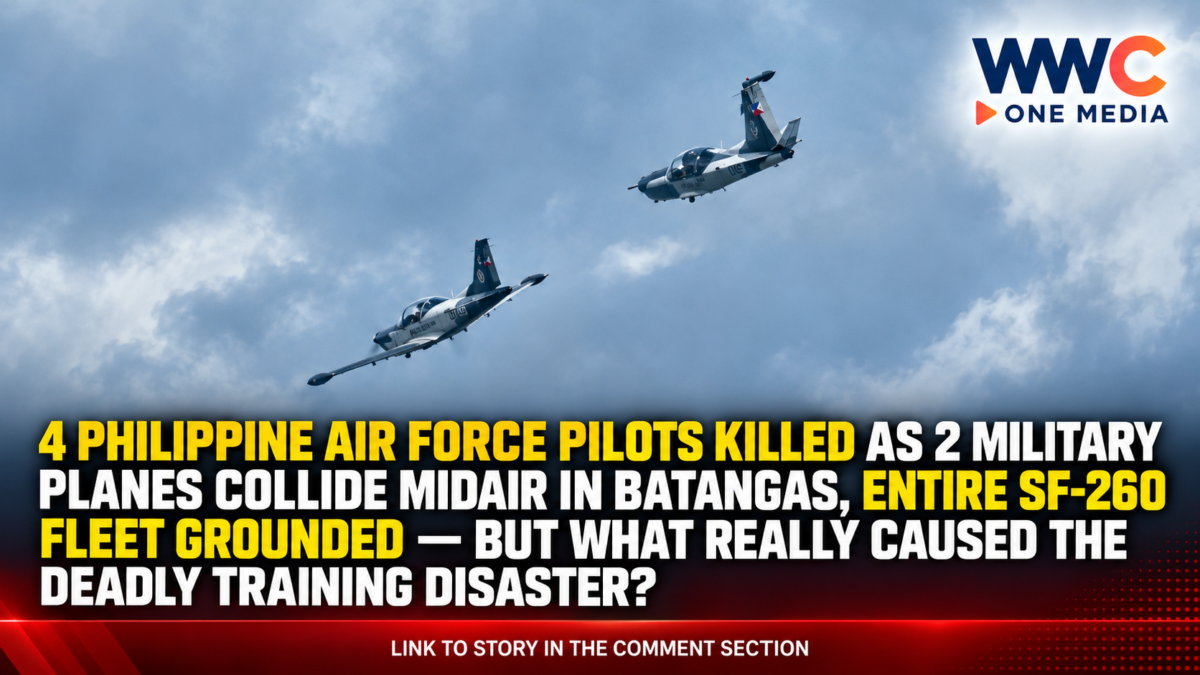
BATANGAS, PHILIPPINES — October 25, 2026 — A routine military training exercise turned into a devastating tragedy after two Philippine Air Force (PAF) aircraft collided in midair over Fernando Air Base in Lipa City, Batangas, killing four military pilots and prompting the immediate grounding of the country’s SF-260 trainer aircraft fleet.
The deadly accident occurred at approximately 3:51 p.m. on Friday, October 23, 2026, during a training flight involving two SF-260 aircraft. The Philippine Air Force officially confirmed the four fatalities the following day.
The incident has brought renewed attention to military aviation safety in the Philippines, particularly following earlier fatal accidents involving the same aircraft type.
Two Aircraft Collide During Military Training
According to the Philippine Air Force, the two SF-260 single-engine trainer aircraft crashed within the perimeter of Fernando Air Base.
Video footage obtained by GMA News showed the aircraft colliding while airborne before falling toward the ground.
The Philippine Star reported that the accident happened during a coordinated flyby exercise involving seven aircraft. Five other aircraft involved in the exercise reportedly landed safely.
The two aircraft involved in the fatal collision were identified in the report as having tail numbers 032 and 037.
Despite the severity of the crash, military authorities confirmed that no additional casualties were reported on the ground.
The identities of the four deceased pilots had not been publicly released in the initial official statements, as the military coordinated with their families.
Philippine Air Force Mourns Four Fallen Aviators
The Philippine Air Force expressed its condolences to the families, colleagues, and loved ones of the four pilots who lost their lives while performing their duties.
The military emphasized that the fallen aviators would be remembered for their dedication and service to the country.
PAF officials also assured the families that necessary assistance was being coordinated.
The Air Force requested the public to respect the bereaved families’ privacy as they mourn the tragedy.
Entire SF-260 Fleet Grounded After Fatal Collision
In response to the accident, the Philippine Air Force ordered the temporary grounding of all SF-260 aircraft as a precautionary safety measure.
The decision allows investigators to examine the circumstances of the crash before the aircraft are cleared to resume operations.
The SF-260 is an Italian-designed military trainer used for pilot instruction and other military aviation duties.
Although the collision has been documented in publicly circulated footage, the precise circumstances that led the aircraft to make contact remain under investigation.
Authorities have not established whether the accident resulted from human error, technical malfunction, operational procedures, or a combination of factors.
Defense Secretary Orders Comprehensive Investigation
Defense Secretary Gilberto Teodoro Jr. said the investigation would examine the full circumstances surrounding the incident, including flight planning, aircraft maintenance, and command leadership.
The inquiry is expected to determine what happened during the training exercise and whether any operational or safety measures require improvement.
The defense chief emphasized that the investigation should be thorough rather than rushed.
These findings will be particularly important in establishing whether the crash was an isolated incident or whether broader safety concerns need to be addressed.
No official determination of responsibility has been announced.
Not the First Fatal SF-260 Accident in the Philippines
The latest tragedy comes after other deadly accidents involving the SF-260 aircraft used by the Philippine Air Force.
In May 2026, two military pilots were killed after an SF-260 aircraft crashed in a mountainous area of Benguet during a training operation.
In January 2023, another SF-260 aircraft crashed in Bataan, killing two military aviators.
These incidents mean that at least eight military personnel have died in three reported fatal SF-260 accidents in 2023 and 2026, including the latest tragedy in Batangas.
However, the previous crashes do not establish that the accidents shared the same cause. Each incident must be assessed according to its own evidence and investigation findings.
Why the SF-260 Aircraft Matters to Philippine Military Aviation
The SF-260 is a military aircraft developed in Italy and widely used for flight training.
Trainer aircraft play a critical role in preparing military aviators for operational assignments, teaching navigation, aircraft handling, formation flying, and other essential aviation skills.
The Philippine military has also previously used SF-260 aircraft for combat-related missions, including operations during the 2017 Marawi conflict.
The temporary grounding could affect activities that depend on the SF-260 fleet, although the Air Force has not announced the full operational impact.
The incident highlights the importance of flight safety procedures, aircraft maintenance, instructor supervision, and operational risk management in military aviation.
What Investigators Still Need to Establish
Several critical questions remain unanswered following the crash.
Investigators must establish how the two aircraft came into contact, whether the pilots were executing a planned maneuver, whether proper separation was maintained, and whether technical or operational conditions played a role.
It also remains unclear when the grounded SF-260 aircraft will be authorized to fly again.
Until official findings are released, suggestions that negligence, mechanical defects, or command failures caused the collision remain unproven.
A Tragedy That Raises Questions About Military Flight Safety
The deaths of four Philippine Air Force pilots represent a significant loss for the country’s military aviation community.
Beyond the immediate tragedy, the incident places renewed attention on the procedures and systems designed to protect personnel during demanding training operations.
As the Philippine Air Force continues its investigation, the priority remains identifying the circumstances behind the collision, supporting the victims’ families, and establishing the measures necessary to prevent similar accidents.
The biggest unanswered question is no longer whether the aircraft collided, but what caused the collision — and whether investigators will identify lessons capable of preventing another tragedy.