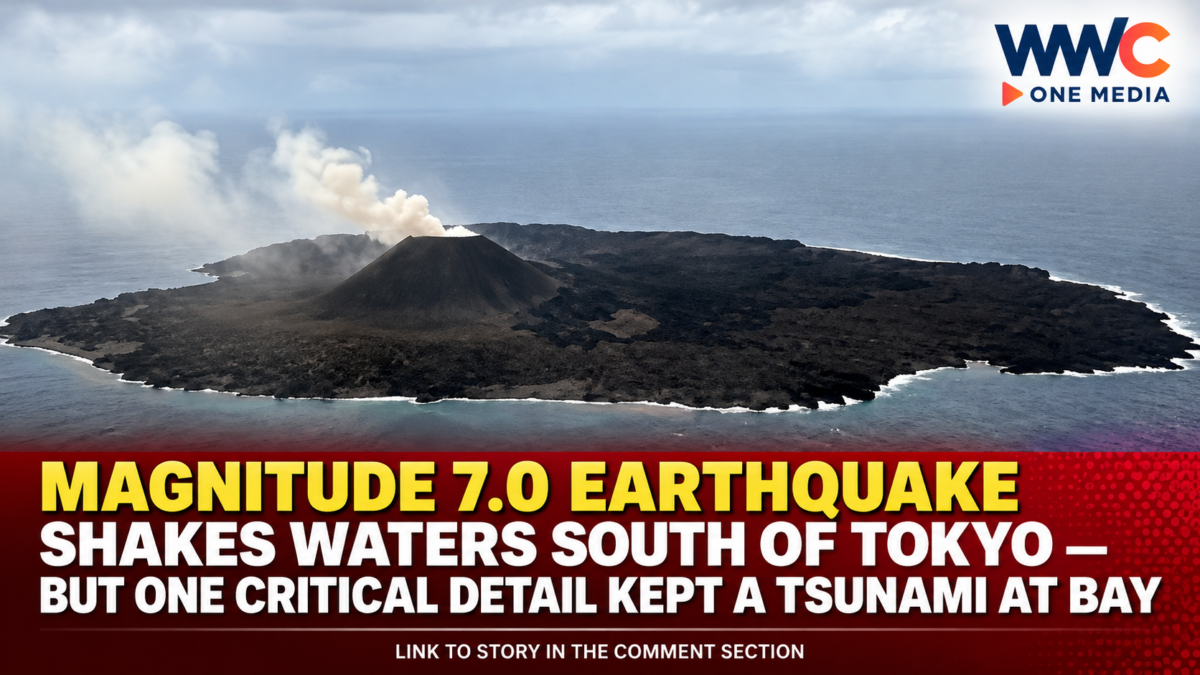
A magnitude 7.0 earthquake struck the Pacific Ocean near Japan’s remote Ogasawara Islands on Sunday, October 25, 2026, but authorities reported no tsunami threat following the powerful tremor.
According to the Japan Meteorological Agency (JMA), the earthquake occurred west of the island chain at a depth of approximately 470 kilometers beneath the Earth’s surface. Despite its considerable depth and distance from the capital, shaking was felt across a wide area of eastern and northeastern Japan.
Deep earthquake strikes far south of Tokyo
The Ogasawara Islands, also known as the Bonin Islands, are located roughly 1,000 kilometers south of Tokyo in the Pacific Ocean.
The earthquake registered a seismic intensity of 3 on Japan’s seven-level intensity scale in parts of the island group, including Chichijima and Hahajima, according to reports citing the JMA.
Although the earthquake reached magnitude 7.0, its depth was a significant factor in assessing its potential effects. Deep earthquakes can send seismic waves across large distances, allowing tremors to be felt far from the epicenter.
Why was there no tsunami warning?
Despite the earthquake’s magnitude, the Japan Meteorological Agency reported no tsunami threat.
The U.S. Tsunami Warning System likewise stated that no tsunami warning, advisory, watch or threat was in effect for the event. Its bulletin placed the earthquake at a depth of approximately 473 kilometers, or 294 miles.
Tsunamis are commonly generated when an undersea earthquake causes significant vertical displacement of the seafloor. A deep earthquake does not necessarily produce that kind of movement at the ocean floor, which helps explain why a powerful tremor does not automatically trigger a tsunami.
However, earthquake magnitude alone is not enough to determine tsunami risk. Authorities assess factors including the earthquake’s depth, location and potential seafloor displacement.
What other international reports say
The Philippine Daily Inquirer reported the initial magnitude and absence of a tsunami in its coverage of the event. The Straits Times also reported the JMA’s preliminary magnitude of 7.0 and noted that the tremor was felt across eastern and northeastern Japan.
The Edge Malaysia, citing Xinhua, independently reported the earthquake’s approximate depth, location and lack of tsunami threat. Meanwhile, the U.S. Tsunami Warning System provided an official bulletin confirming that no tsunami alerts were in effect.
These reports broadly agree on the central facts: a magnitude 7.0 earthquake occurred near the Ogasawara Islands, the tremor originated deep underground, and no tsunami threat was identified.
What residents should know
Japan is situated in a seismically active region where earthquakes occur regularly. Even when a major earthquake does not generate a tsunami, authorities may continue monitoring seismic activity and evaluating any reported impacts.
For this particular event, the cited reports did not establish a confirmed tsunami threat. Readers should consult official Japanese earthquake information and tsunami advisories for any subsequent developments rather than relying on unverified social media claims.
The bottom line: The magnitude 7.0 earthquake was significant, but its considerable depth and the official tsunami assessment meant that no tsunami warning was issued for this event.