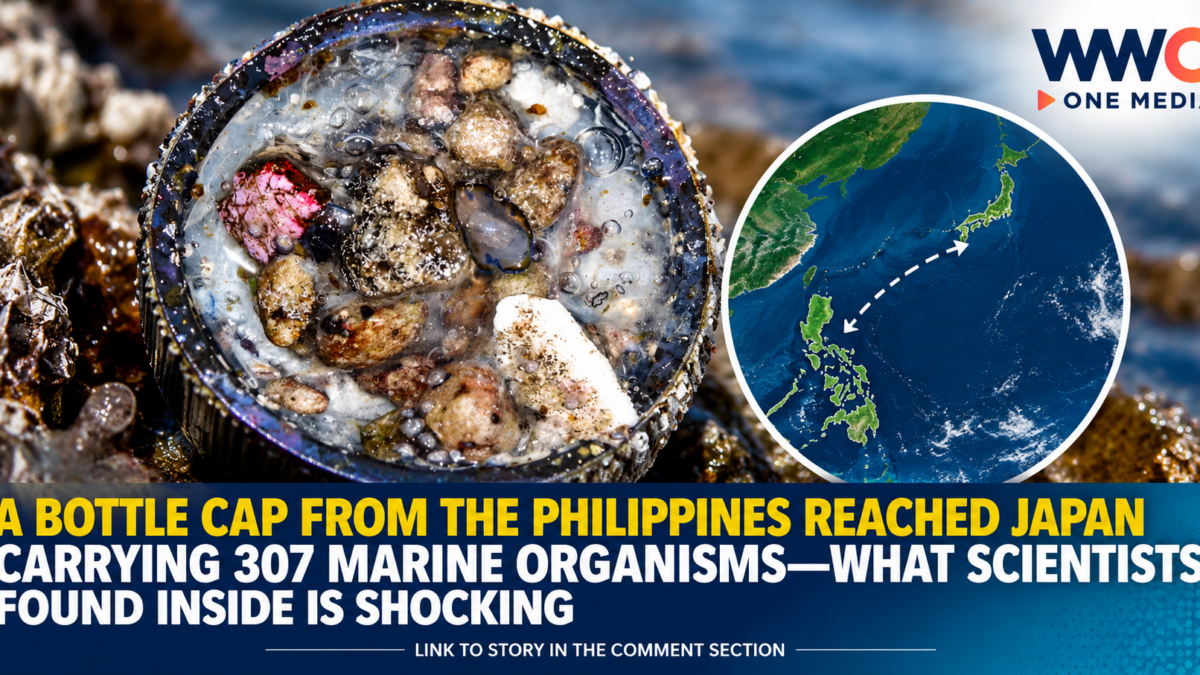
A discarded plastic bottle cap measuring just 3.5 centimeters across has revealed a surprising environmental threat after researchers found that it carried 307 marine organisms from waters near the Philippines to the coast of Japan.
The discovery highlights how even the smallest pieces of plastic pollution can become floating habitats, transporting marine life across vast distances and potentially exposing ecosystems to species from other regions.
The findings came from a research team led by scientists associated with Nagoya University in Japan, working with researchers from several institutions, including the Japan Agency for Marine-Earth Science and Technology (JAMSTEC), Kyoto University, the National Museum of Nature and Science, and Fukui Prefectural University. The study was published in the peer-reviewed journal Marine Pollution Bulletin in July 2026.
According to the researchers, the bottle cap was recovered from waters southeast of Kochi Prefecture during a research voyage. Its label suggested that it originated in the Philippines, while scientific analyses helped reconstruct its likely journey across the Pacific Ocean.
A Tiny Piece of Plastic Became a Floating Marine Habitat
What initially appeared to be an ordinary piece of ocean garbage turned out to contain a miniature ecosystem.
Researchers identified 307 individual organisms belonging to nine taxonomic groups. These included polychaete worms, bryozoans, barnacles, foraminifera and flatworms.
The most notable discovery was a bristle worm scientifically identified as Eunice bipapillata. Measuring approximately nine centimeters long, the worm had constructed a complex nest inside the much smaller bottle cap using mucus and small particles.
Its structure transformed the cap’s otherwise smooth interior into a habitat with spaces and surfaces where other organisms could settle and survive.
Scientists found that the organisms represented different marine environments, including species typically associated with coastal seafloors and rocky habitats, as well as organisms that commonly attach themselves to floating objects.
The findings suggest that a small piece of plastic can become more than a vehicle for individual organisms: it can support an entire community of marine life during a long ocean journey.
How Did the Bottle Cap Travel From the Philippines to Japan?
Researchers combined several types of evidence to investigate the cap’s likely origin and route.
First, the label on the plastic cap pointed toward the Philippines as its probable source. However, the label alone could not establish the exact location where it was discarded.
Scientists also examined the shells of microscopic foraminifera found on the cap. These organisms can preserve chemical clues about the water temperatures they experienced while growing.
Finally, the team used ocean-current simulations to estimate possible drift routes. The results indicated that the cap likely traveled from the northern Philippines through the Kuroshio Current system, which carries warm water northward through the western Pacific.
The reconstructed journey suggested that the cap spent at least around 70 days drifting toward Japanese waters, potentially remaining at sea for several months.
This combination of biological evidence, chemical analysis and computer modeling allowed researchers to reconstruct the likely journey of a single piece of marine debris.
Why Scientists Are Concerned About Invasive Species
The discovery raises concerns beyond the visible problem of plastic waste.
When organisms survive on floating debris and arrive in unfamiliar waters, they may potentially introduce species into environments where they are not normally found. If those organisms survive, reproduce and establish populations, they could affect local ecological relationships.
Researchers identified a worm that had not previously been recorded in Japanese waters. However, this finding does not prove that the species has established a breeding population in Japan or that it has already caused ecological damage.
The study instead demonstrates a possible pathway through which marine organisms can travel to new regions.
Plastic debris can remain afloat longer than some natural materials, giving attached organisms additional opportunities to survive and disperse. This makes plastic pollution a concern not only for wildlife ingestion, entanglement and habitat degradation, but also for marine biodiversity and the spread of non-native species.
The researchers said that studying the drift histories of marine debris could help scientists better understand these pathways and develop approaches to managing the associated ecological risks.
What Other Research Institutions Found
The discovery was also detailed in research announcements from the National Institute of Advanced Industrial Science and Technology (AIST), Kyoto University and JAMSTEC.
These institutions reported the same central findings: the cap measured approximately 3.5 centimeters, contained 307 organisms from nine taxonomic groups, and likely traveled from waters near the Philippines toward Japan through the Kuroshio Current system.
The findings reinforce a growing scientific concern that marine plastic waste can carry living organisms across long distances.
The research also highlights how combining several investigative methods can reveal the history of a piece of debris that would otherwise appear insignificant. Instead of simply documenting where plastic was found, scientists can use its attached organisms, chemical clues and likely ocean-current routes to investigate where it may have originated and how it traveled.
A Reminder That Small Pieces of Plastic Matter
Plastic pollution is often discussed in terms of large floating debris, discarded fishing gear and enormous accumulations of waste. This discovery demonstrates why smaller items also deserve attention.
A bottle cap that can fit in the palm of a hand may appear harmless compared with larger plastic waste. Yet, under the right conditions, it can provide shelter for multiple organisms and transport them across national and ecological boundaries.
The researchers emphasized the importance of properly disposing of plastic waste to reduce the amount entering the marine environment.
The study does not establish how frequently bottle caps carry comparable ecosystems, nor does it prove that the organisms discovered caused harm after reaching Japan. Further research will be needed to determine how often these communities form, which species can survive long journeys, and whether transported organisms successfully establish themselves in new habitats.
Nevertheless, the findings offer a compelling reminder: plastic discarded in one place can have consequences far beyond its point of origin.
The next time a small plastic cap is carelessly thrown away, its possible journey may extend much farther than anyone expects.