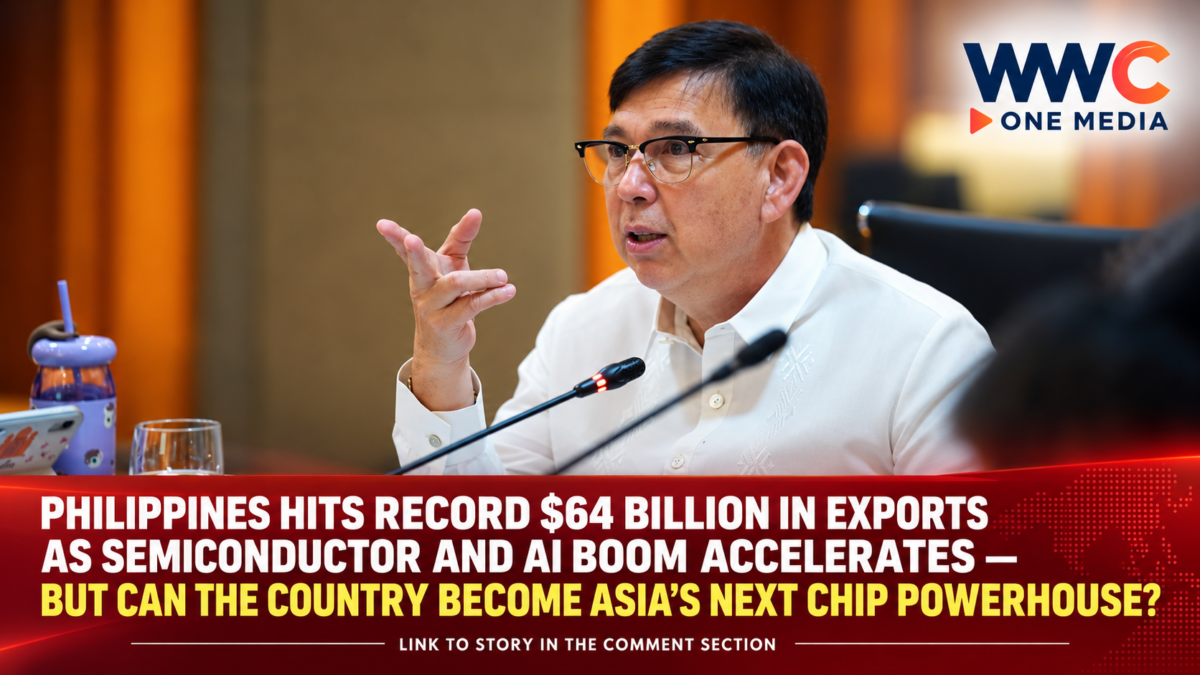
MANILA, Philippines — October 25, 2026 — The Philippines is positioning itself for a bigger role in the global semiconductor and artificial intelligence (AI) industries after total merchandise exports surged to a record US$64.04 billion in the first eight months of 2026, raising hopes that the country could become a major destination for high-value technology investments.
But behind the record-breaking numbers lies a much bigger challenge: Can the Philippines move beyond assembling electronic products and become a regional powerhouse in chip design, advanced manufacturing, and innovation?
According to figures from the Philippine Statistics Authority (PSA), merchandise exports rose 14.8% from January to August compared with the same period last year, supported by strong international demand for electronics and semiconductors.
August alone delivered an impressive US$9.11 billion in export revenues, representing a 27.8% year-on-year increase and marking the highest monthly merchandise export value recorded since the statistical series began in 1991.
Electronic products accounted for approximately US$6.2 billion of August exports, underscoring the sector’s importance to the Philippine economy.
Government Wants More Than Just Assembly Jobs
The Marcos administration is now pushing to convert the export boom into a long-term industrial transformation.
Executive Secretary Ralph Recto, who heads the Semiconductor and Electronics Industry Advisory Council (SEIAC), has emphasized the importance of moving the Philippines beyond traditional assembly and manufacturing operations.
The government’s ambition includes attracting investments in semiconductor design, engineering, research and development, advanced packaging, and other technology-intensive activities.
These industries could provide opportunities for Filipino engineers, researchers, technicians, and skilled manufacturing workers while increasing the value of the country’s participation in international supply chains.
The challenge is significant. While the Philippines has decades of experience in electronics production, a stronger presence in chip design and other advanced technologies will require substantial investment in infrastructure, technical training, research capabilities, and industry partnerships.
Electronics Exports Surge as AI Demand Explodes
The Philippines’ electronics industry is benefiting from the expansion of AI infrastructure, cloud computing, data centers, and digital technology worldwide.
According to the original Bombo Radyo report, electronics exports climbed 26.2% to approximately US$37.1 billion during the first eight months of 2026.
The Semiconductor and Electronics Industries in the Philippines Foundation Inc. (SEIPI) has raised its forecast for 2026 electronics export growth to around 10%, suggesting that annual shipments could reach approximately US$54 billion to US$55 billion.
This follows a strong 2025, when electronics exports reached US$49.64 billion under SEIPI’s industry reporting.
Growing demand for semiconductors is particularly important because chips are fundamental to AI servers, telecommunications systems, smartphones, industrial equipment, automobiles, and data centers.
However, the industry remains exposed to changes in international demand, geopolitical tensions, trade restrictions, and disruptions affecting global technology supply chains.
Toshiba’s Philippine Expansion Could Create 3,000 Jobs
One of the clearest indications of growing investor interest comes from Japanese technology giant Toshiba Corporation.
The company is planning a multibillion-peso expansion of its Philippine manufacturing operations over the next three years, with approximately 3,000 additional jobs expected.
According to the Department of Finance, the investment will focus on expanding production capacity for nearline hard disk drives, which are widely used in data centers to store large volumes of information.
Demand for these storage technologies has increased alongside the expansion of artificial intelligence, cloud computing, and other data-intensive applications.
Toshiba already operates manufacturing facilities in Laguna and has maintained a Philippine manufacturing presence for more than three decades.
Its planned expansion highlights the country’s established role in international electronics manufacturing, although the projected employment gains will depend on successful implementation of the investment.
Philippines Targets $110 Billion in Electronics Exports by 2030
The Philippine Semiconductor and Electronics Industry Roadmap sets an ambitious target of US$110 billion in annual semiconductor and electronics exports by 2030.
Under the roadmap, policymakers aim to increase the country’s participation in global semiconductor assembly, testing, and packaging while strengthening its electronics manufacturing services and integrated circuit design capabilities.
The strategy also includes developing a stronger domestic talent pipeline, expanding research infrastructure, and attracting investments that generate greater value within the Philippines.
The Luzon Economic Corridor, a cooperation initiative involving the Philippines, United States, and Japan, is among the platforms the government hopes will support industrial development and strategic infrastructure investments.
Success could mean more opportunities for Philippine technology suppliers, engineering firms, research institutions, and skilled workers.
However, achieving the US$110-billion target would require an enormous expansion from current electronics export levels. It remains a government objective rather than a guaranteed outcome.
Can Philippine Exports Break the $100 Billion Barrier in 2026?
The semiconductor boom has also strengthened expectations for the country’s overall merchandise export performance.
Philippine Exporters Confederation Inc. president Sergio Ortiz-Luis Jr. has expressed optimism that total merchandise exports could approach or surpass US$100 billion in 2026.
The opportunity reflects strong electronics shipments and the potential recovery of other export industries.
Nevertheless, the outlook remains sensitive to international trade policies, especially possible changes to United States tariffs and restrictions affecting imported components.
The United States remains a major export destination for Philippine goods, making the country’s technology industry particularly exposed to developments in American trade policy.
Industry leaders are also watching whether global AI-related investment can sustain the pace of semiconductor and electronics demand.
The Bigger Challenge: Turning Record Exports Into Better Jobs
The Philippines already plays a significant role in the global electronics supply chain, but record export revenues do not automatically translate into higher wages or widespread economic prosperity.
The longer-term test will be whether major investments create lasting benefits for Filipino workers and domestic businesses.
Moving toward chip design, research, testing innovation, and more sophisticated manufacturing could allow the country to capture a larger share of the value generated by international technology companies.
That shift, however, will require reliable electricity, competitive operating costs, skilled workers, better logistics, and sustained investment in education and industrial infrastructure.
Without these improvements, the Philippines risks remaining heavily dependent on lower-value segments of global electronics production even as export revenues continue to rise.
For now, the numbers point to significant momentum.
With merchandise exports reaching US$64.04 billion in just eight months, multinational manufacturers expanding their Philippine operations, and global demand for AI infrastructure remaining strong, the country has a substantial opportunity to strengthen its technology industry.
But the biggest question is no longer whether the Philippines can manufacture products for the world’s technology giants. It is whether the country can become one of those industries’ leading centers for innovation — and turn today’s export boom into a generation of better-paying Filipino jobs.