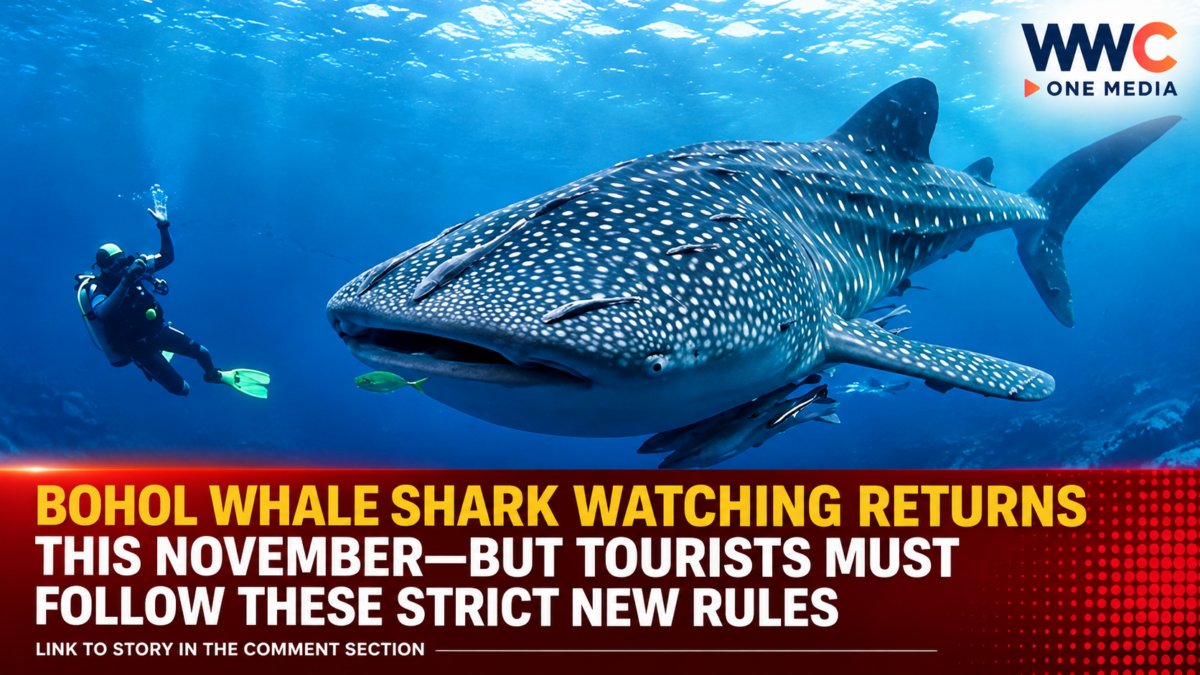
BOHOL, Philippines — Whale shark watching in Bohol is expected to resume in November 2026, offering fresh hope for tourism businesses, boat operators, guides and coastal communities affected by the prolonged suspension of the popular marine attraction.
The planned reopening comes as the provincial government works to revive tourism while enforcing stricter rules intended to protect whale sharks, locally known as tuki or butanding, from harmful human interactions.
According to reports by Bohol Tribune and Inquirer.net, tourism stakeholders are looking forward to the activity’s return, which could help attract domestic and foreign visitors. However, the reopening will depend on compliance with the province’s enhanced marine wildlife regulations and the necessary operating requirements.
Why Bohol Suspended Whale Shark Watching
The province halted whale shark interaction activities in February 2025 after an inter-agency investigation found that operators were using krill to attract and keep the animals near viewing areas.
The practice violated existing regulations governing marine wildlife interactions. Governor Erico Aristotle Aumentado issued Executive Order No. 10, series of 2025, ordering the suspension of operations in Lila, Alburquerque and Dauis.
The closure affected communities that relied on whale shark tourism for alternative livelihoods, including boat operators, tour guides and other tourism workers.
The Philippine Information Agency reported the suspension and explained that the provincial government acted to enforce wildlife protection rules. The shutdown also prompted consultations among government agencies, local officials and tourism stakeholders on how the activity could return under more responsible conditions.
Sources: Philippine Information Agency and Inquirer.net.
New Rules: No Feeding, No Touching and No Harassment
The return of whale shark watching will not mean a return to unrestricted encounters.
Bohol’s Provincial Ordinance No. 2026-004, known as the Enhanced Sustainable Marine Wildlife Interaction Ordinance, establishes a stricter framework for tourism involving whale sharks and other marine wildlife.
Under the implementing rules and regulations, key requirements include:
- No feeding: Operators and tourists are prohibited from feeding or baiting whale sharks to attract them.
- No touching or harassment: Visitors must not touch, chase, ride or otherwise disturb marine wildlife.
- Minimum distances: Tourists must keep at least three meters from a whale shark’s body and four meters from its tail.
- Controlled tourism activities: Designated zones, limits on visitor and vessel capacity, and other safeguards are intended to reduce disturbance and overcrowding.
- Permits and accreditation: Local governments and operators must meet the applicable compliance, environmental, safety and tourism requirements before operating.
The rules also prohibit flash photography and underwater drones during regulated wildlife encounters. Violations may result in fines of up to ₱5,000, imprisonment of up to six months, or both, subject to applicable procedures and penalties.
The provincial government has emphasized that wildlife protection must take priority over commercial interests.
Sources: Inquirer.net on the enhanced rules and Provincial Government of Bohol.
Tourism Industry Hopes for a Much-Needed Boost
Tourism businesses are hoping the reopening will help bring visitors back to Bohol, particularly to communities where whale shark watching has been an important source of income.
The Bohol Tribune reported that the Bohol Association of Hotels, Resorts and Restaurants, led by its president, Doer Escoto, expects the activity to help strengthen tourism demand. Hotels and resorts have also been offering promotional room rates and other services to attract travelers.
The planned reopening is part of a broader effort to encourage both domestic and international tourism. Marketing activities and travel promotions are also being used to highlight Bohol’s beaches, natural attractions and other visitor experiences.
However, the return of whale shark watching alone may not resolve all the challenges facing the province’s tourism sector. Travel costs, market preferences, transport access and the overall visitor experience can also influence arrivals.
Source: Bohol Tribune’s report on the planned reopening.
The Big Challenge: Can Tourism Grow Without Harming Whale Sharks?
One of the biggest challenges will be ensuring that operators can offer wildlife encounters without relying on feeding or other practices that interfere with the animals’ natural behavior.
Unlike attractions where visitors can expect a scheduled performance, whale sharks are wild animals. Their appearance cannot be guaranteed, and responsible tourism must allow them to move freely without being chased or lured.
Bohol’s new framework is intended to make conservation central to the tourism experience. The province has also established seasonal rules allowing whale shark and manta ray interactions only from November through May, subject to compliance with the applicable requirements.
The provincial government says operators and local government units must secure the required authorizations before activities can resume. The November target should therefore not be interpreted as permission for every site or operator to open automatically.
Source: Provincial Government of Bohol.
What Tourists Should Know Before Visiting
Travelers planning a Bohol trip in November should check with local tourism offices and authorized operators for the latest opening announcements, operating locations, booking arrangements and safety requirements.
Visitors should also be prepared for the possibility that whale sharks may not appear during a scheduled trip. Responsible operators should not promise guaranteed sightings or use prohibited feeding practices to attract the animals.
Bohol’s challenge is to make the attraction viable for local communities while ensuring that the wildlife and marine environment remain protected.
If the new rules are properly enforced, the reopening could become an opportunity to rebuild tourism confidence while establishing a more sustainable model for marine wildlife encounters.
For Bohol, the real measure of success will not simply be how many tourists return—but whether the province can protect its marine wildlife while allowing local communities to benefit from tourism.