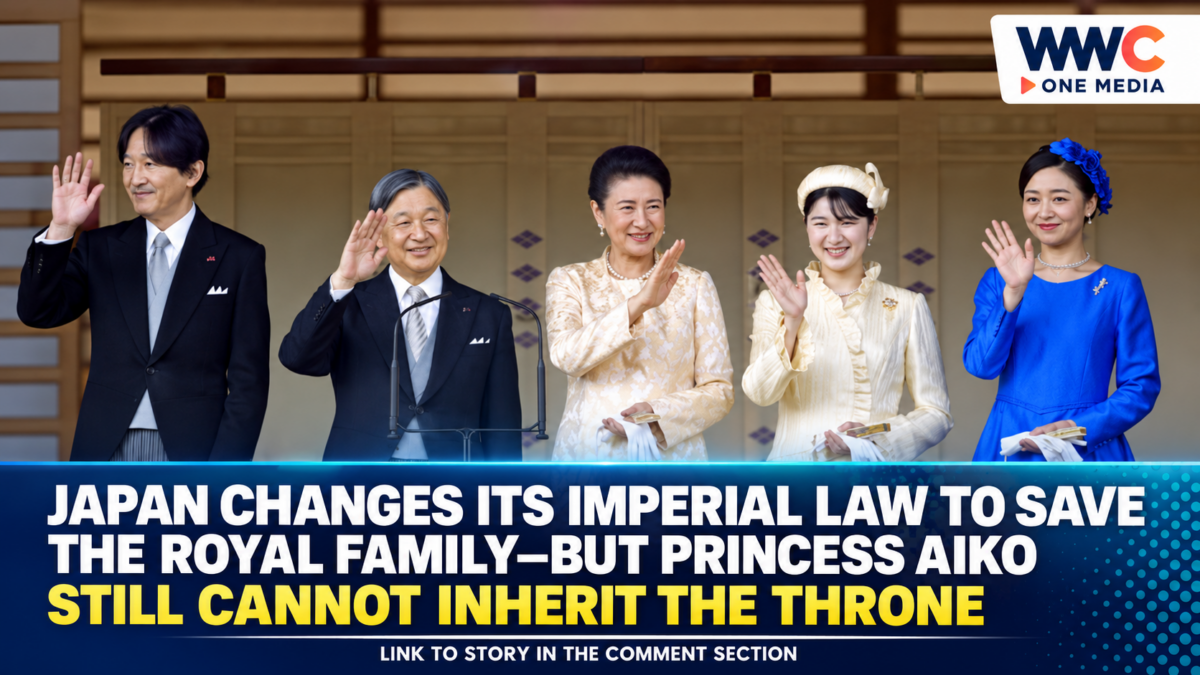
TOKYO, Japan — Japan’s revised Imperial House Law took effect on October 24, introducing new measures to preserve the country’s shrinking imperial family while maintaining its long-standing rule that only men descended through the paternal line can inherit the throne.
The legislation marks the first major revision of the Imperial House Law since it was established in 1947. It introduces two significant changes: allowing eligible male descendants of former imperial branches to enter the royal family through adoption and permitting female imperial family members to retain their royal status after marrying commoners.
However, the reform leaves a central question unresolved: how can Japan secure the future of its monarchy when the number of eligible male heirs remains limited?
According to reports from Kyodo News, The Japan Times and the Associated Press, the revised law seeks to preserve the imperial family’s capacity to carry out official duties without changing the fundamental rules governing succession.
Japan turns to distant male relatives to preserve the monarchy
Under the new law, the Imperial Family can adopt eligible unmarried men aged 15 or older who descend through the male line from 11 former imperial family branches that lost their royal status in 1947.
The adopted individuals themselves cannot become emperor. However, their male-line descendants may become eligible for succession under the revised provisions.
The measure is intended to broaden the pool of potential male heirs without opening the throne to women or descendants whose imperial connection comes through their mothers.
Yet the plan faces practical challenges. The eligible families have been outside the Imperial Family for decades, and questions remain about whether suitable candidates will volunteer and how the selection process will work.
Critics have also raised concerns about transparency and whether bringing distant relatives into the monarchy will provide a lasting solution to its succession difficulties.
Princesses can remain royal after marriage—but their families will not
The second major change removes the previous requirement for female imperial family members to leave the royal household when they marry commoners.
Under the revised rules, eligible princesses can choose to retain their imperial status after marriage, potentially helping the family maintain enough members to carry out public engagements and official duties.
However, their husbands and children will remain commoners and will not automatically receive royal status.
This creates a complicated arrangement in which a princess may continue serving as a member of the Imperial Family while her immediate family remains outside the royal household.
The reform could help retain working members of the monarchy, but it does not resolve the question of whether women or their descendants should be permitted to inherit the throne.
Princess Aiko remains excluded from succession
One of the most closely watched consequences of the law concerns Princess Aiko, the only child of Emperor Naruhito and Empress Masako.
Despite her public popularity and growing role in official engagements, Aiko remains ineligible to succeed her father because Japan’s succession rules require an emperor to be male and descended through the paternal line.
The current succession line passes first to Emperor Naruhito’s younger brother, Crown Prince Akishino, followed by Akishino’s son, Prince Hisahito. Prince Hitachi, the emperor’s 90-year-old uncle, is next.
The limited number of eligible male heirs has intensified debate over whether the existing system can ensure a stable succession for future generations.
The Associated Press and The Washington Post have reported on criticism that the revised law reinforces gender restrictions while leaving the broader succession question unresolved.
Public opinion and tradition collide
Japan’s imperial succession debate reflects a wider tension between preserving historical traditions and responding to changing public attitudes.
Japan has had female monarchs in its history, including Empress Go-Sakuramachi, who ruled from 1762 to 1770. However, the modern succession framework does not permit women to inherit the throne.
Public support for allowing a woman to become emperor has featured prominently in the debate. A report by The Guardian on October 9, 2026, cited a Mainichi Shimbun survey in which 72% of respondents supported the idea of a female emperor.
Support for female succession, however, has not translated into a change in the law. Conservative lawmakers have continued to argue that preserving the male line is essential to maintaining the imperial institution’s historical continuity.
The government’s position is that the revised legislation addresses the immediate decline in imperial family membership, while the wider question of succession remains a politically sensitive issue.
A reform that may not end Japan’s royal succession debate
The revised Imperial House Law is an attempt to keep Japan’s monarchy functioning as its number of working members declines. Allowing princesses to remain royal after marriage could help preserve the pool of people available for official duties, while adoption could introduce new male-line members.
But neither measure changes the fundamental rule that excludes women from the throne.
The legislation’s long-term success will depend on whether eligible male relatives can be brought into the Imperial Family, whether the new arrangements prove workable and whether lawmakers can eventually build broader agreement on the monarchy’s future.
For now, Japan has changed how it can maintain the size of its Imperial Family without changing who can become emperor.
That leaves a difficult question hanging over the Chrysanthemum Throne: will preserving the existing succession system be enough to secure the monarchy for generations to come?