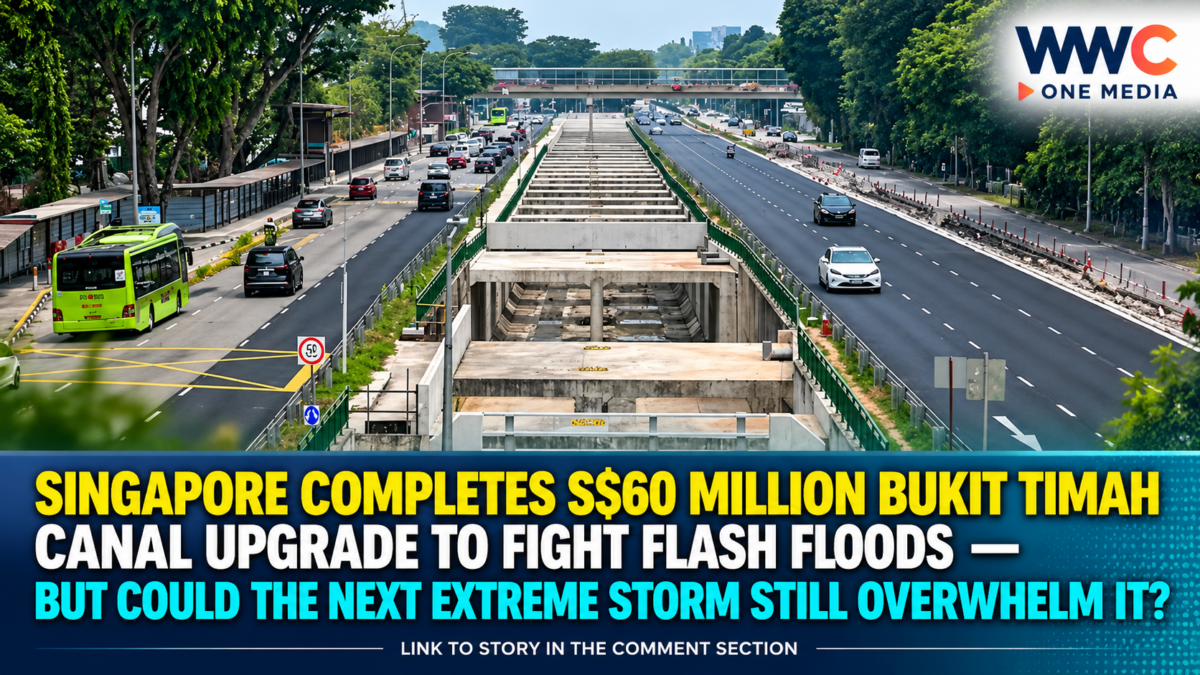
SINGAPORE — One of Singapore’s most flood-prone districts has received a major infrastructure upgrade, with national water agency PUB completing improvement works across the entire 2.3-kilometre Upper Bukit Timah Canal, increasing its stormwater drainage capacity by 30%.
The long-awaited project, announced as completed on October 23, promises stronger protection for homes, shopping centres and transport infrastructure across an approximately 1,000-hectare catchment.
But even with the enhanced drainage system, authorities are warning that exceptionally intense rainfall could still overwhelm the area, raising questions about whether Singapore’s flood defences can keep pace with climate change.
Seven-year construction effort delivers major flood protection upgrade
The final 900-metre section of the Upper Bukit Timah Canal, stretching from Rifle Range Road to Jalan Kampong Chantek near King Albert Park MRT station, has been completed after construction began in October 2019.
According to Channel NewsAsia, the approximately S$60 million project involved widening and deepening the canal to improve its ability to handle heavy rainfall.
Engineers replaced the canal’s original trapezoidal cross-section with a U-shaped drainage channel and box culvert, enabling more stormwater to flow through the system.
The work also incorporated structural supports for the Bukit Timah-Rochor Green Corridor.
An earlier section between Jalan Jurong Kechil and Rifle Range Road was upgraded in 2024, meaning the improvements now extend across the entire Upper Bukit Timah Canal.
PUB says the completed infrastructure is designed to better manage rainfall intensities comparable to major storms experienced over the previous 15 years.
Homes, shopping centres and MRT stations stand to benefit
The upgraded canal serves a catchment covering approximately 1,000 hectares of residential neighbourhoods, commercial districts and transportation infrastructure.
Among the locations expected to benefit from improved flood resilience are Beauty World Plaza, Bukit Timah Shopping Centre, Dunearn Village, Beauty World MRT station and King Albert Park MRT station.
The improvements could help reduce the likelihood and severity of flash flooding during heavy downpours, particularly as Singapore approaches its year-end Northeast Monsoon season.
However, officials have cautioned that additional drainage capacity does not mean the affected districts are completely protected from flooding.
Why Bukit Timah remains vulnerable to dangerous flash floods
Bukit Timah’s geography creates significant challenges for flood management.
The district lies within a valley-like landscape where rainwater naturally flows rapidly toward lower-lying drainage channels.
As urban development has expanded, roads, buildings and other hard surfaces have increased stormwater runoff into the canal network.
This combination of terrain and development means large volumes of rainwater can accumulate rapidly during intense storms.
Space constraints along the heavily developed corridor also make major drainage expansion difficult.
Singapore has spent decades addressing these vulnerabilities.
The Bukit Timah First Diversion Canal, completed in 1972, redirects stormwater toward Sungei Ulu Pandan, while the Second Diversion Canal, completed in 1990, channels water toward the Kallang River.
The first diversion canal was subsequently upgraded, with major improvement works completed in 2019.
Despite these earlier measures, heavy rainfall has continued to cause flash flooding in parts of the Bukit Timah area, demonstrating the complexity of achieving long-term flood resilience.
Why the S$60 million project took longer than expected
The final phase of the project was originally expected to be completed in 2024.
However, construction was extended to 2026 partly to coordinate work with the Bukit Timah-Rochor Green Corridor.
The construction environment created additional difficulties.
Engineers had to operate within narrow spaces between Bukit Timah Road and Dunearn Road, while maintaining traffic access and minimising disruption to commuters.
Temporary road diversions and replacement lanes were introduced to accommodate construction activities.
The canal’s proximity to underground MRT infrastructure required additional precautions, while restrictions on working hours and disruptions caused by the COVID-19 pandemic further complicated progress.
The completion represents a significant engineering milestone in an area where expanding drainage infrastructure is particularly challenging.
Singapore considers underground floodwater storage as climate risks rise
Although the canal upgrade is finished, PUB is already preparing for the next phase of flood protection.
The agency intends to call a tender by the end of 2026 for a feasibility study examining longer-term solutions across the wider Bukit Timah catchment.
One potential option involves underground detention structures designed to temporarily store excess stormwater during extreme rainfall.
Such facilities could help manage sudden surges in runoff when conventional drainage systems approach their capacity.
The study will also consider how future flood mitigation infrastructure could be integrated with existing developments, transportation networks and public spaces.
However, these underground structures remain proposals for evaluation rather than approved construction projects.
PUB Deputy Chief Executive for Flood Resilience Angela Koh acknowledged the challenges posed by the district’s terrain, limited space and increasingly intense rainfall.
The agency has stressed that no drainage network can completely eliminate flooding risks, particularly during unusually severe weather.
Year-end monsoon season will put Singapore’s flood preparedness in focus
The canal’s completion comes ahead of the Northeast Monsoon season, when periods of persistent or intense rainfall can increase flood risks.
PUB is preparing its third annual Flood Resilience Campaign to encourage residents, commuters and businesses to understand potential flood hazards and take precautions.
The agency continues to emphasise public vigilance during heavy rainfall, even in locations where drainage infrastructure has recently been improved.
For residents and businesses around Bukit Timah, the expanded canal represents a meaningful reduction in flood vulnerability, but not a guarantee against future flooding.
The bigger question: Can Singapore’s flood defences keep up with climate change?
The completion of the Upper Bukit Timah Canal upgrade is part of Singapore’s broader effort to adapt its infrastructure to changing weather conditions.
Increasing drainage capacity can provide significant protection against intense storms, but climate change introduces uncertainty about how frequent and severe future rainfall events may become.
The challenge is particularly difficult in densely developed urban districts, where expanding canals, constructing detention facilities and modifying roads can involve substantial costs and engineering constraints.
The authorities’ decision to study additional underground floodwater storage suggests that conventional drainage upgrades alone may not be sufficient over the long term.
For Singapore, the next challenge is not simply improving how quickly stormwater can drain away, but developing an integrated system capable of coping with increasingly unpredictable weather.
The Upper Bukit Timah Canal can now convey 30% more stormwater. The question is whether that added protection will remain sufficient as future storms become more extreme.