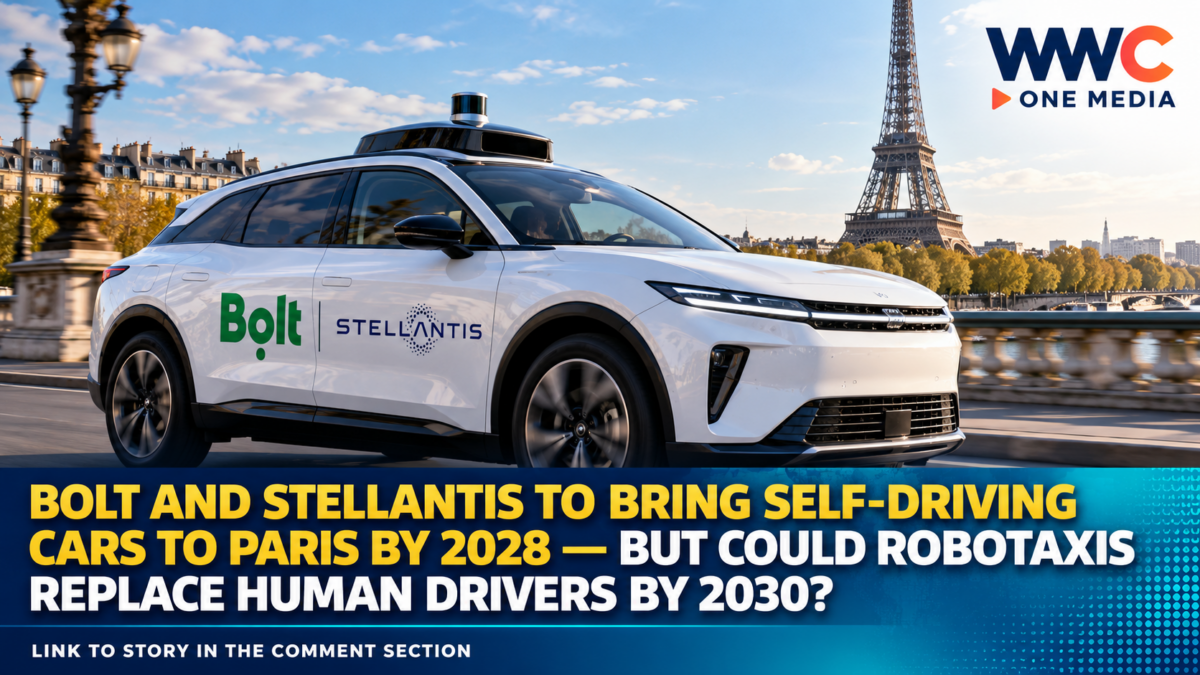
PARIS — The race to bring driverless transportation to Europe’s busiest cities is accelerating, with ride-hailing giant Bolt, automotive manufacturer Stellantis, and metropolitan authorities unveiling an ambitious plan to test autonomous vehicles across Greater Paris starting in 2028.
The partnership could reshape how millions of residents travel around the French capital, potentially paving the way for commercial robotaxi services by 2030.
Announced on October 23, the initiative combines Bolt’s ride-hailing technology, Stellantis’ vehicle engineering capabilities, and the support of Métropole du Grand Paris, the metropolitan authority overseeing Paris and 129 surrounding municipalities.
But while the project promises a glimpse into the future of urban transportation, significant questions remain about safety, regulation, public acceptance, and the future of professional drivers.
Self-driving vehicles could arrive in five Paris-area municipalities
The initiative, officially called the Greater Paris Autonomous Driving Living Lab, is designed to test whether autonomous vehicles can improve transportation services in underserved areas.
According to the partners’ announcement, the initial experimental phase could cover up to five municipalities in northwestern Greater Paris beginning in 2028.
The long-term ambition is to expand to approximately 30 municipalities by 2030, potentially opening the door to commercial autonomous mobility services.
However, the companies have emphasized that commercial deployment will depend on regulatory approvals, safety assessments, and the results of the initial trials.
The project has been submitted to the European Commission’s Autonomous Drive Ambition Cities, or ADACities, initiative, which supports efforts to develop autonomous mobility in European cities.
Stellantis vehicles and artificial intelligence to power the experiment
Stellantis, the automotive group behind brands including Peugeot, Citroën, Fiat, Jeep, and Opel, will supply vehicles built on its Level 4-ready autonomous driving platforms.
Level 4 automation allows a vehicle to perform driving tasks without continuous human intervention under specified operating conditions, such as approved geographic areas and road environments.
Unlike fully unrestricted autonomous driving, Level 4 systems may still have limitations involving road conditions, designated operating zones, or other operational restrictions.
Bolt, meanwhile, will coordinate service integration and deployment planning, using its mobility platform to help connect autonomous vehicles with future passengers.
Chinese autonomous driving technology company Pony.ai has been identified as a potential technology provider, with the proposed system incorporating NVIDIA Hyperion technology and the NVIDIA Halos safety system.
The involvement of multiple international technology companies highlights the growing competition to develop commercially viable self-driving transportation.
Why Greater Paris is becoming a major robotaxi testing ground
Greater Paris has approximately 7.2 million residents and one of Europe’s most extensive urban transportation networks.
Although major infrastructure investments, including the Grand Paris Express, are expanding rail connectivity, certain communities still face challenges accessing convenient transportation.
The proposed autonomous vehicle experiment will investigate whether driverless mobility can improve connections between residential areas, employment centers, and public transit stations.
Particular attention will be given to first- and last-mile transportation, off-peak travel, and mobility during major events.
Rather than immediately replacing established public transportation services, the initial objective is to assess whether autonomous vehicles can complement buses, trains, and other existing mobility options.
That distinction will be important as authorities evaluate whether robotaxis can provide measurable improvements over conventional transport.
Bolt is also preparing autonomous vehicle tests in Madrid
The planned Paris experiment is part of Bolt’s broader push into autonomous transportation across Europe.
According to Reuters, the Estonian mobility company also announced plans to test autonomous vehicles on Madrid’s streets in 2027.
The Madrid initiative would precede the proposed Greater Paris experiment, potentially providing additional experience in integrating autonomous vehicles into busy European traffic environments.
For Bolt, the shift toward robotaxis could eventually create new opportunities in the ride-hailing business, although commercial viability will depend on operating costs, safety performance, regulation, and consumer demand.
For Stellantis, the collaboration represents another opportunity to apply autonomous-driving-ready vehicle technology to emerging mobility services.
Safety, regulation, and public trust remain major challenges
Despite the ambitious timeline, introducing driverless cars into densely populated urban areas remains a complex undertaking.
Greater Paris authorities say the experiment will evaluate operational safety, service quality, passenger acceptance, economic performance, environmental impacts, and integration with public transportation.
The programme will also require coordination with participating municipalities to identify suitable routes and obtain necessary authorizations.
Data protection will be another consideration, particularly as autonomous vehicles rely on sophisticated systems to monitor road conditions and navigate their surroundings.
Independent evaluation of the initial deployment is planned before decisions are made about wider expansion.
Importantly, no unrestricted public robotaxi launch in Paris in 2028 has been confirmed. That year is the target for beginning the experiment, while 2030 remains an ambition for broader deployment and potential commercial operations.
Could robotaxis threaten traditional driving jobs?
One of the biggest questions surrounding autonomous ride-hailing is its potential effect on professional drivers.
If autonomous vehicles eventually become commercially successful, they could change the economics of taxi and ride-hailing services by reducing the need for human drivers in certain operating environments.
However, such an outcome is not guaranteed.
Robotaxi systems require substantial investment in vehicle technology, maintenance, remote operational support, safety infrastructure, and regulatory compliance.
Their effectiveness in dense urban environments also depends on their ability to navigate unpredictable road situations safely.
The Greater Paris programme does not establish a timetable for replacing human drivers. Instead, it is designed to generate evidence about the feasibility and potential benefits of autonomous transport.
What happens next?
From now until the proposed 2028 launch, Bolt, Stellantis, and metropolitan authorities will need to identify participating municipalities, prepare vehicles and technology, coordinate deployment arrangements, and obtain relevant approvals.
The initial experiment could become an important milestone for Europe’s autonomous vehicle industry.
Success might encourage other cities to consider similar transportation systems, particularly in communities where conventional public transport does not adequately meet local travel needs.
Failure to demonstrate reliable safety, affordability, and passenger acceptance could slow expansion plans.
The bigger question is no longer simply whether autonomous vehicles can navigate European streets. It is whether they can become a practical, trusted, and economically sustainable part of everyday transportation.
For Paris, the answer may begin to emerge in 2028.
And if the experiment succeeds, the way residents book and experience city transportation could look very different by the end of the decade.