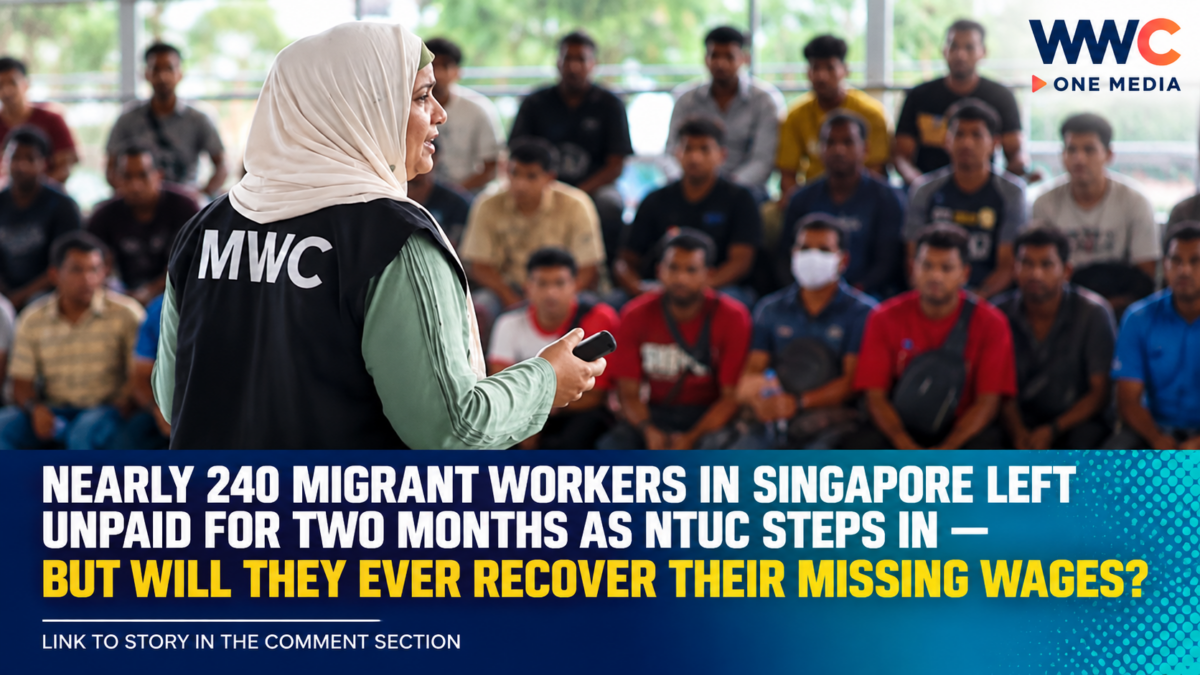
Singapore — Nearly 240 migrant workers in Singapore have reportedly gone without their salaries for up to two months, leaving hundreds of families facing financial uncertainty as the National Trades Union Congress (NTUC) and Ministry of Manpower (MOM) move to provide emergency assistance.
The salary dispute has affected workers employed by Process Maintenance Solutions Pte Ltd and Jurong Technical & Construction Pte Ltd, two companies operating in Singapore’s process sector.
For many of the affected workers, the crisis is more than a workplace salary dispute. It threatens the livelihoods of families thousands of kilometres away who depend on money sent home for food, housing, education and everyday necessities.
The situation has also raised questions about wage protection, recruitment expenses and what happens when migrant workers are left without income in one of Asia’s wealthiest economies.
Workers Wait for Salaries as Authorities Intervene
NTUC deputy secretary-general Desmond Choo disclosed the workers’ situation on Friday, October 23, saying some had not received their wages for as long as two months.
On October 19 and 20, representatives from the Migrant Workers’ Centre (MWC) and MOM’s Assurance, Care and Engagement Group met approximately 230 affected workers to assess their circumstances and determine what immediate assistance was necessary.
The intervention has included daily meals for nearly 90 workers, employment assistance and support in recovering unpaid salaries, including outstanding overtime wages.
Authorities and migrant worker organisations are also examining accommodation needs as the affected employees face an uncertain employment future.
Some Workers Reportedly Spent Up to S$12,000 to Reach Singapore
Additional reporting by The Straits Times, AsiaOne and NTUC’s Migrant Workers’ Centre revealed an especially troubling aspect of the dispute.
Some affected workers from Bangladesh reportedly spent as much as S$12,000 in recruitment-related costs to secure employment in Singapore.
According to the Migrant Workers’ Centre, one group arrived in Singapore on July 17, 2026, expecting employment that would allow them to recover their expenses and support their families.
Instead, they reported waiting months for their salaries.
These substantial upfront expenses have made returning home an especially difficult prospect for some workers.
The reported recruitment costs also highlight the financial risks faced by migrant workers who borrow or spend large amounts of money in hopes of securing higher-paying employment overseas.
The S$12,000 figure represents costs reported by some workers, not an amount established as applying to all affected employees.
Nearly 90 Workers Receiving Meals as Housing Concerns Grow
The Migrant Workers’ Centre has begun providing daily meals to close to 90 workers who lack meal support.
The organisation has also warned that some workers could lose their current accommodation in the coming weeks.
MWC is coordinating with MOM to arrange centralised housing where necessary while helping affected employees explore opportunities to move into new jobs.
Employment agency partners are being engaged to identify suitable positions, while officials work to accelerate the change-of-employment process.
However, finding new employment does not automatically guarantee that outstanding salaries will be recovered.
The workers’ unpaid wage claims remain a separate issue requiring resolution.
Salary Recovery Could Become the Biggest Challenge
The Migrant Workers’ Centre is helping affected employees submit salary claims through the Tripartite Alliance for Dispute Management (TADM), Singapore’s employment dispute resolution body.
These claims include regular wages and any outstanding overtime payments.
As of the October 23 reports, the precise amount owed to each worker was still being established.
MWC officials also acknowledged concerns that the employers might be unable to settle the full outstanding amounts.
Where necessary, the Migrant Workers’ Assistance Fund may provide humanitarian financial support, although such assistance should not be confused with full repayment of salaries legally owed.
For workers supporting relatives overseas, even temporary assistance may not be enough to resolve the financial strain created by missed paydays.
Earlier Unpaid Salary Cases Raise Wider Questions
The latest dispute comes months after Singapore authorities investigated another major migrant worker salary controversy.
In June 2026, hundreds of workers associated with other engineering companies sought government assistance over unpaid wages.
By July, Singapore’s manpower minister had addressed the earlier case in parliament, explaining that some complaints had been resolved in 2025 before a larger wave of salary claims emerged in 2026.
That earlier investigation involved different companies and should not be treated as evidence of wrongdoing by the employers named in the latest dispute.
Nevertheless, the recurrence of major wage complaints highlights the importance of early reporting, enforcement of salary obligations and stronger safeguards for vulnerable workers.
Families Back Home Bear the Financial Burden
According to NTUC officials, almost all the workers affected by the latest case are sole breadwinners.
Their missed paydays therefore have consequences beyond Singapore’s borders.
When a worker goes unpaid, family members in the country of origin may also struggle to meet everyday expenses.
The financial pressure can be even greater for migrants who incurred substantial expenses before beginning their overseas employment.
For these workers, the prospect of finding another job must be weighed against outstanding salary claims and the possibility of returning home without recovering their recruitment expenses.
What Happens Next?
MWC and MOM are continuing efforts to assist the workers with food, accommodation, employment transitions and salary claims.
Three major questions remain unresolved: how much money the workers are collectively owed, whether their employers can pay the outstanding amounts, and how many employees will be able to secure alternative jobs in Singapore.
The Migrant Workers’ Centre has encouraged employees experiencing unpaid salaries or workplace difficulties to seek help early through its 24-hour multilingual helpline at 6536 2692.
For nearly 240 workers who travelled to Singapore in search of financial security, the coming weeks could determine whether their overseas employment experience ends with recovered wages, new opportunities or a difficult return home.
The biggest unanswered question is whether the workers will ultimately receive the money they say they have already earned.