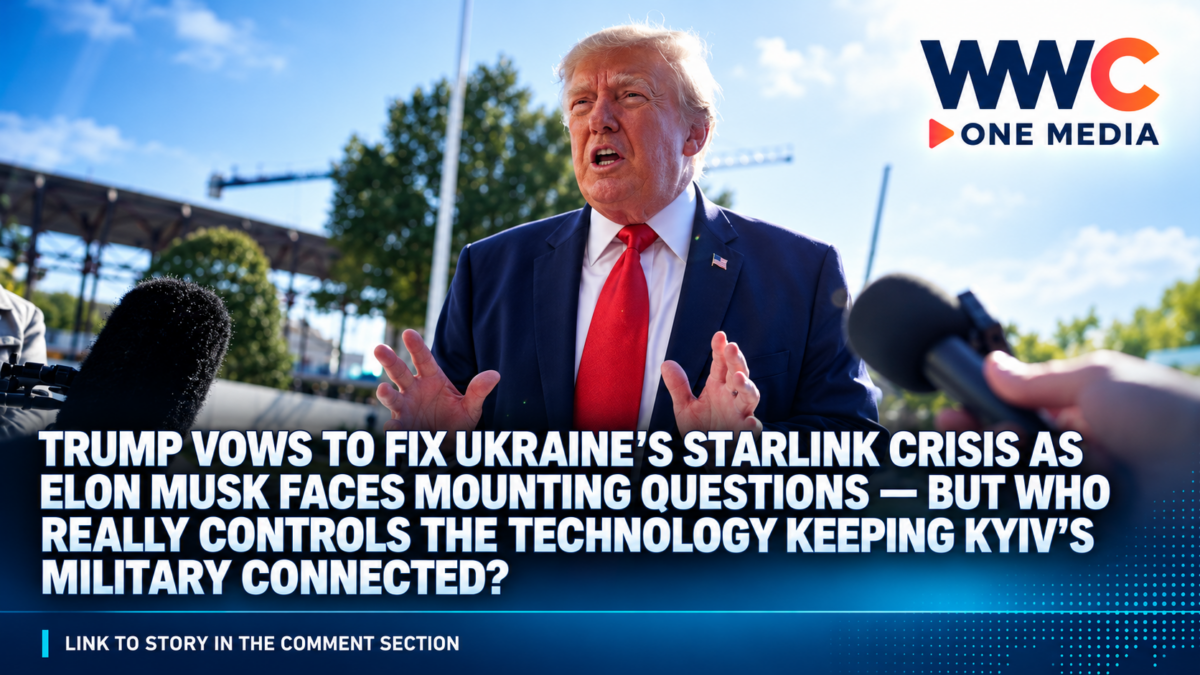
Washington, October 24, 2026 — US President Donald Trump has promised to intervene if restrictions affecting Ukraine’s access to SpaceX’s Starlink satellite communications remain unresolved, escalating attention on billionaire Elon Musk and the growing influence of private technology companies in the Russia-Ukraine war.
The announcement follows conflicting accounts from Washington and Kyiv over whether critical satellite communications services have been fully restored, raising fresh concerns about Ukraine’s ability to maintain military operations and defend against Russian drone attacks.
Speaking to reporters at the White House on Friday, October 23, Trump said he would take action if the connectivity problems continued.
“If there is a problem, I’ll get it straightened out,” Trump declared.
The president said he had not spoken to Musk about the latest reported problems but would contact the SpaceX chief executive if necessary.
However, Ukrainian officials maintained that restrictions affecting the military’s satellite connectivity remained in place, contradicting Trump’s earlier assurances that the issue had already been resolved.
Ukraine says Starlink restrictions continue despite Trump’s assurances
According to Reuters, restrictions introduced on October 13 have interfered with satellite connections used in Ukrainian military operations.
Ukrainian officials said the limitations particularly affected terminals operating aboard fast-moving drones, including aircraft traveling above approximately 160 kilometers per hour.
These restrictions have complicated Ukrainian drone missions at a time when Russia continues launching aerial attacks against Ukrainian cities and infrastructure.
Serhiy Beskrestnov, a defense technology adviser to Ukrainian President Volodymyr Zelenskyy, said on October 23 that Ukrainian forces had not observed a general removal of the restrictions.
Some connections appeared to perform better under specific circumstances, but officials said those isolated improvements did not establish that the limitations had been lifted.
The dispute underscores a serious operational challenge for Kyiv: access to reliable satellite communications has become essential to certain battlefield activities, yet the technology remains dependent on systems operated by an American private company.
Trump and Musk face conflicting reports over who ordered the restrictions
Questions have also emerged over who authorized the limitations and who has the authority to remove them.
The Wall Street Journal reported, according to Reuters, that Trump had contacted Musk and requested the restoration of Ukraine’s satellite connectivity.
The report suggested some improvement following that conversation, although Ukrainian officials continued reporting technical restrictions.
Trump subsequently said he had not personally spoken to Musk about the matter when questioned on Friday.
Meanwhile, Bloomberg reported earlier in October that a senior US official denied Trump had ordered the restrictions.
Musk has also disputed suggestions that he independently controls every aspect of the military service, maintaining that decisions concerning Starshield usage restrictions ultimately involve the US military.
These competing accounts have left the exact chain of responsibility unresolved.
Trump nevertheless publicly defended Musk, describing him as a fair person and expressing confidence that the SpaceX chief executive would not intentionally act improperly.
Why Starlink and Starshield matter in the Ukraine war
Starlink operates a satellite internet network that can provide communications in areas where conventional infrastructure is damaged, unavailable or unreliable.
Since Russia’s full-scale invasion of Ukraine in February 2022, satellite connectivity has become increasingly important to Ukrainian military communications and battlefield coordination.
Starshield, a related SpaceX service designed for government and national-security applications, supports more specialized military requirements.
These capabilities are especially important for drone operations, including reconnaissance, targeting and certain long-range missions.
Unlike an ordinary household internet slowdown, restrictions affecting military satellite terminals can directly influence whether particular operations can be conducted effectively.
Reports from Ukrainian personnel suggest the current limitations have disrupted some drone missions and efforts to intercept incoming Russian aerial threats.
However, the available reporting does not establish that Ukraine has lost all Starlink connectivity or that every Ukrainian military communications system has been affected.
US lawmakers question dependence on a single private company
The controversy has also reached Washington’s political establishment.
According to The Washington Post and Stars and Stripes, Democratic Senator Richard Blumenthal opened an inquiry into the Starshield restrictions, seeking answers about who possesses the legal and technical authority to modify services purchased for government use.
Republican Senator Kevin Cramer also raised concerns about the risks of depending too heavily on one private company for strategically important space capabilities.
The debate extends beyond the immediate dispute between Trump, Musk and Zelenskyy.
It raises a larger national-security question: what happens when an essential wartime communications capability depends on technology controlled by a commercial provider?
Government oversight, contractual authority, operational resilience and alternative communications networks are increasingly important issues as modern militaries rely more heavily on commercial satellite systems.
What happens next for Ukraine and its military communications?
Trump’s latest promise could lead to renewed discussions with Musk, SpaceX and US defense officials over how to address Ukraine’s reported connectivity problems.
For Kyiv, the immediate priority is securing reliable communications for operations against Russian forces, particularly as drone warfare continues to play a major role in the conflict.
For Washington, the controversy represents another test of its relationship with Ukraine and its ability to coordinate military support involving private technology providers.
As of the latest reports reviewed from October 23, Ukrainian officials continued to report restrictions, and there was no independently confirmed announcement that full military satellite functionality had been restored.
The central question remains unresolved: will Trump’s intervention deliver unrestricted access for Ukraine’s military operations, or has the controversy exposed a deeper vulnerability in modern warfare — the enormous influence a single satellite communications provider can have over critical battlefield technology?