
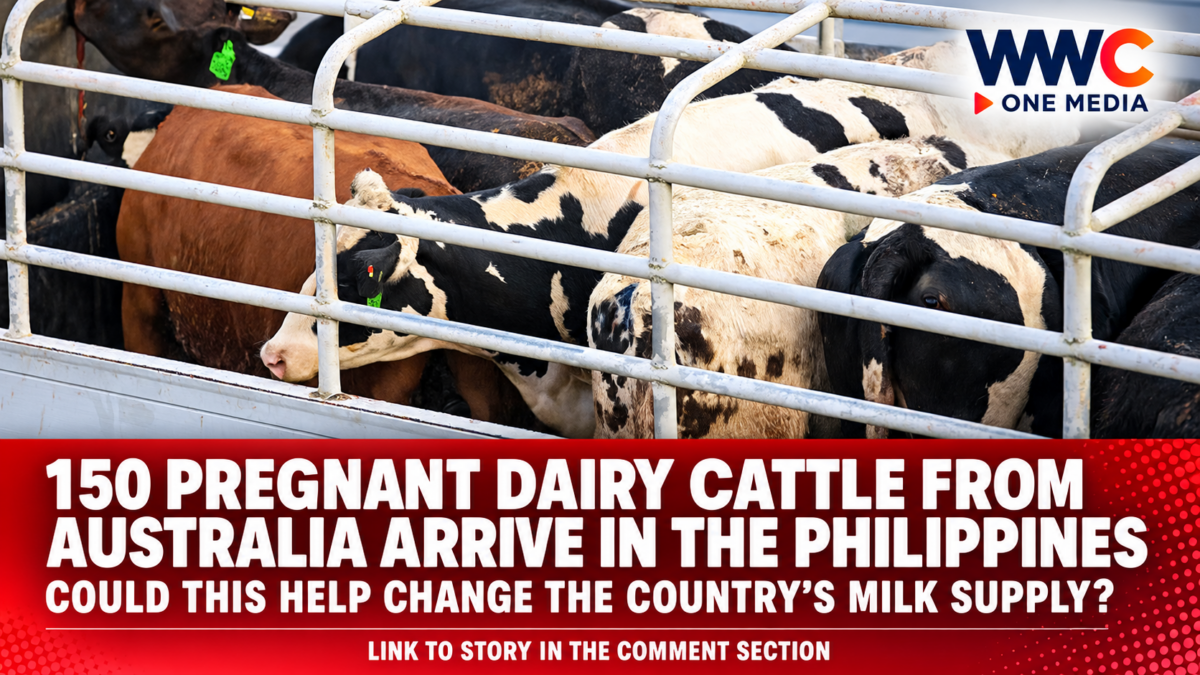
The Philippines is stepping up efforts to strengthen its domestic dairy industry, with pregnant dairy cattle imported from Australia forming part of a broader government initiative to increase local milk production and expand opportunities for Filipino farmers.
The arrival of the animals at Subic Port, as reported by the Philippine Daily Inquirer, highlights the country’s continuing efforts to build its dairy herd and improve its capacity to supply locally produced milk.
The development comes as the government pursues programs designed to reduce the country’s heavy dependence on imported dairy products and strengthen the livelihoods of farmers and agricultural cooperatives.
Australian cattle shipment supports local dairy ambitions
The National Dairy Authority (NDA), under the Department of Agriculture, is responsible for implementing programs to develop the country’s dairy herd, improve breeding, and support local milk production.
In a separate development reported by the Department of Agriculture on October 20, 2026, the NDA confirmed the arrival of 1,419 pregnant dairy cattle from Australia—the agency’s first such importation in nearly three years.
The animals include Holstein-Jersey, purebred Holstein, and Holstein-Jersey crossbreeds. According to the department, 150 cattle are assigned to the NDA stock farm in General Tinio, Nueva Ecija; another 150 to its stock farm in Ubay, Bohol; and the remaining 1,119 to the Del Monte Feed Lot in Bukidnon. The cattle are to undergo quarantine and acclimatization procedures.
The department’s announcement provides important context for reports about the 150-animal shipment: the 150 cattle assigned to Nueva Ecija and the 150 assigned to Bohol are allocations within the larger importation, not the total number of animals in the nationwide program.
The distinction matters because the initiative involves a much larger herd-development effort intended to increase the availability of dairy cattle for local production.
Government projects 5.9 million liters of milk in 2027
The Department of Agriculture said the imported cattle, together with their offspring, are expected to contribute approximately 5.9 million liters of milk in 2027.
The agency projects that the herd could grow to around 2,527 dairy cattle, including the imported animals and their offspring. The projected output would account for approximately 20% of the government’s targeted cattle-milk production for that year.
The program is also intended to make dairy cattle available to qualified farmers and cooperatives through the NDA’s stock-farm and animal-dispersal initiatives.
This could help participating producers expand their herds, increase milk output, and develop additional income sources. However, the projected production figures are government targets and estimates, not a guarantee of future output.
Local milk production is already growing
The importation comes as the Philippine dairy sector records gains in domestic production.
In an August 14, 2026, report, the Department of Agriculture said local milk production reached 25.38 million liters in the first half of 2026, up 21.2% from 20.94 million liters during the same period in 2025.
The agency also reported growth in the country’s dairy-animal inventory, reflecting continued efforts to expand the domestic production base.
Separately, the NDA reported that total Philippine milk production reached 43.3 million liters in 2025, up from 38.6 million liters in 2024. Despite this progress, local production remains limited relative to the country’s overall dairy requirements.
These figures suggest that imported breeding stock is being introduced alongside existing efforts to improve animal nutrition, farm management, breeding, and dairy-enterprise development.
Coconut farmers may also benefit
The cattle program is not limited to increasing milk production. The Department of Agriculture said it is also expected to benefit 176 individual coconut farmers, cooperatives, and associations under the Coconut Farmers and Industry Development Plan.
Through cooperation between the NDA and the Philippine Coconut Authority, eligible beneficiaries may gain opportunities to diversify their livelihoods by participating in dairy farming.
For rural communities, this approach could create an additional source of agricultural income. Its success, however, will depend on practical requirements such as access to animal feed, veterinary care, suitable facilities, technical training, and reliable buyers for the milk produced.
Will the cattle help reduce dairy imports?
Increasing local milk production could strengthen the country’s food supply and provide more opportunities for Filipino dairy farmers. But the arrival of additional cattle alone will not eliminate the Philippines’ reliance on imported dairy products.
The long-term impact will depend on whether the animals adapt successfully, reproduce as expected, and produce milk at commercially viable levels. Farmers will also need dependable processing facilities, cold-chain infrastructure, and access to markets.
The government’s procurement of locally produced agricultural goods under the Sagip Saka Act, together with milk-feeding initiatives, could provide additional demand for domestic dairy producers, according to the Department of Agriculture.
For consumers, the key question is whether increased local production can eventually contribute to a more dependable supply of Philippine-produced milk. Any effect on retail prices will depend on production costs, processing, distribution, market conditions, and the scale of future output.
The arrival of Australian dairy cattle therefore represents an important step in the country’s herd-development strategy—but the real test will be how effectively the animals translate into sustained milk production and stronger livelihoods for Filipino farmers.










